Learn.xyz secured $3M in Seed funding in 2023 to tackle the scalability issues of traditional EdTech. Led by Blockchange Ventures, the round included high-profile angels like LinkedIn CEO Ryan Roslansky. The deck focuses heavily on the efficiency gains provided by generative AI, claiming a reduction in course creation costs from thousands of dollars to less than $0.10. With a team featuring veterans from LinkedIn, Adobe, and PayPal, the company presents a compelling 'Why Now' case based on the inflection point of generative AI. While the deck is light on detailed unit economics or long-term r…
Key takeaways
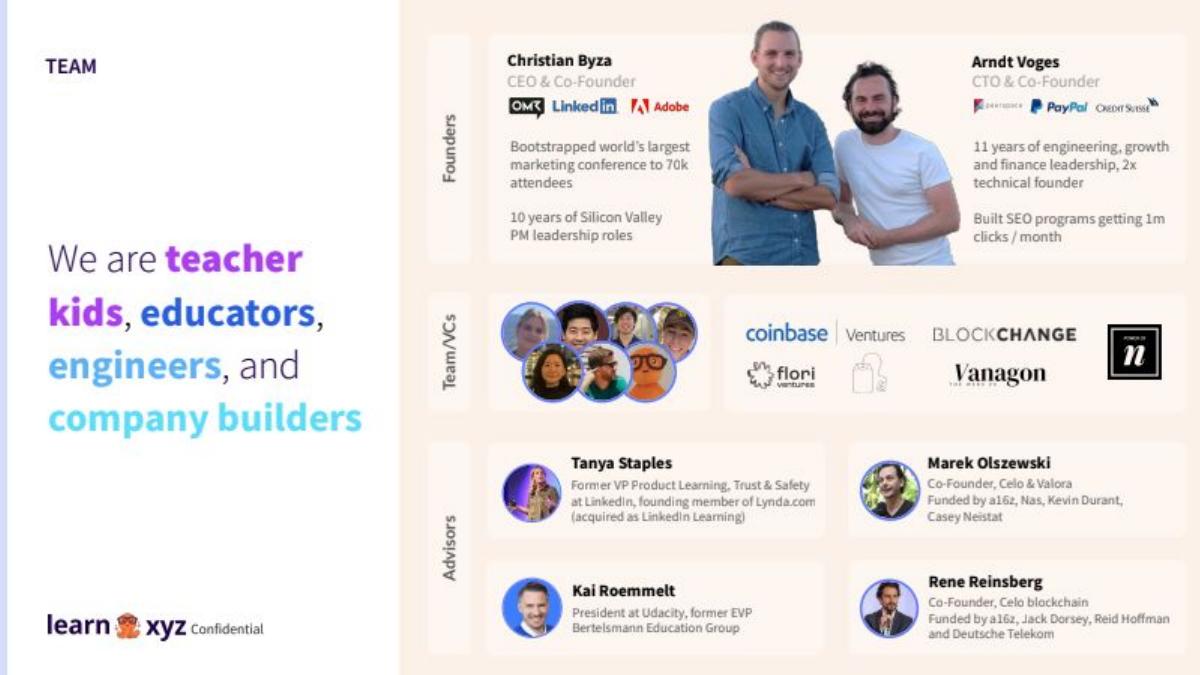
- The team slide highlights deep industry expertise, including a CEO who bootstrapped a 70k-attendee marketing conference and a CTO with 11 years of engineering leadership (Slide 2).
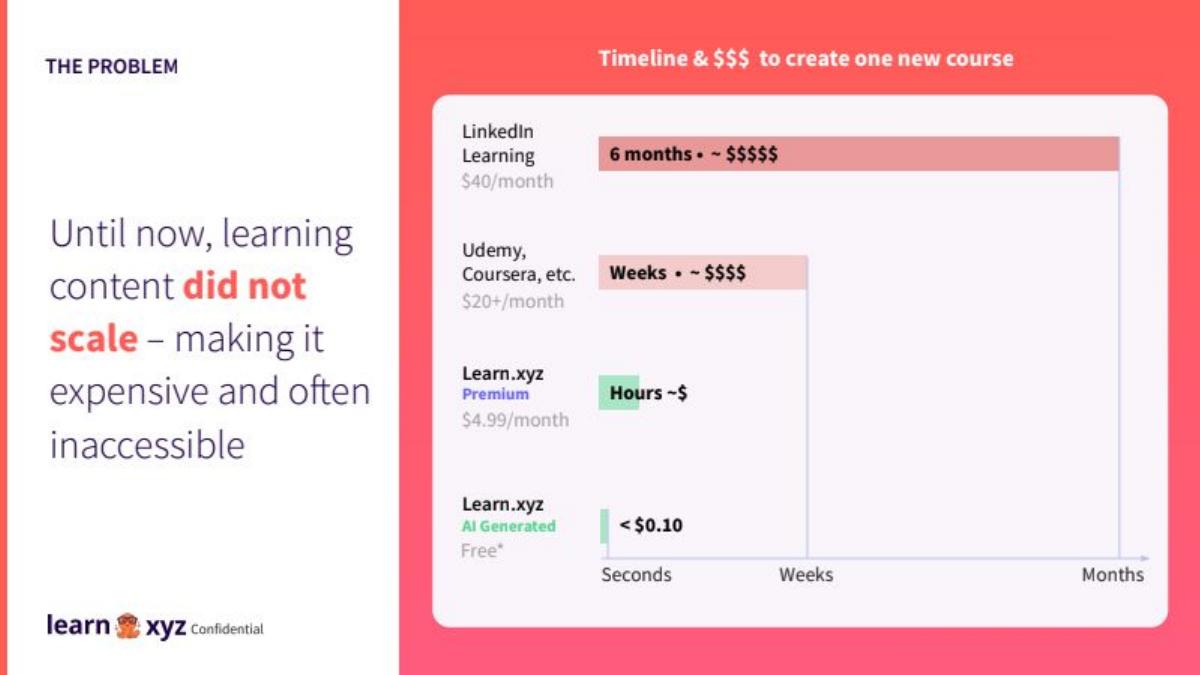
- Learn.xyz claims to reduce the cost of creating a new course from thousands of dollars to less than $0.10 using AI (Slide 4).
- The platform aims to disrupt incumbents like LinkedIn Learning and Udemy by shortening creation timelines from months or weeks to mere seconds (Slide 4).
- Early traction for the web alpha showed a significant jump from 2,580 lessons in February 2023 to 16,730 lessons in May 2023 (Slide 7).
- The market opportunity is framed by a projected $49 billion mobile e-learning market by 2026, representing a 149% increase from 2019 (Slide 8).
- The revenue model is a classic B2C freemium SaaS approach, with a $4.99/month premium tier offering certificates and ad-free learning (Slide 9).
- The company successfully raised a $3M seed round to fulfill its vision of making people 'feel good about the time they spend online' (Slide 10).
- The deck emphasizes a 'magical' user experience where courses can be generated on any topic, in any language, at any level (Slide 5).
Introduction
Learn.xyz entered the EdTech space in 2023 with a clear mission: to use generative AI to make learning instant, engaging, and highly scalable. This teardown examines the 11-slide deck used to secure a $3M Seed round. The deck is a masterclass in positioning a startup against established incumbents by highlighting a massive technological shift—in this case, the transition from human-curated content to AI-generated experiences.
Slide 1: Title and Vision
The cover slide is minimalist and brand-forward. It features the company logo, the tagline "Unleash your curiosities. Every day," and a mobile mockup of the app. The UI shown on the phone suggests a feed-based discovery mechanism, similar to social media, but for educational content like "Cave Diving" and "Chilling at -90 Degrees." This immediately signals that the product is a B2C mobile-first platform designed for casual, daily use rather than formal, long-form education.
Slide 2: The Team
The team slide is exceptionally strong for a Seed stage company. Co-founder and CEO Christian Byza brings 10 years of Silicon Valley PM leadership from LinkedIn and Adobe. Co-founder and CTO Arndt Voges is a 2x technical founder with 11 years of experience at PayPal and Credit Suisse. The slide also lists high-tier advisors like Tanya Staples (former VP at LinkedIn Learning) and Kai Roemmelt (President at Udacity). By including logos from Coinbase Ventures and Blockchange, they also signal strong backing from the Web3 and VC communities. This slide answers the "Why this team?" question by showing a mix of EdTech expertise and engineering scale.
Slide 3: Our Vision
The vision slide focuses on the emotional aspect of the product: "Empower individuals to connect meaningfully through the joy of learning." It uses vibrant UI mockups showing gamification elements like a "7 day streak" and social sharing features ("Luma12 is sharing a lesson she created with you!"). This reinforces the idea that Learn.xyz is as much a social platform as it is an educational one.
Slide 4: The Problem
This is the most critical slide in the deck. It uses a clear horizontal bar chart to compare the "Timeline & $$$ to create one new course." It lists LinkedIn Learning at 6 months and high cost ($$$$$), and Udemy/Coursera at weeks and moderate cost ($$$$). In contrast, it positions Learn.xyz Premium at "Hours" and Learn.xyz AI Generated at "Seconds" for less than $0.10. This creates a stark contrast between the "old way" and the "AI way," framing the incumbents as slow and expensive.
Slide 5: The Solution
The solution slide introduces the "magical learning experience" enabled by generative AI. It shows a simple search bar with the prompt "What are you curious about?" and a "Generate your course" button. Below this, it displays diverse course tiles in multiple languages, supporting the claim of "Any Topic • Any Language • Any Level." This slide effectively communicates the core value proposition: instant gratification for curiosity.
Slide 6: Try the Magic
This is a transition slide designed for an interactive pitch. It provides a call to action to "Try the magic" with a button for Testflight access. In a live pitch, this is where a founder would typically perform a demo to prove that the AI can actually generate a coherent course in seconds.
Slide 7: Traction
The traction slide shows the growth of the "web alpha." A bar chart tracks "Lessons created per month since launch." The numbers show impressive growth: 2,580 in February, 14,759 in March, a dip to 6,989 in April, and a recovery to 16,730 in May 2023. The text notes they had to implement a waitlist to handle demand. While the April dip is not explained, the overall trend from February to May shows a 6.5x increase in activity, validating that users are interested in creating AI-driven content.
Slide 8: Why Now?
The "Why Now" slide uses Statista data to show the "Global online learning revenue opportunity." It highlights that Online e-learning is expected to grow 66% to $168 billion by 2026, but more importantly, Mobile e-learning is projected to grow 149% to $49 billion. This justifies Learn.xyz's mobile-first strategy and suggests they are riding a wave of changing consumer habits.
Slide 9: Revenue Model
The revenue model is a standard freemium comparison table. The Free tier includes ads and limited access to AI/Premium courses. The $4.99 tier removes ads and adds certificates, "Learn Rewards," and priority creator tools. This is a classic B2C SaaS play. The $4.99 price point is notably lower than the $20-$40 monthly fees of incumbents mentioned on Slide 4, further emphasizing their cost advantage.
Slide 10: The Ask
The final slide states the ask: "We are raising a $3M seed round." It reiterates the mission to "make people feel good about the time they spend online" and provides a direct contact email for the CEO. The slide is clean and ends on a positive, mission-driven note.
What Works Well
Clear Competitive Advantage: Slide 4 is a powerful visual that makes the company's value proposition undeniable. By quantifying the time and cost savings of AI, they make traditional platforms look obsolete. · Team Pedigree: The combination of LinkedIn Learning, Adobe, and PayPal experience is a perfect fit for an AI-powered EdTech startup. The inclusion of the LinkedIn CEO as an angel investor is a massive signal of credibility. · Market Timing: The "Why Now" slide successfully links the rise of generative AI with the explosive growth of mobile e-learning, making the investment feel urgent. · Visual Identity: The deck is bright, modern, and consistent. It feels like a consumer app that people would actually want to use, which is rare in the often-stodgy EdTech sector.
What Is Missing
Unit Economics: While the deck mentions a $4.99 price point and a <$0.10 cost per course, it does not detail Customer Acquisition Cost (CAC) or Lifetime Value (LTV). For a B2C SaaS company, these are vital metrics. · Retention Data: The traction slide shows how many lessons were created , but not how many users returned . High creation numbers could just be novelty; investors would want to see Day-30 or Day-90 retention rates. · Content Quality Control: Generative AI is prone to hallucinations. The deck does not address how they ensure the accuracy or safety of the educational content being generated. · Detailed Roadmap: The deck shows what the product does now but doesn't explain the long-term moat. If course creation becomes a commodity, how does Learn.xyz stay ahead of competitors?
Founder Takeaways
Use Comparison Charts: If your startup uses new technology to do something 10x faster or cheaper, use a horizontal bar chart like Slide 4 to make that gap visceral for investors. · Lead with Team: If you have a high-pedigree team, don't hide them at the end. Learn.xyz put their team on Slide 2, which immediately builds trust for the rest of the pitch. · Focus on One Metric: Instead of a cluttered dashboard, Slide 7 focuses on a single, impressive growth metric (lessons created). This tells a simple, clear story of demand. · Keep the Ask Simple: Slide 10 doesn't overcomplicate things. It states the amount and the mission. Founders often bury the ask in a sea of milestones; Learn.xyz keeps it front and center.
Frequently asked questions
- How much did Learn.xyz raise and who were the lead investors?
- Learn.xyz raised a $3M Seed round in 2023. The round was led by Blockchange Ventures, with participation from Borderless Capital, Vanagon Ventures, w3.fund, and Power of N. Notable individual investors included LinkedIn CEO Ryan Roslansky and Go1 founder Andrew Barnes.
- What is the core problem Learn.xyz is solving?
- The company identifies that traditional learning content does not scale because it is too expensive and slow to produce. According to slide 4, platforms like LinkedIn Learning take 6 months and significant capital to create one course, whereas Learn.xyz uses AI to do it in seconds for under $0.10.
- What does the traction look like for Learn.xyz?
- The deck reports traction for its web alpha, showing a steady increase in user activity. In January 2023, lesson creation was near zero, growing to 14,759 in March, and reaching a peak of 16,730 lessons created in May 2023. They also mention implementing a waitlist to manage demand.
- What is the business model for Learn.xyz?
- Learn.xyz operates on a freemium SaaS model. The free tier includes limited AI and premium courses with ads. The premium tier, priced at $4.99 per month, removes ads and provides full access to AI courses, priority creator tools, certificates, and 'Learn Rewards'.
- Who are the founders of Learn.xyz?
- The company was co-founded by CEO Christian Byza and CTO Arndt Voges. Byza has a background at LinkedIn and Adobe and previously built a major marketing conference. Voges is a 2x technical founder with experience at PayPal and Credit Suisse.