Learning while Travelling is an early-stage venture targeting the gap between local startup ecosystems and global standards for Indian students aged 15-25. The deck outlines a plan to leverage 1,000+ startup events across India to reach over 100,000 enthusiasts. While the deck claims partnerships with 200+ events and 100+ applications received, it lacks a concrete product description or business model, instead offering a four-stage pricing philosophy ranging from 'Free' to 'Profitable.' The founder, Vishal Kumar, seeks $100,000 (75 lakh) to execute pilot projects in 10 countries. The deck is…
Key takeaways
- The company targets a specific demographic of startup enthusiasts aged 15-25 years in India (Slide 3).
- The market size is defined by 1,000+ startup events across PAN India schools and colleges, with an estimated 100 participants per event (Slide 3).
- The deck identifies a total target audience of one lakh+ (100,000+) startup enthusiasts across India (Slide 3).
- Traction is indicated by partnerships with 200+ events and the receipt of 100+ online applications (Slide 5).
- The business model is presented as a four-stage 'mass market capture' strategy: Free, Discounted, Break Even, and Profitable (Slide 6).
- The funding ask is exactly 0.1 million USD (75 lakh) to curate the program and execute pilot projects in 10 countries (Slide 6).
- The deck identifies global competitors such as TIE Global, Startup Tour Russia, Startup Tour Barcelona, and AIESEC (Slide 4).
Executive Summary: The Global Ambition of Indian Student Founders
Learning while Travelling is a pitch deck that focuses on the intersection of experiential learning, international travel, and startup mentorship. The deck positions itself as a bridge for Indian students to move from local problem-solving to global entrepreneurship. While the deck provides a clear view of the Indian student market and a specific funding ask, it remains high-level regarding the actual mechanics of the service. The following teardown analyzes the six provided slides to understand the founder's strategy for scaling a 'travel-to-learn' model.
Slide 1: Title and Contact
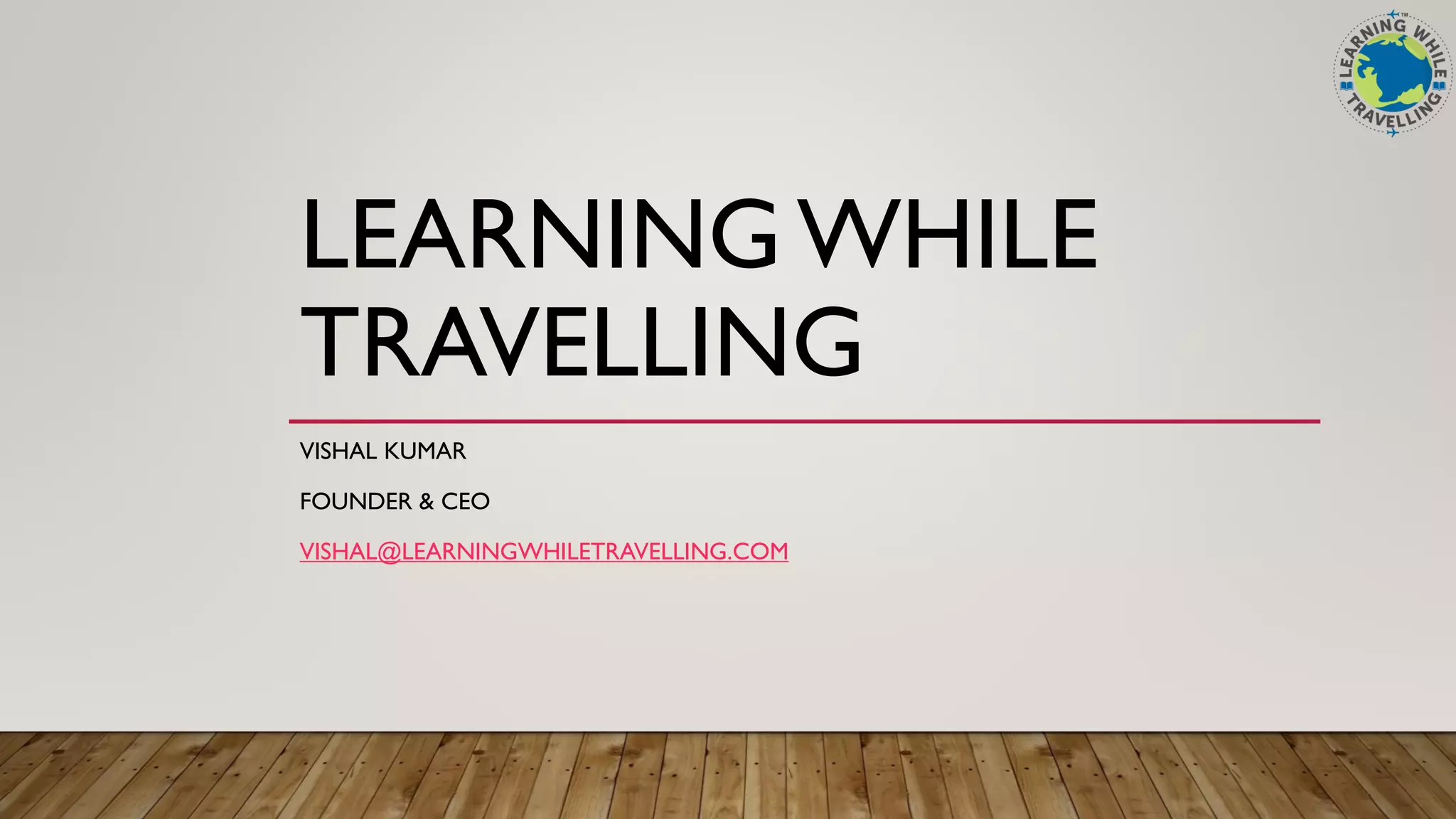
The cover slide is minimalist, featuring the company name LEARNING WHILE TRAVELLING in a bold, sans-serif font. It identifies VISHAL KUMAR as the FOUNDER & CEO and provides a professional email address. A small circular logo in the top right corner depicts a globe with the company name encircling it, emphasizing the international nature of the venture. The use of a wooden floor graphic at the bottom of the slide is a stylistic choice that does not convey specific business information but establishes a consistent visual theme for the deck.
Slide 2: The Problem Statement
Slide 2 outlines the pain points the company intends to address. It focuses on four specific areas:
Local Confinement: Startup enthusiasts are limited to local problems and lack global aspirations. · Team Formation: Founders struggle to form their initial core teams. · Experiential Gap: There is a stated need for internships under existing startups to facilitate learning. · Skill Deficiency: The deck claims that founder communication, focus, and planning skills are 'not at par with global standards.'
This slide establishes a 'deficiency' model, suggesting that Indian startup enthusiasts require external, global exposure to reach their full potential. However, it does not yet explain how travel specifically solves these issues compared to online education or local incubators.
Slide 3: Market Size and Demographics
This slide provides the most concrete data in the deck. It defines the market through the lens of the Indian educational ecosystem:
Event Volume: 1000+ startup events spread across PAN India schools and colleges. · Event Density: An average of 100 participants per event. · Age Bracket: A target demographic of 15-25 years. · Total Addressable Market (TAM): A target audience of 'one lakh+ startup enthusiasts across whole India.'
By quantifying the market through existing events, the company shows a clear path to customer acquisition through established channels rather than trying to build a new market from scratch.
Slide 4: Competitive Landscape
Slide 4 lists four competitors: TIE Global program , Startup Tour Russia , Startup Tour Barcelona , and AIESEC . This is a diverse list that includes professional networking organizations (TiE), specific geographic tours, and the world's largest youth-run organization (AIESEC). The deck does not provide a competitive matrix or a 'Why Us' comparison, leaving the investor to infer how Learning while Travelling differs from these established entities. The inclusion of AIESEC suggests the company views itself as a competitor in the student exchange and internship space.
Slide 5: Marketing Plan and Early Traction
This slide serves as a combined marketing strategy and traction report. It lists three primary methods for growth:
Partnerships: The company claims to have 'already partnered with 200+ events' in the startup contest space across India. · Direct Applications: They report having received 'more 100+ online application' (sic), indicating some level of inbound interest. · Scholarships: A 'Merit cum means' scholarship scheme is mentioned to attract 'selected delegates.'
The mention of '200+ events' is a significant traction metric for an early-stage company, suggesting a strong B2B networking capability within the Indian university circuit.
Slide 6: The Financial Ask ('Money')
The final slide in this set covers both the business model and the funding requirement. The business model is described as a 'four stages of mass market capture' strategy:
Give it for FREE · Give it at DISCOUNTED PRICE · Give it at BREAK EVEN PRICE · Give it at PROFITABLE PRICE
This suggests a freemium or penetration pricing strategy intended to build a user base before seeking profitability. The slide concludes with a specific ask: 'We need 0.1 million USD (75 lakh) to curate the program and execute a pilot projects in 10 countries.' This is a clear, actionable request, though it lacks a breakdown of how the $100,000 will be distributed across those 10 countries.
What Works in This Deck
Specific Market Targeting: The deck does a good job of narrowing down the target audience to a specific age group (15-25) and a specific geographic region (PAN India). By linking the market size to the number of existing startup events, the founders demonstrate a realistic understanding of where their customers currently congregate.
Clear Traction Metrics: Claiming 200+ partnerships and 100+ applications provides a sense of momentum. It shows that the concept has been socialized within the target ecosystem and has moved past the pure 'idea' phase.
Direct Funding Ask: Many early-stage decks are vague about how much money they need. This deck is explicit, providing the figure in both USD and INR, and stating exactly what the money is for: curation and a 10-country pilot.
What Is Missing from This Deck
The Solution/Product Slide: Perhaps the most glaring omission is a slide explaining what the 'program' actually is. Does the student go on a 7-day tour? A 3-month internship? What countries are involved? Without a product description, the 'Problem' and 'Market' slides have no bridge to the 'Money' slide.
Team Background: While Vishal Kumar is named as CEO, there is no information regarding his background, his experience in travel or education, or the presence of any co-founders or advisors. Investors back teams, especially at the pilot stage.
Unit Economics: The 'Money' slide mentions a 'Profitable Price' but does not define what that price is or what the cost per student is. For a travel-based business, logistics costs are high, and investors would need to see a basic breakdown of margins.
The '10 Countries' Detail: The ask mentions pilot projects in 10 countries, but none of these countries are named, nor is the rationale for choosing them explained. This makes the $100,000 ask feel arbitrary.
Founder's Guide: What to Copy and What to Avoid
Copy the Market Sizing Approach: If you are in the education or event space, follow this deck's lead by counting existing events and average attendance. It is a much more grounded way to calculate TAM than simply taking a percentage of the total student population.
Avoid the 'Pricing Philosophy' Slide: The four-stage pricing model (Free to Profitable) is a strategy, not a business model. Founders should instead show a specific price point for their MVP and explain the margin. Telling an investor you plan to give the product away for free initially without showing the path to 'Break Even' can be a red flag regarding sustainability.
Include a Visual Solution: For a business involving travel, visual aids are essential. A sample itinerary or a photo of a pilot event would go a long way in making the 'Learning while Travelling' concept feel tangible rather than theoretical.
Frequently asked questions
- What is the primary problem Learning while Travelling aims to solve?
- According to Slide 2, the company addresses the limitation of startup enthusiasts being confined to local problems rather than global standards. It specifically cites difficulties in forming core teams, the need for startup internships, and a lack of communication and planning skills that meet international benchmarks among founders.
- How does the company plan to acquire customers?
- The marketing plan on Slide 5 relies on three pillars: partnering with PAN India startup contests (claiming 200+ existing partnerships), using an online application process (with 100+ applications received), and offering 'Merit cum means' scholarship schemes to selected delegates to drive interest.
- What is the specific financial request in this deck?
- On Slide 6, the company asks for 0.1 million USD, which it equates to 75 lakh (INR). This capital is earmarked for two specific purposes: curating the educational program and executing pilot projects across 10 different countries.
- Who is the target audience for this service?
- Slide 3 defines the target audience as startup enthusiasts between the ages of 15 and 25 years. The geographic focus is 'PAN India,' specifically targeting students within schools and colleges who participate in startup-related events.
- What is missing from the Learning while Travelling pitch deck?
- The deck omits several critical components for an investor: there is no detailed team slide beyond the CEO's name, no explanation of the actual product or itinerary, no revenue projections, and no clear timeline for the 10-country pilot program. It also lacks a 'Solution' slide that explains how the travel actually improves skills.