New Legends Studios’ 2014 seed deck is a time capsule of the mobile gaming industry's transition toward competitive play. With a massive 50-slide count, the presentation spends a disproportionate amount of time on macro-economic trends, citing sources like Mary Meeker and BI Intelligence to prove that 'phablets' and mobile eSports are viable. While it provides a clear technical architecture slide showing a Unity-based cross-platform approach, the provided slides lack a specific game title, gameplay mechanics, or a clear financial ask. It functions more as a sector thesis than a product-led pi…
Key takeaways
- The deck identifies a gap in the 2014 market: mobile titles that stream gameplay, citing Heroes of Order & Chaos as a lone early mover (Slide 6).
- Technical architecture is built on Unity, supporting iOS and Android with a planned expansion to PC and consoles (Slide 12).
- The startup emphasizes an 'In-Game Community System' as a core technology pillar for streaming to Twitch and YouTube (Slide 12).
- Market validation relies on 2013 eSports data showing 72 million viewers and $25 million in prize money (Slide 21).
- The 'Phablet' trend is used as a primary hardware catalyst, with 5+ inch screens projected to dominate shipments by 2019 (Slide 26).
- Demographic data targets 'Core' gamers in the US with an average age of 29 and a 75% male skew (Slide 30).
- Global mobile gaming revenue in 2013 is cited at $3.0BN for North America and $5.9BN for Asia Pacific (Slide 40).
- The deck claims games account for 67% of total tablet usage based on 2014 Q1 data (Slide 46).
Executive Summary: The Macro-Heavy Approach
The New Legends Studios deck from 2014 is a textbook example of a 'market-first' pitch. At 50 slides, it is exceptionally long by modern standards, where 12-15 slides is the norm. The company, led by CEO Ohad Barzilay, attempts to convince investors that the success of PC eSports is inevitable on mobile. The deck relies heavily on external data from KPCB, BI Intelligence, and Digi-Capital to paint a picture of a massive, untapped opportunity. However, by focusing so much on the 'why,' the deck risks burying the 'what'—the actual games they intend to build.
Slide 1: Title and Vision
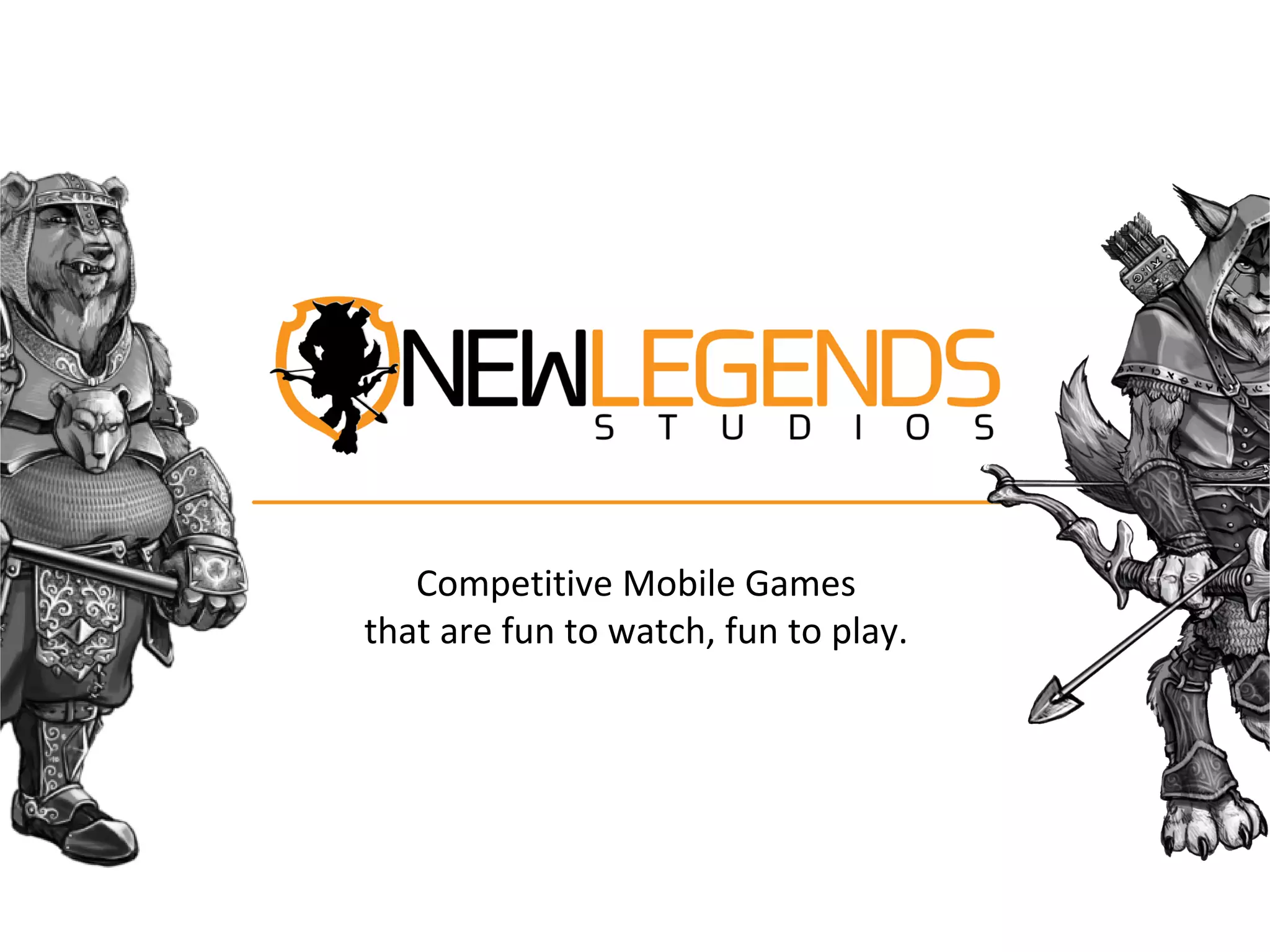
The cover slide introduces New Legends Studios with a clear, concise tagline: "Competitive Mobile Games that are fun to watch, fun to play." The imagery features two high-fidelity character illustrations—a bear-like warrior and a feline archer—which suggests a fantasy-themed RPG or MOBA (Multiplayer Online Battle Arena) setting. The branding is consistent, using an orange and black color palette that evokes a 'sports' or 'competitive' feel.
Slide 6: Industry Players and Revenue Benchmarks
This slide establishes the competitive landscape and the financial potential of the genre. It categorizes titles into three buckets: PC/MMO titles that stream (League of Legends at ~$70 Million Monthly Revenue ), Mobile titles that don't stream (Hearthstone at ~$200 Million by EOY ), and the gap they intend to fill: Mobile titles that stream. They note that Heroes of Order & Chaos only connected to Twitch in September 2014, suggesting the market is in its infancy.
Slide 12: Technical Infrastructure
The Technology slide provides a block diagram of the company's stack. It shows a Unity-based platform feeding into iOS and Android clients. Notably, they include 'Possible Future Clients' for PC, Web, and Consoles, indicating a cross-platform ambition. The most important element here is the In-Game Community System , which is highlighted as the bridge to Twitch.TV and YouTube, reinforcing their 'fun to watch' value proposition.
Slide 16: Contact and Call to Action
This slide serves as a mid-deck transition or a closing slide for a specific section. It features CEO Ohad Barzilay and provides contact details for both Israeli and US mobile numbers. This suggests a company with a presence in the Israeli tech ecosystem but looking toward the US market for capital or distribution.
Slide 21: eSports Growth Metrics
Titled 'eSports Games - Past,' this slide uses a growth chart to show the explosion of the sector. It cites 72 million viewers and $25 million in prize money for the year 2013. By labeling this as 'Past,' the implication is that the future (mobile) will dwarf these numbers. The source is cited as InMobi's 2014 Q2 analysis.
Slide 26: The Hardware Catalyst
New Legends Studios makes a strong case for the 'Phablet' (phones with 5+ inch screens). Using BI Intelligence data, the slide shows phablet shipments overtaking standard smartphones by 2017. The sub-text is clear: competitive gaming requires screen real estate, and the hardware market is finally providing it, 'even at Apple.'
Slide 30: Audience Demographics
This slide breaks down the 'Core,' 'Midcore,' and 'Casual' segments across three major geographies. It notes that Core gamers in the US are 75% male with an average age of 29. This level of detail is intended to show investors that the company knows exactly who they are building for and that the 'Core' audience is distinct from the 'Casual' audience that dominated mobile gaming (like Candy Crush) at the time.
Slide 36: Smartphone Market Upside
Citing Mary Meeker’s 2014 Internet Trends Report, this slide points out that smartphone users only made up 30% of the 5.2B mobile phone user base . This is a classic 'TAM' (Total Addressable Market) slide, suggesting that as the remaining 70% of the world upgrades to smartphones, the market for New Legends' games will naturally expand.
Slide 40: Global Revenue Distribution
This infographic slide breaks down mobile gaming metrics by region for 2013. It highlights Asia Pacific as the largest market at $5.9BN , followed by North America at $3.0BN and Western Europe at $2.3BN. It also includes 'Average Spend' per paying gamer, with North America leading at $3.87 . This data helps justify a global launch strategy.
Slide 46: Tablet Dominance
The final slide in the sample focuses on tablet usage, claiming that games account for 67% of tablet usage (combining the 32% 'Games' slice with other engagement metrics). This reinforces the idea that mobile devices are primarily entertainment hubs, not just communication tools.
What Works in This Deck
Strong Market Validation: The deck is incredibly well-researched. By citing reputable sources like KPCB and BI Intelligence, the founders borrow authority to support their claims about a nascent market. · Clear Technical Roadmap: Slide 12 explains the 'how' without getting bogged down in code. It shows a scalable architecture that accounts for the most important feature: streaming integration. · Identifying a Specific Gap: Slide 6 clearly shows the 'white space' in the market—mobile games that are built for streaming. This is a much better approach than simply saying 'we are building a mobile game.'
What is Missing
The Product: For a 50-slide deck, the absence of a specific game title, gameplay loop, or 'first look' at the product in these 10 slides is concerning. Investors fund games, not just market trends. · The Team: While the CEO is named, there is no mention of the creative leads, game designers, or engineers. In gaming, the pedigree of the studio is often more important than the market data. · Unit Economics and Business Model: There is no mention of how the company will make money (IAP, ads, subscriptions) or what the projected Customer Acquisition Cost (CAC) might be. · The Ask: The deck does not state how much money is being raised or what the milestones for that capital will be.
Founder Lessons
Don't Over-Index on Macro: While market data is important, 50 slides is too many. If you spend 40 slides talking about the industry and only 10 talking about your company, you are selling the sector, not your startup. · Show, Don't Just Tell: The character art on the cover is great, but it needs to be followed by gameplay screenshots or concept art for the environments. · Address the 'Mobile eSports' Problem: In 2014, many were skeptical that mobile controls could ever support 'Core' competitive play. This deck would have benefited from a slide explaining their specific control scheme or UI innovations.
Frequently asked questions
- What is the primary value proposition of New Legends Studios?
- Based on the cover and industry slides, the company aims to develop competitive mobile games designed specifically for both players and spectators. They identify a lack of mobile titles that successfully integrate gameplay streaming, a feature that was already generating significant revenue on PC platforms like League of Legends ($70M/month) at the time of the deck's creation.
- What technical platform does the company use?
- New Legends Studios utilizes the Unity game platform. Their technology stack includes a dedicated game client for iOS and Android, supported by a backend consisting of game servers, database servers, and an analytics layer using tools like Mixpanel. A key differentiator mentioned is their internal 'In-Game Community System' designed to bridge mobile play with streaming platforms.
- How does the deck justify the timing of the investment?
- The deck uses a 'perfect storm' of hardware and market trends. It cites the rise of 'phablets' (large-screen phones), the massive growth of eSports viewership (72 million in 2013), and the fact that smartphone users only represented 30% of the total mobile phone user base in 2013, suggesting significant room for growth in the high-end gaming segment.
- Who is the target audience for their games?
- The deck provides a granular breakdown of gamer demographics. They specifically highlight 'Core' gamers in the US, Europe, and Asia. In the US, this segment is defined as having an average age of 29, being 75% male, and showing significant behavioral differences compared to 'Casual' gamers who skew more female (57%).
- What is missing from the provided slides?
- The most notable omissions are the specific game concept, the business model (monetization strategy), the team's professional background beyond the CEO's name, and the specific funding ask. While the deck is 50 slides long, the provided sample focuses almost entirely on market research and high-level architecture rather than the product itself.