Tamatem is a mobile games publisher focused on the MENA (Middle East and North Africa) region. Their 23-slide deck from 2013 focuses heavily on the massive supply-demand imbalance in Arabic-language digital content. At the time of the deck, Arabic was the 4th largest language globally, yet only 1% of digital content was available in the language. Tamatem positioned itself as the solution to this gap, specializing in localizing international titles for culturally relevant gameplay. The deck successfully leverages high-level market statistics—projecting 100 million smartphone users by 2016 and…
Key takeaways
- The deck identifies a massive linguistic gap, noting on Slide 3 that Arabic is the 4th largest language, while Slide 7 reveals only 1% of content is available in Arabic.
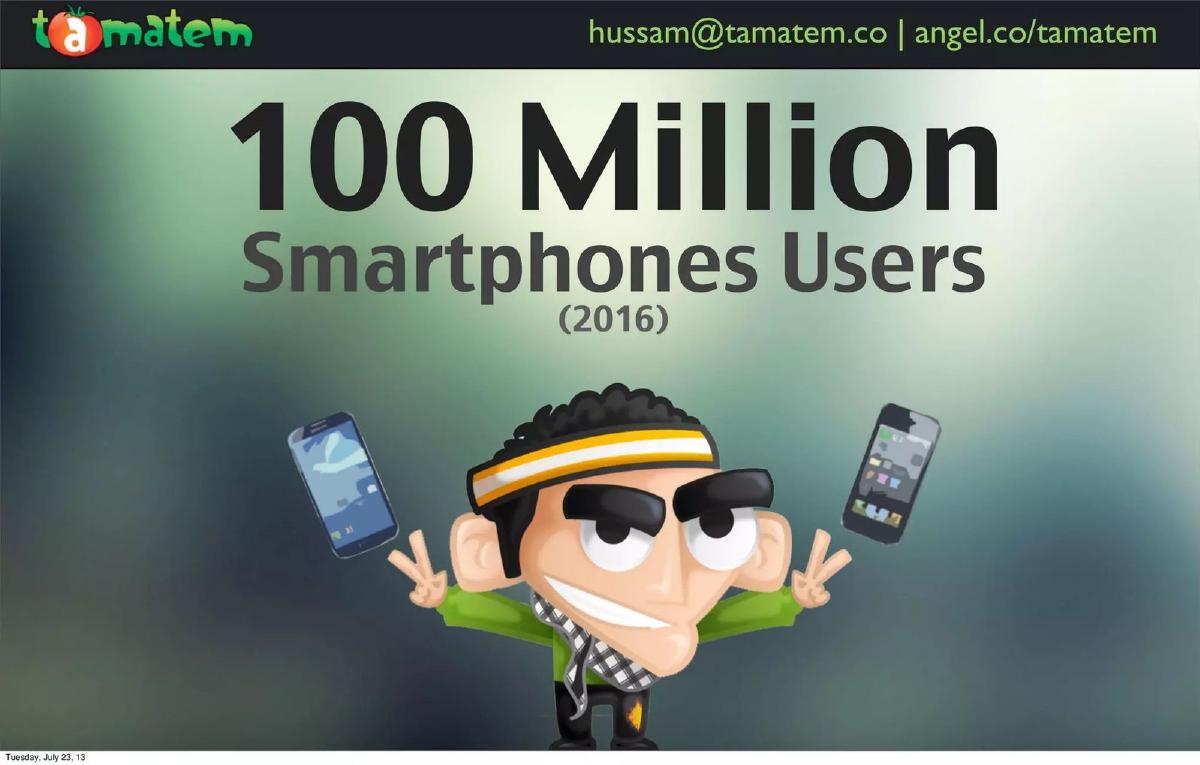
- Market projections were used to create urgency, specifically citing a 100 million smartphone user milestone for 2016 on Slide 6.
- Traction is demonstrated through a high-velocity download metric: 650,000 downloads in a single month as shown on Slide 17.
- The business model relies on cultural relevance rather than just translation, demonstrated by the visual comparisons of US vs. Arabic app store content on Slides 8 through 13.
- The deck highlights the high monetization potential of the region, claiming the 'Highest Average Revenue Per User' on Slide 19, though it lacks specific dollar figures for this metric.
- The team slide (Slide 20) emphasizes relevant experience with logos from Yahoo! Maktoob and Endeavor Jordan to establish regional credibility.
- The initial funding ask was $500,000 to 'Dominate Arabic App Stores,' as stated on Slide 22.
- The deck uses a 'show, don't tell' approach with 6 consecutive slides (Slides 8-13) comparing US app icons and interfaces with their localized Arabic counterparts.
The Market-Gap Strategy: A Teardown of Tamatem's Pitch
Tamatem’s pitch deck is a classic example of a 'Market Opportunity' deck. In 2013, the MENA region was an overlooked frontier for mobile gaming. This deck doesn't spend time explaining why games are fun; it spends time explaining why the Arabic market is a goldmine that everyone else is ignoring. By the time the investor reaches the team slide, the macro-economic argument for the company’s existence is already settled.
Slides 1-7: The Macro Argument
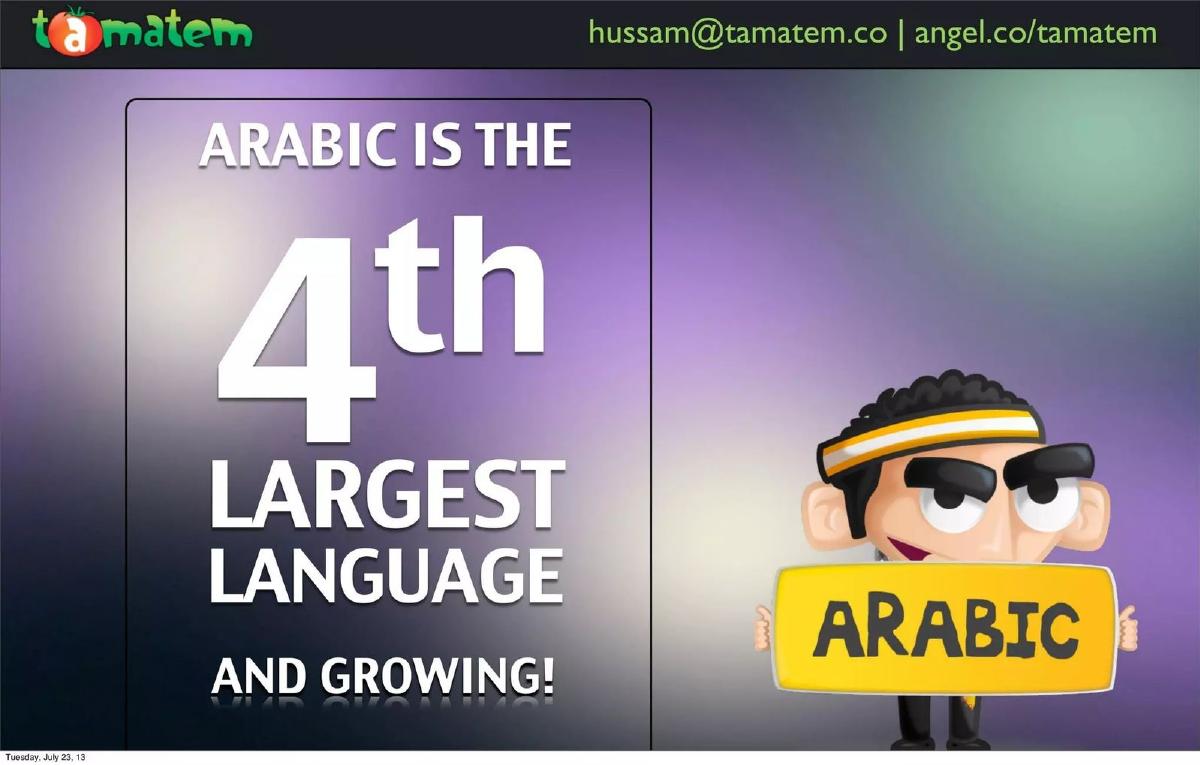
The deck opens with a clear identity: "Mobile Apps Publisher for the Arabic Market" (Slide 1). This is a focused, no-nonsense value proposition. Slides 2 through 7 function as a single logical unit designed to build a sense of 'inevitable growth.' On Slide 3, the company notes that Arabic is the 4th largest language globally. This is immediately followed by Slide 6, which projects 100 Million Smartphone Users by 2016.
The 'killer stat' arrives on Slide 7: "Only 1% of all content is available in Arabic." This creates a massive delta between the size of the audience and the available product. For an investor, this represents a supply-side vacuum that Tamatem is positioned to fill. The use of a cartoon character throughout these slides helps maintain a brand identity consistent with the gaming industry, though the slides themselves are very sparse on text to ensure the big numbers stand out.
Slides 8-15: Product and Localization Proof
Instead of explaining their localization process in bullet points, Tamatem uses a visual 'before and after' sequence. Slide 8 shows the US App Store with 100,000,000 downloads for popular word and puzzle games. Slides 9 through 13 then show the Arabic versions of similar concepts.
This sequence is vital because it demonstrates that the 'Arabic Market' isn't just a different language; it requires different UI/UX and cultural touchpoints. We see localized characters, Arabic script integrated into game mechanics, and culturally relevant imagery (such as the mosque and regional maps on Slide 10). Slide 14 and 15 introduce "Arabic Spring," a game that clearly leans into regional themes, showing that the company isn't just translating—they are creating or adapting content that resonates with the specific zeitgeist of the MENA region.
Slides 16-19: Traction and Monetization
Slide 16 is a blank transition, leading into the 'meat' of the traction. Slide 17 delivers the most important proof point in the deck: 650,000 Downloads in 1 Month . This validates the 1% content gap theory mentioned earlier; it proves that if you build it in Arabic, they will come—and they will come quickly.
Slides 18 and 19 pivot to the financial potential. Slide 18 cites a $6B Market Size for 2016. Slide 19 claims the "Highest Average Revenue Per User" (ARPU) for the region. While the slide lacks a specific dollar amount or a source for this claim, it addresses a common investor concern about the MENA region: whether users will actually pay for digital content. By claiming high ARPU, Tamatem suggests that the market is not just large in volume, but high in value.
Slides 20-23: Team, Advisors, and The Ask
The team slide (Slide 20) is strong on regional pedigree. CEO Hussam Hammo and CTO Sohaib Thiab are linked to Yahoo! Maktoob . This is a critical 'trust signal' for MENA investors, as Maktoob was the first major regional exit. Slide 21 adds global gaming credibility by listing Roger Dickey (Mafia Wars) and Wences Casares as advisors. Having the creator of one of the most successful social games in history as an advisor provides a massive 'stamp of approval' for a gaming startup.
The deck concludes on Slide 22 with a clear ask: Raising $500k to "Dominate Arabic App Stores." This is a modest ask relative to the $6B market they described, making the goal feel attainable and the risk-reward ratio attractive to a seed-stage investor.
What Works in This Deck
The 'Gap' Narrative: The contrast between the 4th largest language and 1% content availability is a perfect hook. It makes the business feel like a logical necessity rather than a speculative bet. · Visual Proof: Showing the actual Arabic game interfaces (Slides 9-13) is much more effective than describing 'localization services.' It proves the team has the technical and design capability to execute. · Velocity Metrics: 650k downloads in a single month is a powerful 'traction' slide that silences doubts about product-market fit. · Regional Credibility: Leveraging the Yahoo! Maktoob connection immediately establishes the founders as experienced operators in the specific geography they are targeting.
What Is Missing from This Deck
Unit Economics: There is no mention of Customer Acquisition Cost (CAC) or Lifetime Value (LTV). While they claim high ARPU, they don't provide the numbers to back it up. · Revenue Model: The deck doesn't specify if they make money through ads, in-app purchases, or a mix. For a gaming company, the monetization loop is a critical piece of the puzzle. · Competitive Landscape: The deck assumes a vacuum. It doesn't mention other regional publishers or how they protect their 'moat' if a larger international publisher decides to localize their own games. · The 'How' of the Ask: The $500k ask is not broken down. Investors generally want to see if the money is going toward hiring more developers, buying users (UA), or securing more IP licenses.
What a Founder Should Copy
The 'Big Number' Opener: If you are in an underserved market, start with the macro stats. Make the investor feel like they are missing out on a massive, obvious trend. · Side-by-Side Comparisons: If your product involves translation or adaptation, show the 'before' and 'after.' It makes the work tangible. · Advisor Logos: If you have high-profile advisors, give them their own slide. It transfers their success and credibility to your unproven startup. · Focus on One Metric: Tamatem focused on downloads. At the seed stage, showing explosive growth in a single key metric is often better than showing mediocre growth across ten different metrics.
Frequently asked questions
- What is Tamatem's core value proposition?
- Tamatem acts as a bridge between international game developers and the Arabic-speaking market. Their value lies in 'culturalization'—going beyond simple translation to make games culturally relevant. This includes localizing art, monetization strategies (like 'whale' management), and user acquisition specifically for the MENA region, where they identified a significant lack of native-language content.
- How does the deck prove market demand?
- The deck uses a 'scarcity' argument. It points out that while the Arabic-speaking population is massive (the 4th largest language group), the digital content available to them is disproportionately small (1%). By showing that they achieved 650,000 downloads in one month, they provide empirical evidence that Arabic users are hungry for localized content and will engage with it immediately when available.
- What financial information is missing from the deck?
- The deck is notably light on detailed financials. While it mentions a $6B market size and 'Highest ARPU,' it does not provide Tamatem's specific revenue, burn rate, or customer acquisition cost (CAC). There are no projections for future earnings or a breakdown of how the $500,000 investment would be allocated across departments like marketing or development.
- Who are the key people behind Tamatem according to the deck?
- The deck highlights CEO Hussam Hammo and CTO Sohaib Thiab. It emphasizes their background with Yahoo! Maktoob, which was a landmark acquisition in the MENA tech ecosystem. They also list high-profile advisors like Roger Dickey (creator of Mafia Wars) and Wences Casares (founder of Lemon.com), which adds significant industry weight to their mobile gaming ambitions.
- Is the $500k ask consistent with their later success?
- The $500k ask on Slide 22 was an early-stage seed request. Given that the company eventually raised over $21 million, this deck represents the successful 'hook' that proved the concept. The early traction of 650k downloads likely gave investors the confidence that the model was scalable, leading to the much larger 'Later' stage rounds mentioned in the catalogue facts.