Surwaze, a six-founder Indian startup pitching an in-app survey SDK that pays mobile developers the way ad networks do, exported a 12-slide text-only PowerPoint deck on 8 February 2017 that follows Sequoia Capital's 'Writing a Business Plan' outline almost verbatim. The structure is right and the content is empty: the market-size slide lists buyer types and survey types with no figure, the business-model slide describes the revenue share as 'a portion', the team slide shows six faces with no roles, and the deck closes on 'Thank you :)' with no funding ask and no contact details anywhere. It a…
Key takeaways
- Surwaze's 2017 deck is 12 text-only PowerPoint slides, 4:3, exported on 8 February 2017, following Sequoia Capital's 'Writing a Business Plan' outline almost verbatim — company purpose, problem, solution, why now, market size, competition, product, business model, team — which means the structure i…
- The problem slide identifies a real, non-obvious issue most survey startups miss: online surveys are answered by members of survey panels rather than the public, so every result carries self-selection bias.
- The strongest commercial argument in the deck is a single bullet: rewarded ads cost a user 30 seconds while a survey costs 15, so surveys are cheaper inventory in the only currency mobile users spend — and it is unsourced and buried third on the problem slide.
- The market-size slide contains no market size: it lists buyer types and survey types, ends both bullets with 'etc.', and cites no figure, despite ESOMAR publicly sizing the market research industry at roughly $45bn in 2016.
- 'Surwaze will be the first of its kind to deploy surveys on a mobile SDK' was false and trivially checkable in February 2017 — Pollfish had run the identical in-app survey SDK model since 2013 and Google Opinion Rewards since 2013 — which re-prices every other claim in the deck downward.
- Slide 10 argues that AdMob's 200 billion monthly ad requests 'can translate to 200 billion questions aired per month', which assumes total inventory substitution and ignores the binding constraint of the business: survey volume is capped by buyer demand, not by available supply.
- The team slide shows six photographs and six names with no roles, titles, backgrounds or responsibilities — on the one slide that carries the entire investment case for a pre-product, pre-revenue company with six co-equal founders.
- The deck contains no traction, no financials, no pricing, no funding ask and no contact details of any kind, and closes on a slide reading 'Thank you :)' — so a reader persuaded by it has no amount to consider and no way to reply.
What this deck actually is
Twelve slides, 1024 x 768 points — 4:3 , built in Microsoft PowerPoint 2013 and exported on 8 February 2017 at 10:43 UTC . No author name in the metadata, no company field, no title. Text only: there is not a single chart, screenshot, product image or diagram anywhere in the file. The one visual element in the entire deck is the row of six team photographs on slide 11.
The first thing to notice is the slide order, because it is not the founders' invention. Company purpose, Problem, Solution, Why now, Market size, Competition, Product, Business model, Team — that is, almost verbatim and in exact sequence, Sequoia Capital's "Writing a Business Plan" outline , the most widely copied deck template of the 2010s. Surwaze followed it faithfully. That is genuinely the right instinct for a first-time team, and it means the deck's structure is not the problem. Every slide is in the place an investor expects to find it.
The problem is what got written on those slides. Sequoia's outline is a set of questions , and Surwaze answered most of them with a restatement of the question. "Market size" says everyone needs surveys. "Competition" says we will be the first of our kind. "Product" says visit our website for a tour. The template supplied the skeleton and the team supplied adjectives where the numbers belonged.
So classify it honestly: this is an early-stage concept deck from a first-time founding team — six people, from the names and photographs almost certainly a student or recent-graduate team in Kerala, India — pitching an ad-network-shaped business built on a real and defensible insight. There is no traction, no financial projection, no funding ask and no product evidence. And yet the core idea on slide 3 is sharper than the ideas in plenty of funded decks, which is what makes this file worth reading closely. Surwaze has one excellent sentence and eleven slides that fail to build on it.
Slide-by-slide walkthrough
Slide 1 — Cover
The tagline is good. Three words, lower case, and it contains the actual thesis: the constraint in survey research is who you can reach , and Surwaze claims to remove it. Compare it to what a 2017 survey startup would more typically have written — "the future of market research" — and this is markedly better, because it names a change in what becomes possible rather than a category.
What is missing is everything else a cover has to carry: no date, no round, no "seed", no location, no contact, no one-line descriptor for anyone who does not already know what Surwaze is. A deck that circulates as an email attachment is read without the founder in the room, and a cover with no date silently ages into a document that misrepresents itself. On the name itself — "Surwaze" reads as survey plus ways, but the -waze ending in 2017 pointed straight at the navigation app Google had bought for $1.1bn four years earlier, and the deck never claims or disclaims the association.
Slide 2 — Company purpose
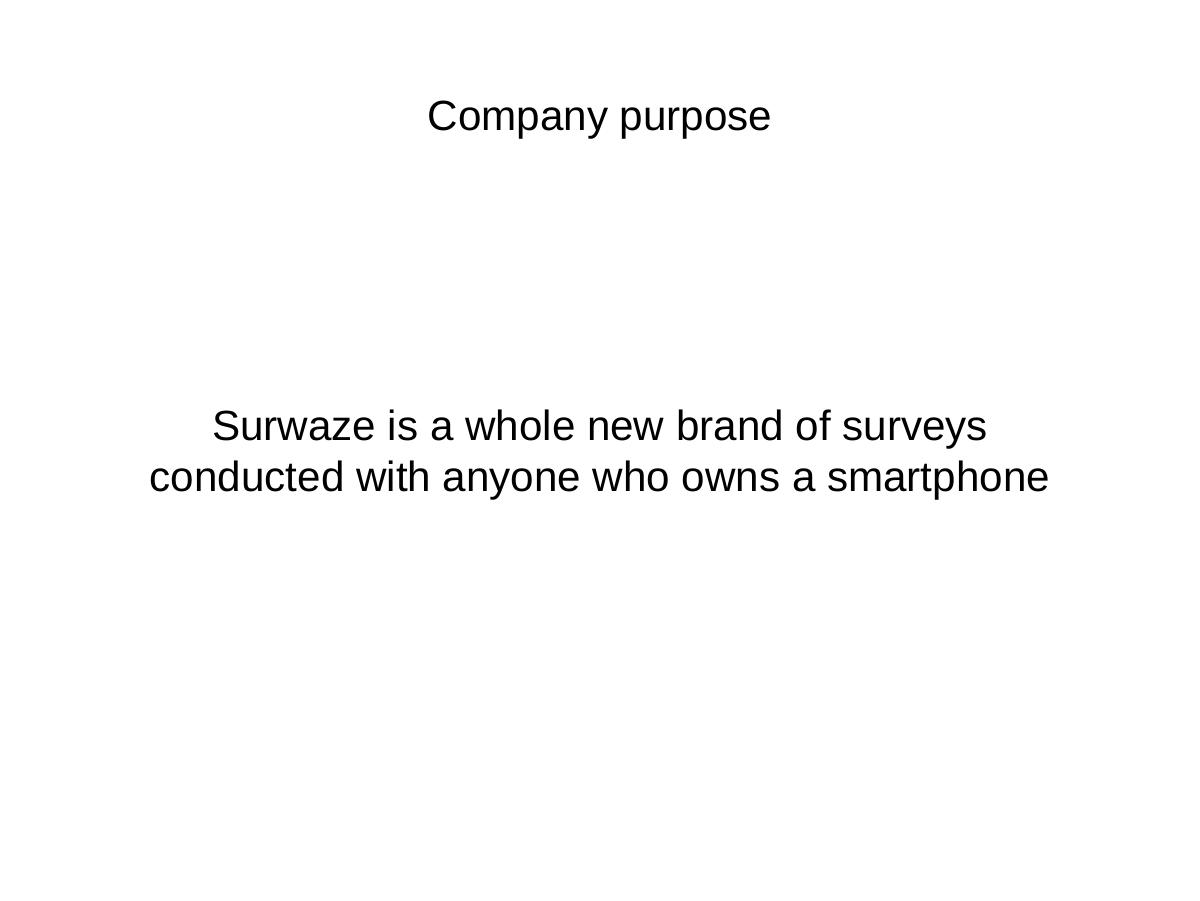
One sentence: "Surwaze is a whole new brand of surveys conducted with anyone who owns a smartphone."
The Sequoia template asks for a single declarative sentence, and Surwaze correctly supplies exactly one. The discipline is right and rarer than it sounds; most first decks fill this slide with a paragraph.
The sentence itself is 70% there. "Conducted with anyone who owns a smartphone" is the substantive half and it is clear. "A whole new brand of surveys" is the wasted half — "brand" is the wrong noun (they mean kind, or channel), and "whole new" is the kind of self-assessment that a reader is supposed to reach themselves. The company-purpose line has to survive being repeated by an investor to their partner from memory, and the repeatable version is already inside this sentence: "Surwaze runs surveys inside mobile apps, so you can survey anyone with a smartphone instead of only people who join survey panels." That sentence does the whole job and requires no adjectives.
Slide 3 — The Problem
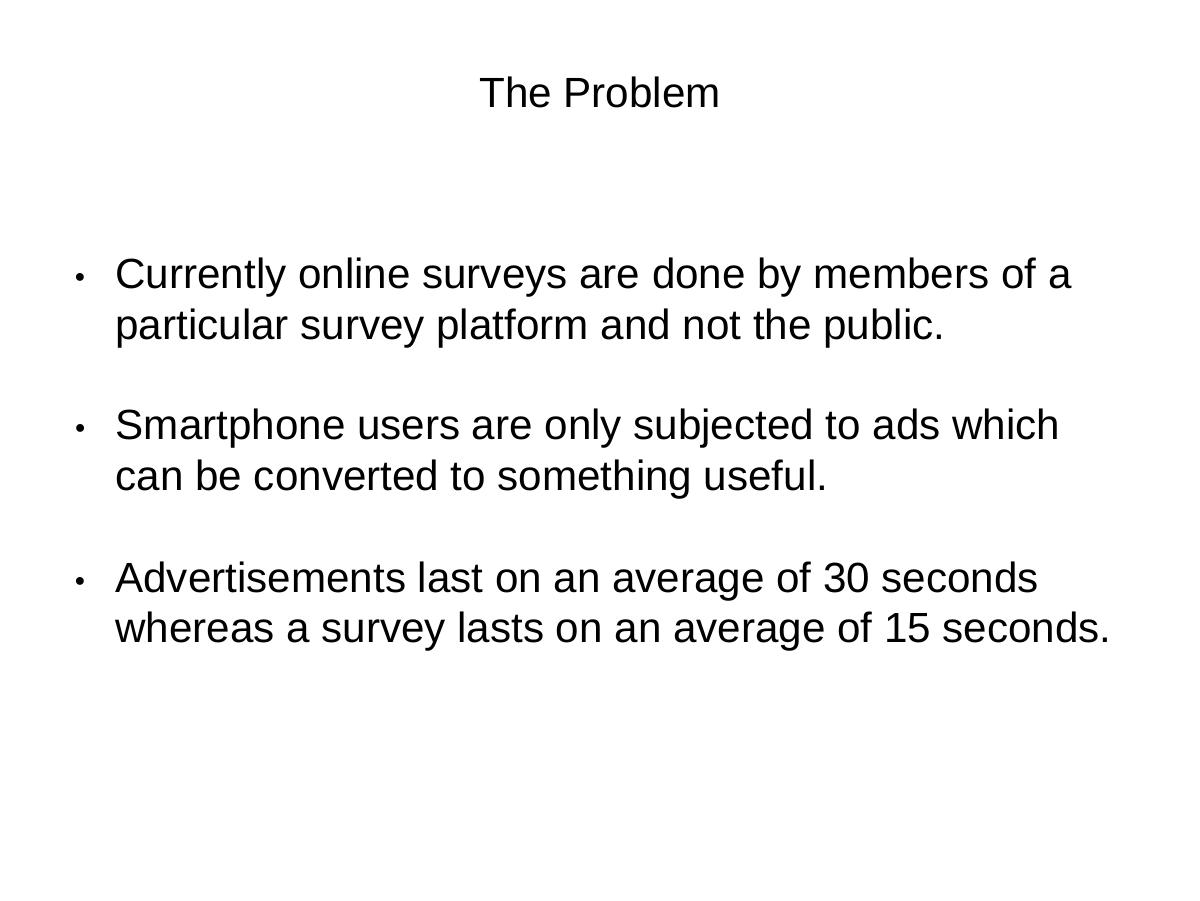
Three bullets. "Currently online surveys are done by members of a particular survey platform and not the public." "Smartphone users are only subjected to ads which can be converted to something useful." "Advertisements last on an average of 30 seconds whereas a survey lasts on an average of 15 seconds."
The first bullet is the best line in the deck and it is a real, specific, non-obvious problem. Panel-based survey research has a self-selection problem that professionals genuinely worry about : the population that signs up to a survey platform for small payments is not the population you want to measure, and every result carries that bias. Naming that as the problem — rather than "surveys are expensive" or "surveys are slow", which is what most survey startups say — shows the team understood something about the industry. This bullet is a legitimate thesis for a company.
The third bullet is the second-best line, because it converts the pitch into an arithmetic argument the buyer on the other side already understands . A rewarded video ad costs a user 30 seconds; a survey costs 15. If both pay the developer, the survey is cheaper in the only currency mobile users actually spend. That is the entire pitch to a game developer, in one comparison, and it is the strongest commercial idea in the file.
It also carries the deck's first credibility problem: both averages are unsourced . Where does 30 seconds come from? Where does 15? A rewarded video in 2017 was typically 15 to 30 seconds and a multi-question survey could easily run past 60. The numbers are plausible and they are asserted, and this is the only slide in the deck with any figures at all — so the one quantitative claim the deck makes is also the one it does not support. A single footnote naming the source would have converted the deck's best argument from an assertion into evidence.
The middle bullet is muddled: "users are only subjected to ads which can be converted to something useful" is trying to say ad inventory can be replaced with survey inventory, and the passive construction obscures it.
Slide 4 — Solution
Three bullets describing the two-sided flow: clients "post the questions on our website and wait for a few days" ; Surwaze "deploys the questions through our SDK which developers have integrated into their apps/games" ; smartphone users "tap to elegant surveys to get in-app rewards instead of watching long advertisements" .
The architecture is correct and clearly described. Three parties — buyer, developer, respondent — each with their action stated. For a marketplace business, showing all three sides on the solution slide is the right move and many far more polished decks fail to do it.
Two phrases undercut it badly. "Wait for a few days" is written as a feature and reads as a limitation. The entire promise of programmatic mobile inventory is speed; a competitor with a real panel can turn a survey around in hours, and Surwaze has volunteered a multi-day wait on its solution slide without explaining why (fill rate) or bounding it (a fielding-time guarantee). "Elegant surveys" is an adjective standing where a screenshot should be. This is a deck about the user experience of answering questions inside a game, and it contains no image of that experience anywhere. One phone mock-up would have done more than all three bullets.
What is entirely absent is the hard question a sophisticated buyer asks immediately: if the respondent is an unknown gamer taking a survey for a reward, what do you know about them? Survey research is sold on demographic targeting and data quality. There is no mention of screening, quotas, demographics, fraud or straight-lining. The deck's central innovation is also its central risk, and the risk is not acknowledged.
Slide 5 — Why Now?
Three bullets: "The need for a whole new brand of surveys." "Huge population of smartphone users by 2020." "Advertisements are too mainstream for developers and users alike."
This is the weakest slide in the deck, and "Why now?" is the slide where a first-time team most often gives itself away. The question is asking what changed recently that makes this possible today and impossible three years ago — a technology shift, a regulatory change, a cost curve, a behaviour change. It is not asking for restated ambition.
Bullet one restates slide 2. Bullet two gestures at a real trend and gives no number , on a slide whose entire job is to quantify a trend — the smartphone-penetration forecasts for 2020 were freely available and widely cited in 2017, and India's own smartphone growth was one of the most quoted statistics on earth that year. Bullet three, "advertisements are too mainstream" , is the single most damaging line in the file: it argues from fashion rather than economics, and it invites the obvious rebuttal that mainstream is precisely what an inventory business wants.
The real "why now" was available and sitting on slide 3. In 2016–17, rewarded video had just become the dominant monetisation format in mobile games , which meant a generation of developers had already built the "watch something, get a reward" loop into their products and users had already been trained to accept it. Surwaze does not need to create a behaviour — it needs to substitute one asset inside a loop that already exists. That is a genuine and defensible why-now, and the deck does not make it.
Slide 6 — Market size
Two bullets. "Everyone needs to conduct surveys, be it fortune 500 companies, Businesses, Researchers etc." "Different types of surveys include political, customer satisfaction, brand awareness, educational surveys etc."
There is no market size on the market-size slide. Not a TAM, not a SAM, not one currency figure, not one count of anything. The slide lists types of buyer and types of survey — a taxonomy where a number belongs.
"Everyone needs to conduct surveys" is the classic beginner's market claim, and it is read by investors as the opposite of what the founder intends. A market of everyone is a market with no beachhead, no defined buyer, no channel and no way to compute a bottom-up number. Ending both bullets with "etc." makes it worse , because "etc." is a signal that the list was not researched to completion.
The frustrating part is how easy this slide was. The global market research industry was publicly sized at roughly $45–47 billion in 2016 by ESOMAR, whose reports are free and citable; online research was a named and sized segment inside it. A bottom-up version was available too: pick the buyer, multiply by an annual spend, show the arithmetic. Any of those, with a source line, turns this from the deck's emptiest slide into a credible one in about twenty minutes of work.
Slide 7 — Competition
Three bullets: "Surwaze will be the first of its kind to deploy surveys on a mobile SDK." "Popular conventional survey platforms like survey monkey, typeform etc." "On acquiring a developer network, the popular monetisation SDK Google admobs."
The structure here is actually thoughtful — the team distinguishes between the competitors it faces on the buyer side (SurveyMonkey, Typeform) and the competitor it will face on the supply side once it has developers (AdMob). Recognising that a two-sided business has two competitive sets is a real insight and most seed decks miss it.
Then bullet one destroys the slide. "First of its kind" was not true in February 2017 and was trivially checkable. Google Consumer Surveys had been running since 2012, including a mobile app model — Google Opinion Rewards, launched 2013 — that paid Android users Play Store credit for short surveys. Pollfish, founded 2013, was a survey SDK that delivered questionnaires inside mobile apps and paid developers , which is Surwaze's exact model, and it was well known enough to be listed in the major mobile-monetisation SDK roundups of the period.
The consequence is not that the market was closed — Pollfish's existence proves the model works and is the single most useful validation Surwaze could have shown. The consequence is what a "first of its kind" claim does to the reader when they know it is false : every subsequent claim gets re-priced downward, because the deck has demonstrated it will assert things it has not checked. A founder who says "Pollfish proved this model; here is why we win in India, where they are weak" is more credible than one who claims an empty field, and the position is stronger too.
Naming the competitors without a single axis of comparison is the secondary failure. Three named companies, no grid, no "they do X, we do Y", no wedge.
Slide 8 — Product
Three bullets: a website dashboard to conduct surveys or monetise an app; "simple one line integration of the SDK in the android studio" ; and "to have a visual experience visit surwaze.com/tour" .
The one-line-integration claim is exactly the right thing to say to a developer audience. Integration friction is the whole battle in the SDK business, and stating it as a single line — the way every successful developer tool has — shows the team knows who it is selling to. It should have been shown, not claimed: one line of code, printed on the slide, in monospace . It would have taken the space of one bullet and been the most persuasive object in the deck.
Instead the slide does the thing a deck must never do: it sends the reader away. "Visit surwaze.com/tour" outsources the product demonstration to a URL, and an investor reading a PDF on a phone between meetings will not open it. Everything a link can show, a screenshot can show inside the file, without asking the reader to spend effort or losing them to a browser tab that never comes back.
The slide also quietly limits the company. Android Studio is named; iOS is not mentioned anywhere in the deck. Android-first was a sane choice for an Indian team in 2017 and it is a legitimate strategy — but the deck never says it is a strategy, so the reader is left to decide whether the founders chose Android or simply never considered the other half of the market.
Slide 9 — Revenue Model
Three bullets: "In layman terms, clients pay us to conduct surveys and we pay a portion of it to the developers who integrate Surwaze SDK." Clients charged on "number of questions, Response rate etc." ; developers paid on "the number of responses and other factors."
The mechanism is right, the revenue share is the correct model for this business, and stating it plainly is better than obscuring it. But this slide has to answer a specific question — how much money does one unit of this business make? — and it answers with the word "portion".
Everything a reader needs is missing: the price per completed response, the developer's share, the resulting gross margin. Those three numbers are the entire investment case for an inventory business, and none is present. Nor is there a floor price, a minimum order, or an indication of whether a client buys 200 responses or 20,000. "Etc." and "other factors" appear again, in the two places where the specifics matter most.
A single worked example would have carried the whole slide: a client buys 1,000 completed responses at ₹X each; the developer earns ₹Y per completed response; Surwaze keeps the difference, a Z% gross margin. Three lines. Even with invented illustrative numbers labelled as illustrative, it demonstrates that the founders have thought in units — which is the actual thing being assessed on a revenue-model slide.
Slide 10 — "A beanstalk?"
Four bullets, and the deck's only real numbers: "Google acquired admobs for a whooping $750 million." "More than a billion dollars were paid to developers since july 2012." "A glimpse on the network, 200 billion ad request to the servers per month that can translate to 200 billion questions aired per month." "Surwaze proposes a similar business model to the admobs while not directly competing with them."
This is the most revealing slide in the deck, and its final bullet is the one genuinely sophisticated sentence in the file. "A similar business model while not directly competing" is a precise articulation of a real strategy: build the AdMob shape — SDK, developer network, revenue share, programmatic delivery — but sell a different product to a different buyer, so the incumbent is a template rather than an opponent. That is an argument an investor will engage with seriously.
The three bullets above it then undermine it in three different ways.
First, the arithmetic on the third bullet is the deck's central fallacy. "200 billion ad requests per month that can translate to 200 billion questions aired per month" assumes total inventory substitution — that every ad slot becomes a survey slot. It will not: Surwaze will hold a small fraction of the developer network, only some placements suit surveys, and — the binding constraint the deck never mentions — survey inventory is capped by demand, not supply. Ad inventory clears because advertisers will buy essentially unlimited impressions. Nobody needs 200 billion survey responses a month; a client needs 1,000 responses matching a demographic and then stops. Surwaze's whole business is limited by how many questions buyers want asked, and this slide inverts that into a supply number roughly eight orders of magnitude above any plausible reality.
Second, the AdMob acquisition figure is stale and used as validation of the wrong thing. Google bought AdMob in 2009 for $750m ; by February 2017 that was eight-year-old news, and a company citing an acquisition price as evidence of its own opportunity is showing an exit comparable, not a market.
Third, the slide is titled "A beanstalk?" — with a question mark. On the one slide making the biggest claim in the deck, the header is a metaphor nobody outside the team will decode, hedged into a question. Title it what it is: "The AdMob model, applied to research."
Slide 11 — Team
Six photographs and six names: Anna S Lal, Aswin CJ, Basil Arackal, Britto Saji, Livin Mathew, Nihal Ismail. No roles, no titles, no backgrounds, no education, no prior employers, no links, no allocation of responsibility.
Six faces and six names is not a team slide; it is a group photo with captions. For a pre-product, pre-revenue company, the team slide is frequently the only slide carrying investable information, and this one carries none. A reader cannot tell who writes the SDK, who sells to clients, who has ever shipped anything, whether anyone has worked in research or ad tech, or whether all six are full-time.
Six co-equal founders is itself something a deck has to address rather than ignore. An investor sees a six-way cap table, an unclear decision-maker and a high probability of attrition ; the founders see a complete team. Only the deck can close that gap, and one line under each face — role, and the single most relevant credential — would have done it at zero cost in space. The absence of any role labels, on a slide that is otherwise well laid out, suggests roles had not yet been decided, which is precisely the inference the team least wants a reader to draw.
Slide 12 — Thank you :)
No ask, no amount, no use of funds, no milestone, no runway, no email address, no phone number, no website, no team contact. A reader who is persuaded by this deck has no way to act on it.
The emoticon is the smaller issue but it is not nothing: ":)" on the closing slide of an investment document reads as informality where authority is expected, and it lands harder on a deck that has just failed to make an ask. The closing slide is the single highest-intent moment in the document — the reader has finished, and either wants to know what happens next or does not. Surwaze uses it to say thank you.
What this deck does better than most startup pitch decks
The problem on slide 3 is real and non-obvious. "Surveys are answered by members of survey platforms, not by the public" identifies panel self-selection bias — the thing professional researchers actually complain about — rather than the cost-and-speed complaints every other survey startup recycles. · The 30-seconds-versus-15-seconds comparison is a complete pitch in one line. It reframes the product in the currency the buyer already trades in — user attention inside a rewarded loop — and makes the substitution argument self-evident. Every marketplace should find its version of this sentence. · It follows the Sequoia outline faithfully. Company purpose, problem, solution, why now, market, competition, product, business model, team, in that order. Every slide is where a reader expects it. The structure is not what is broken here. · It recognises that a two-sided business has two competitive sets. SurveyMonkey and Typeform on the demand side; AdMob on the supply side once a developer network exists. That distinction is more strategic thinking than most seed decks display. · "A similar business model to AdMob while not directly competing with them" is a genuinely sophisticated positioning sentence: use the incumbent as a blueprint, not an opponent, by selling different output to a different buyer through the same machinery. · It talks to developers in developer terms. "One line integration in Android Studio" is the correct promise to the correct audience — integration friction is the whole battle in the SDK business, and the team knows it. · Twelve slides, one idea each. No wall of text, no forty-slide sprawl, no appendix. What is wrong with this deck is what is absent, which is a far easier problem to fix than what is crammed in.
Where this deck would fail in an investor meeting
No ask. No amount, no round, no valuation, no use of funds, no runway. The deck closes on "Thank you :)". · No contact details anywhere in twelve slides. No email, no phone, no website on the closing slide, no LinkedIn. A persuaded reader cannot reply. · No market size on the market-size slide. A list of buyer types and survey types with no figure, no source and two instances of "etc." — when ESOMAR's ~$45bn industry sizing was free and citable. · No traction of any kind. No users, no developers, no apps integrated, no surveys run, no clients, no revenue, no pilot, no waiting list, not even a beta count. · No financials. No price per response, no developer share, no gross margin, no projection, no cost structure. "A portion of it" is the only unit economics the deck contains. · "First of its kind" was false and checkable. Pollfish had been running the same in-app survey SDK model since 2013, and Google Opinion Rewards since 2013. An investor who knows one of them re-prices every other claim in the deck downward. · The 200-billion fallacy. Treating AdMob's monthly ad requests as addressable survey volume assumes total inventory substitution and ignores the binding constraint: survey demand is finite and buyer-capped, unlike ad demand. · The team slide has no roles. Six names, six photographs, no titles, no backgrounds, no responsibilities — on the slide that carries the entire investment case for a pre-product company. · No product evidence. Zero screenshots in a deck about a user experience; "elegant surveys" as an adjective, and the actual demonstration outsourced to a URL the reader will not visit. · Data quality is never addressed. An anonymous gamer answering for an in-app reward raises targeting, screening, fraud and straight-lining questions that any research buyer asks first, and the deck does not acknowledge them. · "Wait for a few days" is stated as part of the solution, conceding a fielding-speed weakness on the slide meant to establish the advantage.
What the Sequoia template asks versus what Surwaze answered
Template slide The question it is actually asking What Surwaze wrote
Company purpose One repeatable declarative sentence Delivered — weakened by "a whole new brand of"
Problem Whose pain, how big, evidenced A genuinely sharp problem, two unsourced averages
Solution The mechanism, shown The mechanism, described; "elegant" instead of a screenshot
Why now What changed recently to make this possible "Ads are too mainstream" — fashion, not a shift
Market size A number, built bottom-up, sourced A taxonomy of buyers and survey types, no number
Competition Who you beat, on which axis "First of its kind" — untrue and checkable
Business model Price, cost, margin per unit "We pay a portion of it to developers"
Team Why these people specifically Six names, six photos, no roles
Financials / ask How much, for what, to reach which milestone Absent — the deck ends on "Thank you :)"
How you would rebuild this deck in 2026
Promote the 30-vs-15-second comparison to slide 2. It is the strongest idea in the file and it currently sits third on a bullet list. Put it on its own slide with a source, and let the whole deck argue outward from it. · Drop "first of its kind" and use Pollfish as proof. "In-app survey SDKs work — Pollfish and Google Opinion Rewards proved the model. Here is the market they serve badly and how we take it." That is a stronger position and it survives a five-minute search by the investor. · Put a real number on market size. A top-down anchor with a named source, and a bottom-up build for the beachhead: target buyer count times annual survey spend. Show the arithmetic on the slide. · Replace the revenue-model bullets with one worked unit. Price per completed response, developer payout, gross margin, minimum order size. If the numbers are illustrative, label them illustrative — thinking in units is what is being assessed. · Fix the why-now. The real answer is that rewarded video had already trained a generation of mobile users and developers on the watch-then-reward loop; Surwaze substitutes one asset inside a behaviour that already exists rather than creating a new one. · Add the data-quality slide the deck is missing. How respondents are screened, what demographics are captured, how quotas are filled, how fraud and straight-lining are detected. In research this is not a footnote; it is the product. · Show the product. Three phone screens — the survey card inside a game, the question, the reward confirmation — plus the actual one line of integration code in monospace. Delete the URL. · Put roles on the team slide. One line per person: role, and the single most relevant credential. Address the six-founder structure directly rather than leaving the reader to worry about it. · Get any traction onto the deck. One developer integrated, one survey fielded, 200 completed responses, a fill rate, a completion rate — for a pre-seed team, the smallest real number beats the largest projection. · Replace "Thank you :)" with the ask. Amount, runway in months, the two or three milestones the money buys, and the founder's direct email in type large enough to read on a phone.
The transferable lesson
Surwaze did the thing every founder is told to do: it found the canonical template and followed it exactly. Twelve slides, every section in the expected order, one idea per page, no bloat. And it still fails, because a template tells you which questions to answer and cannot stop you answering them with the question restated. "Market size: everyone needs surveys." "Competition: we are the first of our kind." "Business model: clients pay us and we pay a portion to developers." Each of those is the header rephrased. The template was followed and the work was not done.
What makes this deck genuinely instructive rather than merely weak is that the raw material was there. The panel-bias problem on slide 3 is a real thesis. The 30-versus-15-second substitution is a complete commercial argument in one sentence. "A similar business model to AdMob while not directly competing with them" is a strategy an investor will sit forward for. Three good ideas, buried on bullet three of slides three, three and ten respectively , surrounded by adjectives that a reader will discount and a "first of its kind" claim that costs the deck its credibility on the slide before the product.
So the test to apply to your own deck is not whether every section is present. Surwaze's are. Go slide by slide and ask, of each one: could a reader who knows nothing about my company extract a fact from this page that they could not have guessed from the header? A number, a name, a date, a price, a screenshot, a source. If the answer is no on more than two slides, you have a template with your logo on it — and the good idea you actually have is somewhere inside it, on bullet three, where nobody will find it.
Frequently asked questions
- What is Surwaze?
- Surwaze was an early-stage startup pitching a mobile survey network: clients post survey questions on its website, the questions are delivered through an SDK that developers integrate into their Android apps and games, and users answer short surveys in exchange for in-app rewards instead of watching video ads. The 2017 deck lists six founders and no product, revenue or funding details.
- Is the Surwaze deck a good pitch deck for investors?
- It is a structurally correct deck with almost no substance. All 12 slides follow Sequoia's business plan outline in the right order, but the market-size slide has no number, the competition slide claims a false first-mover position, the business-model slide gives no price or margin, the team slide has no roles, and the deck ends with no funding ask and no contact details.
- Which slides from the Surwaze deck should founders copy?
- The problem framing, and specifically two bullets on slide 3. First, that online surveys are answered by survey-panel members rather than the public — a real self-selection bias that professional researchers care about. Second, the comparison that ads cost a user 30 seconds while a survey costs 15, which reframes the entire pitch in the currency a mobile developer already trades in. Both need sources.
- What is the biggest mistake in the Surwaze pitch deck?
- Claiming to be 'the first of its kind to deploy surveys on a mobile SDK' in February 2017. Pollfish had been running the same in-app survey SDK model since 2013, and Google Opinion Rewards since 2013. Any investor who knew either one would discount every subsequent claim in the deck — and citing Pollfish as proof the model works would have been a stronger position than claiming an empty field.
- Why is 'everyone needs surveys' a bad market-size slide?
- Because it is unquantified and unbounded. A market of everyone has no beachhead, no defined buyer, no channel and no way to build a bottom-up number, so an investor cannot size the opportunity or judge whether the team can reach it. The fix takes about twenty minutes: a sourced top-down figure for the research industry, plus a bottom-up build of target buyers times annual spend.
- What would make an investor reject the Surwaze deck?
- No traction, no financials, no pricing, no market number, no product screenshot, no roles on the team slide, no funding ask and no contact details across 12 slides. Add a false first-mover claim and an addressable-volume argument that assumes 200 billion ad requests become 200 billion survey responses. There is nothing quantitative in the deck for an investor to write a memo against.