SupplyHog’s 2011 seed deck is a masterclass in industry-specific branding and clear value propositioning. Operating in the 'Other' industry category (specifically construction tech), the company identified a massive $1 trillion residential construction market (Slide 13) served by 1.6 million contractors. The deck utilizes a narrative-heavy opening, using imagery to establish the friction in current contractor workflows before presenting a streamlined digital quote and checkout system. While the deck lacks traditional financial projections or a formal team slide in the provided 14-slide sample…
Key takeaways
- The deck targets a massive $1 trillion residential construction spending market (Slide 13).
- SupplyHog positions itself as a price leader, showing a $835.69 quote vs. $1,236.67 at Lowe's (Slide 9).
- The platform boasts a network of 1,000 distribution points across the United States (Slide 11).
- The initial funding ask was $1.3 million (Slide 6), though the company ultimately raised $3 million according to catalogue data.
- The product focuses on saving time for contractors, with testimonials claiming it gives them 'more time to spend with family' (Slide 12).
- SupplyHog integrates modern payment stacks for 2011, including Stripe, Dwolla, and Zipmark (Slide 10).
- The supply chain is supported by major partners like ABC Supply with 400+ locations and Lansing with 73 locations (Slide 11).
- The branding is intentionally 'blue-collar,' using a hard-hat pig logo and the tagline 'Get. Ship. Done.' (Slide 1).
Introduction: The Blue-Collar Digital Revolution
SupplyHog entered the market in 2011 with a clear mission: to digitize the messy, analog world of construction procurement. At the time, contractors were still largely relying on physical trips to big-box retailers or phone-tag with local distributors. This teardown examines the 14 available slides of their 27-slide deck, which successfully bridged the gap between 'old school' construction and 'new school' e-commerce.
The Hook and the Problem (Slides 1-5)
Slide 1 sets the tone immediately. The branding is rugged, featuring a pig in a hard hat and the punchy tagline 'GET. SHIP. DONE.' This isn't a generic SaaS deck; it is built for the construction industry. The inclusion of Nathan Derrick’s contact info and social handles (Angel.co, Twitter) signals a founder who is accessible and plugged into the then-emerging startup ecosystem.
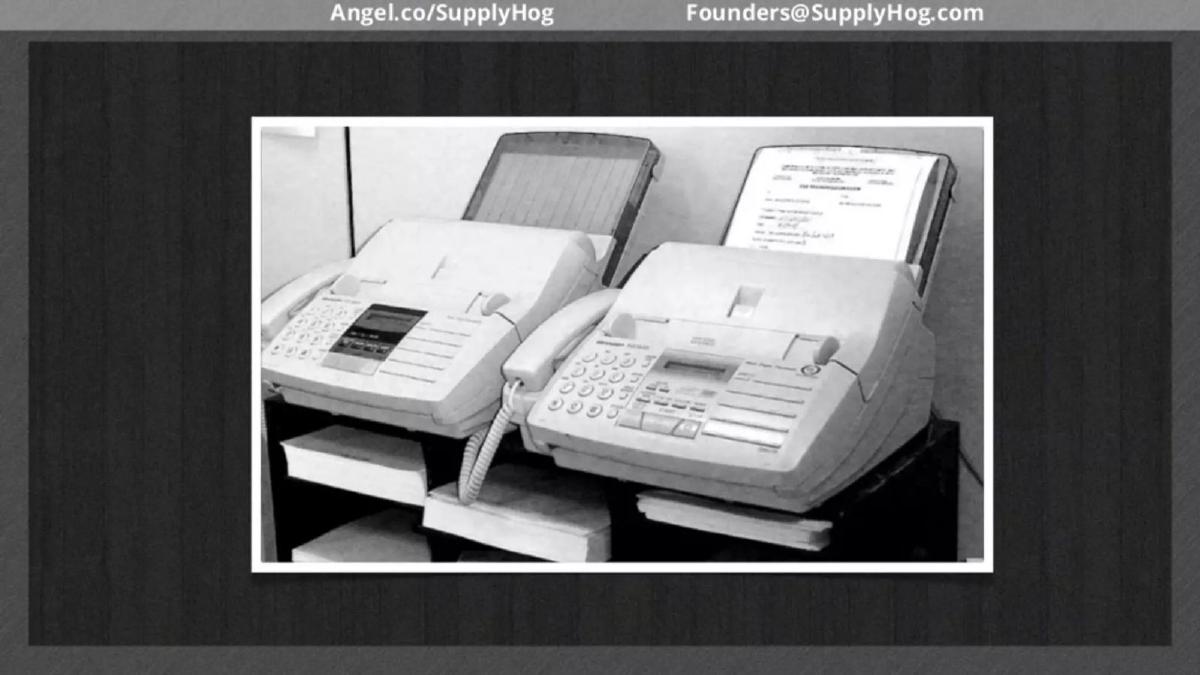
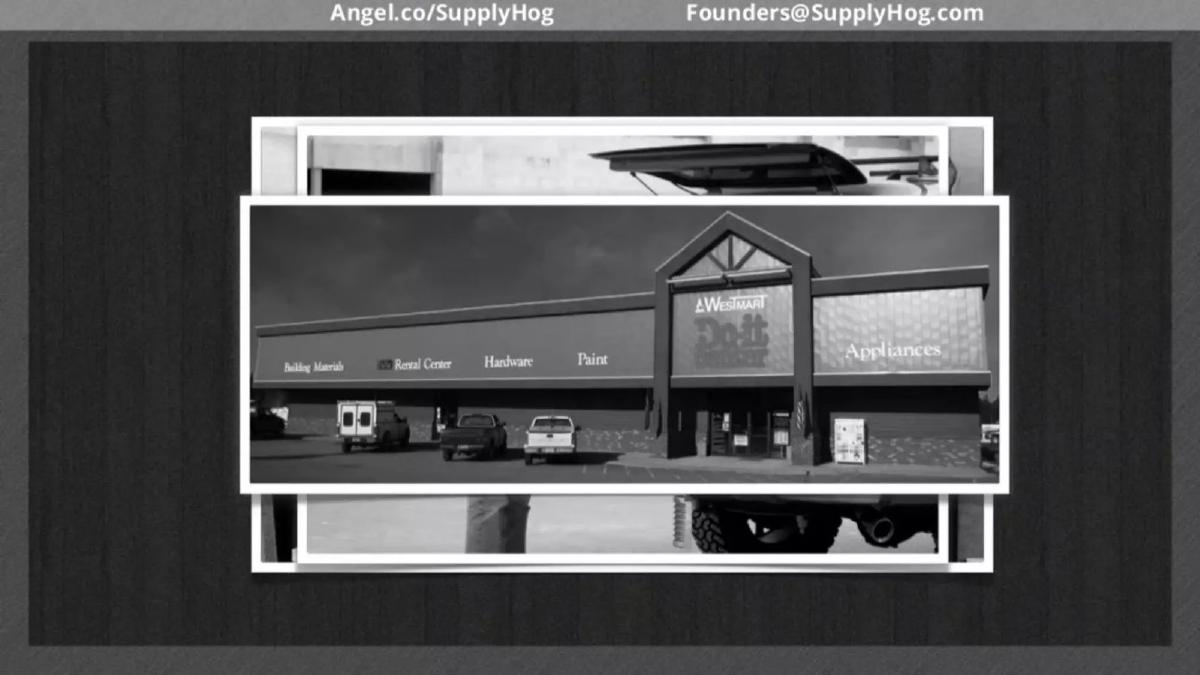
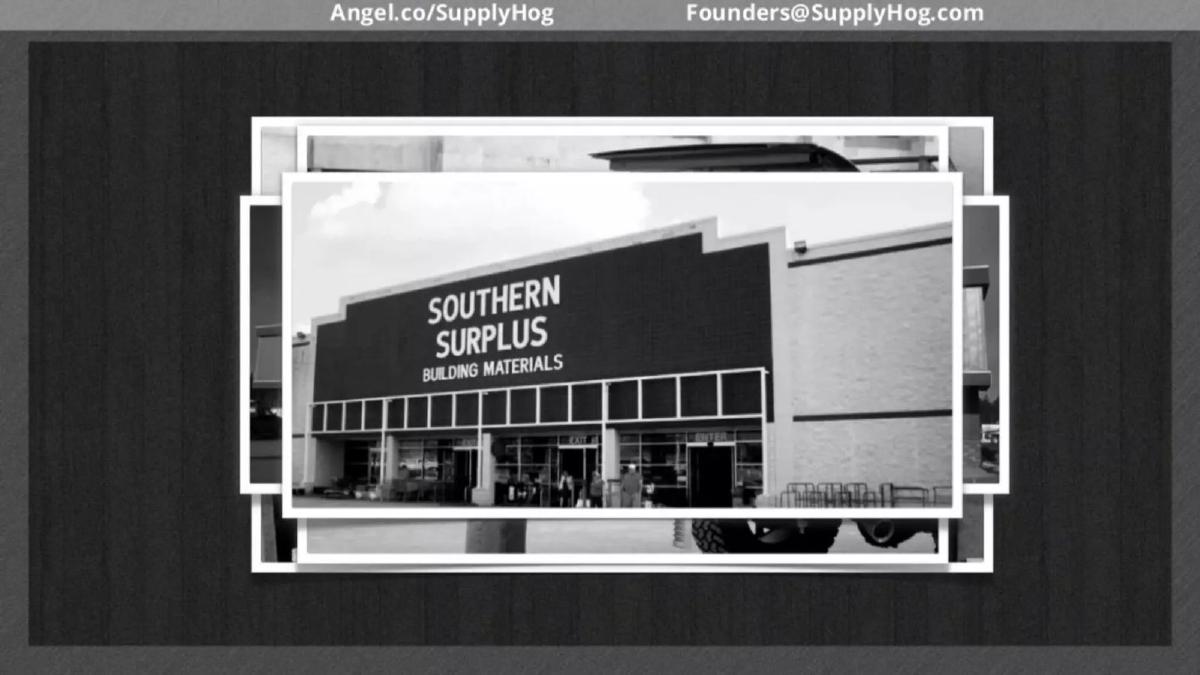
Slides 2 through 5 function as a silent narrative. There is no text on these slides, only black-and-white photography. We see a contractor loading a truck (Slide 2), a physical storefront for 'Southern Surplus Building Materials' (Slide 3), a contractor on a mobile phone in a cluttered truck cab (Slide 4), and a worker on a job site (Slide 5). This sequence is designed to make the investor feel the 'grind' of the current workflow. It highlights the isolation, the manual labor, and the logistical headache of managing supplies from the field.
The Ask and the Team (Slides 6-7)
Slide 6 is the 'Show Me The Money' slide. It is bold and direct, stating a raise of $1.3 Million. The background image is blurred, keeping the focus entirely on the figure. It is worth noting that the company eventually raised $3,000,000, according to catalogue data, which suggests this deck was the starting point for a very successful seed cycle.
Slide 7 is an unconventional 'Team' or 'Culture' slide. Instead of headshots and resumes, it features a collage of family photos—founders and employees with their spouses, children, and even a dog. In a 2011 context, this was likely intended to humanize the brand and reinforce the 'hard-working individual' persona mentioned in their self-description. However, from a modern venture perspective, the omission of professional backgrounds (previous exits, industry experience) on this specific slide is a notable gap.
The Product and Competitive Advantage (Slides 8-10)
Slide 8 provides the first look at the interface. It shows a 'Quote' for 'Jackson Astronaut' (a placeholder name) for building materials like shutters and vinyl siding. The UI is clean and mimics a professional invoice, which is critical for contractors who need to present these costs to their own clients. It includes unit prices ($37.95/pair for shutters) and sub-totals, proving the software can handle the granular SKUs of the trade.
Slide 9 is the 'Killer App' slide. It shows a direct price comparison for a specific order: SupplyHog ($835.69) vs. Lowe's ($1236.67) vs. Home Depot ($1031.98). By positioning themselves as significantly cheaper than the two biggest incumbents, SupplyHog makes a compelling case for immediate user adoption. This slide answers the 'Why now?' and 'Why us?' questions simultaneously.
Slide 10 focuses on the checkout experience. It highlights a 'Confirm Purchase' screen with multiple payment options: Credit Card (powered by Stripe), Dwolla, and Zipmark. In 2011, Stripe was still relatively new, and including these logos signaled to tech-savvy investors that SupplyHog was building on a modern, scalable stack. The 'Order Summary' repeats the $835.69 total from the previous slide, maintaining consistency in the narrative.
Scale and Social Proof (Slides 11-12)
Slide 11 addresses the 'How' of their logistics. A map of the U.S. is covered in dots representing '1000 Distribution Points Across The Nation.' A legend lists major partners: ABC Supply (400+ locations), Tapco Group (100), and Lansing (73). This slide is crucial because it proves SupplyHog isn't a small local play; they have the back-end partnerships to fulfill orders nationwide without the capital expenditure of owning warehouses.
Slide 12 , titled 'Customer Love,' provides three testimonials. The quotes emphasize price ('the prices were great'), time ('more time to spend with my family'), and utility ('like having another employee'). Using real company names like 'Go Green Construction' and 'Wallace Guttering' adds a layer of authenticity that generic quotes lack.
Market Size and Vision (Slides 13-14)
Slide 13 quantifies the opportunity. It cites 1.6 Million Contractors and $1 Trillion in residential construction spending per year. The use of hard-hat icons and stacks of cash as visual aids is simple but effective. It places SupplyHog in a massive, albeit fragmented, market where even a small percentage of capture represents a significant business.
Slide 14 is the closing slide, overlaying the SupplyHog logo on top of the Zappos and Alibaba logos. This is a classic 'The X for Y' move. They are telling investors: 'Zappos conquered shoes, Alibaba conquered global B2B trade, and we will conquer construction supplies.'
What Works in This Deck
Industry Alignment: The visual language—from the logo to the black-and-white site photos—perfectly matches the target demographic. It feels authentic to the construction world. · Direct Price Comparison: Slide 9 is the strongest slide in the deck. It provides a tangible reason for a customer to switch from a known brand (Home Depot) to a startup. · Leveraged Infrastructure: Slide 11 brilliantly shows how the company scales. By listing 1,000 distribution points through partners, they prove they are a 'light' software layer on top of a 'heavy' industry. · Payment Flexibility: Showing Dwolla and Zipmark alongside Stripe (Slide 10) demonstrates an understanding of how contractors actually move money (often via checks or bank transfers rather than just credit cards).
What Is Missing
Professional Pedigree: While the family photos (Slide 7) are charming, the deck lacks a slide detailing the founders' specific expertise in construction or e-commerce. Investors usually want to see 'Founder-Market Fit' in a more traditional format. · Unit Economics: There is no mention of take rates, margins, or Customer Acquisition Cost (CAC). We see the price to the customer, but not the profit to SupplyHog. · Retention Data: The deck shows that customers like the service (Slide 12), but it doesn't show how often they return. In a marketplace, repeat purchase rate is a vital metric. · The 'How it Works' for Suppliers: We see the contractor's view, but not the interface or incentive for the 1,000+ distributors to participate in the platform.
What a Founder Should Copy
The Narrative Arc: Start with the 'day in the life' of your user. Slides 2-5 do this without saying a word, creating empathy for the problem before pitching the solution. · The Competitive Matrix: Don't just use a checkmark grid. Use actual price comparisons if you are a marketplace. It is much harder for an investor to argue with a $400 price difference (Slide 9) than a subjective feature list. · The Partner Map: If your business relies on a network, visualize it. Slide 11 turns a list of names into a 'national footprint,' which feels much more substantial. · Clear Contact Info: Every slide features the Angel.co link and the founders' email in the header. This makes the deck a standalone lead-generation tool.
Frequently asked questions
- How much did SupplyHog raise with this deck?
- While Slide 6 of the deck explicitly states they were 'Raising $1.3 Million,' catalogue data from pitchdeckhunt.com indicates the company successfully raised a total of $3,000,000 in 2011. This suggests the seed round was oversubscribed or followed by additional tranches shortly after the initial pitch.
- What is SupplyHog's core value proposition to contractors?
- The value proposition is two-fold: time and money. Slide 12 features testimonials highlighting that the platform acts like 'another employee,' freeing up time for family. Slide 9 provides a direct price comparison showing SupplyHog is approximately 32% cheaper than Lowe's for a specific set of building materials.
- Who are SupplyHog's main competitors according to the deck?
- The deck identifies big-box retailers Lowe's and The Home Depot as the primary price competitors (Slide 9). On the final slide (Slide 14), the company visually aligns itself with major e-commerce disruptors like Zappos and Alibaba, suggesting an ambition to be the 'Alibaba of construction.'
- How does SupplyHog handle logistics and distribution?
- SupplyHog does not appear to hold its own inventory. Instead, Slide 11 shows a map of 1,000 distribution points across the nation, leveraging existing manufacturers and distributors like ABC Supply, Lansing, and RSG to fulfill orders.
- What payment methods does the platform support?
- According to Slide 10, the platform was an early adopter of diverse digital payment methods. It supported standard credit cards (powered by Stripe), bank transfers via Dwolla, and digital checks through Zipmark, catering to the varied financial habits of contractors.