Supernormal’s Seed deck is a lean, product-centric presentation that successfully raised $10M in 2023. The company positions itself as the 'System of Record' for digitized meetings, moving beyond simple transcription into automated, human-grade note-taking. The deck stands out by showcasing significant early traction—60,000 hours of annotated meetings bootstrapped—and a highly efficient bottom-up go-to-market strategy where paying seats double every 10 days within organizations. By contrasting their proprietary model costs against industry giants like GPT-4, Supernormal builds a strong case f…
Key takeaways
- Supernormal defines itself as the 'System of Record for digitized meetings' on slide 2.
- The team features deep expertise with former ML leads from Facebook, Instagram, and Stripe (slide 3).
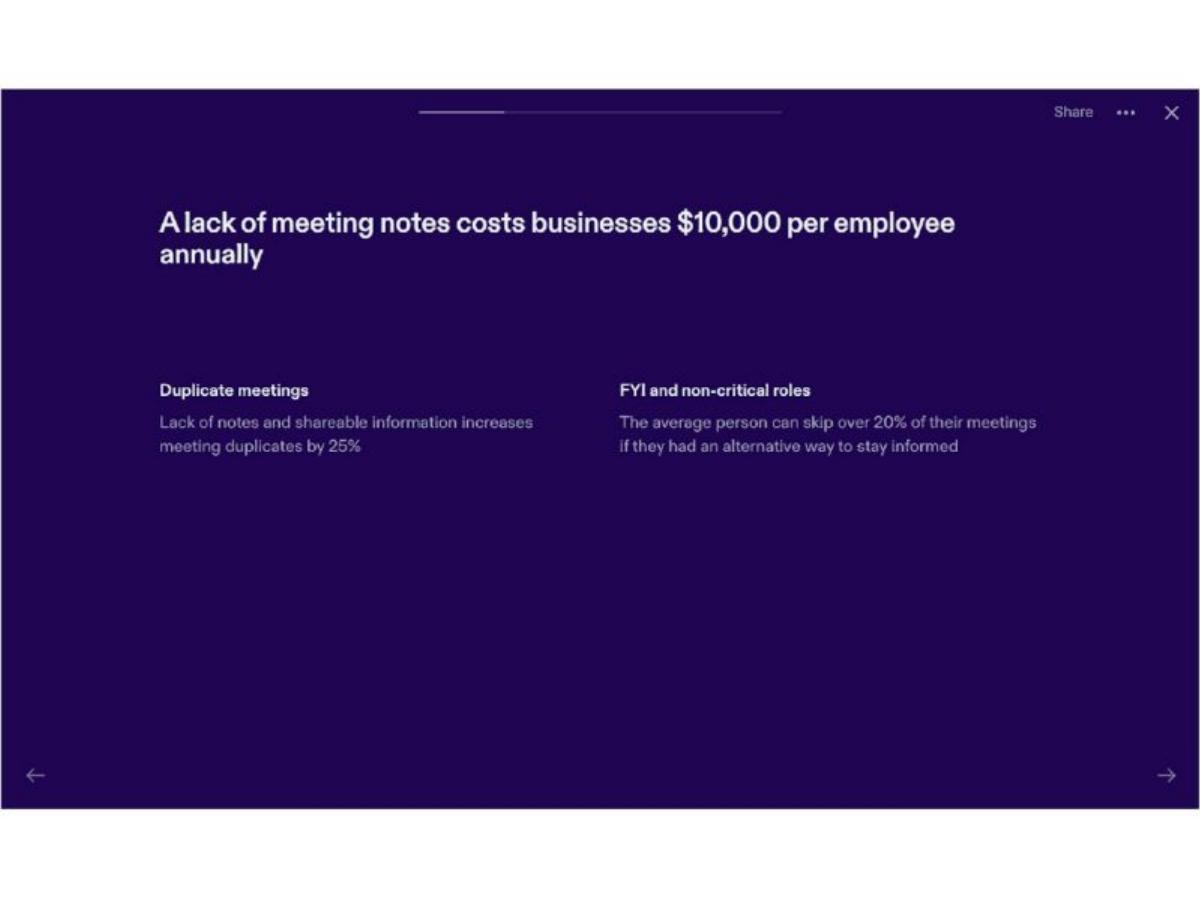
- A lack of meeting notes is quantified as a $10,000 annual cost per employee (slide 4).
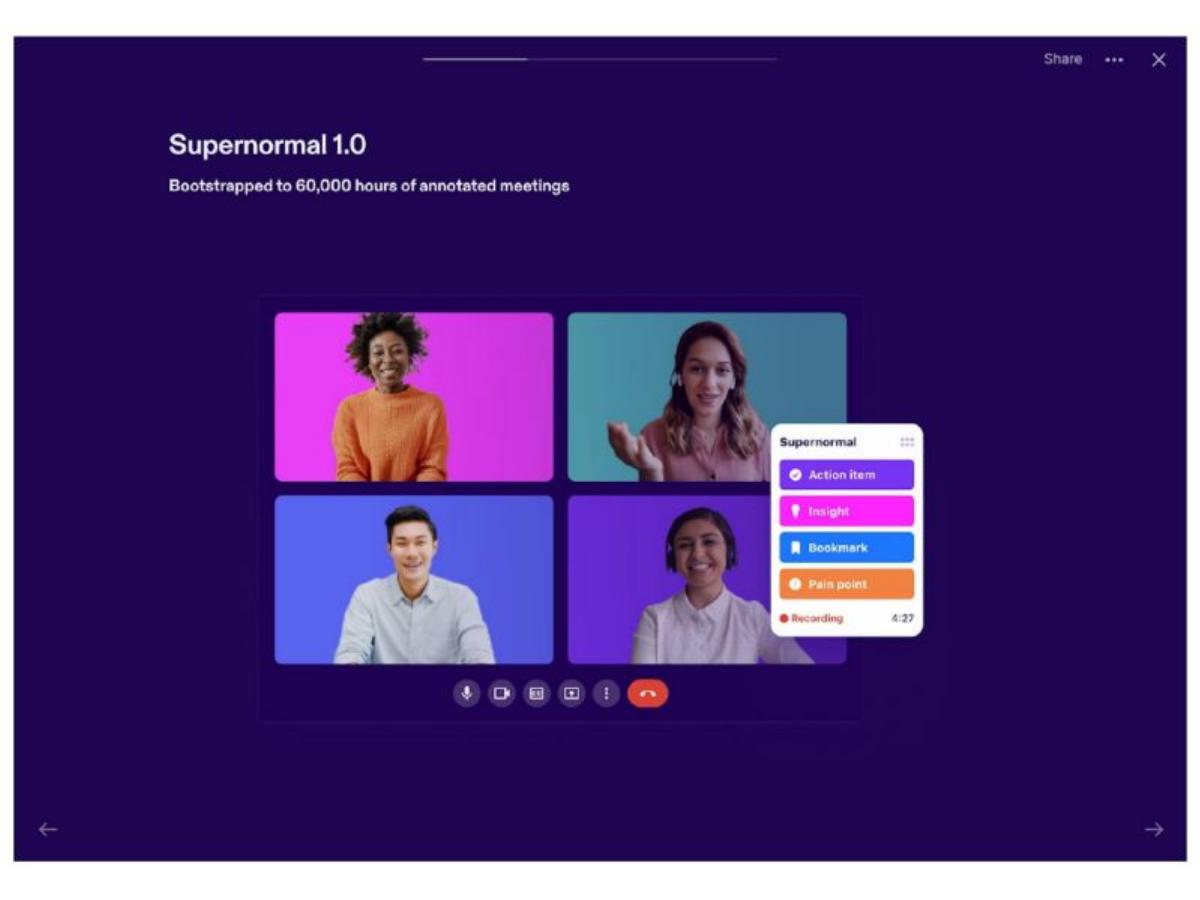
- The platform achieved 60,000 hours of annotated meetings while bootstrapped (slide 5).
- Engagement is exceptionally high, with a 72% DAU/MAU ratio and 3.8 recordings per day per user (slide 10).
- The deck claims a 48% conversion rate from sign-up to 'aha moment' (slide 10).
- Supernormal projects a massive cost advantage, showing their V3 and 'On Device' models costing near $0.00 compared to GPT-4's ~$7.00 per hour (slide 14).
- The GTM strategy targets a $250M early market specifically within Google Meet users (slide 16).
Introduction: The System of Record for Voice
Supernormal’s 2023 Seed deck is a masterclass in how to present an AI utility as a foundational enterprise platform. While many AI startups struggle to move past the 'feature' stage, Supernormal uses this 18-slide presentation to argue that they are building the 'System of Record' for the massive, previously untapped data set of internal meetings. The deck is visually sparse, focusing on high-contrast text and product screenshots, which reflects a product-first culture. With $10M raised from top-tier VCs like Balderton and EQT, the narrative clearly resonated by focusing on efficiency, unit economics, and rapid bottom-up adoption.
Slide 1-2: The Hook and the Vision
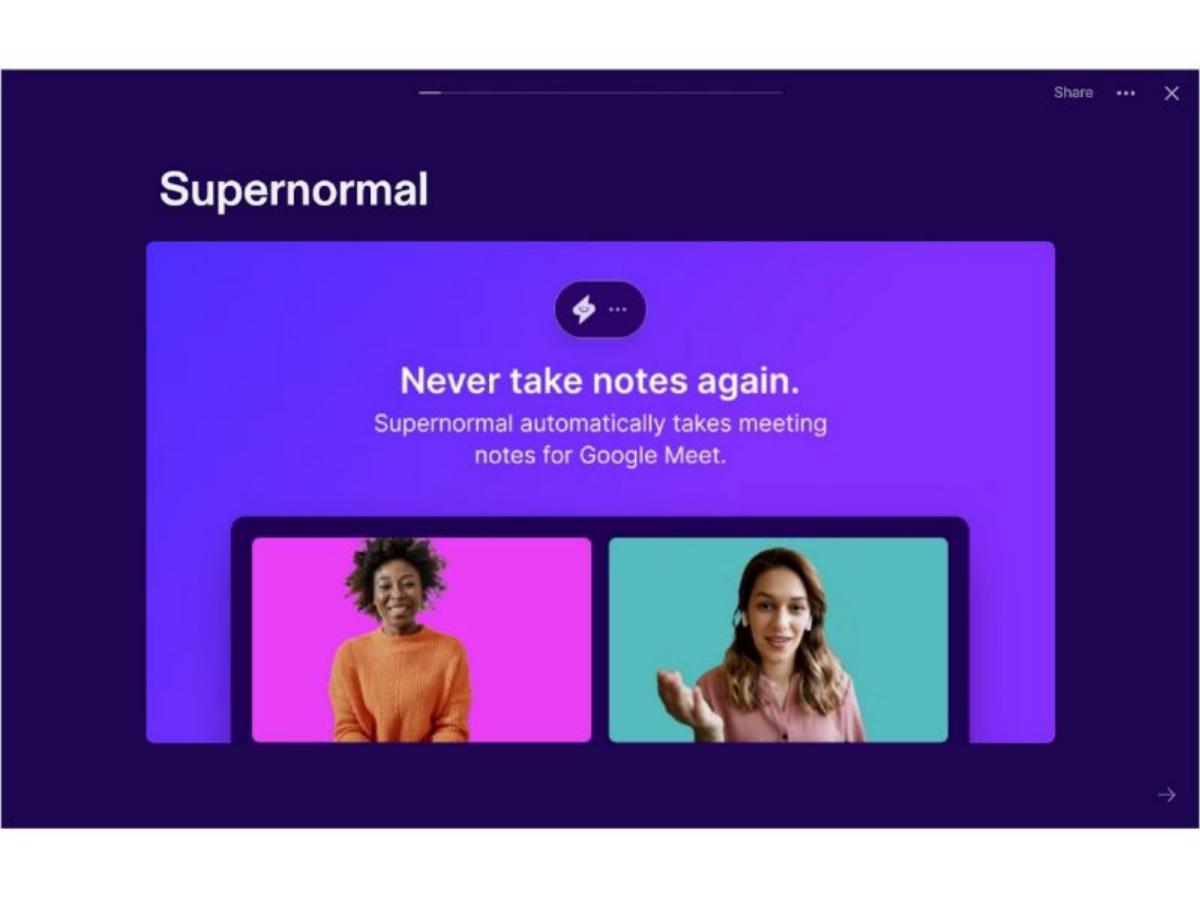
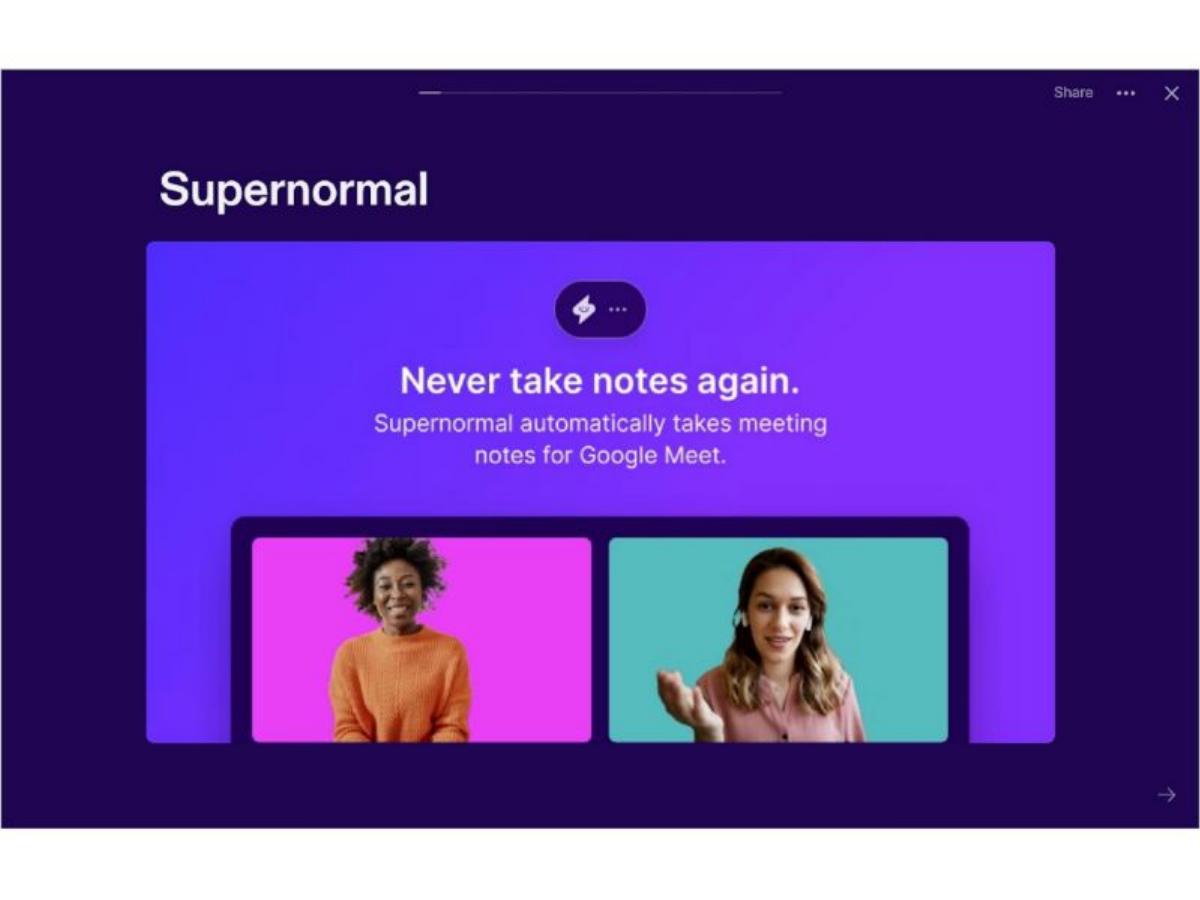
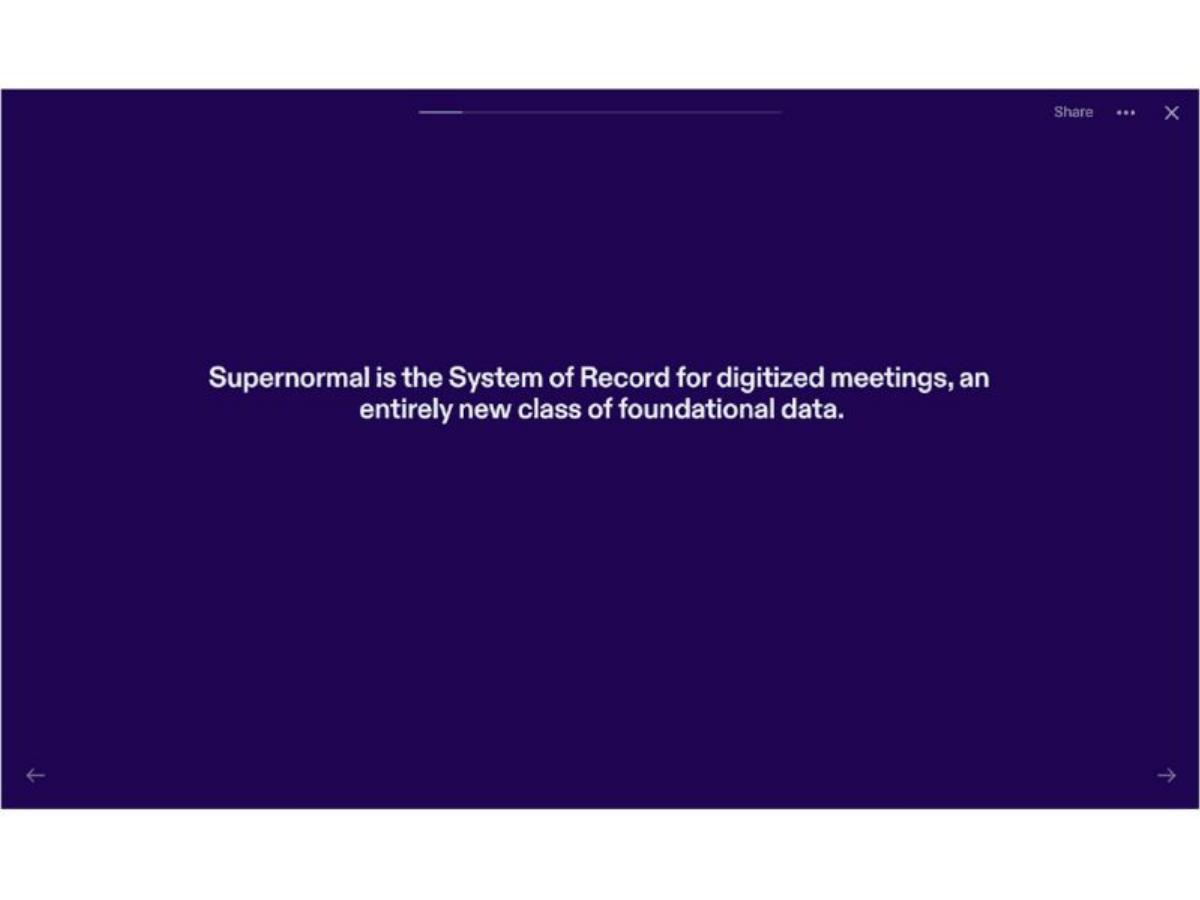
The deck opens with a simple, bold promise: "Never take notes again." Slide 1 establishes the immediate utility—automatically taking meeting notes for Google Meet. This is a classic 'hair on fire' problem-solving approach. However, slide 2 immediately elevates the conversation from a tool to a platform, stating that Supernormal is the "System of Record for digitized meetings, an entirely new class of foundational data." This transition is crucial for a Seed round; it tells investors that while the product starts as a note-taker, the ultimate value lies in the data ownership.
Slide 3: The Pedigree
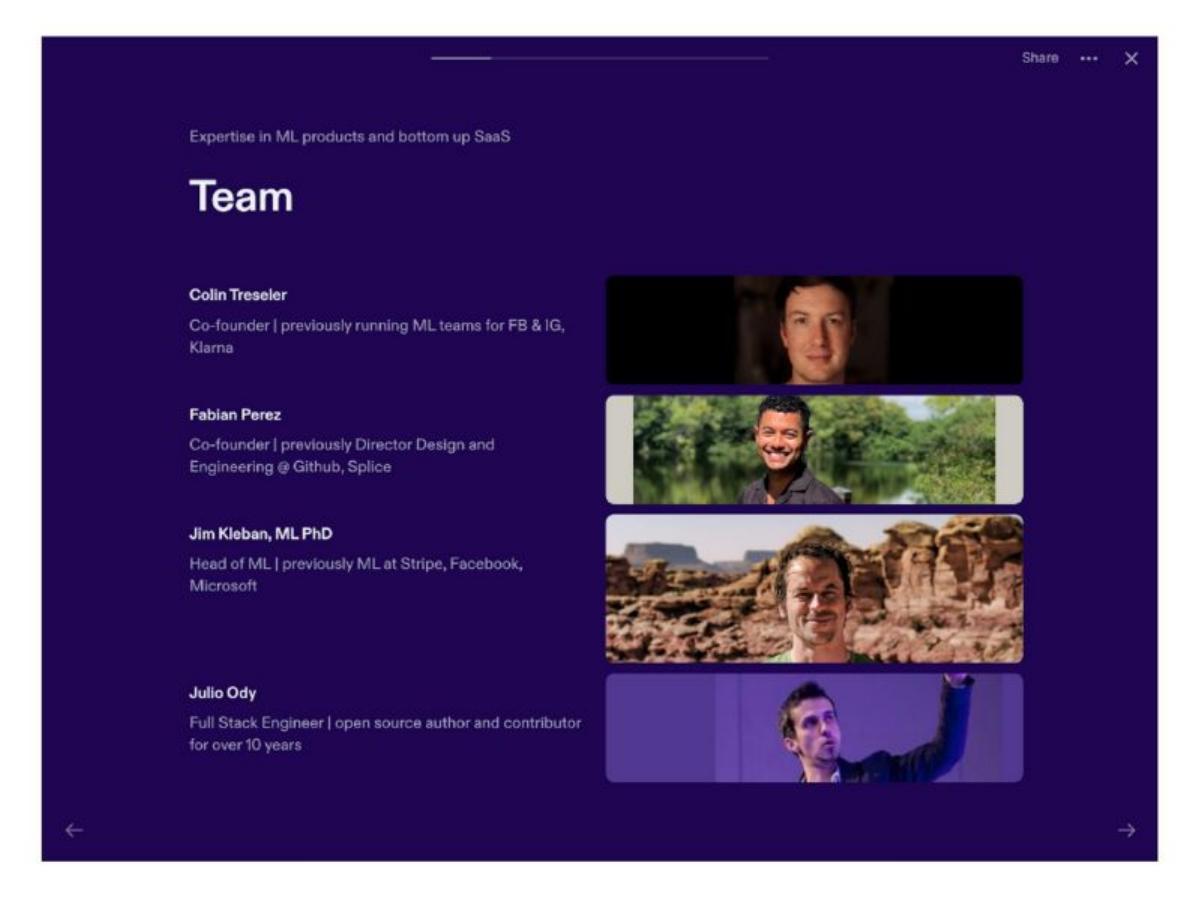
The team slide is positioned early, which is common when the founders have significant domain expertise. Colin Treseler (Co-founder) is noted for running ML teams at FB, IG, and Klarna. Fabian Perez (Co-founder) brings design and engineering experience from Github and Splice. The inclusion of Jim Kleban, ML PhD , with a background at Stripe, Facebook, and Microsoft, reinforces the technical depth required to build proprietary ML models rather than just using off-the-shelf APIs. The slide header explicitly calls out "Expertise in ML products and bottom up SaaS," checking two major boxes for modern VC interest.
Slide 4-5: Quantifying the Pain and the Progress
Slide 4 attempts to put a dollar value on the problem, claiming a lack of meeting notes costs businesses "$10,000 per employee annually." It breaks this down into two categories: duplicate meetings (increased by 25% due to lack of notes) and non-critical roles (where 20% of meetings could be skipped). Slide 5 introduces 'Supernormal 1.0,' which was "Bootstrapped to 60,000 hours of annotated meetings." This is a powerful traction signal; it shows the team can build and scale a product to significant usage without external capital, providing a massive data set to train their '2.0' models.
Slide 6-8: Product Evolution and Extensibility
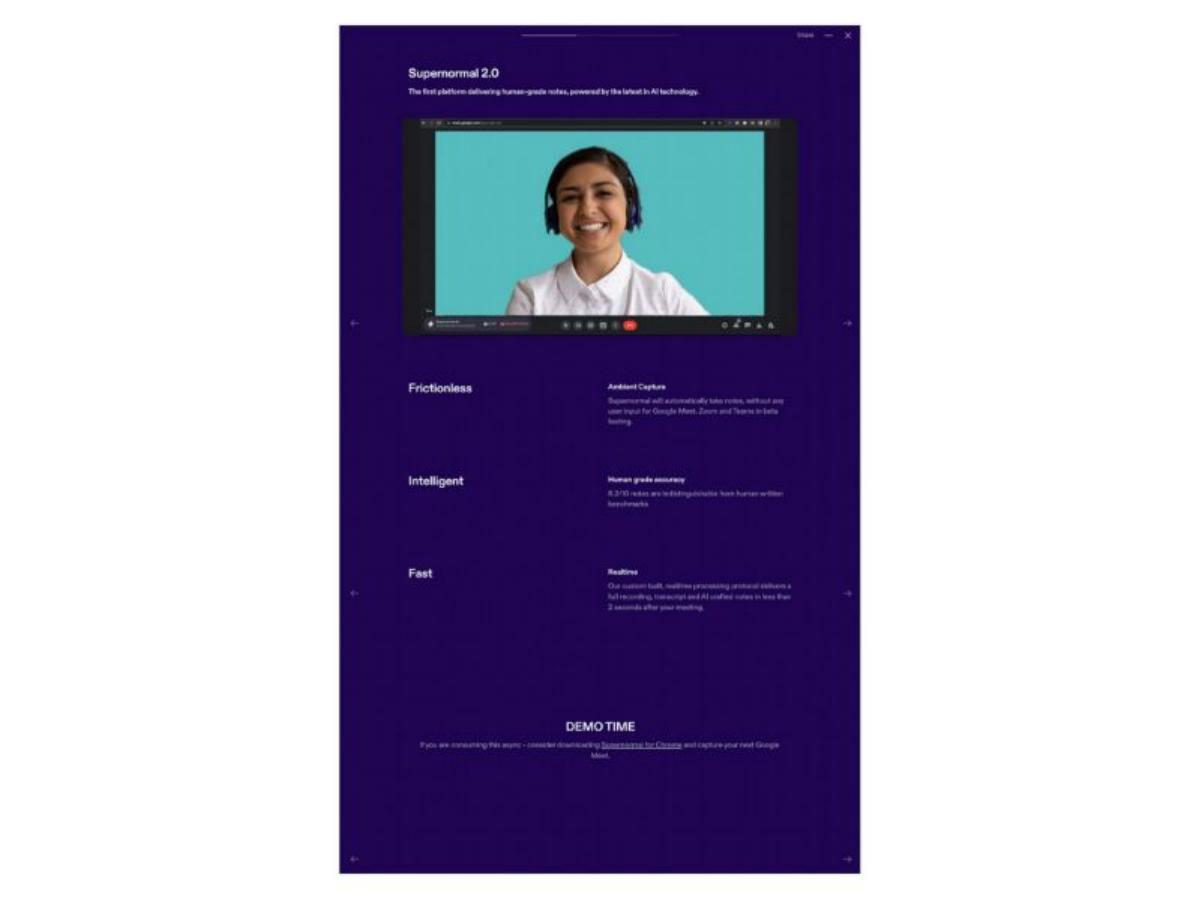
Slide 6 introduces 'Supernormal 2.0,' described as the first platform delivering "human-grade notes." It highlights three pillars: Frictionless (ambient capture), Intelligent (8.2/10 accuracy vs human benchmarks), and Fast (notes delivered in less than 2 seconds). Slide 7 shows a visual representation of an action item being shared directly via email, emphasizing the workflow integration. Slide 8 explains the technical approach to 'extensibility,' noting that different sections of notes (Summary, Decisions, Action Items) are treated as prompts run through a "fine-tuned version of our base model." This suggests a level of technical sophistication beyond simple transcription.
Slide 9-10: The Growth Engine
These are perhaps the most important slides for a Seed investor. Slide 9 details the 'Personal -> Team -> Organization' expansion path, noting that the "Avg paying organization has 5 seats in the first week, doubling every 10 days." This is the holy grail of bottom-up SaaS. Slide 10 backs this up with hard metrics: "$600K in productivity gains over the last 3 months," a 72% DAU/MAU ratio, and 3.8 average recordings per day . A 48% conversion rate from sign-up to 'aha moment' is exceptionally high for the sector, indicating very low friction in the user experience.
Slide 11-12: Validation and Timing
Slide 11 displays a 'who's who' of tech logos, including Netflix, Salesforce, Wayfair, and Clover . Seeing these names at the Seed stage suggests that the product is already solving problems for sophisticated enterprise users. Slide 12, the 'Why Now' slide, is brief, citing the macro AI environment, the continued dominance of meetings, and the lack of a "completely automatic solution" on the market. It’s a simple argument: the technology is finally ready, the problem is growing, and the competition is lagging.
Slide 13-14: The Raise and the Moat
Slide 13 details the round mechanics. It mentions EQT Ventures as a pre-seed investor and lists an impressive array of angels, including Nir Eyal (Hooked) and David Helgason (Unity founder) . The slide notes they were "Targeting $4M ARR with 200K+ DAU." Slide 14 is a technical 'moat' slide, showing a graph of "Cost per recorded hour across models." It shows Supernormal V3 and 'On Device' models approaching a cost of $0.00 , while GPT-4 remains near $7.00 . This is a compelling argument for margin defensibility; as competitors pay high API fees to OpenAI, Supernormal’s proprietary, fine-tuned models allow them to scale much more profitably.
Slide 15-16: Feedback and GTM
Slide 15 uses social proof, quoting customers who claim the notes are "exactly what I was going to write" and that they "canceled our Zoom business plan" to switch to Google Meet with Supernormal. Slide 16 provides the GTM strategy, identifying a $22B TAM and a $250M early target market specifically within the Google Meet ecosystem. It defines the ICP (Ideal Customer Profile) as a team lead at a Google Workspace company who manages 3-5 meetings per day, providing a clear roadmap for the sales and marketing teams.
Slide 17-18: Closing
The deck ends with a simple logo slide and a final slide (likely added by the hosting platform) encouraging viewers to browse more decks. The absence of a formal 'Ask' slide with a specific dollar amount is notable, though the catalogue facts confirm the $10M raise. This often happens in highly competitive rounds where the 'ask' is fluid based on investor interest.
What Works in the Supernormal Deck
1. Metric-Driven Narrative: The deck doesn't just say users like the product; it proves it with a 72% DAU/MAU and a 48% 'aha moment' conversion rate. These are top-decile engagement numbers that make the investment feel 'de-risked.'
2. The Cost Advantage: In a world where many AI startups are just 'GPT wrappers,' slide 14 is a powerful differentiator. By showing their path to near-zero marginal costs via proprietary models, they address the biggest concern in AI SaaS: long-term profitability.
3. Clear Expansion Path: The 'doubling every 10 days' metric on slide 9 provides a clear visualization of how the company will grow from a single user to an enterprise-wide deployment without a massive sales force.
What is Missing from the Supernormal Deck
1. Explicit Financial Projections: While they mention a target of $4M ARR, there is no multi-year financial forecast or breakdown of how the $10M will be spent (e.g., hiring vs. R&D vs. Marketing).
2. Competitive Landscape: The deck mentions that "no one on the market has a completely automatic solution," but it doesn't explicitly name or compare itself to incumbents like Otter.ai, Fireflies, or the native AI features being built into Zoom and Microsoft Teams.
3. Detailed Roadmap: The deck focuses heavily on what has been built (1.0 and 2.0). It lacks a forward-looking product roadmap that explains how they will move from 'notes' to the 'System of Record' vision mentioned on slide 2.
Founder Takeaways: What to Copy
Focus on 'Aha' Moments: If you have a high conversion rate to a specific product milestone, highlight it. Supernormal’s 48% 'sign up to aha moment' conversion is a standout stat that every founder should strive to track and present.
Quantify the Inefficiency: Don't just say your product saves time. Assign a dollar value to the problem you are solving, as Supernormal did with the $10,000 per employee cost on slide 4. This helps VCs understand the potential ROI for customers.
Show the Moat Early: If your technical approach gives you a cost advantage over companies using generic LLMs, visualize it. The cost-per-hour comparison on slide 14 is a brilliant way to show technical defensibility without needing a 50-page whitepaper.
Keep it Lean: This deck is 18 slides, but many are very low-density. It respects the investor's time by focusing on the 4-5 key metrics and arguments that actually move the needle.
Frequently asked questions
- What is Supernormal's core value proposition?
- Supernormal positions itself as an AI platform that eliminates the need for manual note-taking. According to slide 1 and 6, it provides 'human-grade' automated notes for Google Meet, Zoom, and Teams. The broader vision, stated on slide 2, is to become the foundational 'System of Record' for all digitized meeting data within an organization.
- How does Supernormal demonstrate product-market fit in this deck?
- The deck uses high-velocity engagement metrics on slide 10 to prove fit. Specifically, they cite a 72% DAU/MAU ratio and an average of 3.8 recordings per day per user. Furthermore, slide 9 notes that paying organizations typically start with 5 seats and double their seat count every 10 days, indicating strong internal virality.
- What is the technical defensibility of the product?
- Supernormal emphasizes its proprietary model efficiency on slide 14. They show a significant downward trend in 'cost per recorded hour,' claiming their V3 and on-device models are exponentially cheaper than using third-party LLMs like GPT-4 or GPT-3 Da Vinci 2. This suggests they are building specialized, cost-effective infrastructure rather than just wrapping an API.
- Who are the key investors in this round?
- According to the catalogue facts, the $10M Seed round was led by Balderton Capital, with participation from EQT Ventures, byFounders, and Acequia Capital. Slide 13 also lists a high-profile group of angels including founders and executives from Unity, Airbnb, Twitter, and Facebook.
- What are the primary market segments Supernormal is targeting?
- Slide 16 outlines a vertical-by-vertical approach, specifically targeting Sales, CS, Design, Operations, HR, and Finance. Their Ideal Customer Profile (ICP) is a team lead at a Google Workspace company who manages 3-5 meetings per day. They estimate their early target market within Google Meet alone at $250 million.