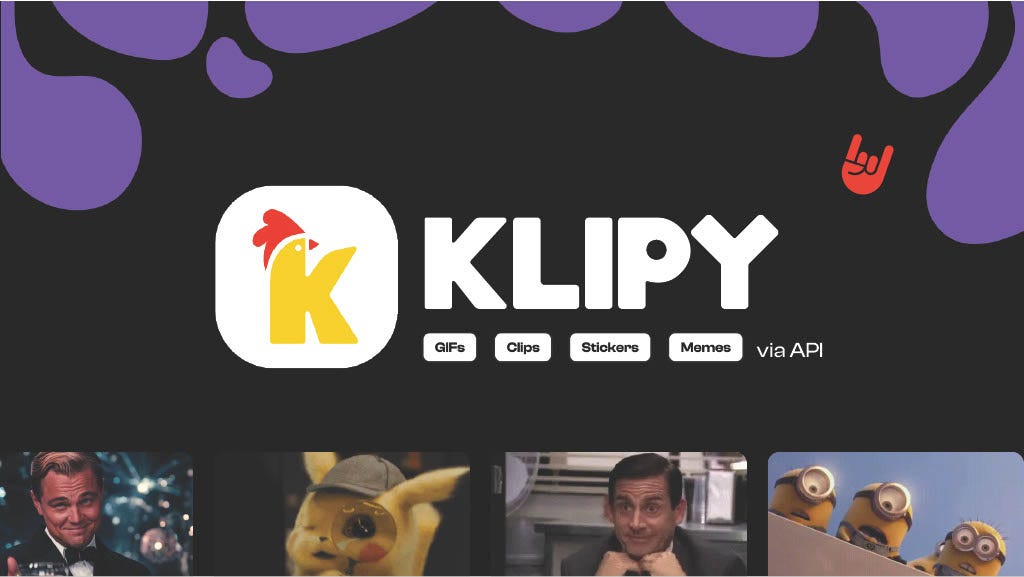
Klipy’s seed deck is a masterclass in timing and founder-market fit. By identifying a specific 'Market Moment' (Slide 5)—the sunsetting of Google’s Tenor API—the team positioned their platform not just as a competitor, but as the inevitable successor. The deck leans heavily on the pedigree of the Tenor founding team (Slide 4) and impressive early traction, citing 8,500+ developers and 40,000+ creators (Slide 6). While the deck is light on detailed financial projections and a specific 'Ask' slide, it compensates with aggressive performance metrics, claiming a 2:1 outperformance in share rates…
Key takeaways
- The deck identifies a massive total addressable market by citing 10 trillion GIFs, stickers, and memes shared annually (Slide 2).
- Klipy uses a 'Market Moment' slide to highlight a specific competitive opening: Google sunsetting the Tenor API service (Slide 5).
- Founder-market fit is established by noting the team includes members from the Tenor founding team, a company previously acquired by Google (Slide 4).
- Traction is demonstrated through a list of high-profile developers using the API, including BeReal, Canva, and Figma (Slide 6).
- The company claims a significant performance advantage, stating their API outperforms others 2:1 in share rates (Slide 5).
- Content supply is addressed by citing a library of 10M+ short-form media assets and partnerships with 40,000+ creators (Slide 4, Slide 7).
- The monetization strategy is built around 'Emotional Targeting' within an ad inventory, mapping user sentiment to specific ad formats (Slide 9).
- The deck lacks a formal 'Ask' slide detailing the specific use of funds or the valuation sought for the $3.8M round.
The Hook: Massive Scale and Digital Expression
Slides 1-3: Setting the Stage
Klipy opens with a clear, minimalist title slide (Slide 1) that defines their product immediately: GIFs, Clips, Stickers, and Memes delivered via API. This is a B2B2C play, and the clarity of the 'via API' tag is essential for setting investor expectations. Slide 2 follows with a 'Woah' factor, claiming 10 trillion GIFs, stickers, and memes are shared annually. While this is a broad market stat, it establishes the sheer volume of the medium they intend to dominate.
Slide 3, titled 'Day of Digital Expression,' provides the demographic justification for the business. It cites that 61% of Gen Z prefer emojis and GIFs, and 75% of those aged 13-36 share memes. By framing the product as 'having it all,' Klipy positions itself as the infrastructure for how younger generations communicate. The slide uses high-contrast colors and simple icons to make these statistics digestible, though it lacks specific sources for the data points.
The Solution: A New Industry Standard
Slides 4-5: The Tenor Connection and Market Opportunity
Slide 4 introduces the Klipy API, highlighting a library of 10M+ assets. The most critical bullet point here is 'Built by tenor founding team.' In the world of venture capital, founder-market fit is a primary indicator of success. Tenor was the gold standard in this space before its acquisition by Google, and leveraging that pedigree immediately de-risks the technical and operational execution in the eyes of an investor.
Slide 5 is the 'Market Moment' slide, and it is arguably the most important slide in the deck. It identifies a specific catalyst: 'Google is sunsetting Tenor API service for app developers.' This creates a 'forced' migration event. Klipy positions itself as the 'new default,' claiming to outperform other APIs 2:1 in share rates. This slide effectively turns a general business idea into an urgent investment opportunity by showing a massive, sudden vacuum in the market that Klipy is uniquely positioned to fill.
Traction and Ecosystem
Slides 6-8: Developers, Creators, and Performance
Slide 6 focuses on developer adoption, claiming 8,500+ developers are building with Klipy. The slide features a 'who's who' of modern tech logos, including BeReal, Microsoft SwiftKey, Baidu, Miro, Zangi, Canva, Figma, and Hootsuite. This 'logo soup' is highly effective because it demonstrates that major platforms have already vetted and integrated Klipy's technology. The slide also mentions 'Monthly query growth' with a line chart, though the Y-axis lacks specific numbers, focusing instead on the upward trend.
Slide 7 addresses the supply side of the marketplace. With 40,000+ creators and partnerships with movie studios and TV networks, Klipy shows it has solved the 'cold start' problem. By featuring specific creators like 'Fresh Cake' and 'DarkViperAU,' they humanize the platform and show it is a destination for high-quality, licensed content, not just user-generated noise.
Slide 8 provides the technical 'proof' via A/B tests. It compares Klipy to 'Others' across four metrics: Percentage of shares, Position of GIF results, Share Rate, and Session Time. In every category, Klipy’s bar is significantly higher. While the chart is stylized and lacks a precise Y-axis, the visual message is clear: Klipy’s search algorithm and asset library result in more shares and longer user sessions than the competition.
Monetization and Team
Slides 9-11: The Business Model and Leadership
Slide 9 explains how Klipy will actually generate revenue: Ad Monetization. They introduce the concept of an 'Emotional Graph,' which maps queries like 'Sassy' (3.7M), 'Smile' (7.0M), and 'Cool' (3.5M). The argument is that by targeting the emotion of a conversation rather than just keywords, brands can deliver 'Emotional Targeting' where the 'Ad is the Message.' This is a sophisticated take on native advertising that fits perfectly within messaging environments where traditional banner ads would be intrusive.
Slide 10 introduces the leadership. Givi Beridze (CEO) and Waska Chaduneli (CTO) are listed as 2x founders. The inclusion of Frank Nawabi as a Board Director and Co-Founder—specifically highlighting his role as a Co-Founder of Tenor at Google—reinforces the domain expertise mentioned earlier in the deck. This slide is simple, focusing on titles and past successes rather than long bios.
The deck concludes on Slide 11 with a simple 'Join' call to action featuring the brand's mascot and 'Tea Spilled' stickers, maintaining the playful, consumer-focused aesthetic of the company while signaling the end of the presentation.
What Works in This Deck
Urgency: The 'Market Moment' slide is a textbook example of how to create a 'why now' narrative. By pointing to a specific competitor's exit (Tenor API), they make the investment feel like a time-sensitive land grab.
Social Proof: The list of developers on Slide 6 is exceptional for a Seed round. Having companies like Canva, Figma, and Microsoft as partners provides massive credibility that few startups can match at this stage.
Founder-Market Fit: The explicit connection to the Tenor founding team is their strongest asset. It tells investors that this team has already built, scaled, and exited a company doing exactly what they are doing now.
What Is Missing from This Deck
The Ask: As reported by Business Insider, the company raised $3.8M, but the deck itself does not state how much they are looking for, what the terms are, or what the specific milestones for the next 18 months will be. This is a significant omission for a fundraising document.
Financials and Unit Economics: There is no mention of the cost to serve these API queries, the projected revenue from the 'Emotional Graph' ads, or the current burn rate. Investors are left to guess the margins of the business.
Roadmap: While the deck shows what Klipy is today, it doesn't detail the future product roadmap. How will the AI features mentioned on Slide 4 evolve? What is the long-term vision beyond being a Tenor replacement?
Founder Takeaways
Identify the 'Why Now': If there is a shift in the market—a regulation change, a competitor sunsetting a product, or a new technology becoming viable—make it a central pillar of your deck. · Leverage Past Wins: If you or your team have relevant experience from a successful incumbent, highlight it early and often. It is the fastest way to build trust. · Visual Performance Data: Even if you can't share exact internal revenue numbers, A/B test results comparing your performance to the industry standard (as seen on Slide 8) can be very persuasive. · Keep it Visual: For a consumer-facing or media-heavy product, the deck should reflect the brand's aesthetic. Klipy’s use of stickers, memes, and bold colors makes the deck feel like the product itself.
Frequently asked questions
- What is Klipy's primary value proposition for developers?
- Klipy positions itself as the 'new default' API for short-form media. According to Slide 4 and Slide 5, it offers a library of 10M+ assets, AI-powered localization, and industry-leading content moderation. Most importantly, it claims to outperform other APIs 2:1 in share rates, which is a critical metric for apps looking to increase user engagement and retention.
- How does Klipy plan to make money?
- Slide 9 outlines an 'Ad Monetization' strategy based on an 'Emotional Graph.' Instead of traditional keyword targeting, Klipy enables brands to use 'Emotional Targeting.' By understanding the sentiment of a GIF or meme being shared (e.g., 'Sassy' with 3.7M queries or 'Smile' with 7.0M), brands can deliver ads that act as the message itself, delivered by a trusted source.
- Who are the founders and what is their background?
- The team, detailed on Slide 10, includes Givi Beridze (CEO) and Waska Chaduneli (CTO), both noted as 2x founders. Crucially, the team includes Frank Nawabi, a Board Director and Co-Founder who was previously a Co-Founder at Tenor, the GIF platform acquired by Google. This provides significant domain expertise and credibility in the GIF API space.
- What specific market gap is Klipy exploiting?
- Slide 5 explicitly states that 'The market just lost its default.' It points to Google sunsetting the Tenor API service for third-party app developers. This creates an immediate need for thousands of apps (like the 8,500+ developers mentioned on Slide 6) to migrate to a new service provider, allowing Klipy to capture market share rapidly.
- What metrics does Klipy use to prove its growth?
- Klipy highlights three main growth pillars: developer adoption (8,500+ developers including Canva and Figma), creator supply (40,000+ creators), and user engagement. Slide 8 shows A/B test results where Klipy leads in share rates and session time compared to 'Others,' though specific numerical values for these percentages are represented by bar charts rather than raw digits.