Birdie’s Series B pitch deck is a study in efficiency, using just nine slides to secure a significant funding round. The deck leans heavily on the 'ageing tsunami' narrative, citing that the 65+ population will double to 2 billion over the next 20 years. By positioning home care as a 'broken' system where 70% of operations are still paper-based, Birdie creates an immediate need for its digital platform. The traction slide is the deck's strongest asset, showing a 5x growth in care recipients and a network of 300 agencies. While the deck lacks a formal 'Ask' slide or detailed unit economics, th…
Key takeaways
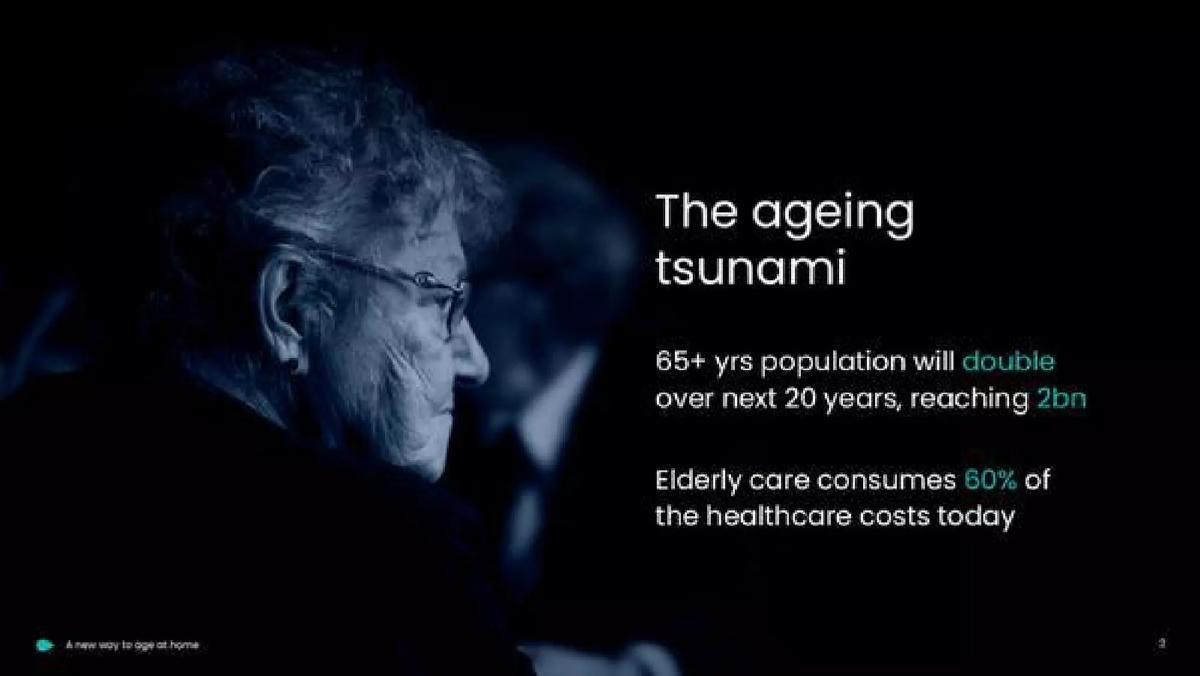
- The deck identifies a massive demographic shift, noting the 65+ population will reach 2 billion in 20 years on slide 2.
- Elderly care is framed as a critical financial burden, consuming 60% of healthcare costs today according to slide 2.
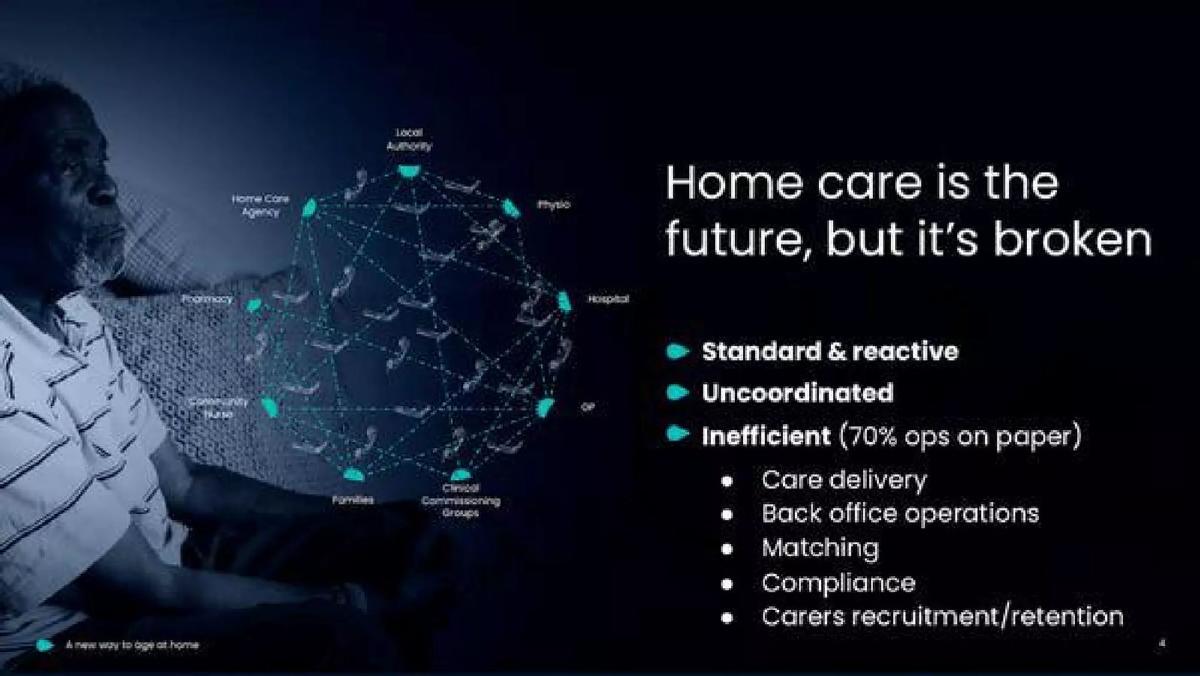
- The problem is defined by inefficiency, with 70% of home care operations currently managed on paper as stated on slide 4.
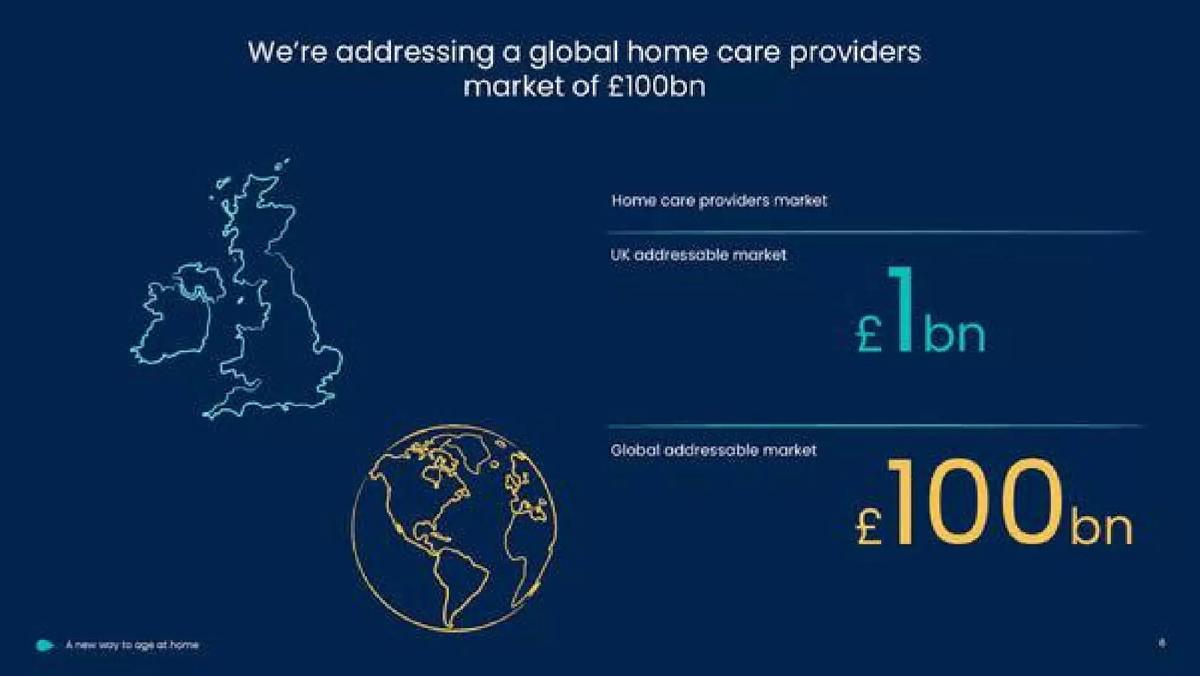
- Birdie defines its UK addressable market at £1bn and its global addressable market at £100bn on slide 6.
- Traction is visualized through a 5x growth curve in active care recipients between January and December 2020 on slide 7.
- The platform supports 15,000 older adults weekly through 300 client home care agencies as of slide 7.
- The team slide highlights deep institutional credibility with former NHS and Babylon Health experience on slide 8.
- The deck omits a specific funding 'Ask' and detailed financial projections, focusing instead on vision and current momentum.
The Series B Narrative: From Product to Infrastructure
Birdie’s 2017-era Series B deck is a masterclass in brevity. At just nine slides, it avoids the common pitfall of over-explaining features and instead focuses on the macroeconomic inevitability of their solution. By the time a company reaches Series B, the question is no longer 'does the product work?' but rather 'how big can this get and how fast are you moving?' Birdie answers these questions by anchoring their pitch in a global demographic shift they call the 'ageing tsunami.'
Slide 1: The Vision Statement
The deck opens with a clean, high-contrast title slide. The tagline, "A new way to age at home," immediately establishes the category. The background features blurred UI elements, suggesting a digital-first approach without cluttering the opening message. It is a standard but effective entry point that focuses on the outcome rather than the technology.
Slides 2-3: The Macro Problem and Vision
Slide 2, titled "The ageing tsunami," provides the 'Why Now?' for investors. It cites two critical statistics: the 65+ population will double to 2bn over the next 20 years, and elderly care already consumes 60% of healthcare costs today. This slide establishes that the current system is financially unsustainable.
Slide 4 follows up by visualizing the 'broken' state of home care. It uses a complex web graphic to show uncoordinated communication between pharmacies, GPs, families, and hospitals. The most damning metric provided is that 70% of operations are still on paper . This identifies a massive opportunity for digital transformation in a laggard industry. The slide lists specific pain points: care delivery, back-office operations, matching, compliance, and recruitment/retention.
Slide 5: The Solution
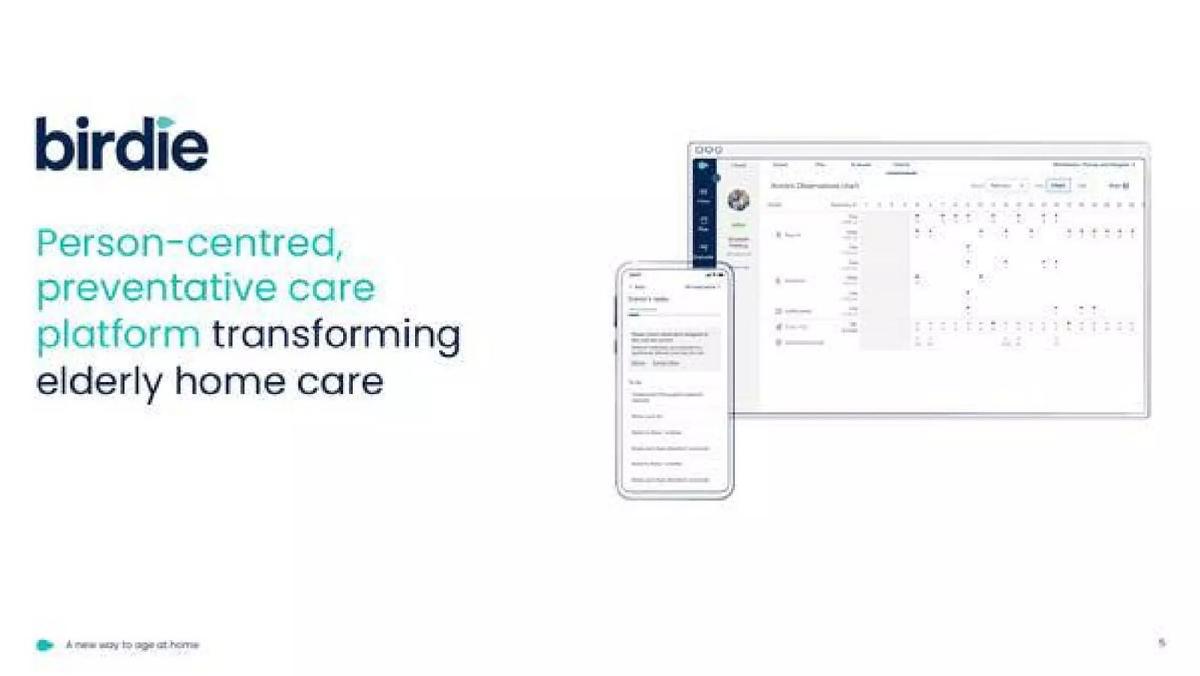
Birdie introduces its platform on slide 5 as a "Person-centred, preventative care platform transforming elderly home care." The slide is minimalist, showing a mobile app and a desktop dashboard. By keeping the description high-level, Birdie emphasizes that they are an end-to-end platform rather than a point solution for just one of the problems listed on the previous slide.
Slide 6: Market Sizing (TAM)
The market slide is exceptionally clear. It breaks the opportunity into two distinct figures: a £1bn UK addressable market and a £100bn global addressable market . For a Series B investor, the £1bn UK figure proves there is a solid 'home base' to dominate, while the £100bn global figure provides the venture-scale upside required for a large round. The use of simple icons (a map of the UK and a globe) keeps the focus on the numbers.
Slide 7: Traction and Growth
This is the 'money slide' of the deck. Slide 7 shows a 5x growth in the number of active care recipients and monthly visits completed on Birdie throughout 2020. The chart shows a consistent upward trajectory with no significant plateaus. To the right, Birdie provides three hard numbers to ground the graph: 15,000 older adults supported weekly, 300 client home care agencies, and 3,000 families using the platform. A heat map of the UK shows dense clusters of adoption, proving they have moved past the early-adopter phase and are achieving regional density.
Slide 8: Team and Social Proof
Slide 8, "An all-star passionate team to deliver," focuses on institutional credibility. Instead of just listing names, it highlights logos from the NHS and Babylon Health , signaling that the team understands the regulatory and clinical complexities of healthcare. The inclusion of a 61+ Employer Net Promoter Score is a unique addition, suggesting a strong internal culture which is often a proxy for operational stability in high-growth startups. The bottom half of the slide is dedicated to 'Awards & press' and 'Accelerators and accreditations,' including their B-Corp certification and logos from Forbes and Google.
Slide 9: The Team Culture
The deck concludes with a full-team photo. While it contains no data, it serves to humanize the company and reinforce the 'all-star passionate team' claim from the previous slide. It ends the presentation on a high-energy, cultural note rather than a dry financial table.
What Works in the Birdie Deck
Urgency through Demographics: By framing the ageing population as a 'tsunami,' Birdie makes their solution feel like a necessity rather than a luxury. Investors are drawn to 'painkiller' products that solve systemic financial drains, and the 60% healthcare cost stat does exactly that.
The 70% Paper Stat: This is the most effective 'Problem' metric in the deck. It tells an investor that the competition isn't necessarily another sophisticated software company, but rather the status quo of physical notebooks. This suggests a high 'win rate' for sales teams once they get in front of an agency.
Visualizing Complexity: Slide 4’s web of uncoordinated care is a great way to show why a 'platform' is needed. It justifies why Birdie isn't just a scheduling app; it’s a communication hub for an entire ecosystem.
What is Missing
The Ask: There is no slide detailing how much money is being raised or what the specific milestones for the next 18-24 months are. While this information is often handled in the verbal pitch or a separate term sheet, its absence in the deck leaves the narrative somewhat unfinished.
Unit Economics: For a Series B deck, investors usually expect to see LTV (Lifetime Value), CAC (Customer Acquisition Cost), and churn rates. Birdie shows 'soaring customer adoption' but doesn't explicitly show the efficiency of that growth.
Competitive Landscape: The deck assumes Birdie is the only solution to the 'broken' system. A slide acknowledging other digital players in the space and explaining Birdie’s specific moat (perhaps their clinical AI or B-Corp status) would have strengthened the 'Why Birdie?' argument against competitors.
What Founders Should Copy
The 'Traction Heat Map': If you are a marketplace or a B2B platform with geographic concentration, use a heat map like the one on slide 7. It visually proves that you aren't just getting random sign-ups, but are actually capturing territory.
Credibility by Association: Birdie’s team slide (Slide 8) is excellent because it uses logos (NHS, Babylon) to do the heavy lifting. Founders should use the most recognizable logos from their past lives to instantly build trust in technical or regulated industries.
Simple TAM/SAM/SOM: Don't overcomplicate the market slide. Birdie’s two-tier approach (Local vs. Global) is easy to digest in five seconds and clearly defines the ceiling of the business.
Final Verdict: Birdie’s deck succeeds because it doesn't try to do too much. It identifies a massive, failing status quo and provides clear, visual evidence that they are the primary beneficiary of the industry's inevitable shift to digital. It is a 'momentum' deck designed to get a meeting, not a 'data room' deck designed to answer every possible question.
Frequently asked questions
- What is Birdie's primary value proposition?
- Birdie positions itself as a person-centred, preventative care platform. According to slide 5, the goal is to transform elderly home care by moving away from reactive, uncoordinated, and paper-based systems (70% of ops) toward a digital suite that allows for better planning, monitoring, and assessment of patients in their own homes.
- How large is the market Birdie is targeting?
- The deck outlines a tiered market opportunity on slide 6. It identifies a £1bn addressable market within the UK and a significantly larger £100bn global addressable market for home care providers. This scale justifies the Series B stage by showing clear room for international expansion beyond their initial UK footprint.
- What specific traction does the deck show?
- On slide 7, Birdie demonstrates significant momentum during 2020. They achieved a 5x growth in active care recipients and monthly visits. The slide also lists 15,000 older adults supported weekly, 300 client home care agencies, and 3,000 families using the platform weekly, supported by a heat map of UK coverage.
- Who are the key members of the Birdie team?
- Slide 8 highlights a leadership team with strong clinical and technical backgrounds. Key figures include Malte Gerhold (Chief Integrated Care Officer), Jo Barlow (Clinical PM with NHS experience), Kath Middleton (Clinical AI Product Lead with NHS/Babylon experience), and Gwen le Calvez (CTO). The team is backed by a B-Corp certification and various startup awards.
- What is missing from this pitch deck?
- This deck is notably missing a 'Use of Funds' or 'The Ask' slide, which is unusual for a fundraising deck but common in 'teaser' versions or decks used for established Series B leads. It also lacks a detailed competitor analysis and specific unit economics like CAC, LTV, or churn rates, which investors would typically require during due diligence.