BioSculpture Technology (BST) presents a specialized medical device play focused on the multibillion-dollar obesity and cosmetic surgery markets. The deck, dated September 2016, highlights a shift from their established Airbrush Liposculptor line to a novel Endoscopic Visceral Lipectomy (EVL) device designed to treat obesity and type 2 diabetes. Financially, the company projected a steep revenue climb from $0 in 2016 to $44.5 million by 2020, contingent on the success of their patented Twin-Cannula Assisted Liposuction (TCAL) technology. The offering is structured as a Tier 2 Regulation A, se…
Key takeaways
- The company is raising $5,000,000 through a Tier 2 Regulation A offering at a price of $3.50 per share (Slide 19).
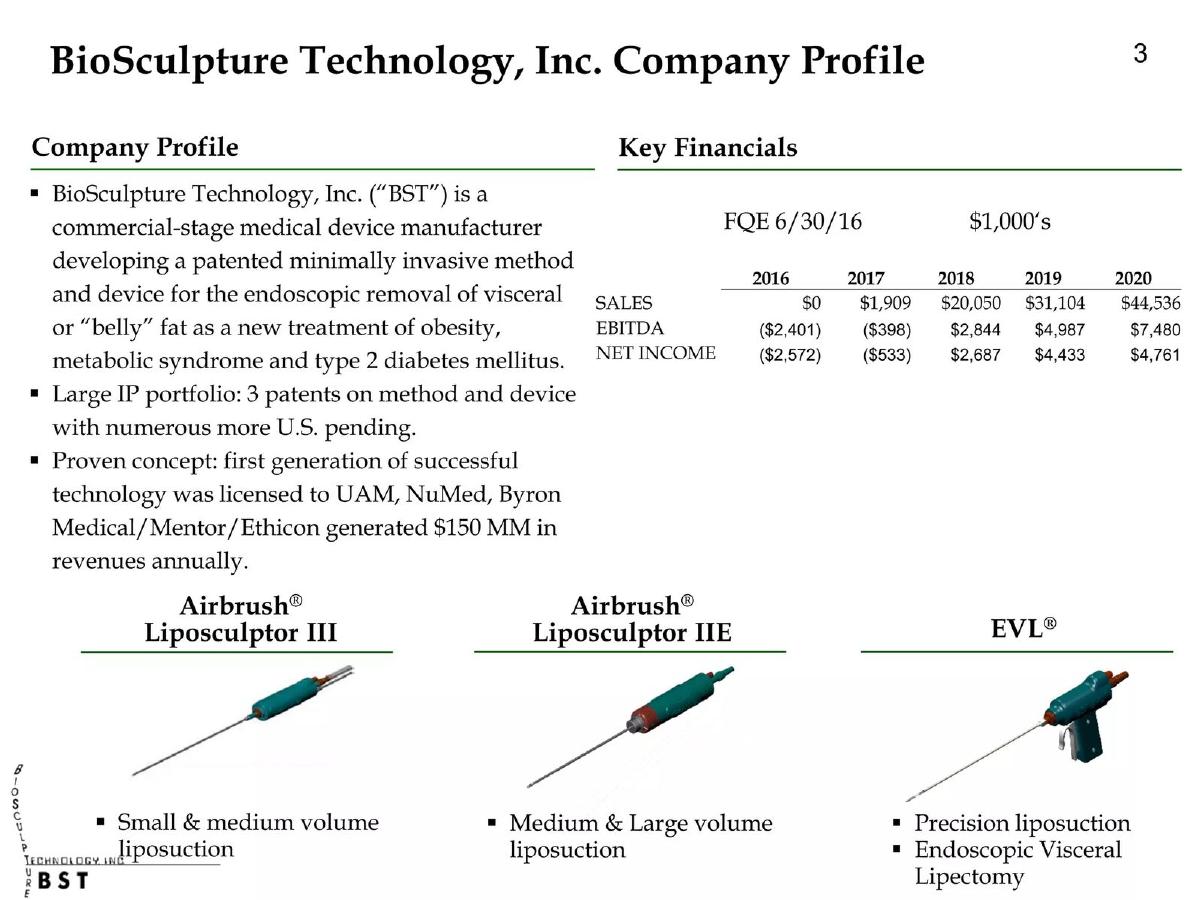
- BST claims a large IP portfolio including three patents on method and device with numerous U.S. patents pending (Slide 3).
- Financial projections estimate a jump from $0 sales in 2016 to over $44.5 million in sales by 2020 (Slide 3).
- The core technical differentiator is the 'Twin-Cannula' system, which uses an adjustable reciprocation stroke of 1.3 to 2 inches to reduce surgeon fatigue and patient trauma (Slide 10).
- The EVL device is positioned as a safer alternative to bariatric surgery, avoiding the need to cut into the stomach or rearrange 'alimentary plumbing' (Slide 12).
- Market data cites that 2/3 of the U.S. population is overweight and obesity-related expenditures exceed $2 trillion worldwide (Slide 7).
- The sales strategy involves a 20% promotional budget and direct marketing to 'podium doctors' and Key Opinion Leaders (Slide 16).
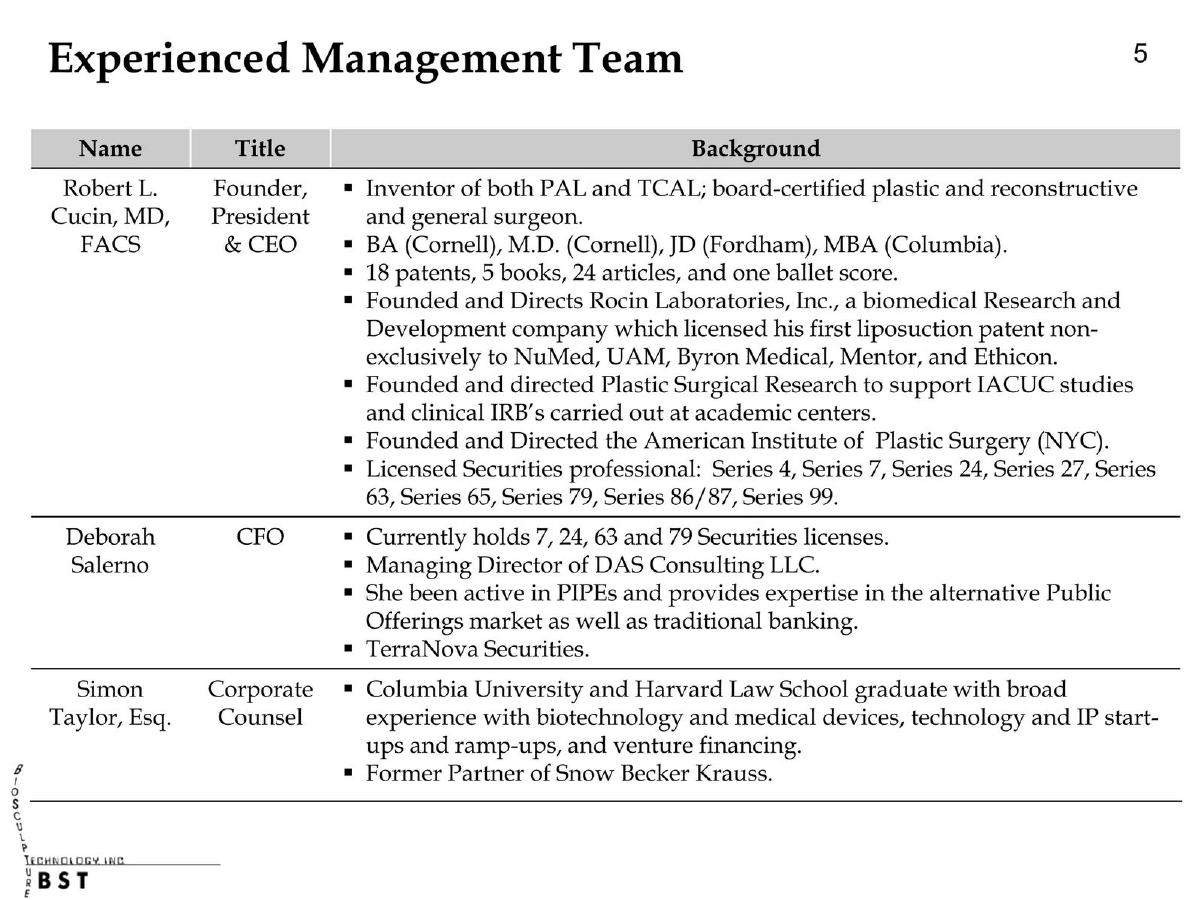
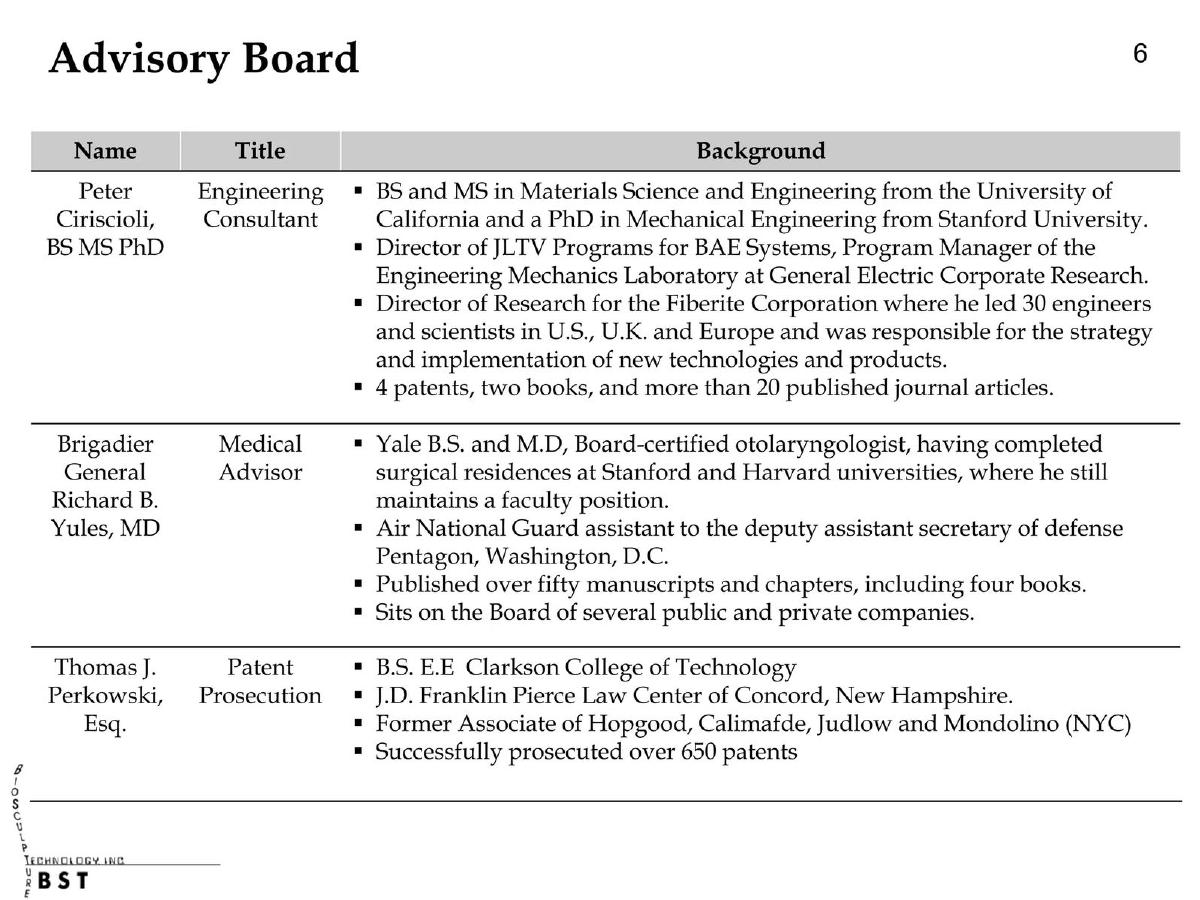
- The deck omits a comprehensive team slide, listing only CEO Robert L. Cucin, M.D., J.D., M.B.A. on the contact page (Slide 22).
BioSculpture Technology: A Deep Dive into the 2016 Investor Presentation
BioSculpture Technology, Inc. (BST) represents a specific era of medical device fundraising, utilizing the then-relatively new Regulation A+ framework to solicit investment. The deck, dated September 10, 2016, focuses on the transition from traditional cosmetic liposuction to a therapeutic medical intervention for obesity. The following teardown examines the eight provided slides to understand how the company positioned its intellectual property and financial future.
Slide 1: Title and Branding
The cover slide is utilitarian, featuring the company name 'BioSculpture Technology, Inc.' and the acronym 'BST.' It clearly labels the document as 'Investor Presentation Highlights' and provides the date of September 10, 2016. The vertical branding on the left side emphasizes the full name, while the copyright notice at the bottom indicates the proprietary nature of the content. There is no tagline or mission statement present on the opening slide.
Slide 3: Company Profile and Financial Projections
This slide serves as a high-level executive summary. It defines BST as a 'commercial-stage medical device manufacturer' focused on a patented method for endoscopic removal of visceral fat. Key highlights include a 'Large IP portfolio' with three granted patents and a claim of 'Proven concept,' noting that their first-generation technology was licensed to major industry players like Mentor/Ethicon and generated $150 million in annual revenues. The slide also introduces three product iterations: Airbrush Liposculptor III, Airbrush Liposculptor IIE, and the EVL device.
The 'Key Financials' table on this slide is aggressive. It shows a jump from zero sales in 2016 to $1.9 million in 2017, followed by a massive scaling to $20.05 million in 2018. By 2020, the company projected $44.5 million in sales. Net income is projected to flip from a $2.57 million loss in 2016 to a $4.76 million profit by 2020. These figures are presented in thousands ($1,000's).
Slide 7: Market Opportunity and Obesity Statistics
BST anchors its value proposition in the global obesity epidemic. The slide cites a McKinsey Global Institute report stating that obesity-related expenditures exceed $2 trillion worldwide. It bifurcates the market into 'Liposuction' (cosmetic) and 'Bariatric Treatment' (medical). The company notes that $668 million was spent on liposuction in 2015, while bariatric surgery spending reached $1.4 billion in 2014. The core argument here is that BST's 'Twin-Cannula' technology allows liposuction to move from a cosmetic procedure measured in 'inches' to a medical weight-loss procedure measured in 'pounds,' effectively bridging the gap between the two markets.
Slide 10: The Technical Advantage
This slide provides the most technical detail in the deck, comparing 'Single Cannula Power Assisted Liposuction' (the competition) to BST's 'Twin Cannula Assisted Liposuction.' The competition is criticized for only vibrating 1/4 inch, requiring the surgeon to manually stroke the cannula, which causes fatigue and potential trauma to the patient. In contrast, BST's system features an adjustable reciprocation stroke of 1.3 to 2 inches. Because the inner cannula reciprocates inside a stationary outer tube, the company claims it eliminates vibration, saves surgeon labor, and reduces patient trauma. The slide also mentions 'Intellimotion control' with closed-loop DSP control as a safety feature.
Slide 12: EVL vs. Traditional Bariatric Surgery
Focusing on the Endoscopic Visceral Lipectomy (EVL) device, this slide contrasts BST's approach with existing surgical options like Gastric Bands, Sleeve Gastrectomies, and Gastric Bypasses. The deck characterizes existing options as 'invasive and expensive,' involving the 'rearranging of alimentary plumbing' and risks of 'malabsorption syndromes.' BST positions EVL as a 'minimally invasive and cost-effective' alternative that provides the benefits of weight loss without cutting into the stomach or bowel. The slide explicitly states that results are 'expected to be permanent.'
Slide 16: Sales and Marketing Strategy
The go-to-market strategy relies heavily on professional networks. BST claims management has connections with 'podium doctors' and Key Opinion Leaders (KOLs). The tactical plan includes direct marketing to hospitals, doctor training, and the publication of white papers. A significant detail is the 'Promotional budget set at 20% of sales.' The domestic strategy involves salaried representatives in major hubs like Los Angeles and New York City, while international markets would be handled via distributors. The slide also mentions cross-selling bariatric surgery, liposuction, and stem cell autografts.
Slide 19: Capitalization and The Ask
This slide details the financial structure of the offering. As of September 1, 2016, the company had a Tier 2 Regulation A offering qualified. The 'Ask' is $5,000,000 for 1,428,571 common shares, priced at $3.50 per share. The capitalization table shows 6,367,313 shares outstanding prior to the offering, with a total of 8,032,339 shares projected after a full sell-out. Footnotes provide additional context on an ESOP from 2011 and a 'Cucin Note' representing a personal guarantee on corporate credit lines by the CEO.
Slide 22: Contact Information
The final slide provides contact details for Robert L. Cucin, M.D., J.D., M.B.A., listing him as the CEO. It provides addresses for an 'Administrative Office' and a 'Research & Development Office,' both located in West Palm Beach, Florida. Multiple phone numbers, a Skype handle, and two URLs (biosculpturetechnology.com and evl.technology) are included. This is the only slide that identifies a specific member of the leadership team.
What Works in This Deck
Clear Technical Differentiation: Slide 10 does an excellent job of visually and textually explaining why the Twin-Cannula system is superior to standard power-assisted liposuction. The use of red 'X' marks for competitors and green checkmarks for BST is a classic but effective comparison method. · Market Alignment: The deck successfully ties a technical medical device to a massive, well-documented global problem (obesity). By citing reputable sources like McKinsey, the founders establish the scale of the opportunity. · Regulatory Clarity: For a Reg A+ offering, being specific about the qualification date (9/1/16) and the exact share price ($3.50) is essential for compliance and investor clarity. · Product Evolution: The deck shows a logical progression from a licensed first-generation product to a more sophisticated, proprietary third-generation device, suggesting a history of R&D success.
What Is Missing from This Deck
Team Slide: This is the most significant omission. While the CEO's credentials (MD, JD, MBA) are impressive, a medical device company requires a robust team of engineers, regulatory experts, and clinical trial managers. None of these people are mentioned or pictured. · Clinical Data: While the deck claims 'proven concept' and 'successful technology,' it lacks specific data points from clinical trials or peer-reviewed studies to back up the claims of 'permanent' results or 'safer' outcomes compared to bariatric surgery. · Use of Proceeds: While the deck asks for $5 million, it does not provide a breakdown of how that capital will be spent. Investors typically want to see how much is allocated to R&D, clinical trials, marketing, and working capital. · Competition Beyond 'Traditional': The deck compares itself to 'Single Cannula' devices and 'Bariatric Surgery,' but it does not mention other emerging non-invasive fat reduction technologies (like cryolipolysis or laser-assisted systems) that were gaining traction in 2016. · Milestones: There is no timeline slide showing the path to FDA approval or commercial launch dates for the EVL device specifically.
Founder Takeaways: What to Copy and What to Avoid
Copy the technical comparison: If you have a hardware or medical device product, use a side-by-side comparison like Slide 10. It forces you to articulate exactly what your 'secret sauce' is and why the current industry standard is failing the end-user (in this case, both the surgeon and the patient).
Avoid the 'One-Man Show' look: Even if you are a solo founder with a brilliant idea, your deck must show the 'bench.' In the medical field, an advisory board of respected surgeons or a partnership with a research university is often more important than the CEO's resume. By only listing the CEO, BST makes the venture look like a private practice rather than a scalable technology company.
Be careful with hockey-stick projections: Projecting a jump from $0 to $20 million in two years (Slide 3) is a red flag for many sophisticated investors unless there is a massive pre-order book or a signed distribution agreement mentioned. If you include such aggressive numbers, you must explain the specific 'engine' that will drive that growth.
Use specific market segments: Slide 7 is a good example of how to break down a 'Total Addressable Market.' Instead of just saying 'Obesity is a big problem,' they broke it down into the cosmetic spend ($668M) and the surgical spend ($1.4B), showing exactly where they intend to steal market share.
Final Note: This deck is a product of its time, leaning heavily on the 'General Solicitation' rules of the JOBS Act. While the technical arguments for the device are compelling, the lack of a team and a clear roadmap for the $5 million raise makes it a high-risk presentation from an institutional investor's perspective.
Frequently asked questions
- What is the primary product BioSculpture Technology is pitching?
- The company pitches two main product lines: the Airbrush Liposculptor (IIE and III) for cosmetic fat removal and the EVL (Endoscopic Visceral Lipectomy) device for treating obesity and metabolic syndrome. The technical foundation for both is their patented Twin-Cannula Assisted Liposuction (TCAL) technology, which uses a stationary outer cannula and a reciprocating inner cannula to remove fat more efficiently than traditional methods.
- What are the specific terms of the investment offering?
- According to Slide 19, BioSculpture Technology filed a Form 1-A for a Tier 2 Regulation A offering. They sought to sell 1,428,571 common shares at $3.50 per share to raise a total of $5,000,000. The slide notes that the offering was qualified on September 1, 2016, and included a success fee for participating broker-dealers.
- How does the company justify its market opportunity?
- BST points to the global obesity crisis, noting that 2.1 billion people worldwide are obese, a figure expected to reach 50% of the population by 2030. They specifically target the gap between cosmetic liposuction ($668M spent in 2015) and bariatric surgery ($1.4B spent in 2014), claiming their EVL device offers the benefits of weight loss surgery without the invasive risks of gastric bypass.
- What are the projected financials for the company?
- The company provided a five-year financial forecast on Slide 3. They projected $0 in sales for 2016 with a net loss of $2.57 million. By 2018, they expected to turn profitable with $20.05 million in sales and $2.68 million in net income. By 2020, the projection reaches $44.5 million in sales and $4.76 million in net income.
- Who is leading the company according to the deck?
- The only individual identified in the presentation is Robert L. Cucin, who holds M.D., J.D., and M.B.A. degrees. He is listed as the CEO on Slide 22. While the deck mentions 'Management' has extensive connections to research hospitals and Key Opinion Leaders on Slide 16, it does not name any other executives, board members, or advisors.