Biomarker Labs presents a concise 11-slide deck focused on bridging the gap between wellness products and measurable health outcomes. Operating in a massive $3.7 trillion industry, the company positions itself as an unbiased data platform that uses hardware, software, and lab data to quantify the impact of diets and supplements. The deck is notable for its clear B2B2C value proposition: helping consumers 'Connect, Track, and Discover' while helping companies 'Validate Offerings' and 'Increase Retention.' With early traction of $20K MRR and a $2M pipeline, the deck makes a strong case for mark…
Key takeaways
- The company identifies a massive $3.7 trillion global health and wellness industry as its total addressable market on slide 3.
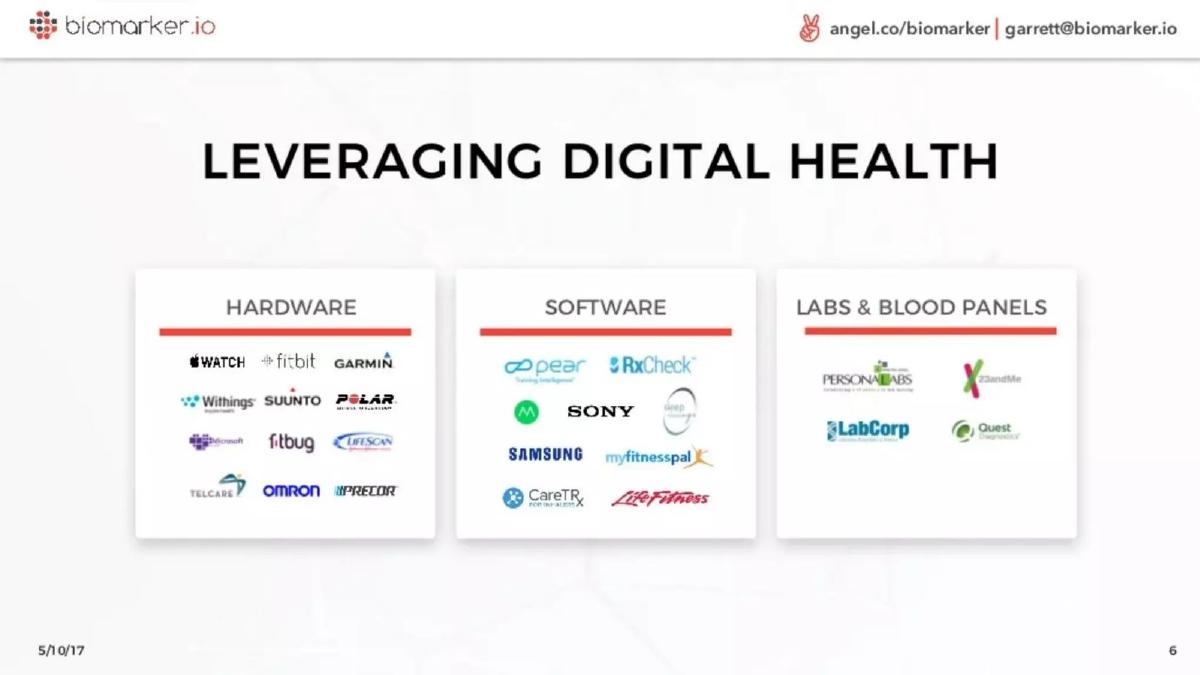
- Biomarker Labs positions itself as an aggregator of digital health data, citing integrations with hardware like Apple Watch and Fitbit, and labs like LabCorp and Quest Diagnostics on slide 6.
- The business model targets two distinct users: consumers who want to track health impacts (slide 7) and companies that need to validate product claims (slide 8).
- The team slide (slide 9) highlights a strong academic and professional pedigree, featuring logos from Duke, Stanford, Google, and the NIH.
- The deck claims early financial validation with $20,000 in Monthly Recurring Revenue (MRR) from 4 customers as shown on slide 11.
- A significant production error exists on slide 10, where the 'Targeting the Supplement Industry First' data points are illegible white text on a white background.
- The deck completely omits a formal 'Ask' slide, failing to specify how much capital is being raised or the valuation terms.
- There is no mention of unit economics, customer acquisition costs, or a detailed long-term roadmap beyond the initial focus on supplements.
The Vision: Quantifying Wellness
Biomarker Labs entered the market in 2016 with a clear, if ambitious, goal: to become the data layer for the fragmented wellness industry. At the time of this deck, the 'quantified self' movement was hitting its stride, with wearables becoming mainstream and consumer lab testing gaining traction. This deck attempts to position Biomarker Labs not just as another app, but as the analytical engine that proves whether the $3.7 trillion spent on wellness actually yields results.
Slides 1-2: The Hook and the Human Element
Slide 1 is a standard title slide featuring the company logo and the tagline: "Connecting The Dots In Health & Nutrition." The visual theme of interconnected nodes establishes the company's identity as a data aggregator from the outset.
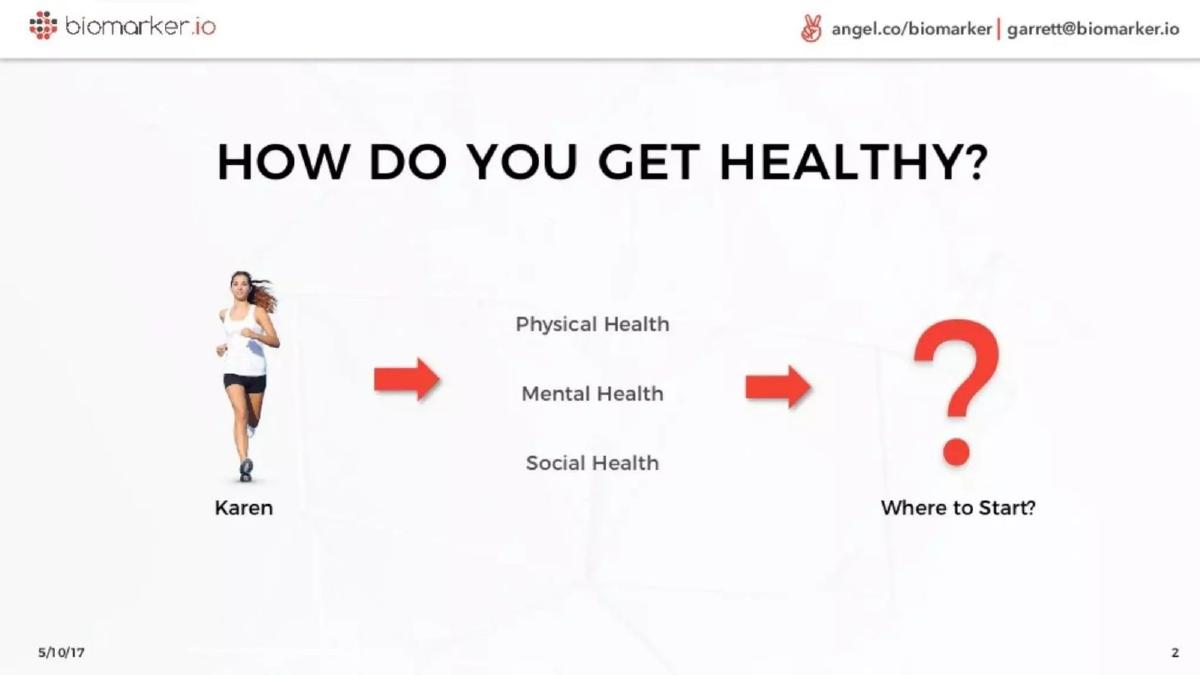
Slide 2 introduces 'Karen,' a persona representing the confused consumer. The slide asks, "How do you get healthy?" and lists Physical, Mental, and Social health, ending with a large red question mark and the phrase "Where to Start?" This is a classic 'Problem' slide, though it leans more on emotional confusion than specific market pain points. It sets the stage for a solution that provides direction in an oversaturated market.
Slides 3-4: Market Size and Conceptual Framework
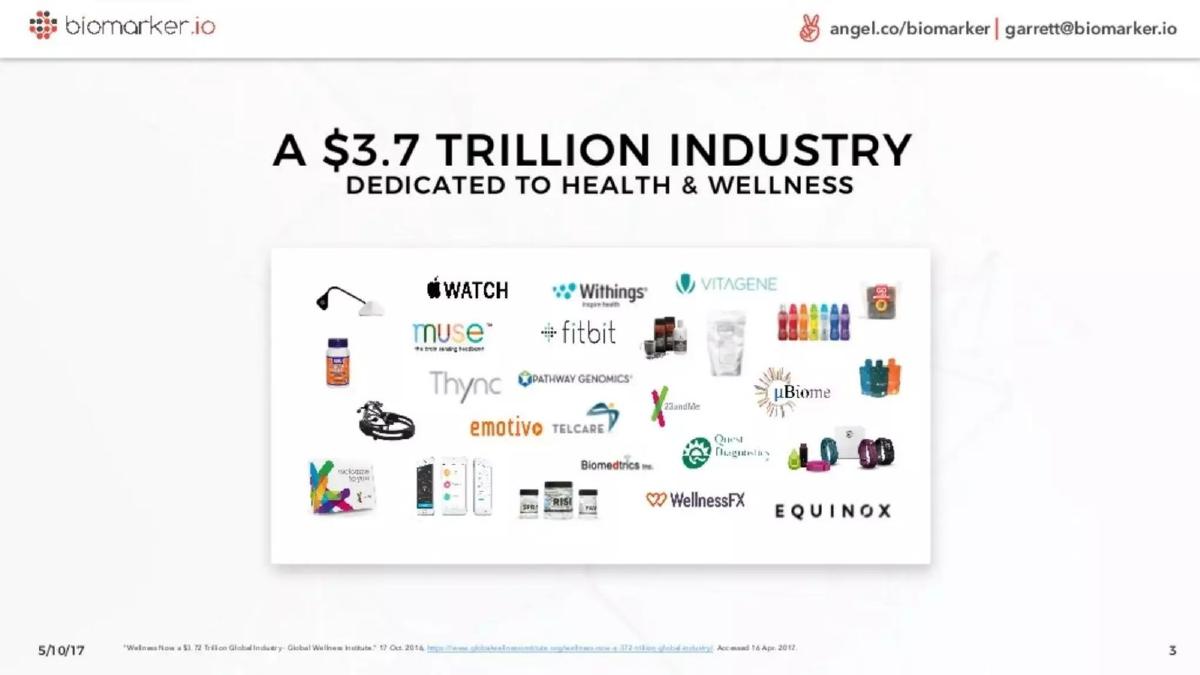
Slide 3 hits the investor with a massive number: "A $3.7 Trillion Industry Dedicated to Health & Wellness." To ground this staggering figure, the slide includes a collage of logos ranging from Apple Watch and Fitbit to Equinox and 23andMe. This demonstrates that Biomarker Labs isn't competing with these giants; it is positioning itself to sit on top of them. The footnote cites the Global Wellness Institute as the source for this data.
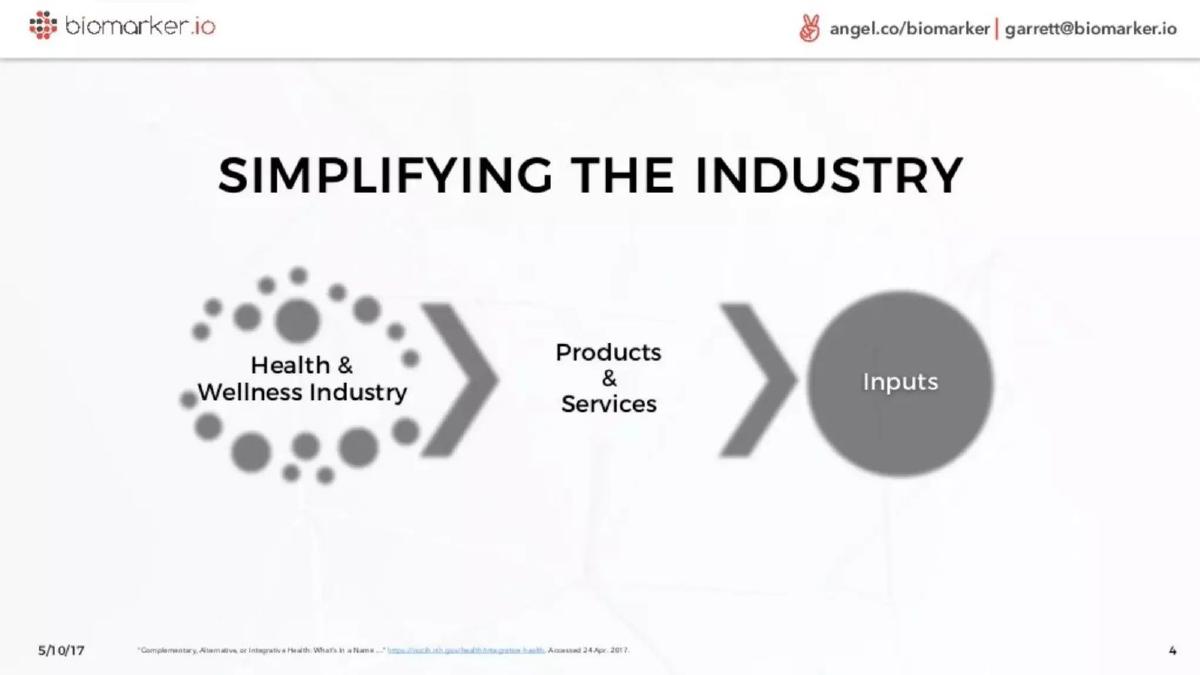
Slide 4 , titled "Simplifying the Industry," uses a flow chart to explain their logic. It moves from the broad "Health & Wellness Industry" to "Products & Services," and finally to "Inputs." This is the core of their thesis: everything a consumer buys for their health should be treated as a data input for a larger system.
Slides 5-6: The Solution and Data Sources
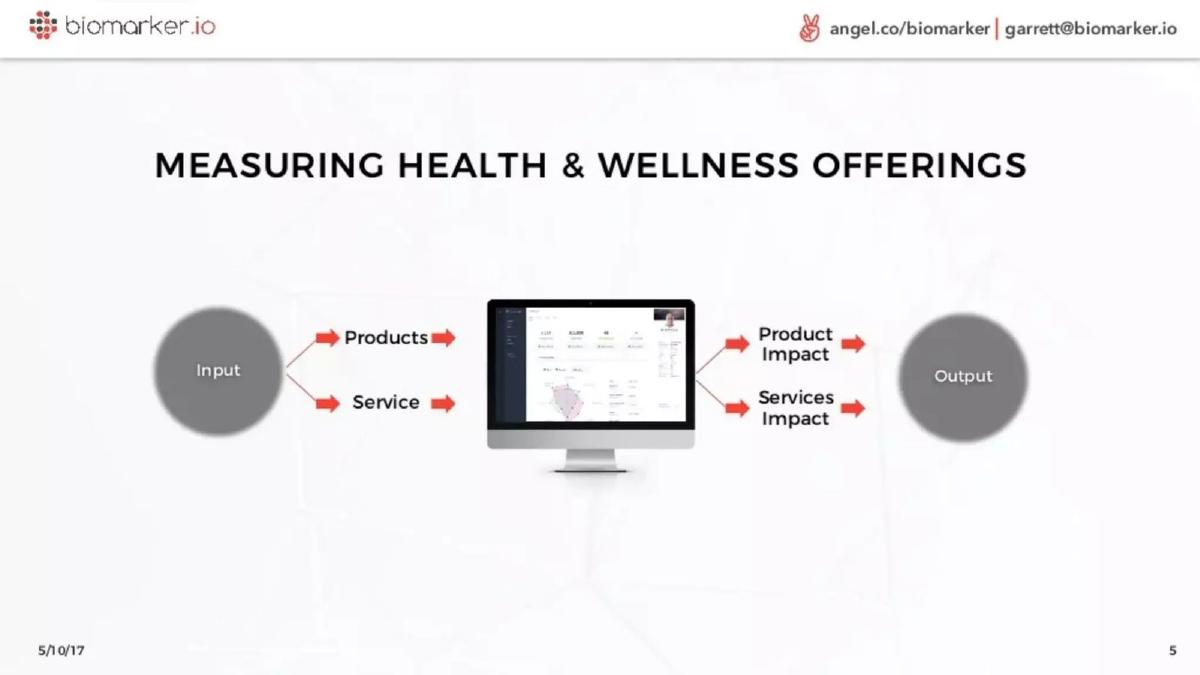
Slide 5 introduces the product interface via a desktop mockup. It explains the process of "Measuring Health & Wellness Offerings." The diagram shows Inputs (Products and Services) going into the Biomarker platform and resulting in Outputs (Product Impact and Services Impact). This slide is crucial because it defines the company's role as the validator of efficacy.
Slide 6 is perhaps the most important slide for technical due diligence. Titled "Leveraging Digital Health," it categorizes their data sources into three buckets: Hardware (Apple Watch, Fitbit, Garmin, etc.), Software (MyFitnessPal, Sony, Samsung), and Labs & Blood Panels (LabCorp, Quest, 23andMe). By listing these logos, Biomarker Labs signals that they are building a platform capable of ingesting diverse data sets to create a unified health score.
Slides 7-8: The Dual-Sided Value Proposition
Slide 7 focuses on the consumer ("Customers"). The value prop is distilled into three words: Connect, Track, Discover . The accompanying mockup shows a 'spider chart' or radar plot, which is a common way to visualize multi-factor health data. This suggests a sophisticated user experience that goes beyond simple step-counting.
Slide 8 pivots to the B2B side ("Companies"). Here, the value proposition is Validate Offerings, Targeted Sales, and Increase Retention . This is where the revenue model likely lives. By providing brands with an 'Admin Dashboard' (shown in the mockup), Biomarker Labs allows supplement and nutrition companies to see how their products are performing across their user base, providing a powerful tool for R&D and marketing.
Slides 9-11: Team, Market Focus, and Traction
Slide 9 presents the team. Led by Garrett T. Ruhland (CEO) and Bryan M. Welker (COO), the six-person team includes an MD/Biomedical Engineer and three engineers. The logos on the right—Duke, Stanford, Google, NIH, IBM—provide significant 'social proof,' suggesting the founders have the pedigree to execute in a highly regulated and technical space.
Slide 10 is a significant failure in the deck's production. Titled "Targeting the Supplement Industry First," it features three red circles that presumably contain key market statistics. However, the text inside the circles is white on a white background, making it completely illegible. In a professional pitch environment, this is a major oversight that obscures the rationale for their go-to-market strategy.
Slide 11 concludes the deck with "Early Traction." The numbers are respectable for a Seed stage startup in 2016: 4 Customers , $20K MRR , and a $2M Pipeline . These figures suggest that at least four companies were already paying $5,000 per month on average to access Biomarker's validation data, proving the B2B model has legs.
What Works in This Deck
The deck excels at positioning . By framing the wellness industry as a collection of 'inputs' that require 'validation,' Biomarker Labs carves out a niche that doesn't require them to fight Apple or Fitbit. Instead, they become a necessary partner for the thousands of supplement and nutrition brands that lack their own data infrastructure. The traction slide is also a high point; $20K MRR with only 4 customers indicates a high-value enterprise sale rather than a low-cost consumer subscription, which is often more attractive to Seed investors.
What is Missing
The most glaring omission is The Ask . There is no slide detailing how much money they are raising, what the valuation is, or what the milestones are for the next 18 months. Furthermore, the Competitive Landscape is missing. While they show who they integrate with, they don't show who they compete against (e.g., InsideTracker or other wellness analytics platforms). Finally, the Unit Economics are absent. We see the MRR, but we don't know the cost of acquiring those four customers or the churn rate of the end consumers using the app.
What a Founder Should Copy
Founders should emulate the clear categorization of data sources found on Slide 6. If your startup relies on integrations, showing the logos of the ecosystem you inhabit helps investors immediately understand your place in the 'stack.' Additionally, the dual-sided value proposition (Slides 7 and 8) is a great way to show how a single product serves two different masters—the user and the payer. This clarity is essential for B2B2C models. Lastly, the use of clean, high-fidelity mockups on slides 5, 7, and 8 gives the impression of a product that is already built and functional, which reduces perceived execution risk.
Final Thoughts
Biomarker Labs presents a compelling case for the 'Data-fication' of wellness. Despite a technical glitch on the market focus slide and a missing 'Ask,' the combination of a high-pedigree team and solid early revenue makes this a strong Seed-stage deck. It successfully moves the conversation from 'wellness is a hobby' to 'wellness is a measurable clinical outcome,' which is exactly the shift needed to capture venture capital interest in the health-tech space.
Frequently asked questions
- What is the primary problem Biomarker Labs is solving?
- According to slides 2 and 4, the primary problem is the complexity and lack of measurable outcomes in the health and wellness industry. Consumers often don't know 'where to start' or if the products they buy are actually working. Biomarker Labs aims to simplify this by turning products and services into measurable 'inputs' that result in quantifiable 'outputs' or health impacts.
- How does Biomarker Labs generate data for its platform?
- Slide 6 reveals a three-pronged data strategy. They leverage hardware (wearables like Garmin and Jawbone), software (apps like MyFitnessPal and Sleep Cycle), and clinical data (blood panels and labs from providers like 23andMe, LabCorp, and Quest Diagnostics). This allows them to create a holistic view of a user's health profile.
- What is the value proposition for B2B customers?
- As shown on slide 8, Biomarker Labs offers companies the ability to 'Validate Offerings,' engage in 'Targeted Sales,' and 'Increase Retention.' By providing data-backed proof that a supplement or diet works, brands can build higher trust with consumers and reduce churn by showing progress through the Biomarker dashboard.
- Is the team qualified to build a health-tech startup?
- The team slide (slide 9) suggests a high level of technical and medical expertise. It includes a CEO, COO, two software engineers, an enterprise sales lead, and a Biomedical Engineer with an MD. The inclusion of logos like Stanford Health Care, NIH, and IBM indicates the team has experience in both clinical and enterprise technology environments.
- What are the major red flags in this pitch deck?
- The most glaring red flag is slide 10, which contains illegible white text inside red circles, effectively hiding the market data for their first target industry. Additionally, the deck lacks a 'The Ask' slide, which is standard for fundraising. There is also no competitive landscape analysis or detailed financial projection, making it a very high-level overview rather than a deep-dive investment memo.