Angelcam’s 17-slide deck is a masterclass in visual storytelling and traction-first pitching. Eschewing dense text for high-impact imagery and clear growth charts, the company positions itself as the unifying layer for a fragmented security camera market. They successfully move from a simple cloud-recording utility to a sophisticated 'app store' for computer vision, showcasing use cases ranging from retail analytics to traffic flow. While the deck lacks traditional financial projections and a specific 'ask' slide, it compensates with strong momentum indicators, including a $300,000 run rate a…
Key takeaways
- The deck leads with a $300,000 run rate on slide 2, establishing immediate financial credibility.
- Angelcam positions itself as a hardware-agnostic solution, showing compatibility with brands like D-Link and Axis on slide 1.
- Traction is visualized through a consistent growth curve, reaching 6,000 cameras by July on slide 8.
- The company identifies a massive market opportunity of 150,000,000 existing cameras on slide 15.
- The product evolution is framed as a transition 'from platform to app store' on slide 10.
- Specific computer vision applications are detailed on slide 11, including 'Anonymizer' and 'Movement heatmaps'.
- The team slide (16) uses logos from Adobe, Microsoft, and Skype to signal technical pedigree without requiring long bios.
- The deck utilizes a minimalist design with almost no bullet points, relying on single-sentence claims and full-bleed images.
The Vision: Making Cameras Smart
Angelcam’s pitch deck is a visual narrative that focuses on the transformation of 'dumb' hardware into 'smart' software platforms. The deck is characterized by its extreme brevity; most slides contain fewer than five words, forcing the presenter to guide the narrative while the slides provide emotional and statistical punctuation.
Slides 1-3: The Hook and Financial Traction
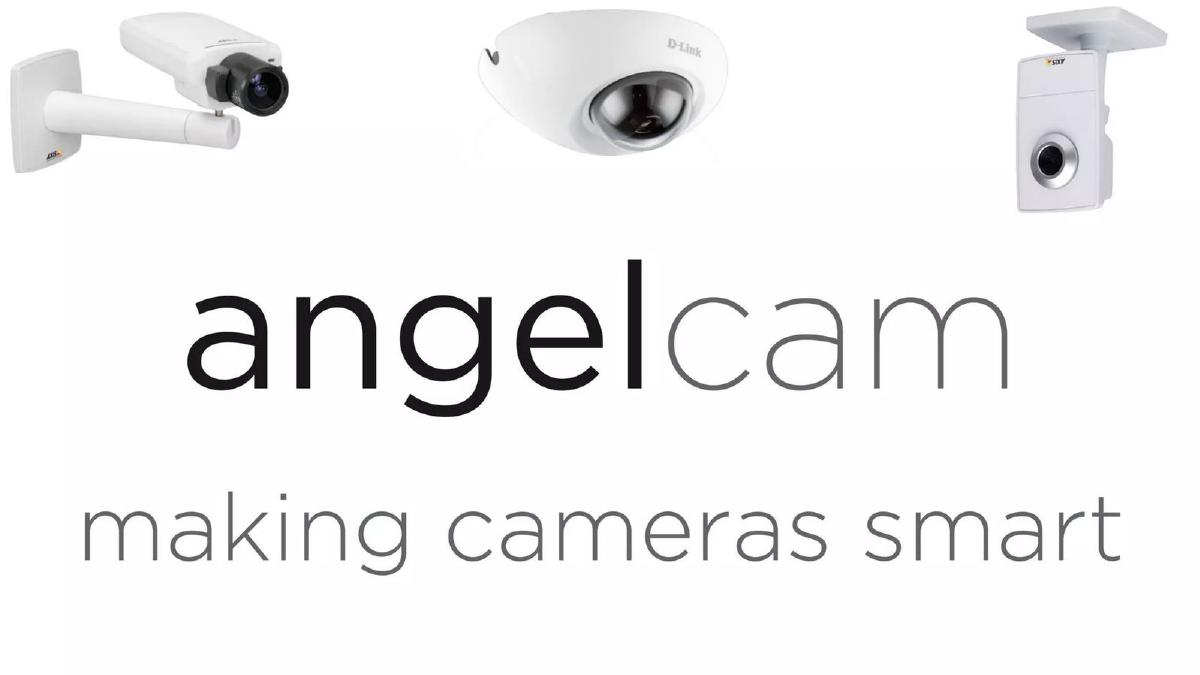
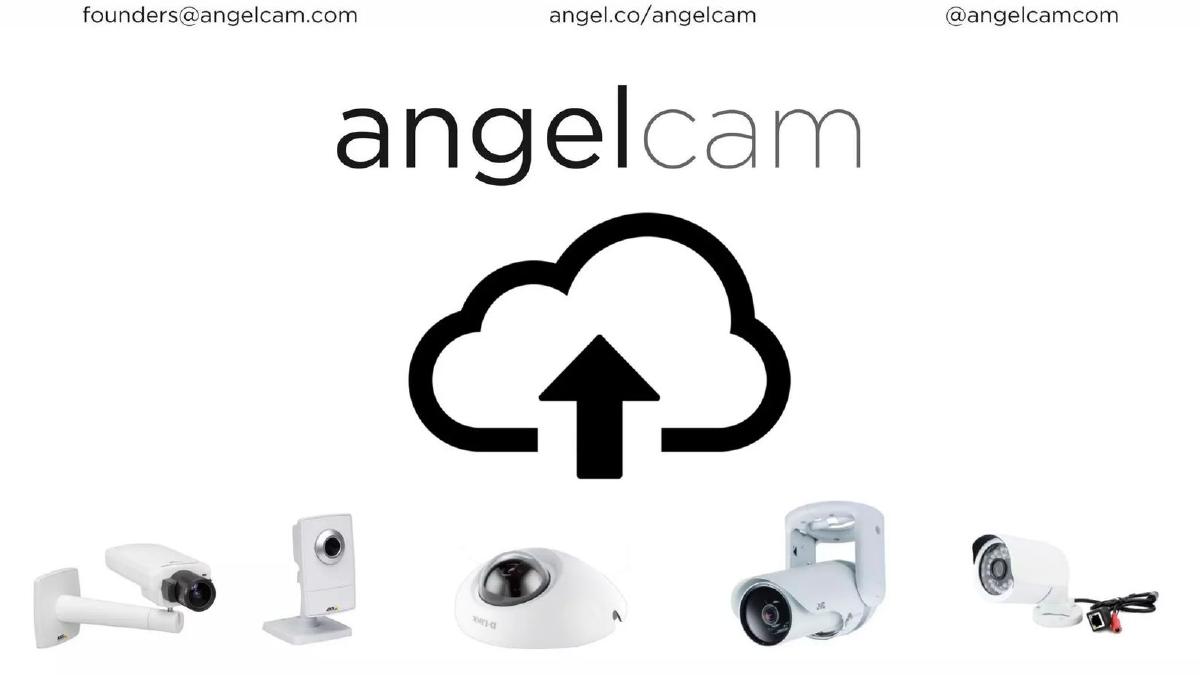
Slide 1: Title Slide The deck opens with the company logo and the tagline 'making cameras smart.' It features three different types of security cameras (Axis and D-Link brands are visible), immediately signaling that this is a hardware-agnostic software play. This is a critical distinction in a fragmented market.
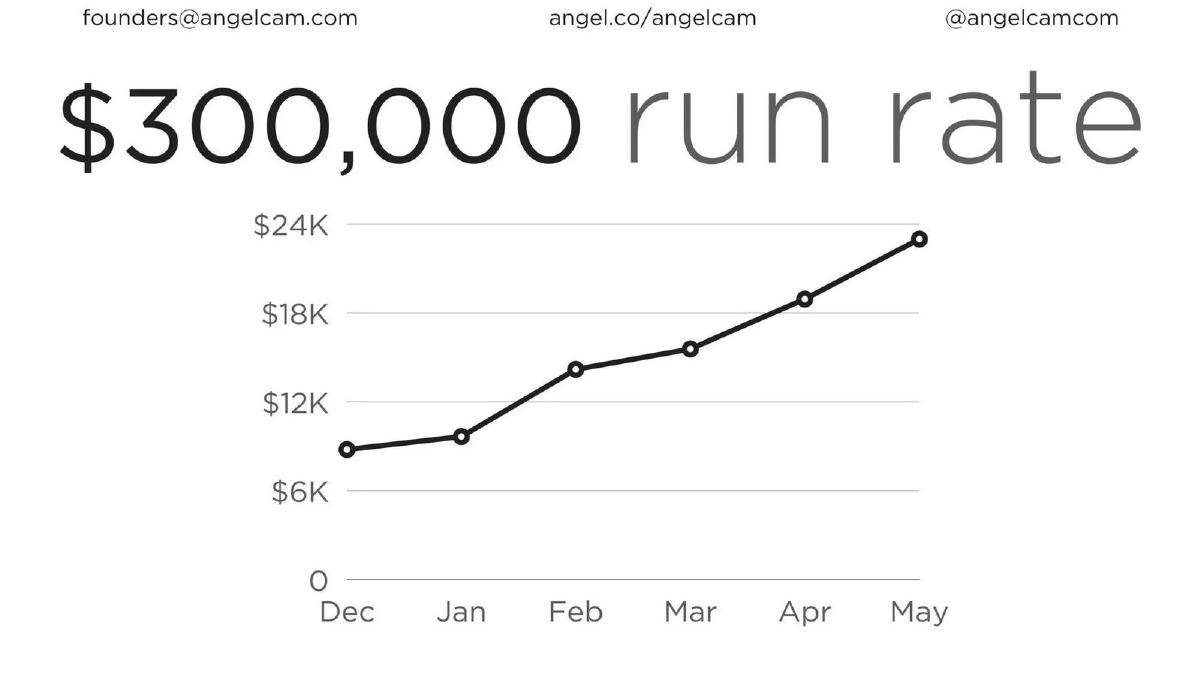
Slide 2: Revenue Traction In a bold move, Angelcam puts its financials on the second slide. It claims a $300,000 run rate . The accompanying line graph shows monthly revenue climbing from roughly $9,000 in December to $24,000 in May. By leading with revenue, they eliminate the 'is there a market?' question before it can even be asked.
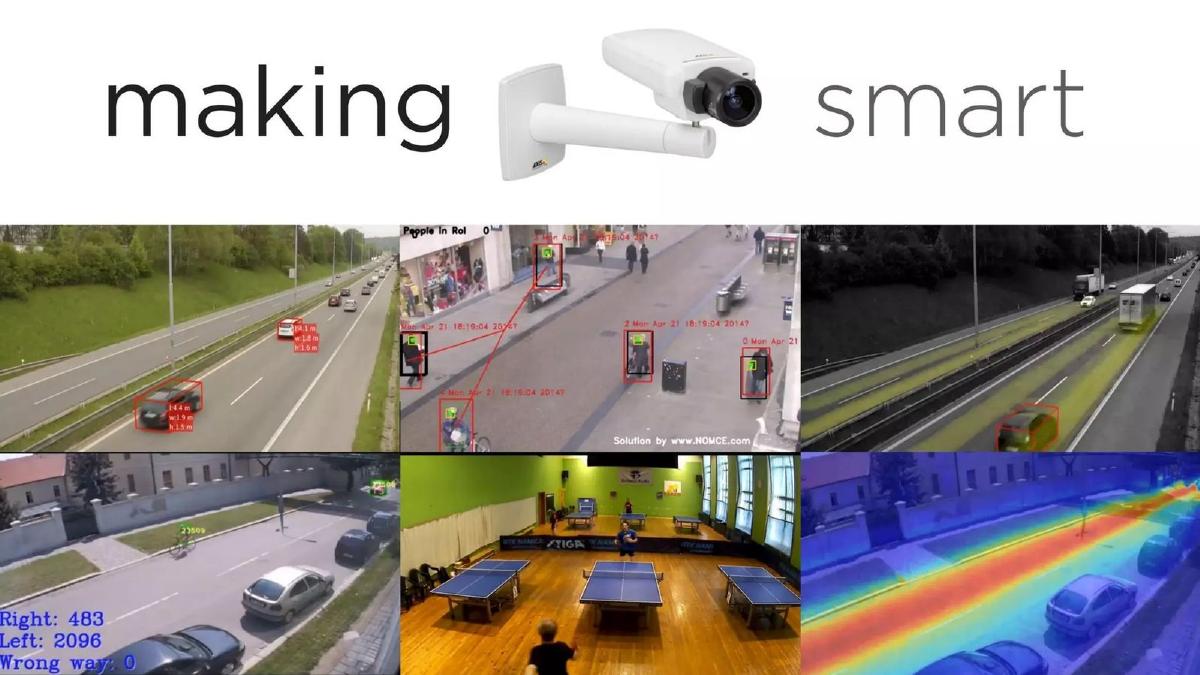
Slide 3: Visualizing 'Smart' This slide repeats the 'making cameras smart' tagline but adds six panels of computer vision in action. We see bounding boxes around cars on a highway, heatmaps of foot traffic, and people-counting algorithms in a retail setting. It moves the concept from abstract software to concrete utility.
Slides 4-7: The Problem and the Cloud Solution
Slide 4: The Problem A stark image of a cracked, dry desert with the text 'no ready-to-buy solution.' This represents the 'feature desert' that existing security camera owners face once they buy the hardware. There is no easy way to add intelligence to an existing setup.
Slide 5: The Bridge An image of a high-end dome camera with the text 'connected to the internet.' This identifies the first step of the Angelcam value proposition: taking local hardware and making it cloud-accessible.
Slide 6 & 7: The Cloud Platform These slides use a cloud icon with an 'up' arrow to symbolize the ingestion of data from various camera types. Slide 7 introduces three app-like icons: Recording, a Timer (likely for time-lapse or scheduling), and a Wireless signal. This is the transition point from 'connectivity' to 'services.'
Slides 8-9: Growth and Demand
Slide 8: Camera Growth The deck returns to hard data. It shows a curve reaching 6,000 cameras by July, with a callout stating '500+ new cams monthly.' This proves that the 'connectivity' part of their business is already scaling effectively.
Slide 9: Market Pull An image of a shouting crowd with the text 'they want more.' This is a classic 'market pull' slide, suggesting that current users are demanding the advanced features teased in the earlier computer vision slide.
Slides 10-13: The Pivot to an App Store
Slide 10: The Strategy The text 'from platform to app store' defines the company’s long-term moat. They don't want to just be the cloud storage provider; they want to be the marketplace where developers sell camera intelligence.
Slide 11: The Product Roadmap This is one of the most informative slides in the deck. It lists nine 'new apps':
Cloud Recording · Snapshotting · Objects counting · Anonymizer · Movement heatmaps · Sudden Light Alert · Counting People Waiting In Line · Counting People · Alert When Crossing Line
This list demonstrates the breadth of the B2B and B2C applications for their technology.
Slide 12 & 13: Use Cases These slides pose two direct questions: 'how many people visited my store?' and 'how traffic flows in the city?' By framing the technology as answers to business questions, they move the conversation from 'security' to 'business intelligence' and 'smart cities.'
Slides 14-17: Market Size, Positioning, and Team
Slide 14: Total Addressable Market A massive figure: 150,000,000 . This represents the number of existing security cameras globally. The image of a bus stop with a camera overhead emphasizes that these devices are everywhere, waiting to be 'activated' by Angelcam.
Slide 15: The Goal The company states its ambition clearly: 'no.1 app store for security cameras.' This is their 'category king' claim.
Slide 16: The Team The team slide features Peter Ocasek (CEO), Robert Prokes (CTO), and Adam Herout (Computer Vision). Below the photos are the logos for Adobe, Microsoft, and Skype . This is a high-signal way to communicate that the team has 'been there, done that' at the highest levels of tech, likely implying previous employment or successful exits to these firms.
Slide 17: Contact The deck ends with the company logo and the founders' email address. Notably, there is no 'Ask' slide detailing how much money they are raising or the terms of the round.
What Works in This Deck
1. Traction First: By putting the $300k run rate on slide 2, the founders immediately earn the right to be heard. It changes the investor's mindset from 'is this possible?' to 'how big can this get?'
2. Visual Simplicity: The deck is almost entirely devoid of bullet points. It uses high-quality, full-bleed imagery to evoke the scale of the problem and the sophistication of the solution. This is ideal for a live presentation where the speaker wants the audience's eyes on them, not reading a wall of text.
3. Clear Evolution: The transition from 'connecting cameras' (Slide 5) to 'app store' (Slide 10) is a logical progression. It shows a path from a low-margin utility (storage) to a high-margin platform (marketplace).
What Is Missing
1. The Ask: There is no mention of how much capital is being raised. While this is common in 'teaser' decks, a full pitch deck should ideally include the round size and what that capital will achieve (e.g., 18 months of runway, 50k cameras connected).
2. Unit Economics: We see the run rate, but we don't see the CAC (Customer Acquisition Cost) or LTV (Lifetime Value). For a platform play, understanding the cost to acquire a new camera and the churn rate of those users is vital.
3. Competitive Landscape: The deck implies they are the only ones doing this ('no ready-to-buy solution'). In reality, camera manufacturers (Nest, Arlo) were starting to build their own clouds around this time. A slide addressing why a hardware-agnostic platform wins over vertical integration would have been helpful.
What a Founder Should Copy
1. The 'App Store' Analogy: If you are building a platform for a fragmented hardware market, use the 'App Store' or 'Operating System' analogy. It is a mental model that every investor understands instantly.
2. Logo Association: If your team has worked at prestigious companies, don't write long bios. Use the logos. They act as a visual shorthand for 'this team can execute.'
3. Question-Based Use Cases: Slides 12 and 13 are excellent. Instead of saying 'We provide retail analytics,' they ask 'how many people visited my store?' This forces the investor to visualize the customer's pain point and the value of the answer.
4. The Traction Slide: Use a simple, clean line graph for revenue or user growth. Avoid over-complicating the chart with too many variables. Angelcam’s slide 2 and slide 8 are perfect examples of how to show momentum at a glance.
Frequently asked questions
- What is Angelcam's core business model according to the deck?
- Based on the slides, Angelcam began as a cloud connectivity layer for security cameras (slide 6) and evolved into an 'app store' for security cameras (slide 15). They monetize by providing value-added services like cloud recording and computer vision apps (slide 11), such as people counting and traffic flow analysis, which sit on top of the user's existing camera hardware.
- How much traction did Angelcam have at the time of this pitch?
- The deck reports significant early traction. Slide 2 highlights a $300,000 run rate with monthly revenue growing from under $12,000 in December to approximately $24,000 by May. Slide 8 shows they had 6,000 cameras connected to their platform, with a growth rate of over 500 new cameras being added every month.
- What specific problems does Angelcam solve for camera owners?
- The deck identifies the lack of a 'ready-to-buy solution' for smart features (slide 4). By connecting cameras to the internet (slide 5), Angelcam allows users to move beyond simple monitoring to active data gathering. Examples include retail analytics ('how many people visited my store?' on slide 12) and urban planning ('how traffic flows in the city?' on slide 13).
- Who are the key people behind Angelcam?
- Slide 16 introduces the leadership team: Peter Ocasek as CEO, Robert Prokes as CTO, and Adam Herout focusing on Computer Vision. The slide also displays logos for Adobe, Microsoft, and Skype, implying that the team members have professional backgrounds or prior exits associated with these major technology firms.
- Is there a clear investment 'ask' in this deck?
- No. The 17-slide deck concludes with a contact slide (slide 17) but does not specify the amount of capital being raised, the valuation, or the intended use of funds. This suggests the deck may have been used as a teaser or a presentation for a demo day rather than a final closing document.