Anrok’s Series A deck is a highly structured narrative that leverages 'regulatory dread' to sell a technical solution. By centering the entire pitch on the 2018 South Dakota v. Wayfair Supreme Court case, the company transforms an administrative burden into a critical financial risk. The deck excels at quantifying the 'cost of doing nothing,' citing a 4.3% average revenue drag for non-compliant companies. While it lacks traditional granular metrics like CAC or LTV, it compensates with high-signal social proof from Sequoia and Index Ventures. The presentation functions more like an educational…
Key takeaways
- The deck uses the 2018 South Dakota v. Wayfair case as a definitive market catalyst (Slide 7).
- Anrok defines two types of tax nexus—economic and physical—to broaden their addressable problem (Slide 8).
- The presentation quantifies the cost of non-compliance as an average 4.3% drag on profitability (Slide 14).
- Social proof is established early by highlighting backing from Sequoia and Index Ventures (Slide 4).
- The product is positioned as the 'only solution' that tracks both economic and physical nexus (Slide 18).
- The deck utilizes a 'Path Forward' vs. 'Anrok Approach' comparison to demonstrate operational efficiency (Slide 17).
- Specific state thresholds, such as New York's $500k sales and 100 transaction limit, are used to ground the problem in reality (Slide 9).
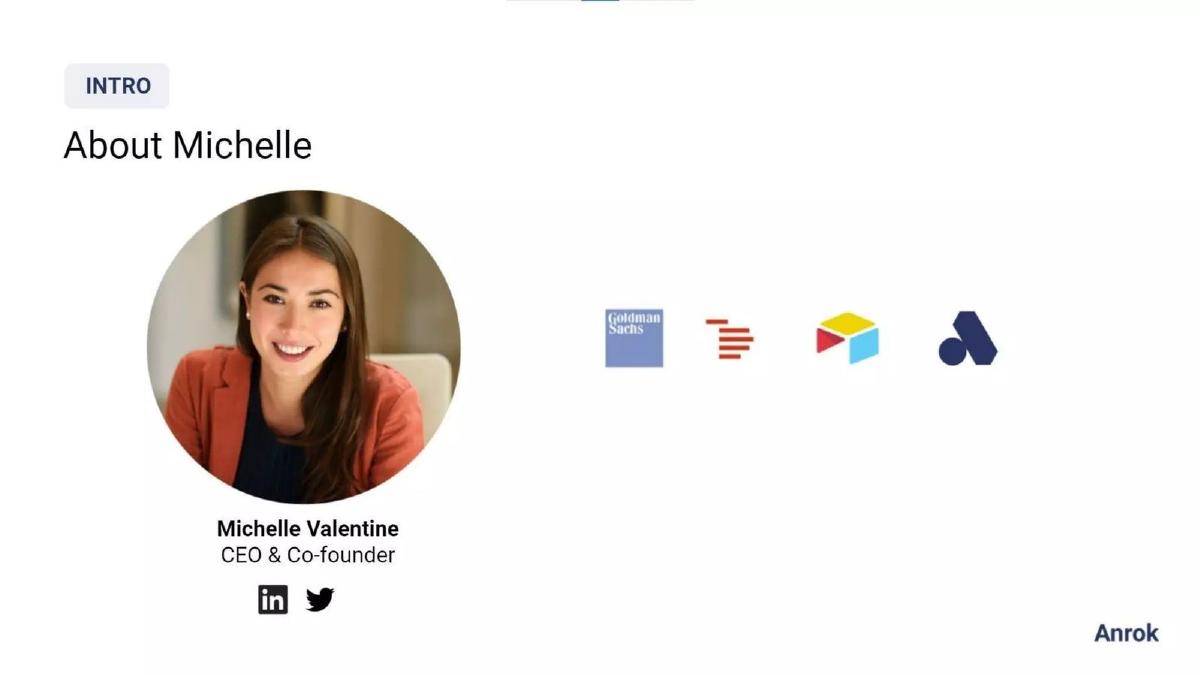
- The team slide focuses on CEO Michelle Valentine's background with logos from Goldman Sachs and Index Ventures (Slide 3).
The Narrative Strategy: Turning Regulation into Revenue
Anrok’s Series A deck is a textbook example of how to pitch a 'boring' back-office solution by framing it as an existential threat. Sales tax is rarely a topic that excites venture capitalists, but by grounding the entire pitch in a 2018 Supreme Court ruling, Anrok creates a sense of urgency. The deck doesn't just say 'we calculate tax'; it says 'the law changed, and your portfolio companies are currently losing 4.3% of their margin to unaddressed liabilities.'
Intro and Social Proof (Slides 1-4)
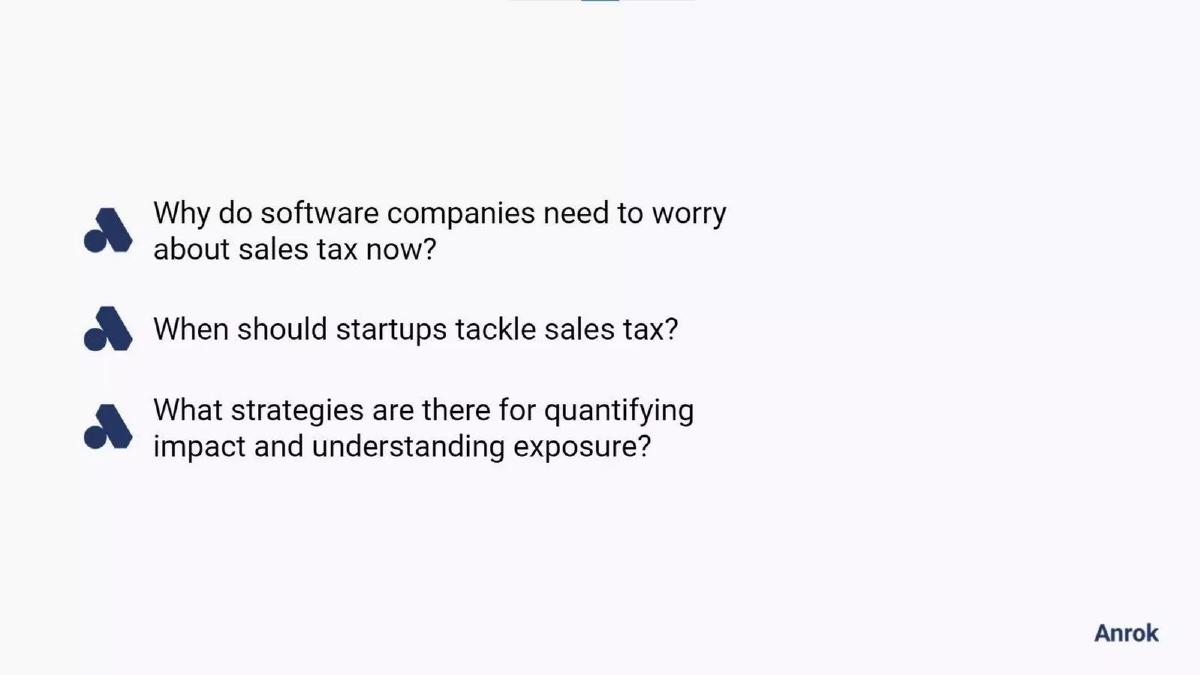
The deck opens with a clean, professional aesthetic. Slide 1 introduces the tagline 'Navigating sales tax for SaaS,' immediately narrowing the focus to a high-value vertical. Slide 2 acts as a table of contents, phrased as three critical questions that a CFO or founder would ask. This 'consultative' approach sets the tone for the rest of the presentation.
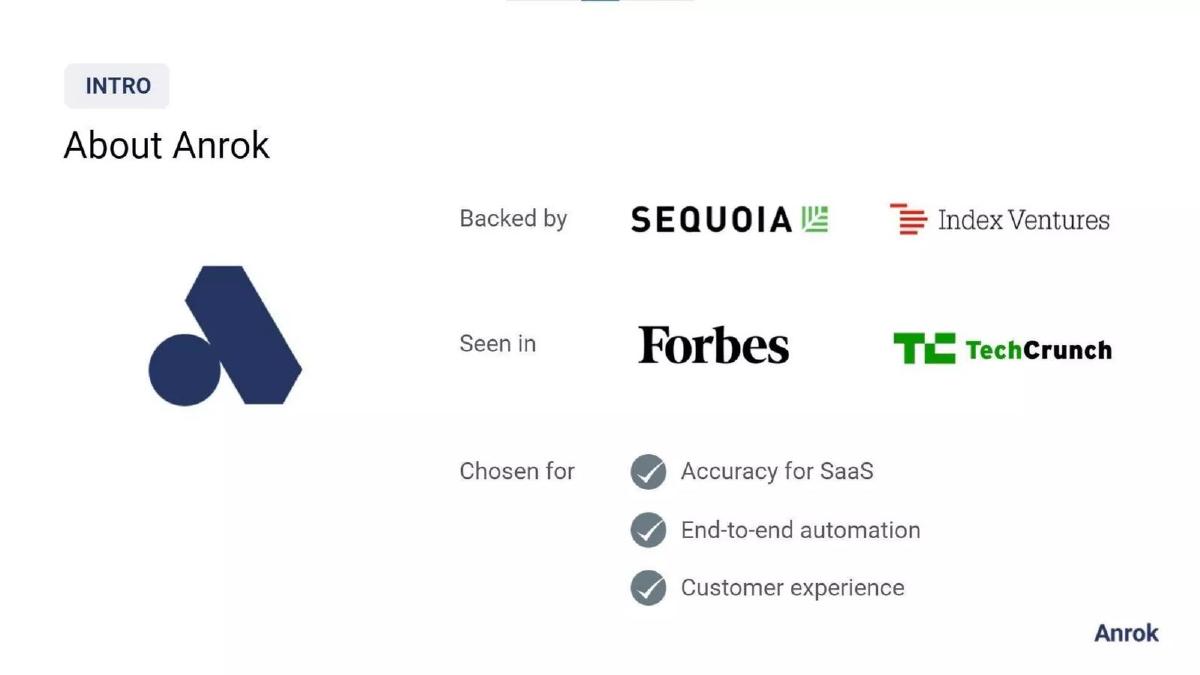
Slide 3 introduces CEO and Co-founder Michelle Valentine. Instead of a long bio, the slide uses high-signal logos: Goldman Sachs and Index Ventures. This immediately establishes her as someone who understands both the financial intricacies and the venture-backed startup ecosystem. Slide 4 doubles down on this credibility, showing that the company is already backed by Sequoia and Index Ventures , and has been featured in Forbes and TechCrunch. For a Series A pitch, having Sequoia in the 'Backed by' section on slide 4 often does more work than ten slides of metrics.
The Regulatory Catalyst (Slides 5-9)
This section is the 'Why Now?' of the deck. Slide 7 identifies the 2018 South Dakota v. Wayfair Supreme Court case as the turning point. It explains that SaaS companies now have to remit tax based on 'physical and economic presence.' This is a crucial distinction that many founders overlook.
Slide 8 defines 'Nexus'—the legal term for a tax obligation. It breaks it down into Economic Nexus (sales/transactions) and Physical Nexus (offices/remote employees). By including remote employees, Anrok expands its value proposition to any company with a distributed workforce. Slide 9 provides concrete examples of thresholds: New York requires $500k in sales AND 100 transactions, while Utah requires $100k in sales OR 100 transactions. These specific figures ground the abstract legal concept in operational reality, proving the complexity of manual tracking.
Quantifying the Pain (Slides 10-14)
The deck moves from 'what is the law' to 'how much does this cost you.' Slide 12 lists the costs of non-compliance: Audit risk, Revenue impact, and Hiring implications. This connects the tax problem to the three things VCs care about most: risk mitigation, profitability, and the ability to scale a team.
Slide 14 is arguably the most important slide in the deck. It features a table titled 'Average annual revenue drag weighted by State GDP.' It calculates an 'Effective non-compliance rate'—which includes the tax rate plus penalties and interest—and weights it by state. The conclusion is bold: 'Not charging sales tax may result in ~4.3% drag on profitability.' In the low-margin world of early-stage growth, a 4.3% hit to the bottom line is a massive leak that demands a solution.
The Solution: The Anrok Approach (Slides 15-20)
After establishing a massive, legally-mandated problem, Anrok introduces its platform. Slide 17 uses a 'Path Forward' vs. 'The Anrok Approach' comparison. The 'Path Forward' (the manual way) involves five distinct, painful steps: survey, registration, calculation, returns, and remittance. The 'Anrok Approach' promises to automate these steps: real-time monitoring, guided registration, auto-file returns, and auto-pay.
Slides 18, 19, and 20 show the product in action. The UI highlights features like 'Connecticut economic nexus: Approaching' and 'Connecticut physical nexus: Exposed.' This visualizes the 'monitoring' aspect of the software, showing that Anrok isn't just a calculator—it's an early-warning system. Slide 19 mentions 'Automate tax calculation across your finance stack,' signaling that they integrate with existing tools like Stripe, NetSuite, or QuickBooks, which reduces the friction of adoption.
What is Missing from the Deck
While the narrative is compelling, this version of the deck is notably light on traditional 'hard' startup metrics. There is no slide detailing current Revenue (ARR) , growth rates, or customer count. There is no mention of Unit Economics (CAC, LTV, or Churn). Furthermore, the deck omits a Competition slide entirely, failing to mention legacy players like Avalara or newer competitors in the space. Finally, there is no 'Ask' slide ; the amount of capital being raised and the intended use of funds are not disclosed in these 22 slides.
What Founders Should Copy
The 'Why Now' Slide: Using a specific legal or regulatory change (Slide 7) is the most effective way to create market urgency. · Quantifying the Cost of Inaction: Slide 14’s calculation of 'revenue drag' turns a boring compliance task into a financial imperative. If your product saves money, show exactly how much is being lost right now. · Vertical Focus: By branding themselves as 'Sales tax for SaaS,' Anrok makes their product feel more relevant than a general-purpose tax tool. · Visualizing the Workflow: The comparison on Slide 17 between the manual process and the automated process clearly communicates the 'before and after' value proposition. · High-Signal Logos: If you have top-tier investors or a pedigree background, put those logos on the first five slides. It builds immediate trust for the more complex data that follows.
Conclusion
Anrok’s deck succeeded because it didn't try to sell 'tax software.' It sold 'risk insurance' and 'margin protection' for the SaaS industry. By focusing on the 2018 Wayfair ruling and the rise of remote work, they positioned their product as a mandatory utility for the modern era. The lack of metrics suggests this was a 'vision and team' led Series A, where the strength of the market opportunity and the quality of the existing cap table (Sequoia/Index) were enough to drive the $24.3M round.
Frequently asked questions
- What is the primary market driver identified in the deck?
- The primary driver is the 2018 Supreme Court ruling in South Dakota v. Wayfair. This case changed the rules for sales tax, requiring companies to collect tax based on where their customers are located (economic nexus) rather than just where the company has a physical office. Anrok uses this to argue that every SaaS company now has an unavoidable compliance burden.
- How does Anrok quantify the risk for potential customers?
- On slide 14, Anrok provides a table showing 'Average annual revenue drag weighted by State GDP.' They calculate an effective non-compliance rate across various states (e.g., 11.3% in NY, 12.4% in TN) and conclude that not charging sales tax results in an average 4.3% drag on total profitability once penalties and interest are factored in.
- Does the deck include financial projections or a formal 'Ask'?
- No. This specific version of the deck omits revenue projections, burn rate, and the specific dollar amount being raised. It focuses entirely on the problem, the regulatory environment, and the product's unique ability to solve for 'nexus' monitoring across a financial stack. The $24.3M raise figure is known from external catalogue data rather than the slides themselves.
- What makes Anrok's product different from traditional tax software?
- Anrok differentiates itself by being 'built specifically for SaaS.' Slide 18 claims it is the only solution tracking both economic nexus (sales volume) and physical nexus (remote employees). It also emphasizes integration across the 'financial stack,' meaning it unifies monitoring, calculation, and remittance rather than being a standalone calculator.
- Why is the 'physical nexus' point so important in this deck?
- Slide 8 and 18 highlight that hiring remote employees creates a 'physical nexus' in new states. In a post-2020 world, this significantly increased the complexity for startups. By tracking where employees are hired alongside where sales are made, Anrok positions itself as a holistic HR and Finance compliance tool, not just a checkout plugin.