Angle Paisa, which began operations in July 2010, attempts to position itself as a bridge between small-scale investors and innovative startups through an online crowdfunding model. The deck functions more as a primer on the benefits of startup investing and equity crowdfunding rather than a traditional investor pitch. It lacks nearly every essential metric required for a professional fundraise, including a team slide, financial history, user traction, and a specific capital ask. While it outlines a process for investors to sign agreements and publicize their investments, the presentation fai…
Key takeaways
- The company began operations in July 2010, initially focusing on real estate and websites before pivoting to crowdfunding (Slide 1).
- The platform facilitates investment from family, friends, independent investors, and community members (Slide 4).
- The deck defines three distinct funding categories: Crowd Funding, Angel Investment, and Startup Funding (Slide 5).
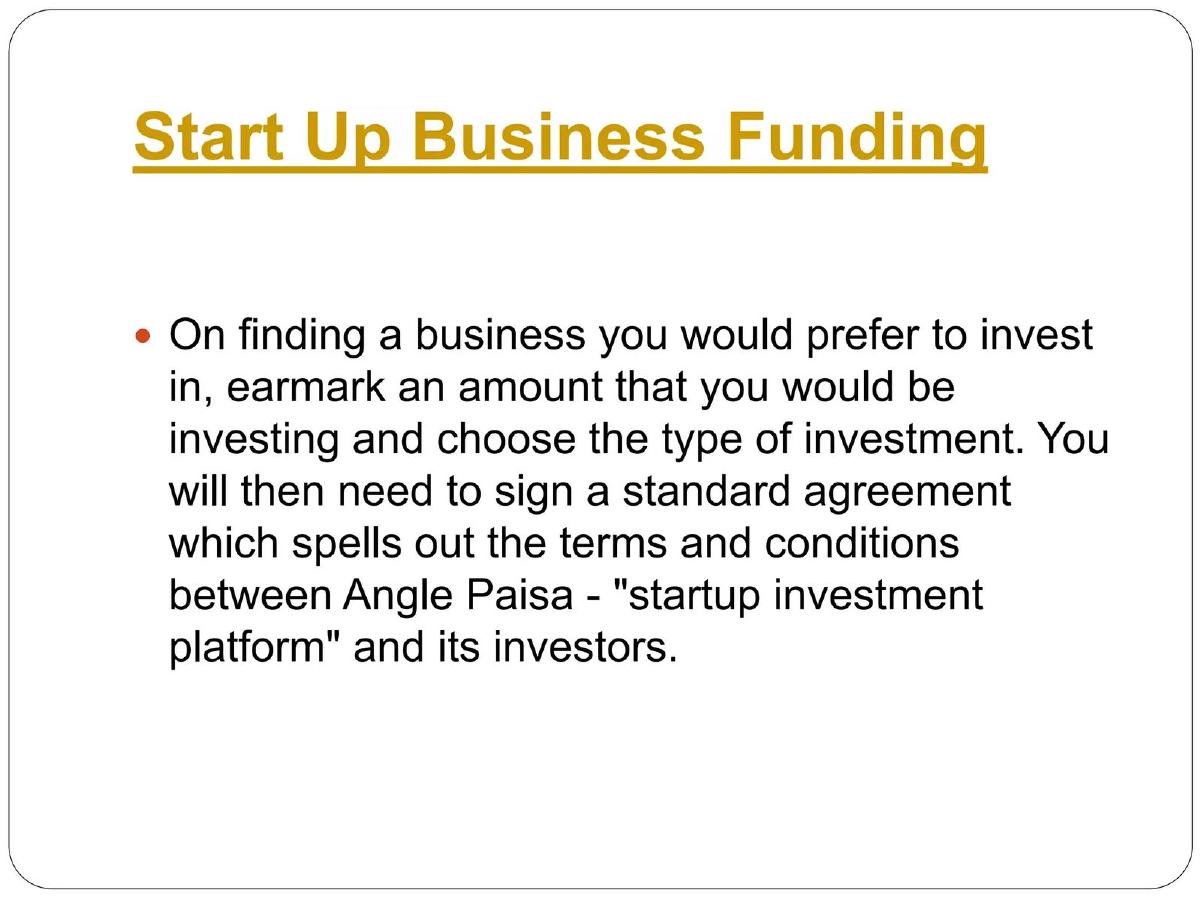
- Investors are required to sign a 'standard agreement' that spells out terms between the platform and the investor (Slide 2).
- The business model relies on 'simple online procedures' to allow investors to support startups with small amounts of capital (Slide 4).
- The deck claims that small businesses are less risky because they have 'loyal and consistent' markets (Slide 8).
- There is a total absence of a team slide, meaning no information is provided regarding the founders or management (Omission).
- The deck contains no financial data, revenue models, or specific funding ask (Omission).
Angle Paisa: An Educational Approach to a Pitch Deck
The Angle Paisa pitch deck is an unusual artifact in the world of startup fundraising. Rather than focusing on the 'why us' and 'why now' of a specific investment opportunity, the deck spends the majority of its real estate defining the industry in which it operates. For a company that claims to have started operations in 2010, the lack of performance data is a significant red flag for any professional analyst. The following teardown examines the slides provided, noting the heavy emphasis on conceptual definitions over operational reality.
Slide 1: Title and Origin
The cover slide introduces Angle Paisa and provides a brief historical context. It states that operations began in July 2010. Interestingly, the company did not start as a crowdfunding platform. It originally worked on 'projects in the real estate sector and websites' in collaboration with U.S. counterparts. The slide notes a later shift into the 'crowd funding market' to reach a larger pool of investors. This indicates a pivot from a service-based or sector-specific investment firm to a platform-based financial technology model. However, the slide lacks a clear value proposition or a concise mission statement, opting instead for a short paragraph of text.
Slide 2: The Investment Process
Titled 'Funding for Startup Business,' this slide outlines the mechanics of using the platform. It mentions a 'standard agreement' that defines the relationship between the 'startup investment platform' and its investors. A unique aspect mentioned here is the social component: investors are encouraged to 'popularize and publicize' their investments via social media and personal contacts. This suggests that Angle Paisa views its investors not just as sources of capital, but as marketing agents for the startups on the platform. This 'viral' funding mechanism is a core part of their stated strategy.
Slide 3: The Case for Startups
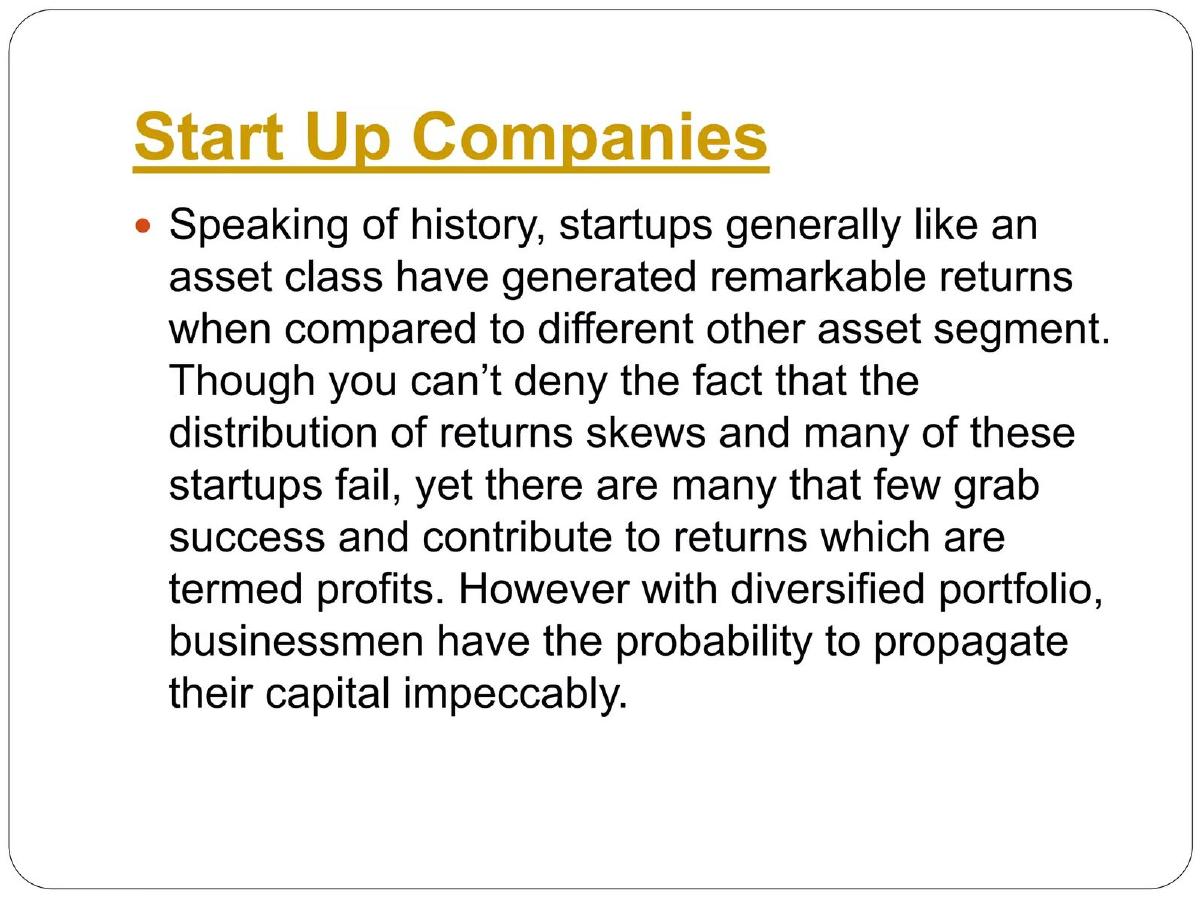
This slide, 'Start Up Companies,' serves as a justification for the asset class. It claims that startups have generated 'remarkable returns' compared to other segments. It acknowledges the high failure rate but suggests that a 'diversified portfolio' allows businessmen to 'propagate their capital impeccably.' The language is somewhat non-standard for a financial deck (e.g., 'propagate their capital impeccably'), and it lacks any specific data points or benchmarks to support the claim of remarkable returns. It functions more as a motivational slide for hesitant investors than a data-driven argument for a VC.
Slide 4: Platform Positioning
Slide 4 positions Angle Paisa as a 'frontrunner' and a 'pioneering online platform.' It reiterates the goal of helping entrepreneurs raise 'crowd funding and seed capital seamlessly.' The slide lists the target sources of capital: family, friends, independent investors, and community members. This confirms that the platform is targeting the very early stages of a company's lifecycle, often referred to as the 'friends and family' round, but attempting to formalize it through an online interface.
Slide 5: Defining the Funding Landscape
Under the heading 'Funding for Business,' the deck provides definitions for three terms: Crowd Funding, Angel Investment, and Startup Funding. Crowd Funding is described as multiple investors contributing small bits of money. Angel Investment is defined as investing small amounts with high yield potential. Startup Funding is described as a method where the investor gets 'more control and authority over the operations.' The distinction between these three is somewhat blurry as presented, and the slide feels more like a glossary than a strategic breakdown of the platform's specific product offerings.
Slide 6: The Investor's Dilemma
This slide focuses on the 'Business Investors.' It argues that investment is the 'pulse of any business organization.' The core claim here is that Angle Paisa 'excels in providing the suitable destination' for investors who find it difficult to choose the right opportunity. Again, the deck relies on a bold claim ('We excel') without providing the evidence—such as a proprietary vetting process, an algorithm, or a track record of successful selections—to back it up.
Slide 7: Equity Crowdfunding Mechanics
Slide 7 defines 'Equity Crowdfunding' as exchanging shares for money in non-listed companies. It describes this as a 'smart way of grabbing the partial ownership hold.' The slide emphasizes that this method is 'promising' and has 'huge benefits for both entrepreneur and investor.' Like previous slides, this is purely educational. It explains what equity crowdfunding is rather than explaining how Angle Paisa’s specific implementation of it is superior to competitors like Kickstarter, Indiegogo, or AngelList.
Slide 8: Small Business Advantages
The final slide in this set, 'Small Business Investors,' attempts to de-risk the investment. It makes the counter-intuitive claim that small businesses are 'less risky' because they have 'loyal and consistent' markets and 'do not sink.' It also highlights that 'people with average financial background' can become backers because the capital requirements are low. This slide targets the 'retail' investor, emphasizing affordability and safety, which is a significant departure from traditional venture capital pitching that usually highlights high risk and high reward.
What Works in This Deck
The deck is consistent in its messaging regarding the democratization of investment. It clearly identifies its target audience: the non-institutional investor who wants to participate in the startup economy with 'small bits' of money. The inclusion of a process slide (Slide 2) is helpful, as it demystifies how a user actually interacts with the platform. By emphasizing the social aspect of investing, the deck identifies a potential growth lever—using the existing investor base to recruit more capital through their own networks.
What is Critically Missing
The omissions in this deck are extensive and would likely prevent it from passing an initial screening by any professional investment group. First, there is no Team Slide. In early-stage investing, the team is often the most important factor. We have no idea who is running Angle Paisa, what their financial background is, or if they have ever successfully managed a platform or a fund. Second, there is no Traction Slide. Since the company started in 2010, there should be years of data available. How many startups have been funded? How much total capital has moved through the platform? What is the average return for investors? The absence of these numbers is glaring. Third, there is no Revenue Model. The deck never explains how Angle Paisa makes money. Do they take a percentage of the funds raised? Do they charge listing fees? Do they take equity carry? Without this, it is a description of a service, not a business. Finally, there is no 'Ask.' A pitch deck is a tool to raise money, yet this deck never specifies how much capital the company is seeking or what that capital will be used for.
Founder's Takeaway: What to Copy and What to Avoid
Founders should look at the clear, jargon-free definitions used in this deck as a positive trait. If you are building a platform for non-experts, you must explain the 'how' and 'what' simply. However, this deck serves as a cautionary tale regarding text density and lack of evidence. Avoid using slides to define the industry; investors already know what crowdfunding is. Instead, use those slides to show your specific market share or your unique approach to that industry. Most importantly, never omit the team and the financials. A deck without a team is a deck without a soul, and a deck without financials is just a brochure. If you have been in operation for several years, as this company has since 2010, your primary argument must be based on your historical performance, not on the theoretical benefits of your sector.
Frequently asked questions
- What is Angle Paisa's primary business model?
- Based on Slide 4 and Slide 7, Angle Paisa operates as an online equity crowdfunding platform. It connects entrepreneurs looking for seed capital with a pool of investors, including friends, family, and the general public. The platform facilitates the exchange of company shares for capital, allowing small-scale investors to gain partial ownership in early-stage startups through simple online procedures.
- When did the company start and what was its original focus?
- According to Slide 1, Angle Paisa started operations in July 2010. Its initial focus was not crowdfunding; instead, it worked in collaboration with U.S. counterparts and local investors on projects specifically within the real estate sector and website development. The shift into the crowdfunding market was a later expansion intended to reach a larger pool of investors.
- How does the deck justify the risk of startup investing?
- Slide 3 and Slide 8 address risk by emphasizing diversification and the nature of small businesses. The deck argues that while many startups fail, a diversified portfolio allows for 'impeccable' capital propagation. Furthermore, it claims that small businesses are safer for investors because they require less capital and operate within loyal, consistent markets that prevent them from 'sinking.'
- What is the investor workflow described in the deck?
- Slide 2 outlines a two-step process. First, the investor selects a business, earmarks an investment amount, and signs a standard agreement with Angle Paisa. Second, the investor is encouraged to 'popularize and publicize' their investment proposal through social networking sites, advertisements, and personal contacts to help the startup reach its funding goals.
- What critical information is missing from this pitch deck?
- This deck is missing almost all standard venture capital requirements. There is no information on the founding team, no financial history or projections, no mention of the current user base or number of successful exits, and no specific 'ask' regarding how much money they are raising or at what valuation.