Clutch Wallet’s 2021 pre-seed deck is a masterclass in identifying a specific demographic void within a booming market. By highlighting that only 3.9% of the population owned cryptocurrency at the time, the founders framed their 'social wallet' not just as a tool, but as an onboarding ramp for women and first-time users. The deck successfully raised $800,000 by leaning into early beta traction—reporting 750 unique wallet addresses in its first week—and promising a 'no seed phrase' recovery model. While the deck is visually cohesive and heavy on product screenshots, it lacks a detailed competi…
Key takeaways
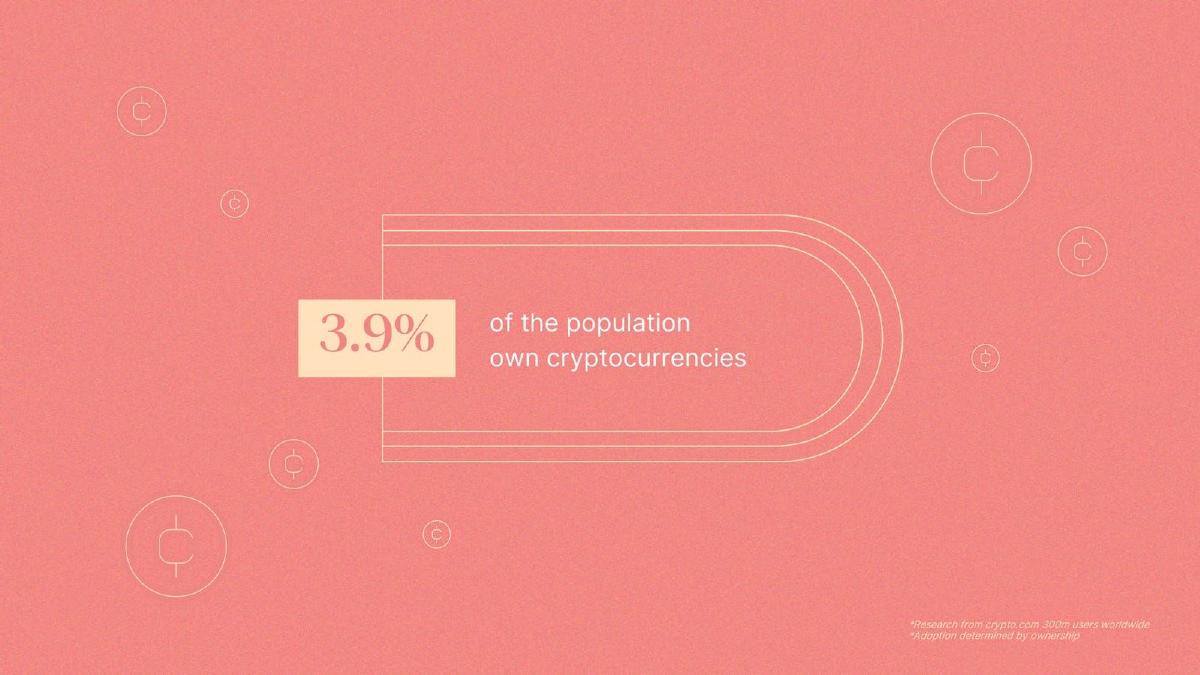
- The deck identifies a massive market gap by citing that only 3.9% of the global population owned crypto in 2021 (Slide 3).
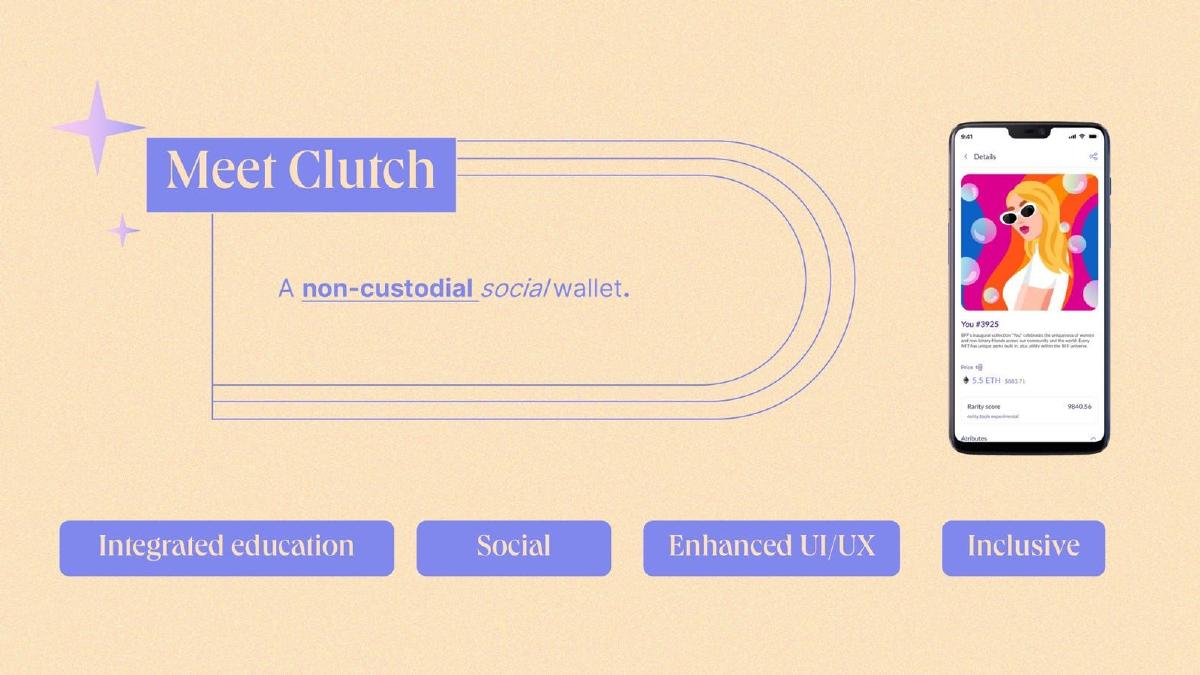
- Clutch positions itself as a 'non-custodial social wallet' with four pillars: integrated education, social features, enhanced UI/UX, and inclusivity (Slide 5).
- The problem slide attributes low adoption to 'poor wallet UI/UX' and 'undiversified messaging/branding' (Slide 7).
- Early traction is demonstrated by 750 unique wallet addresses joining the beta in its first week (Slide 9).
- The product features a 'no confusing seed phrases' approach, utilizing guardian recovery instead (Slide 17).
- Target segments are clearly defined as women (ages 18-45), first-time users, and the unbanked in specific regions (Slide 15).
- The revenue model is mentioned on Slide 16, though specific fee structures are not detailed in the provided text.
- The deck concludes with a use of funds slide (Slide 18), though the specific dollar amount requested is not listed on the slide itself.
The Vision: Bridging the 3.9% Gap
Clutch Wallet’s pitch deck, used to raise an $800,000 pre-seed round in 2021, centers on a single, compelling statistic: only 3.9% of the population owned cryptocurrency at the time of the raise. This figure, cited on Slide 3 , serves as the foundation for the entire business case. By framing the current state of crypto as an exclusionary environment, Clutch positions itself not just as another fintech app, but as the necessary infrastructure for the remaining 96.1% of the world.
Slide 1-2: Branding and Team
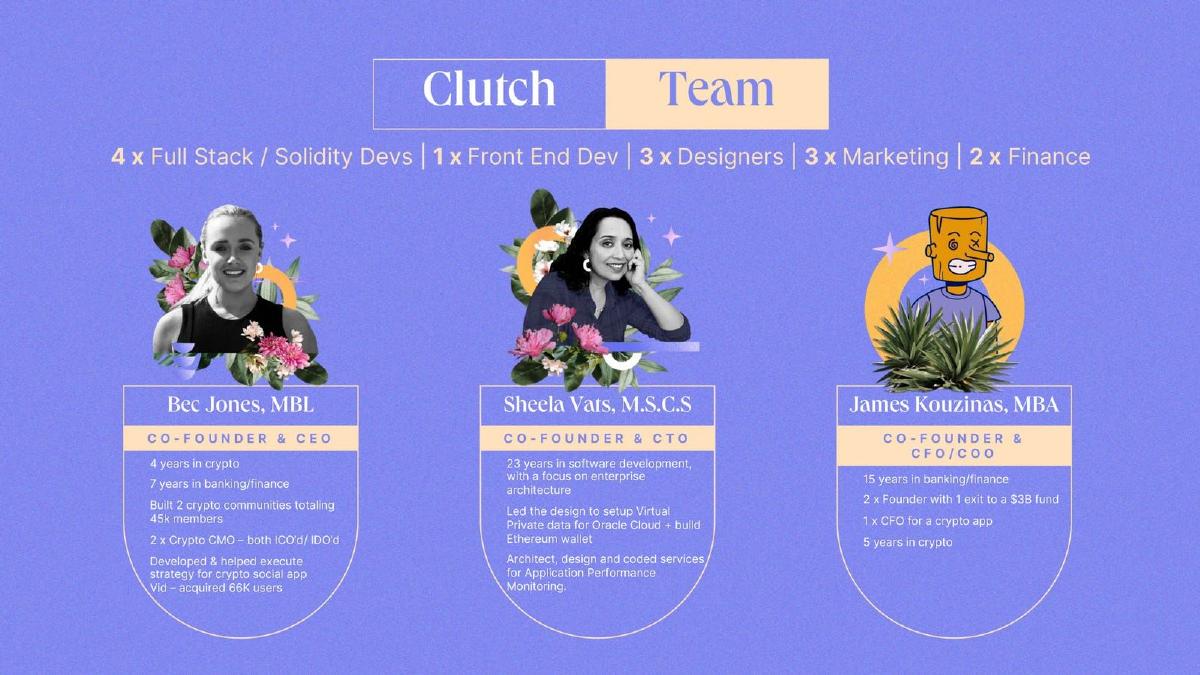
The deck opens with a minimalist aesthetic, using a soft purple and pink gradient that signals a departure from the 'dark mode' and neon aesthetics common in the 2021 crypto space. Slide 1 introduces the tagline 'It starts with Your wallet,' emphasizing personal ownership. Slide 2 introduces the team, though the specific names and backgrounds are not detailed in the text provided, the placement of the team slide early in the deck suggests the founders relied heavily on their personal credibility to secure pre-seed interest.
Slide 3-4: The Macro Opportunity
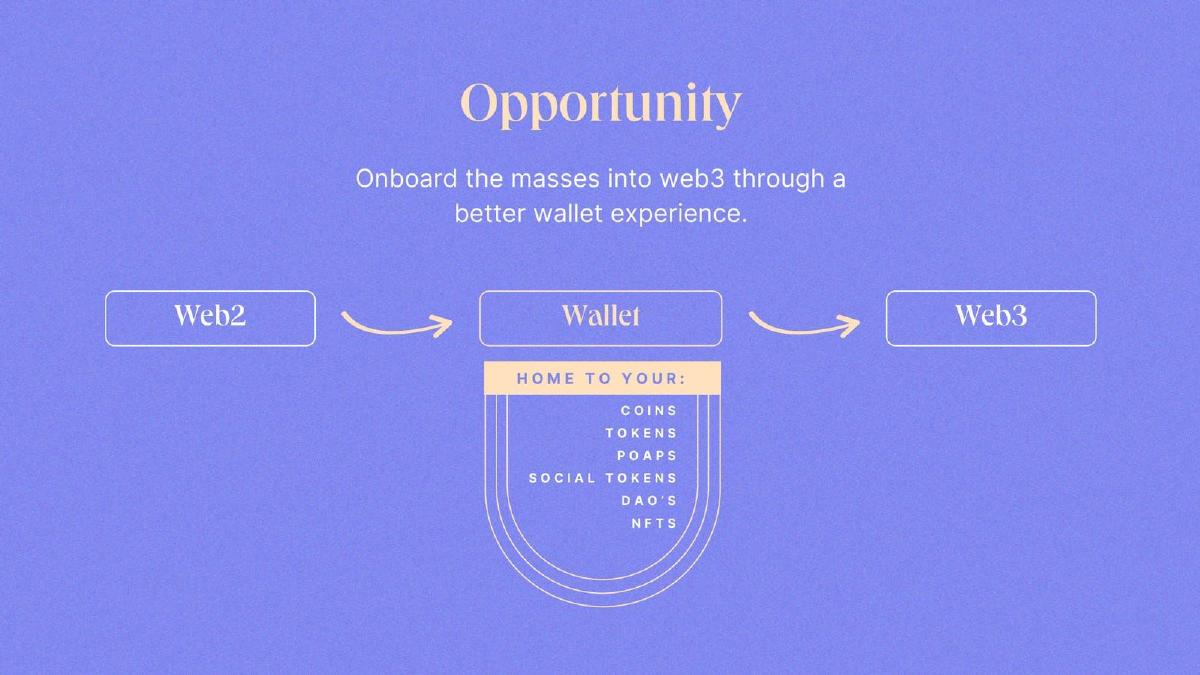
Slide 3 presents the 3.9% ownership stat, sourced from Crypto.com research. This is followed by Slide 4 , which expands on the market opportunity. In pre-seed decks, these slides are critical for convincing investors that the 'Total Addressable Market' (TAM) is large enough to justify a venture-scale investment. By highlighting how few people are currently 'in' crypto, Clutch argues that the growth potential is exponential rather than incremental.
Slide 5-7: Defining the Problem and Solution
Slide 5 introduces the product as a 'non-custodial social wallet.' It lists four key value propositions: Integrated education, Social, Enhanced UI/UX, and Inclusive. This is a direct response to the 'Low Adoption Causes' listed on Slide 7 . On that slide, the company identifies four barriers: poor UI/UX, undiversified branding, lack of education, and one-dimensional products. The inclusion of user sentiment quotes like 'They don’t make sense' and 'They are kinda ugly' helps humanize the technical problem of wallet management.
Slide 8-11: Product Deep Dive and Beta Traction
The deck moves into product execution starting on Slide 8 , showing the wallet across web, mobile, and browser extensions. Slide 9 is perhaps the most important for a pre-seed raise: it shows early traction. The company reports 750 unique wallet addresses in its first week of beta. For an $800,000 raise, this level of immediate interest validates the 'inclusive' branding strategy. Slides 10 and 11 demonstrate the core functionality—connecting existing wallets and performing transactions (swaps, sends, and receives) within a simplified interface.
Slide 12-14: The 'Social' and 'Educational' Differentiators
To justify the 'Social Wallet' label, Slides 12, 13, and 14 showcase non-transactional features. Slide 12 focuses on educational resources, while Slide 13 highlights an NFT gallery with 'live analytics.' Slide 14 introduces social media features, suggesting that the wallet is intended to be a destination for community interaction, not just a utility for moving funds. This 'sticky' product strategy is a common theme in successful fintech pitches, as it suggests higher user retention.
Slide 15-17: Strategy and Competitive Advantage
Slide 15 breaks down customer segmentation into three buckets: Women (ages 18-45 in Western markets), First-time users, and the Unbanked (specifically women in the Middle East and Indigenous groups). This level of specificity is rare in crypto decks, which often target 'everyone.' Slide 16 addresses the revenue model, and Slide 17 summarizes the competitive 'moat.' The standout feature here is 'Guardian recovery,' which replaces the traditional seed phrase—a major friction point for new users.
Slide 18-19: The Ask and Conclusion
Slide 18 outlines the use of funds, focusing on scaling the team and product development. While the slide doesn't explicitly state the $800,000 figure (which was reported by Business Insider), it provides the roadmap for what that capital will achieve. The deck closes on Slide 19 , returning to the logo and tagline to reinforce the brand identity.
What Works in the Clutch Wallet Deck
The most effective element of this deck is its demographic focus . By explicitly targeting women and first-time users, Clutch avoids a direct head-to-head comparison with established giants like MetaMask or Coinbase Wallet, which at the time were perceived as more technical or 'developer-first' tools. The use of Slide 9 to show 750 users in one week provides the 'proof of life' that investors need to see before committing nearly a million dollars to a pre-seed company.
Furthermore, the visual language of the deck is perfectly aligned with its mission. The soft colors and clean layouts support the claim that existing wallets are 'ugly' or 'confusing.' The deck shows, rather than just tells, how the product will feel different from the status quo.
What Is Missing from the Clutch Wallet Deck
Despite its strengths, the deck has notable omissions. There is no detailed competitor matrix . While Slide 17 lists how they are different, it doesn't name specific competitors or show a feature-by-feature comparison. In a crowded wallet market, investors usually want to see exactly how a startup plans to win against incumbents with massive distribution.
Additionally, the unit economics and financial projections are absent from the provided slides. While typical for a pre-seed deck to be light on financials, a slide detailing the expected 'take rate' on swaps or the cost of customer acquisition (CAC) for their target segments would have strengthened the business case. The revenue model on Slide 16 is mentioned but not quantified, leaving a gap in the 'how we make money' narrative.
Founder Takeaways: Lessons from a $800k Raise
Lead with the Gap: If you are entering a crowded market, don't just talk about the market size; talk about who is being left out. Clutch’s use of the 3.9% ownership stat is a perfect example of this. · Traction Trumps Theory: Even a small amount of data—like 750 beta users—is infinitely more valuable than a hundred slides of market research. If you have a beta, put the results front and center. · Solve a Specific Friction Point: Clutch identified 'seed phrases' as a barrier and offered 'Guardian recovery' as the solution. Identifying a single, high-friction technical hurdle and solving it can be the core of a successful pitch. · Design is a Feature: In consumer fintech, the 'look and feel' of your pitch deck is a proxy for the 'look and feel' of your app. If your value prop is 'better UI/UX,' your deck must be flawlessly designed.
Frequently asked questions
- What is a 'social wallet' as defined by Clutch?
- Clutch defines its social wallet as a non-custodial platform that integrates community features like chat and social feeds directly with DeFi capabilities. Unlike standard wallets that focus solely on transactions, Clutch emphasizes 'social, chat, & community' alongside traditional features like swapping and NFT galleries to make the experience more engaging and less intimidating for new users.
- How does Clutch solve the 'seed phrase' problem?
- According to Slide 17, Clutch removes the friction of 'confusing seed phrases' by implementing 'Guardian recovery.' This is a social recovery mechanism where trusted contacts or devices can help a user regain access to their funds, which aligns with their mission to make crypto feel safer and more accessible to non-technical users.
- Who was the primary target audience for this raise?
- The deck identifies three core segments on Slide 15: Women (ages 18-45 in the U.S., UK, AUS, and CA), first-time users (male and female), and the 'unbanked,' specifically women in the Middle East and Indigenous groups. The publisher notes the company was particularly designed to make Web3 more accessible to women.
- What traction did Clutch show to investors?
- Clutch utilized its first week of beta testing as a key proof point. Slide 9 reports that the platform secured 750 unique wallet addresses within the first seven days of its web beta launch. This early interest served as a proxy for product-market fit in a crowded fintech landscape.
- What were the main reasons cited for low crypto adoption?
- Slide 7 lists four primary causes for low adoption: poor wallet UI/UX, undiversified messaging/branding, lack of education, and one-dimensional products. The deck uses user quotes like 'They don’t feel safe' and 'They are kinda ugly' to highlight the emotional barriers to entry that Clutch intended to solve.