Clowder’s 15-slide deck is a highly visual, low-text presentation that prioritizes traction and unit economics over technical specifications. The core thesis rests on the inefficiency of traditional coffee retail, highlighting a $48B market where consumers are frustrated by wait times. Clowder positions itself as a high-margin alternative by eliminating physical storefronts, claiming 2x the margins of traditional cafes. With a reported $8k CAPEX compared to $2M for traditional competitors, the deck argues for rapid, low-cost scalability. While the deck excels at demonstrating early product-ma…
Key takeaways
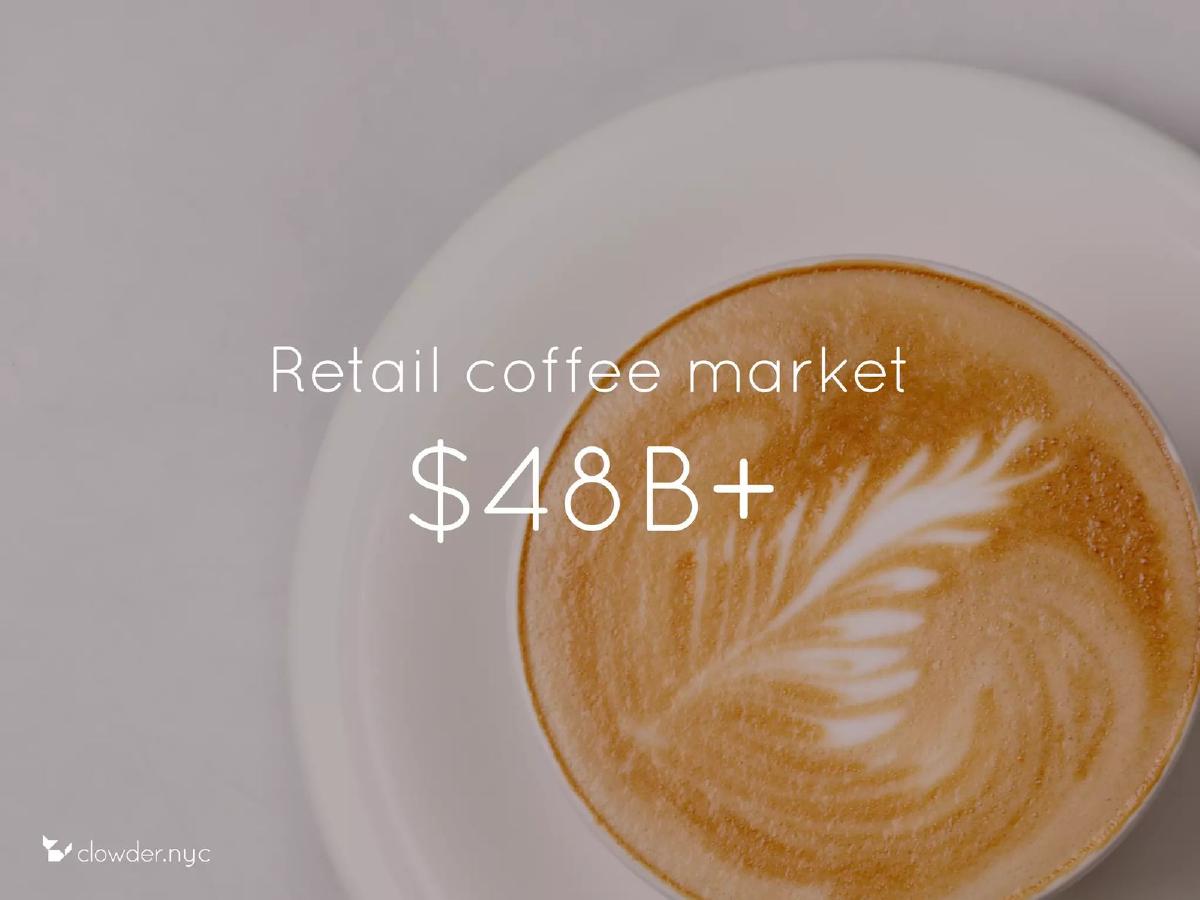
- The deck identifies a massive $48B retail coffee market opportunity (Slide 3).
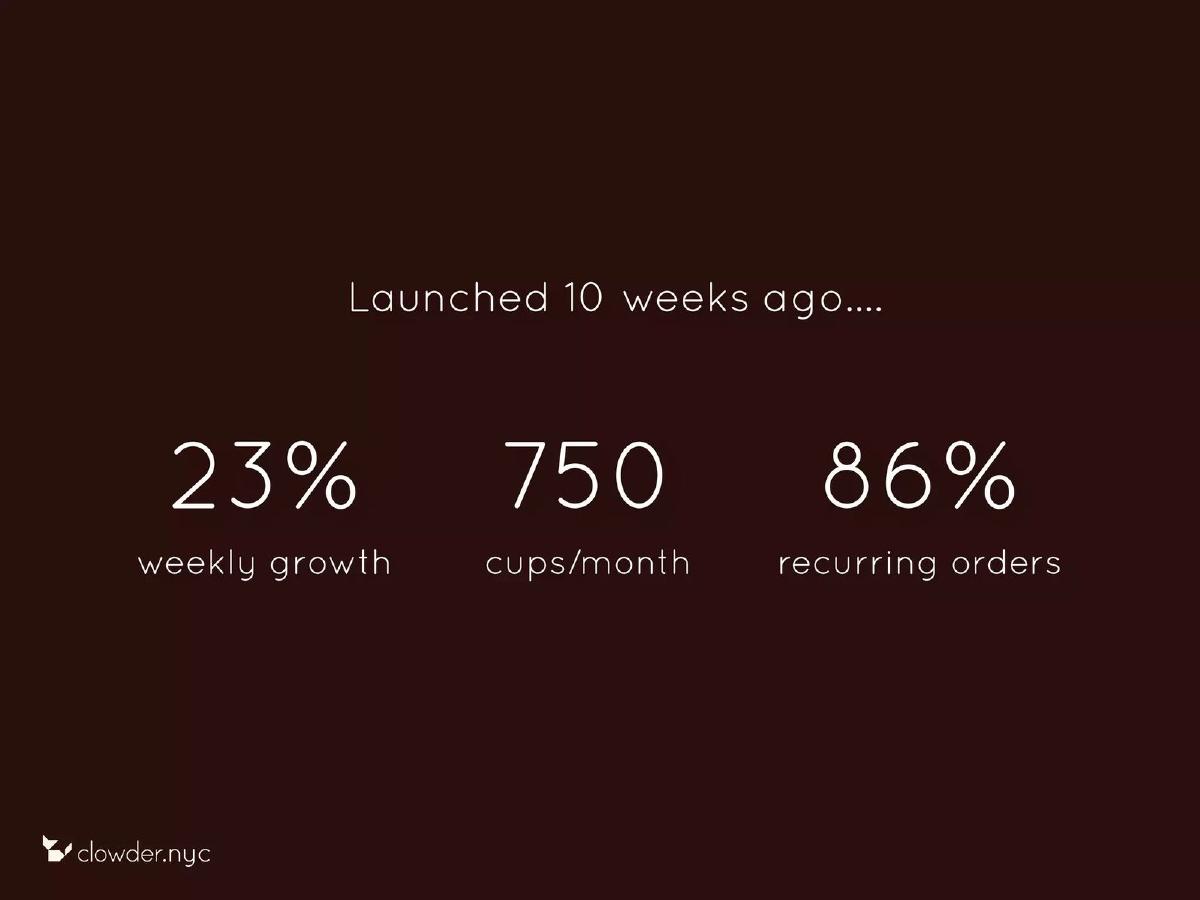
- Traction is strong for a 10-week-old startup, boasting 23% weekly growth and 750 cups per month (Slide 6).
- Clowder claims a high retention rate with 86% of orders being recurring (Slide 6).
- The business model relies on a 'no brick-and-mortar' approach to achieve 2x the margins of traditional coffee shops (Slides 8, 9).
- Capital efficiency is a central theme, with Clowder stating an $8k CAPEX versus $2M+ for traditional competitors (Slide 12).
- The team leverages high-prestige backgrounds, citing experience at McKinsey & Company and Digital Labs (Slide 14).
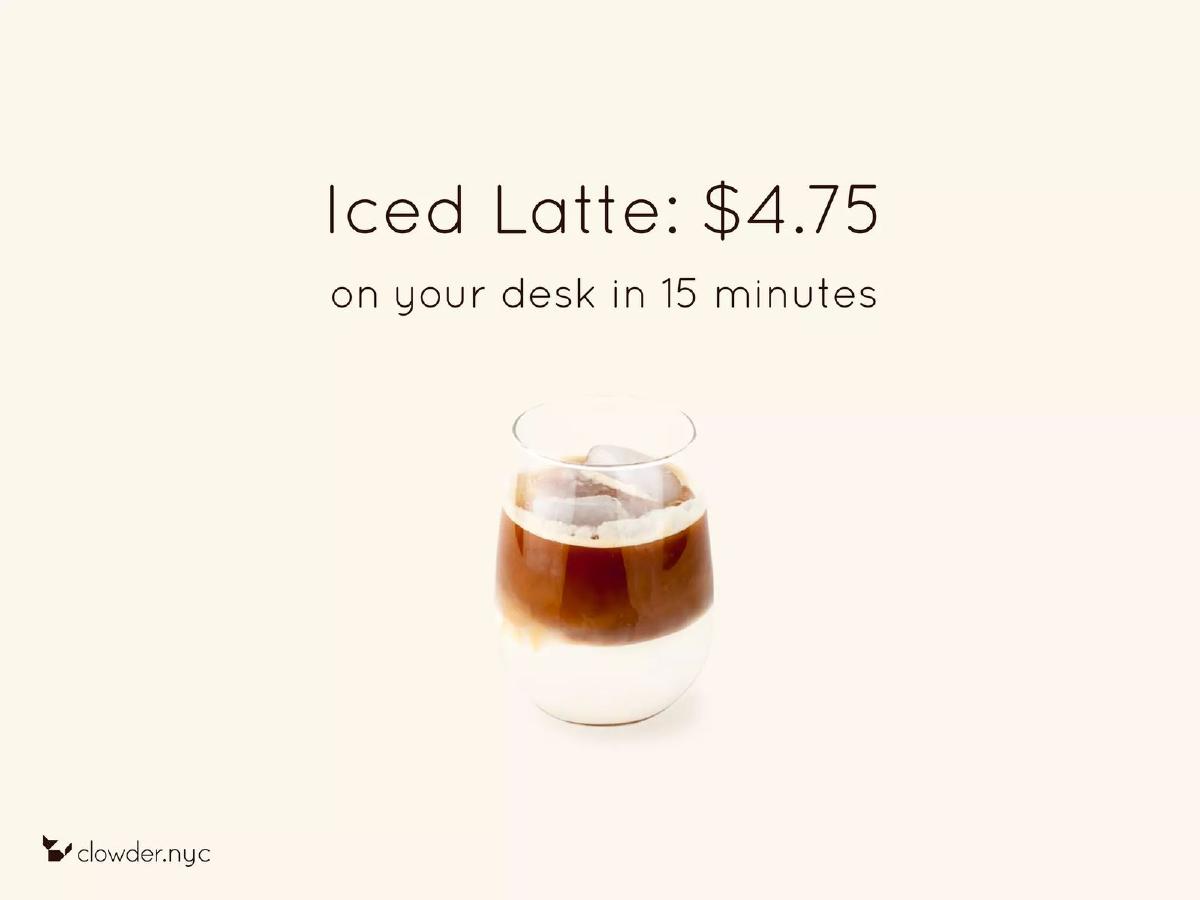
- The product promises delivery to a user's desk in 15 minutes for a $4.75 iced latte (Slide 5).
- The deck lacks a formal 'Ask' slide, omitting the specific dollar amount being raised and the intended use of funds.
The Visual Narrative of Clowder
Clowder’s pitch deck is a striking example of the 'less is more' philosophy. In an era where many founders clutter slides with dense paragraphs and complex charts, Clowder opts for high-resolution imagery and single, impactful data points. This approach forces the investor to focus on the core narrative: coffee is a massive market, the current retail model is inefficient, and Clowder has found a way to deliver it faster and cheaper.
Slides 1-3: The Hook and the Market
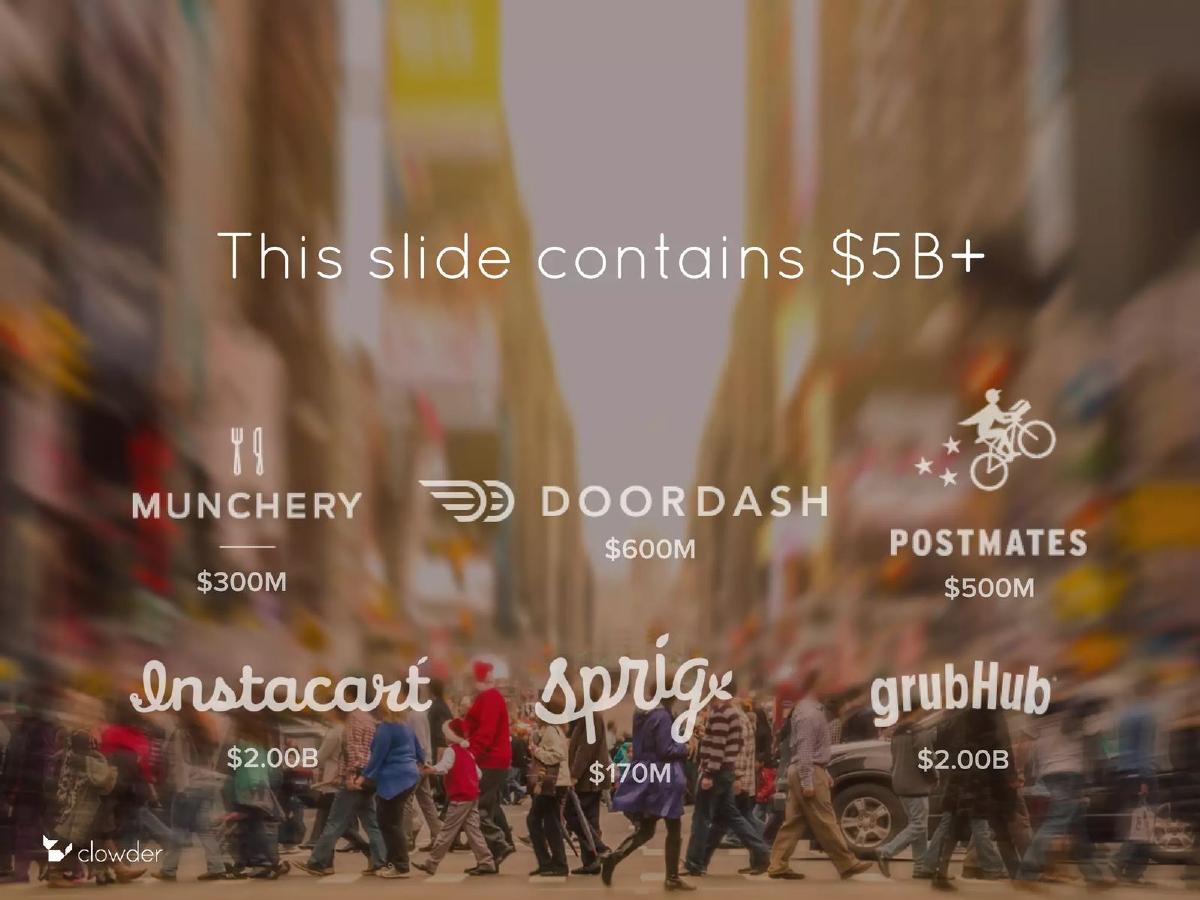
Slide 1 is a simple title slide featuring a latte art image and the tagline 'Your latte, delivered.' It immediately establishes the product category without ambiguity. Slide 2 attempts to build 'market FOMO' by showing the logos of massive delivery and food-tech companies like Instacart ($2.00B), GrubHub ($2.00B), DoorDash ($600M), and Postmates ($500M). The headline 'This slide contains $5B+' suggests that Clowder is the next logical evolution in this high-value delivery lineage. Slide 3 quantifies the specific opportunity: a $48B+ retail coffee market. By starting with these three slides, Clowder establishes that they are playing in a proven, high-stakes arena.
Slides 4-5: The Problem and the Solution
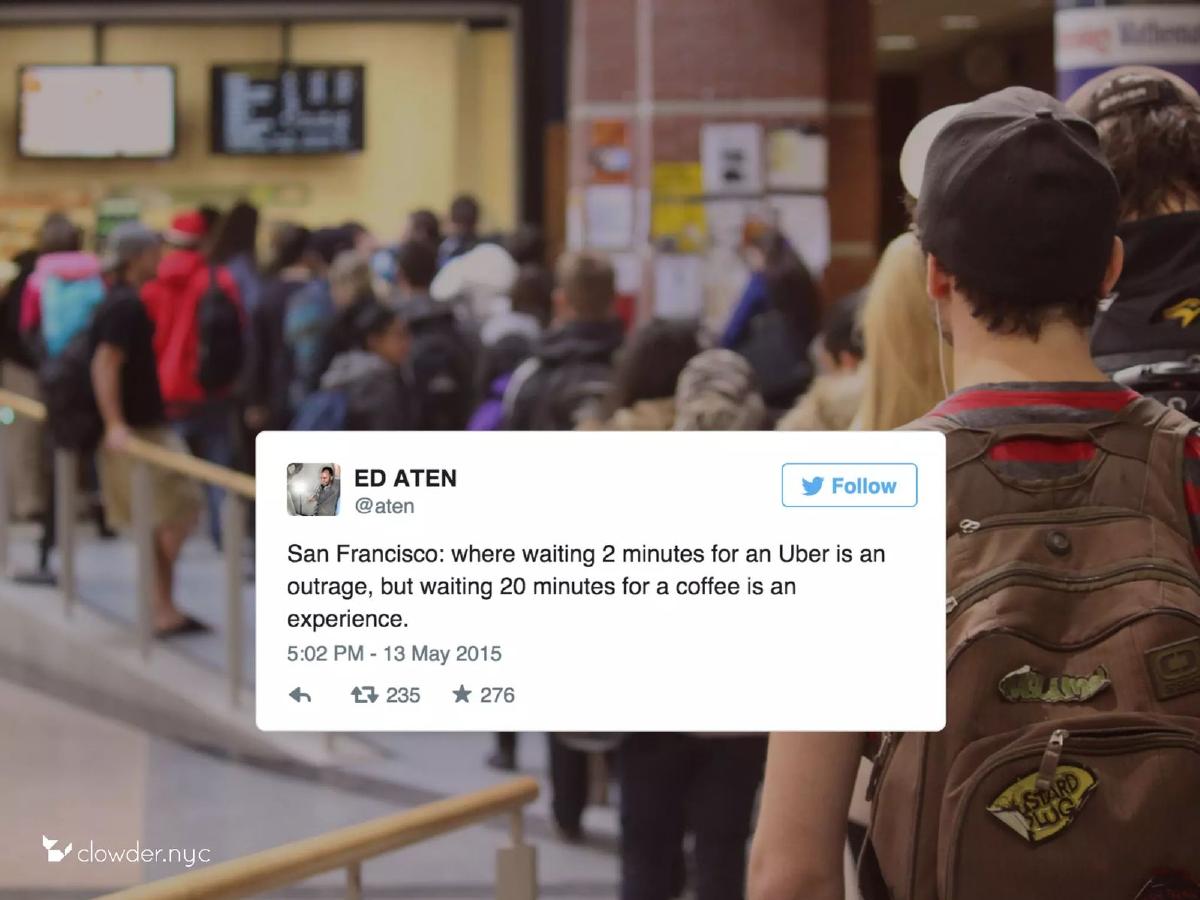
Slide 4 uses a clever piece of social proof to define the problem. It features a tweet from Ed Aten: 'San Francisco: where waiting 2 minutes for an Uber is an outrage, but waiting 20 minutes for a coffee is an experience.' This perfectly encapsulates the inefficiency Clowder aims to solve. Slide 5 presents the solution in its simplest form: 'Iced Latte: $4.75 on your desk in 15 minutes.' There is no mention of apps, logistics, or beans—just the end result for the consumer. This is a powerful way to frame a value proposition.
Slides 6-7: Early Traction and Habituation
Slide 6 is the 'meat' of the deck for investors. It shows metrics from a 10-week launch period: 23% weekly growth, 750 cups per month, and an 86% recurring order rate. The 86% figure is particularly important for a B2C app, as it suggests high stickiness. Slide 7 takes this further by comparing 'Purchases per month.' Clowder claims 5.1 purchases per month, which they contrast against Starbucks (4.1) and Dunkin' Donuts (3.6). This slide argues that Clowder isn't just a novelty delivery service; it is becoming a daily habit for its users, potentially more so than the industry giants.
Slides 8-13: The Economic Moat and Scalability
Slide 8 and 9 introduce the business model's primary advantage: '2x margins' compared to traditional coffee shops, enabled by a 'No brick-and-mortar' strategy. Slide 10 shows the product interface across MacBook, iPad, and iPhone, emphasizing a seamless digital-first experience. Slides 11, 12, and 13 are a progressive build on the concept of '1% of capex, 3x the coverage.' Slide 12 reveals Clowder’s CAPEX is only $8k, while Slide 13 contrasts this with the '$2M+' required for traditional competitors. This is a compelling scalability argument—Clowder suggests they can blanket a city with service points for the cost of a single traditional cafe's renovation.
Slides 14-15: The Team and the Close
Slide 14 introduces the team: Matthew Casey (CTO), Christine Miao (CEO), and Michael Morreale (Lead Software Engineer). The slide prominently features the McKinsey & Company and Digital Labs logos, signaling high-level professional pedigree. The claim of '30+ Fortune 500 solutions deployed' adds a layer of technical and operational credibility. Slide 15 is a standard contact slide with the tagline 'Rethink your coffee break' and a founder email address. Notably, the email uses a .nyc domain, reinforcing the geographic focus of their initial traction.
What Works in the Clowder Deck
1. Extreme Clarity: You don't need to read a single paragraph to understand what Clowder does. The '15 minutes to your desk' promise is a perfect North Star metric for the entire pitch.
2. Comparative Economics: The deck does a fantastic job of contrasting the 'old way' (high CAPEX, slow service) with the 'Clowder way' (low CAPEX, instant delivery). The $8k vs. $2M comparison is the most memorable part of the deck.
3. Focus on Retention: By highlighting the 86% recurring order rate and the 5.1 purchases per month, the founders address the biggest concern in food delivery: customer acquisition costs (CAC) vs. lifetime value (LTV). They are proving that coffee is a high-frequency utility, not a discretionary luxury.
What is Missing from the Clowder Deck
1. The 'How': While the deck says 'no brick-and-mortar,' it never explains where the coffee actually comes from. Are they partnering with existing kitchens? Do they have 'dark' brewing hubs? Do they use mobile carts? This is a significant operational question that an investor would ask immediately.
2. The Ask: There is no slide stating how much money is being raised or what the milestones for the next round will be. This makes the deck feel more like a general company overview than a specific fundraising tool.
3. Competitive Landscape: The deck compares Clowder to Starbucks and Dunkin', but it ignores other 'delivery-first' or 'app-first' coffee startups (like Luckin Coffee in China or similar US-based ventures). It also doesn't address the threat of UberEats or DoorDash adding more specialized coffee delivery features.
Founder's Guide: What to Copy
Use 'The Build' for CAPEX: Slides 11-13 are a great way to show geographic advantage. If your startup has a significantly lower cost of entry than incumbents, use a map to show how many more 'nodes' you can place for the same amount of capital.
Lead with Habituation: If you are in a B2C space, don't just show total users. Show frequency of use. Comparing your frequency to the industry leaders (as seen on Slide 7) is a bold but effective way to prove you are capturing 'mindshare' and not just 'market share.'
The 'Tweet' Problem Statement: Using a viral tweet or a well-known quote to illustrate a pain point (Slide 4) is much more engaging than a bulleted list of 'Problems.' It adds a human element and proves that the market is already complaining about the status quo.
Frequently asked questions
- What is Clowder's primary value proposition?
- Clowder focuses on extreme convenience and speed, promising to deliver a $4.75 iced latte to a customer's desk within 15 minutes. This addresses the 'pain point' of long wait times at traditional coffee shops, which the deck illustrates through a viral tweet comparing Uber wait times to coffee shop lines.
- How does Clowder achieve higher margins than Starbucks?
- According to slides 8 and 9, Clowder achieves 2x the margins of traditional coffee shops by operating without brick-and-mortar locations. By removing the overhead of physical retail space, they claim to reduce CAPEX from over $2M (for traditional shops) to just $8k per 'location' or service area.
- What evidence of product-market fit does the deck provide?
- The deck provides three key metrics from its first 10 weeks: 23% weekly growth, 750 cups sold per month, and a high recurring order rate of 86%. Additionally, slide 7 shows that Clowder users purchase 5.1 times per month, outperforming Starbucks (4.1) and Dunkin' Donuts (3.6).
- Who is the team behind Clowder?
- The team consists of Matthew Casey (CTO & Co-Founder), Christine Miao (CEO & Co-Founder), and Michael Morreale (Lead Software Engineer). The deck highlights their collective experience in deploying over 30 Fortune 500 solutions and their background at McKinsey & Company.
- What is missing from the Clowder pitch deck?
- The deck is missing several standard components: a clear 'Ask' (how much money they are raising), a detailed 'Use of Funds' breakdown, a competitive landscape analysis beyond just 'traditional coffee shops,' and a technical explanation of their fulfillment logistics (where the coffee is actually brewed if they have no storefronts).