CoachMarket’s 14-slide deck from 2014 is a study in extreme minimalism. Eschewing dense text blocks, the company relies on high-impact visuals and singular data points to convey its value proposition as an on-demand marketplace for career coaching. The deck highlights a 50% month-over-month growth rate in gross revenue and a clear $160 net-per-transaction business model. While the deck excels at establishing the 'why' through emotional imagery and broad labor market statistics, it lacks traditional depth in areas like competitive landscape, detailed go-to-market strategy, and a specific finan…
Key takeaways
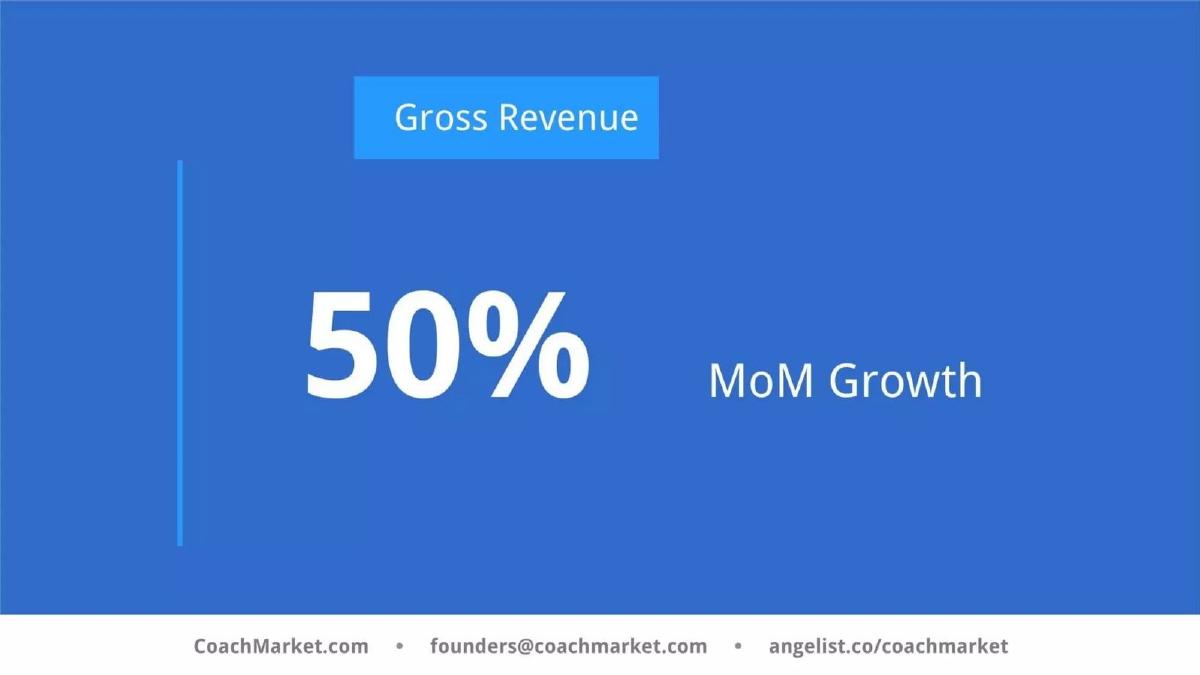
- The company reports a 50% Month-over-Month (MoM) growth in gross revenue on slide 3.
- Market pain is quantified by the statistic that 52% of people are unhappy in their current jobs on slide 4.
- The business model is built on an $800 average order value with a 20% commission, resulting in $160 net per transaction as shown on slide 11.
- The founding team claims over 40 years of combined experience in e-commerce and marketplaces on slide 12.
- The deck uses a narrative persona, 'Jack,' to illustrate the user journey from job seeking to being matched with a coach on slides 8 through 10.
- CoachMarket positions itself as the 'Expert Help' alternative to the 'DIY' job search method on slide 13.
- There is no specific funding ask, valuation, or use of funds slide included in the 14-slide deck.
- The deck omits a competitive analysis or a detailed breakdown of the total addressable market (TAM).
Introduction
The CoachMarket pitch deck, dating from 2014, is a quintessential example of the 'less is more' philosophy in early-stage fundraising. At 14 slides, it moves quickly through the problem, solution, and business model, relying on the pedigree of its founders to fill in the gaps. The company describes itself as an on-demand marketplace for career coaching, aiming to connect professionals with trusted advisors via a cloud-based platform.
The Opening Hook and Traction
Slide 1: Title Slide The deck opens with the company name, CoachMarket, and the tagline 'Be happy at work.' It identifies Glenn Laumeister as the Founder & CEO. The design is clean, using a solid blue background that remains consistent throughout the presentation.
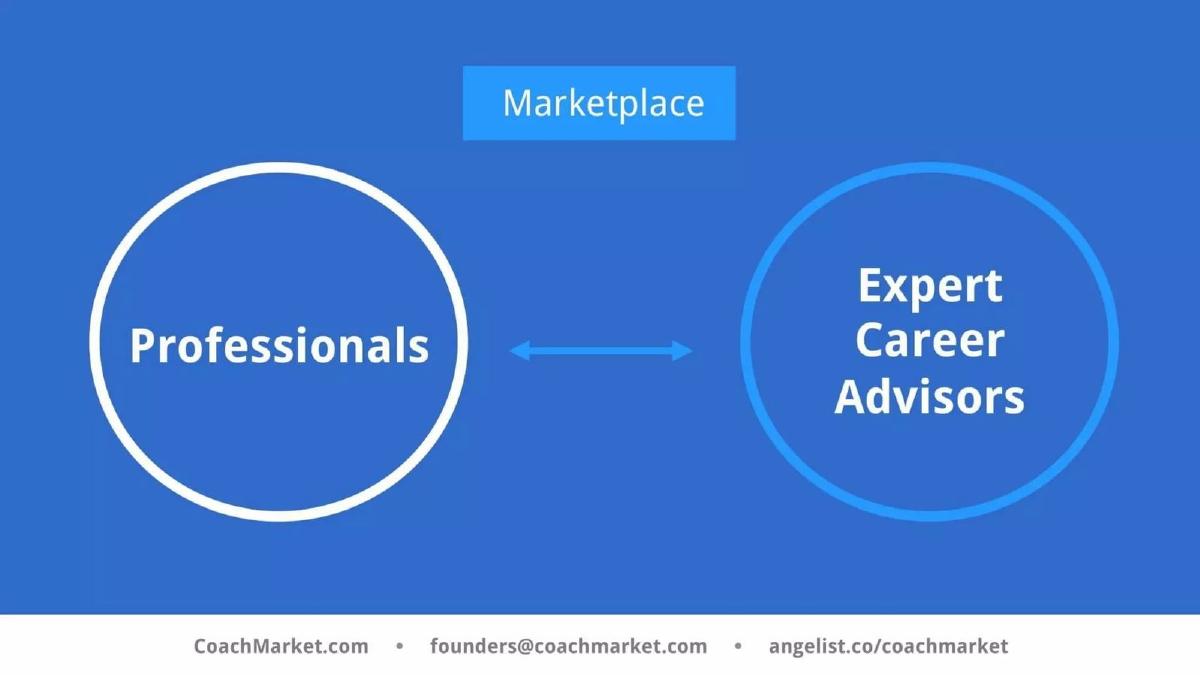
Slide 2: The Marketplace Concept This slide defines the two sides of the marketplace: 'Professionals' and 'Expert Career Advisors.' It is a simple visual representation of a two-sided platform, establishing the company as the bridge between these two groups. The footer includes the company website, a contact email, and an AngelList URL, which was a common practice for startups in the mid-2010s.
Slide 3: Gross Revenue Growth CoachMarket leads with traction. The slide displays a large '50%' next to the text 'MoM Growth' under the header 'Gross Revenue.' By placing this on slide 3, the founders are attempting to immediately de-risk the investment by showing that the market is already responding to their product. However, the lack of absolute numbers (e.g., growing from $1k to $1.5k vs. $100k to $150k) is a notable omission that a sophisticated investor would question.
Defining the Problem
Slide 4: The Unhappy Workforce The deck shifts to the 'Problem' phase. It features a black-and-white photo of a man in distress on a set of stairs. A blue circle overlays the text: 'Today, 52% Unhappy in their current jobs.' This slide establishes the scale of the potential user base by citing a broad labor market statistic.
Slide 5: The 'Why?' This is a transition slide featuring the word 'why?' against a background of question marks. It serves as a rhetorical pause before diving deeper into the specific pain point of the job search process.
Slide 6: The Pain of Job Hunting The deck gets specific about the emotional friction of their industry: 'People HATE looking for a job.' Accompanied by another image of a stressed professional, this slide aims to build empathy for the user and justify the need for a guided service rather than a self-service job board.
The Solution and User Journey
Slide 7: Product Visualization CoachMarket introduces its solution with a mockup of the platform on a desktop monitor. The headline is 'CoachMarket: Personalized Career Help.' The screen shows a hero image with the text 'A better way to find your next job' and a 'Get Started' button. This provides the first look at the actual user interface and brand aesthetic.
Slide 8: The Persona - Jack To explain the service, the deck uses a narrative approach. Slide 8 introduces 'Jack,' a professional who 'wants to find a new job.' Using a persona helps investors visualize the target demographic—in this case, a clean-cut, mid-career professional.
Slide 9: The Match The narrative continues: 'CoachMarket: Jack is matched with Jennifer.' This slide illustrates the core value proposition of the marketplace: the matching algorithm or curation process that connects a seeker with an expert.
Slide 10: The Outcome The final slide in the narrative sequence shows the results of the coaching. Jennifer (the coach) helps Jack with a 'New Career Path,' 'Targets Growth Industries,' and 'Updates LinkedIn.' This slide is crucial because it defines what the 'product' actually is—not just a conversation, but tangible career assets and strategy.
Business Model and Team
Slide 11: Unit Economics This is arguably the most important slide for a marketplace business. It breaks down the math: '$800 (Avg order) x 20% (Commission) = $160 (Net per transaction).' This clarity is excellent. It tells the investor exactly how the company makes money and what the throughput needs to be to reach significant scale. It avoids complex jargon and focuses on the core transaction.
Slide 12: The Team The 'Team' slide is a heavy hitter. It claims 'Over 40 Years of E-Commerce & Marketplace Experience.' It lists Glenn (CEO), Gus (CTO), Alex (CMO), and Shari (VP/Partnerships). The bottom of the slide is lined with logos: Priceline.com, MLBAM, HBO, Oracle, Idealab, GM, and Reynolds & Reynolds. For a 2014 seed-stage deck, this level of pedigree is designed to convince investors that the team has the operational maturity to execute on the marketplace model.
Conclusion and Call to Action
Slide 13: DIY vs. Expert Help The penultimate slide summarizes the market shift CoachMarket is betting on. It shows a 'DIY' circle with a dashed arrow pointing to 'CoachMarket: Expert Help.' This positions the company as a disruptor of the traditional, lonely job search process.
Slide 14: Closing Slide The deck ends with a photo of a smiling professional and the company email: 'founders@coachmarket.com.' There is no specific 'Ask' slide detailing the amount of capital being raised or the milestones that capital will achieve.
What Works in the CoachMarket Deck
The primary strength of this deck is its clarity of purpose . By the time an investor reaches slide 11, they understand the problem, the solution, the user experience, and the revenue model. The use of a persona (Jack) is an effective way to explain a service-based marketplace without getting bogged down in technical architecture diagrams.
The unit economics slide (Slide 11) is a model of simplicity. Many founders overcomplicate their business model slides with multi-year projections and tiered pricing. CoachMarket focuses on the single most important metric: the net revenue per transaction. This allows investors to quickly do the mental math on what it takes to get to a $10M or $100M revenue run rate.
Finally, the team pedigree (Slide 12) is presented with high authority. By grouping the logos of massive, successful corporations at the bottom, the founders borrow the credibility of those brands. The claim of '40 Years of Experience' provides a sense of stability that is often missing in early-stage pitches.
What is Missing from the CoachMarket Deck
The most glaring omission is the Fundraising Ask . A pitch deck is a tool to facilitate a transaction, yet this deck never specifies what that transaction is. Investors need to know how much money is being raised, the terms (if applicable), and most importantly, what the 'Use of Funds' will be. Will the money go toward acquiring more 'Jacks' (demand) or recruiting more 'Jennifers' (supply)?
There is also a complete lack of Competitive Analysis . In 2014, the career coaching and job search space was already crowded with players ranging from LinkedIn to niche coaching platforms and traditional outplacement firms. Failing to acknowledge competitors can make a founder look naive or suggest they haven't done their homework on market positioning.
The Market Size (TAM) is only hinted at. While slide 4 mentions that 52% of people are unhappy, it doesn't translate that into a dollar value. Investors want to see the Total Addressable Market calculated by multiplying the number of potential users by the average transaction value. Without this, it is difficult to judge if CoachMarket is a venture-scale opportunity or a lifestyle business.
Lastly, the Go-To-Market (GTM) Strategy is absent. We see that they are growing at 50% MoM, but we don't know how. Are they using SEO, paid search, B2B partnerships, or social media? A marketplace lives and dies by its ability to acquire users at a cost lower than the Lifetime Value (LTV), and this deck offers no insight into their acquisition engine.
What a Founder Should Copy
Founders should emulate the visual consistency of this deck. The blue-and-white theme is professional and unobtrusive, ensuring that the data points (like the 50% growth or the $160 net) are the stars of the show. The use of high-quality, relevant imagery helps to break up the text and maintain engagement.
The narrative flow is another strong point. Moving from a broad problem (job unhappiness) to a specific pain point (hating the job search) to a specific solution (Jack and Jennifer) is a classic storytelling structure that works well in a 10-minute pitch. It builds a logical case for the business before ever asking for money.
Finally, the simplicity of the business model is a major takeaway. If you cannot explain how you make money in a single equation, your business model might be too complex for an initial pitch. CoachMarket’s '$800 x 20% = $160' is a perfect example of how to communicate value capture effectively.
Final Thoughts
The CoachMarket deck is a product of its time—a period when 'Uber for X' and 'Marketplace for Y' were the dominant themes in venture capital. It succeeds in establishing a professional, high-pedigree image and clearly defining a simple business model. However, its lack of competitive context and a specific financial ask makes it feel more like a high-level teaser than a complete investment memorandum. For modern founders, this deck serves as a reminder that while pedigree and traction are powerful, they must be supported by a clear roadmap and a deep understanding of the competitive landscape to win over sophisticated investors in a crowded market.
Frequently asked questions
- What is the core business model of CoachMarket?
- According to slide 11, CoachMarket operates as a traditional marketplace. They facilitate transactions between professionals and career coaches. The deck specifies an average order value of $800. CoachMarket takes a 20% commission on these transactions, yielding a net revenue of $160 per transaction. This transparency in unit economics is a highlight of the deck.
- How does the deck demonstrate early traction?
- Traction is presented very early in the deck on slide 3. The company claims 50% month-over-month growth in gross revenue. However, the deck does not provide the baseline revenue figures or the duration over which this growth was sustained, which are common details investors look for to validate the quality of the growth.
- Who are the key members of the CoachMarket team?
- Slide 12 introduces four key leaders: Glenn (CEO), Gus (CTO), Alex (CMO), and Shari (VP/Partnerships). The slide emphasizes their collective 40+ years of experience and displays logos from prominent companies where they have worked, including Priceline.com, MLBAM, HBO, Oracle, Idealab, GM, and Reynolds & Reynolds.
- What problem is CoachMarket trying to solve?
- The deck identifies two primary problems: job dissatisfaction and the difficulty of the job search. Slide 4 notes that 52% of people are unhappy in their current jobs. Slide 6 explicitly states that 'People HATE looking for a job.' CoachMarket aims to alleviate this by replacing the 'DIY' approach with 'Expert Help' from career advisors.
- What critical information is missing from this pitch deck?
- The deck is missing several standard components: a specific financial ask (how much they are raising), a slide detailing the use of proceeds, a competitive landscape analysis, and a roadmap for future product development. It also lacks a detailed breakdown of the market size (TAM/SAM/SOM) beyond a single percentage of job unhappiness.