Codec’s pitch deck is a masterclass in brevity and high-signal communication. Spanning just 11 slides, it eschews dense text for powerful imagery and stark financial metrics. The narrative begins by identifying a massive inefficiency in global marketing spend—$166 billion wasted on 'lame content'—and illustrates this with visceral examples of brand blunders from Apple and Victoria's Secret. The solution is presented as a 'cultural intelligence' platform that uses AI to predict audience desires. With a reported $65k monthly revenue and a 50% CMGR, the deck proves product-market fit through a r…
Key takeaways
- The deck uses a provocative opening question on Slide 1 to immediately frame the value proposition around audience insight.
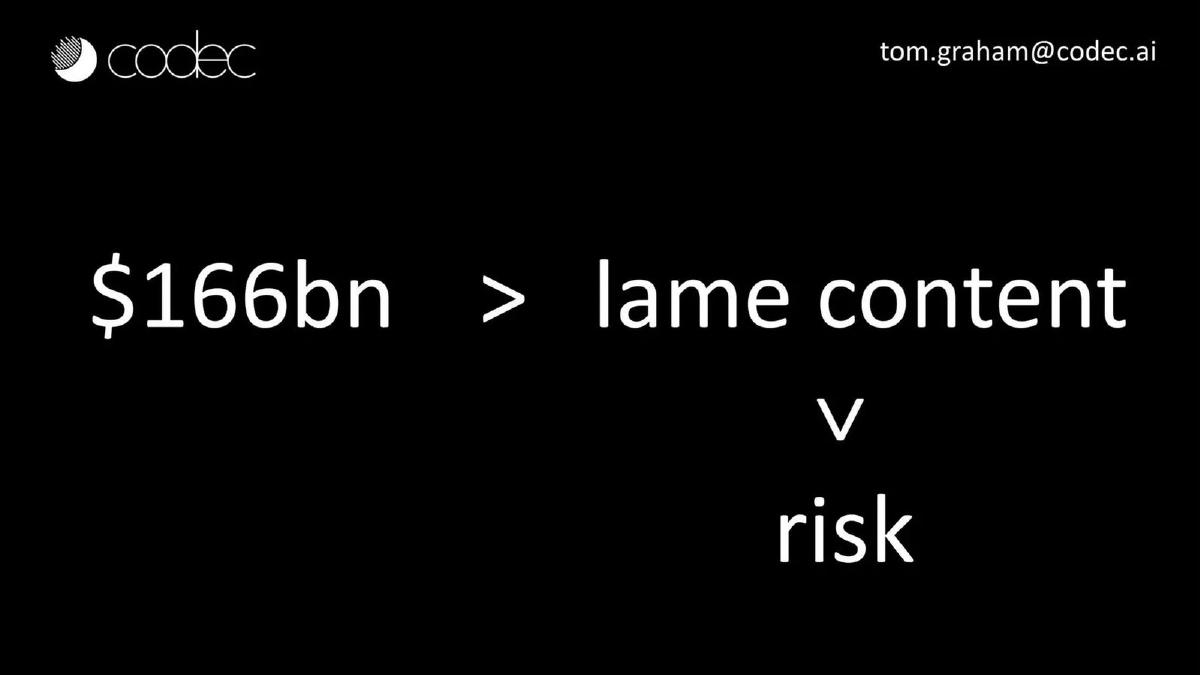
- Slide 4 identifies a specific $166bn market inefficiency, categorizing it as 'lame content' vs 'risk'.
- Visual storytelling is used on Slides 5 and 6 to highlight high-profile marketing failures by Apple and Victoria's Secret.
- Traction is presented with extreme clarity on Slide 8, citing $65k/month revenue and a 50% Compound Monthly Growth Rate (CMGR).
- The platform's predictive power is demonstrated via a 88% confidence score for a hypothetical campaign on Slide 7.
- The deck features an impressive logo wall on Slide 8, including global giants like Unilever, P&G, and L’Oréal.
- The team slide (Slide 10) emphasizes high-pedigree backgrounds including Harvard Law, Google-backed startups, and Expedia.
- The presentation completely omits a financial ask, use of funds, or a detailed roadmap, relying instead on momentum to drive interest.
The Power of Minimalist Persuasion
Codec’s 11-slide deck is a striking example of how to raise significant capital ($8.7 million) without overwhelming investors with data. In an era of 50-slide appendices, Codec opted for a high-contrast, visual-heavy approach that focuses on one thing: the massive gap between what brands create and what audiences actually want. By the time an investor reaches the traction slide, the problem has been so clearly illustrated through cultural 'fails' that the solution feels inevitable.
The Hook: Framing the Problem
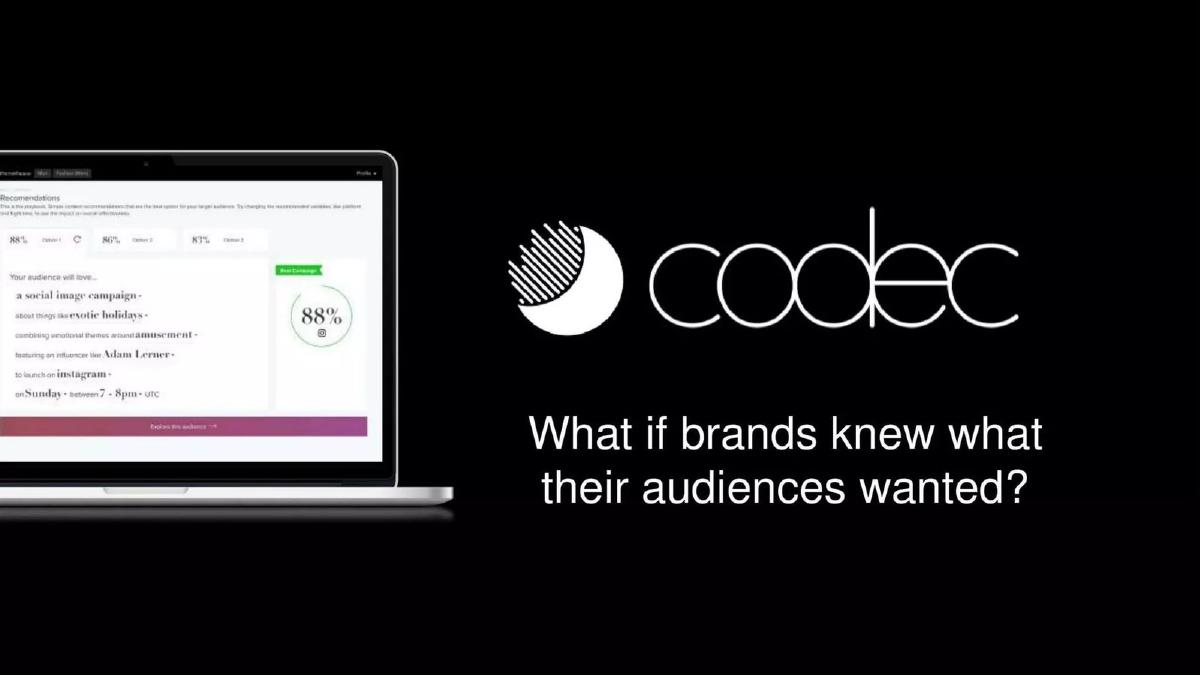
Slide 1: Title Slide The deck opens with a simple, provocative question: "What if brands knew what their audiences wanted?" This is paired with a clean product mockup showing a dashboard with an 88% resonance score. It immediately establishes that Codec is a predictive tool, not just an analytics tool.
Slides 2-3: Visual Context These slides appear to be placeholders for a video or a live demonstration involving P&G and Olay. Using a Miss Universe clip as a backdrop suggests that Codec operates in the world of high-stakes, high-glamour global marketing where brand sentiment is everything.
Quantifying the Inefficiency
Slide 4: The $166bn Gap This is the 'Market Opportunity' slide, though it doesn't look like a traditional one. It states that $166bn is spent on "lame content" vs "risk." This slide suggests that marketing spend is currently a binary choice between being boring or being dangerously out of touch. Codec positions itself as the third way: data-backed cultural relevance.
Slides 5-6: The Cost of Failure Codec uses two famous case studies to drive home the 'Risk' element mentioned on the previous slide. Slide 5 shows "Apple's $100 million U2 debacle," referring to the time Apple forced a U2 album onto every iPhone user's library. Slide 6 shows the Victoria's Secret "Perfect Body" campaign, which faced massive cultural backlash. By using these examples, Codec isn't just selling software; they are selling insurance against tone-deafness for CMOs.
The Solution and Product Interface
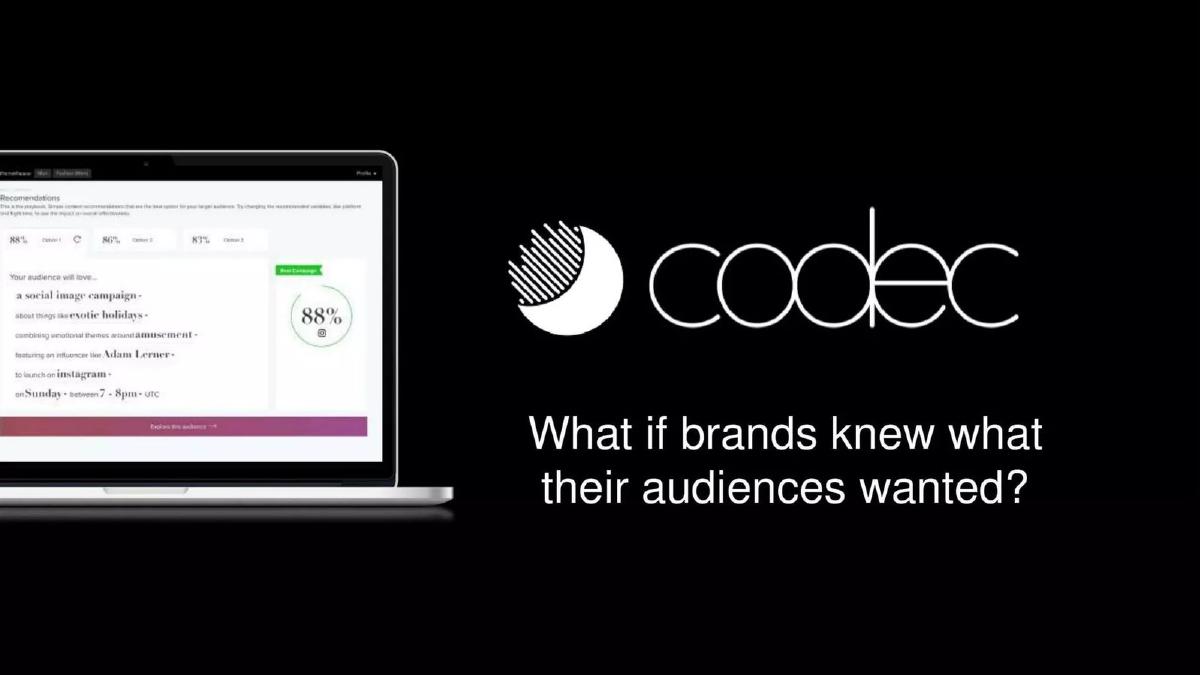
Slide 7: The Codec Platform We return to the product mockup. The slide lists specific variables the AI controls: Topics/Passions, Formats, Platforms, Visual Imagery, and Influencers. The mockup shows a specific recommendation: "a social image campaign about things like exotic holidays... featuring an influencer like Adam Lerner... on Sunday between 7-8pm." This slide is crucial because it moves the conversation from abstract 'AI' to concrete 'Actionable Insights.'
Traction and Social Proof
Slide 8: The Money Slide This is arguably the most important slide in the deck. It is split into two halves. On the left, two numbers: "65k /month" (revenue) and "50% CMGR" (Compound Monthly Growth Rate). On the right, a massive logo wall. Seeing Unilever, L’Oréal, P&G, and BP on the same slide as 50% monthly growth is a powerful signal to later-stage investors that the product has achieved enterprise-level product-market fit.
Slide 9: The Five Pillars This slide reinforces the data points Codec analyzes: Topics, Formats, Platforms, Visual Imagery, and Influencers. It’s a simplified view of their proprietary 'Cultural Intelligence' engine, stripping away the complexity of the AI to show the categories of output a brand receives.
The Team and Closing
Slide 10: The Pedigree The team slide features four individuals with high-signal backgrounds. Martin Adams (CEO) brings the legal and business development weight (Harvard Law, Songkick). Thomas Graham (Product) brings the startup 'exit' credibility (MapD, backed by Google and NVIDIA). Mark White and David Shawcross provide the technical backbone from Expedia and theAudience. This team composition suggests they have the 'right to win' in both the technical build and the enterprise sales cycle.
Slide 11: Contact The deck ends as simply as it began, with a repeat of the product mockup and a direct email address. There is no 'Ask' slide, no 'Use of Funds,' and no 'Financial Projections.' For a later-stage raise of $8.7M, this suggests the deck was used as a high-level teaser to secure a meeting, where the deeper due diligence would occur.
What Works
Extreme Focus on Pain Points: By using the Apple and Victoria's Secret examples, Codec makes the problem visceral. Every investor understands the embarrassment and cost of a PR disaster. · High-Signal Traction: Reporting a 50% CMGR alongside enterprise logos like Unilever is a 'best-in-class' traction signal. It shows they can sell to the hardest customers (Fortune 500) and do it quickly. · Visual Simplicity: The deck uses a black background with white text and high-quality images. It feels like a premium brand, which is exactly who their customers are. · Actionable Product Mockups: Instead of showing a complex 'how it works' diagram with gears and clouds, they show the output. Investors care more about what the customer gets than how the code is written.
What is Missing
The Ask: There is no mention of how much capital is being raised or what the valuation expectations are. While common in teaser decks, it leaves the reader without a sense of the deal's scale. · Competitive Landscape: The deck assumes Codec is in a category of one. It doesn't address how they differ from traditional social listening tools (like Brandwatch) or agency-led research. · Business Model: There is no explanation of how they charge. Is it a SaaS subscription? A per-campaign fee? A percentage of media spend? This is a significant omission for a later-stage deck. · The 'Why Now': While the problem of 'lame content' is eternal, the deck doesn't explain why 2015 was the specific moment this technology became possible or necessary.
What a Founder Should Copy
The 'Logo Wall' Strategy: If you have enterprise clients, put them front and center. Codec doesn't just list them; they let the logos take up half the traction slide. · Use Real-World Failures: If your product prevents a specific type of failure, show a famous example of that failure. It creates an immediate 'Aha!' moment for the investor. · The Traction/Growth Combo: Don't just show total revenue; show the growth rate. "$65k/month" is good, but "$65k/month at 50% CMGR" is an entirely different investment proposition. · Clean Design: Keep text to a minimum. If a slide requires more than two sentences to explain, it’s too crowded. Codec uses icons and short phrases to maintain a fast narrative pace.
Frequently asked questions
- What is the primary problem Codec is solving?
- Codec addresses the disconnect between brands and their audiences. According to Slide 4, brands spend $166 billion on content that is either 'lame' or carries significant reputational risk. The deck uses examples like Apple’s U2 album forced-download and Victoria’s Secret’s 'Perfect Body' campaign to show how even the largest companies fail to understand cultural nuances, leading to massive financial and brand equity losses.
- How does Codec prove its market traction?
- Codec uses a single, high-impact slide (Slide 8) to prove traction. It lists two key metrics: $65k in monthly revenue and a 50% Compound Monthly Growth Rate (CMGR). This is supported by a logo wall featuring over 20 major brands and agencies, including Unilever, L’Oréal, BP, and Castrol, indicating that their 'cultural intelligence' platform has already been vetted by enterprise-level marketing departments.
- What does the Codec platform actually do?
- Based on the product mockups on Slides 1 and 7, the platform provides specific, AI-driven recommendations for marketing campaigns. It suggests topics (e.g., 'exotic holidays'), emotional themes ('amusement'), specific influencers ('Adam Lerner'), and even the optimal time and platform for posting ('Instagram', 'Sunday between 7-8pm'). It assigns a percentage score (88%) to represent the likelihood of audience resonance.
- Who are the key members of the Codec team?
- The team (Slide 10) consists of four leaders with deep technical and legal backgrounds. CEO Martin Adams is a Harvard Law graduate and co-founder of Union. Thomas Graham (Product) co-founded a Google-backed GPU database. Mark White (Technology) was a Principal Architect at Expedia, and David Shawcross (Data Science) led data teams at theAudience and Unruly. This mix of enterprise architecture and data science expertise supports their AI-first claims.
- What is missing from the Codec pitch deck?
- The deck is notably missing several standard venture components. There is no 'Ask' slide detailing how much they are raising or the valuation. There is no competitive analysis or 'Why Now' slide. Additionally, the deck lacks a detailed business model or unit economics beyond the top-line revenue figure. It functions more as a high-level teaser for a later-stage round where these details would likely be handled in a data room.