Hum Capital’s Series A deck is a masterclass in positioning a service-heavy industry as a scalable technology platform. By framing themselves as the 'Kayak.com for Private Capital,' they successfully bridge the gap between traditional investment banking and modern fintech. The deck relies heavily on impressive top-of-funnel metrics, such as a $10B+ TTM revenue for active companies on the platform and $11B+ in investor AUM. While the deck is light on specific revenue models and unit economics, it compensates with a high-pedigree team slide featuring backgrounds from Google, KKR, and Stanford.…
Key takeaways
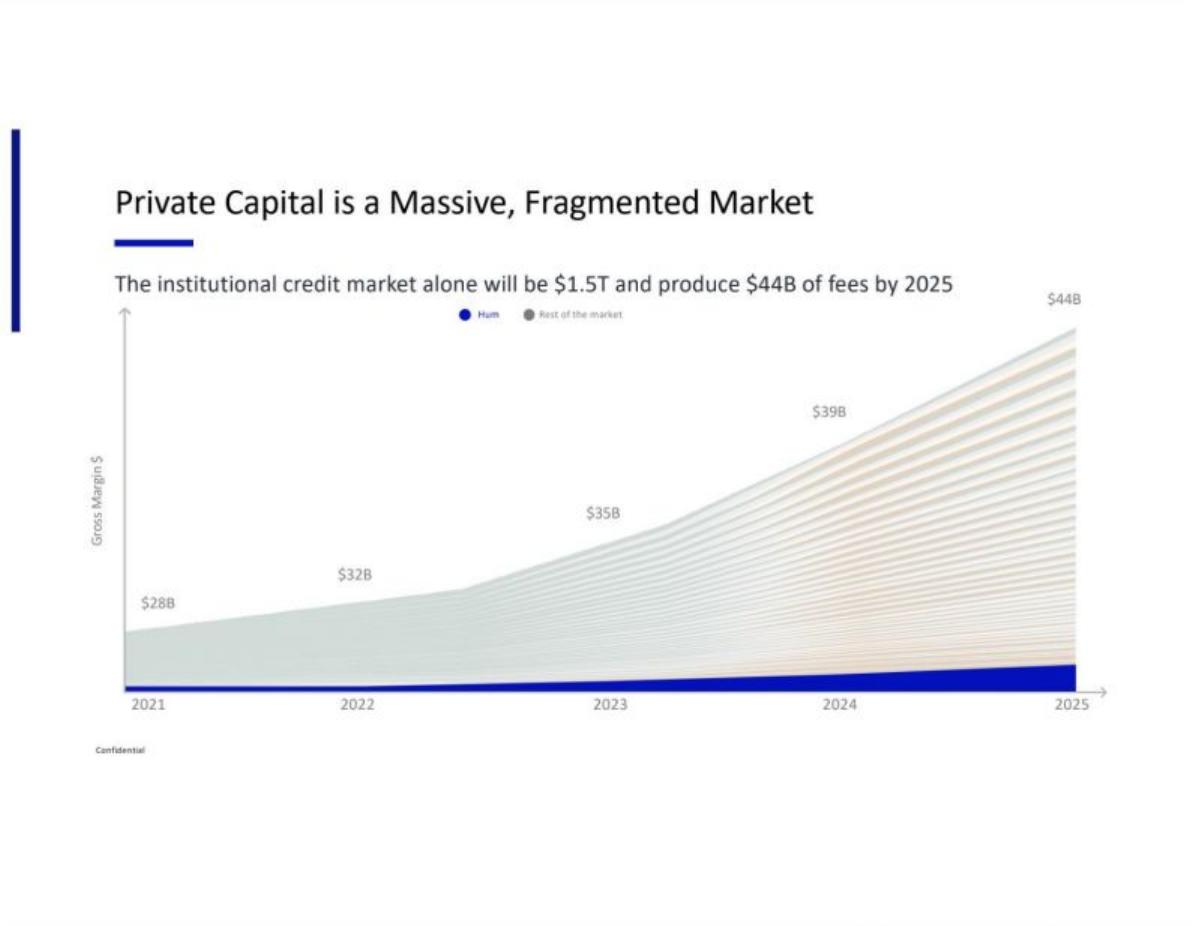
- Hum Capital positions itself as a marketplace solution for a $1.5T institutional credit market projected to produce $44B in fees by 2025 (Slide 3).
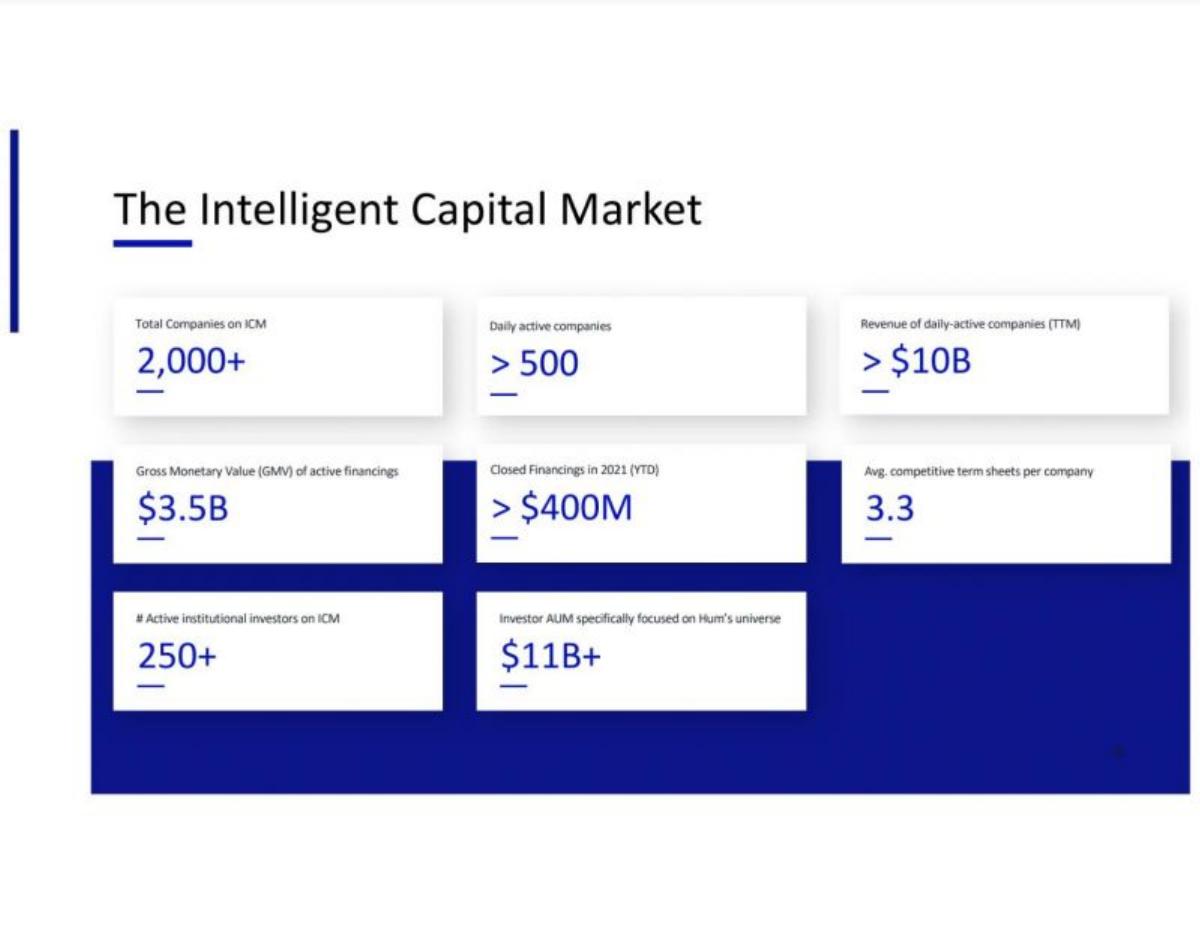
- The platform reports significant traction with over 2,000 total companies and $400M in closed financings in 2021 YTD (Slide 5).
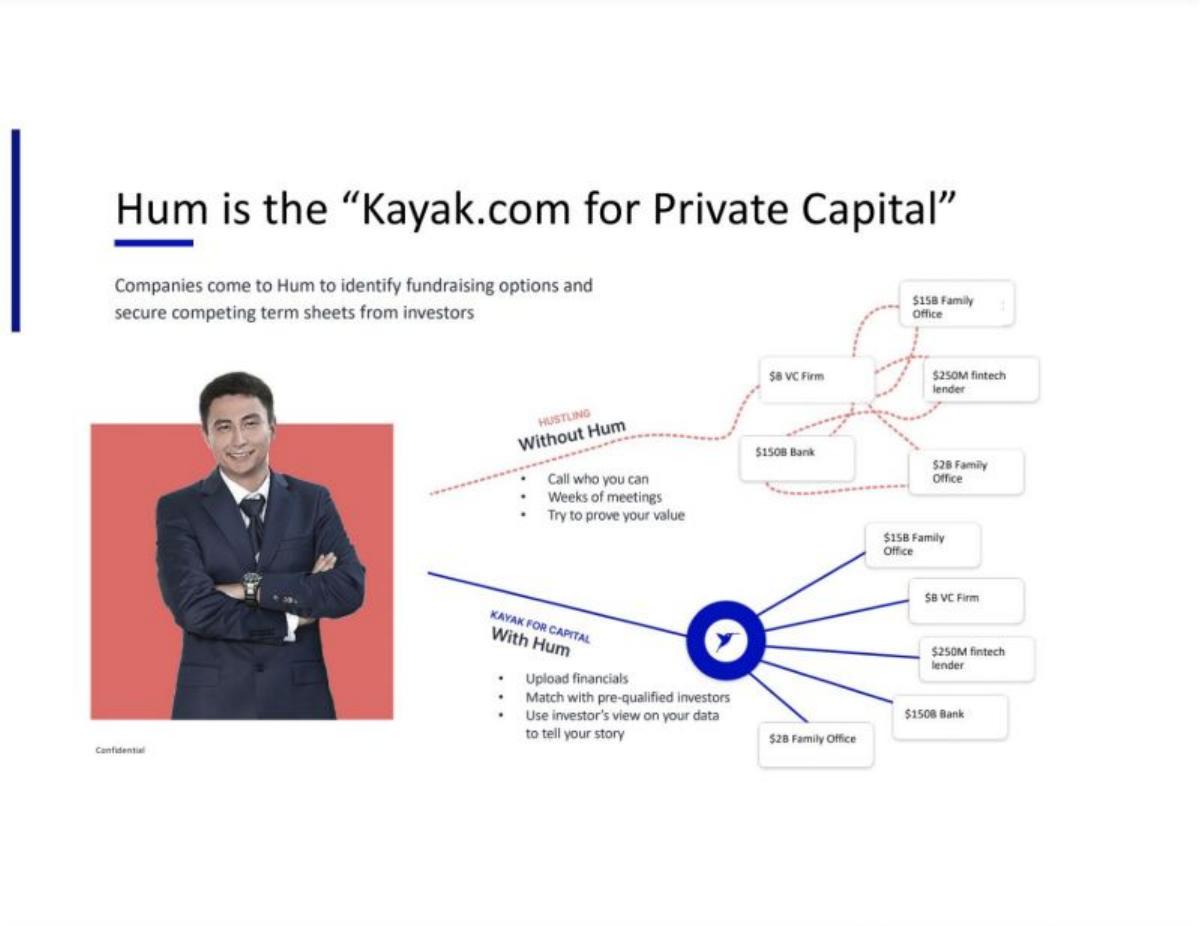
- The 'Kayak for Capital' analogy effectively simplifies a complex B2B process into a recognizable consumer-tech framework (Slide 6).
- The deck highlights a competitive advantage with an average of 3.3 term sheets per company, suggesting high platform efficiency (Slide 5).
- Network effects are central to the pitch, arguing that more deal flow attracts more investors, which in turn lowers the cost of capital (Slide 8).
- Technical defensibility is claimed through a 'Data Acquisition Engine' that ingests data from systems like NetSuite, Plaid, and Salesforce (Slide 9).
- The team slide emphasizes a 'Silicon Valley meets Wall Street' hybrid, featuring executives from Twitch, KKR, and Credit Suisse (Slide 10).
- The deck lacks a specific 'Ask' slide or detailed financial projections, focusing instead on the existing scale of the Intelligent Capital Market.
The Narrative: From Manual Hustle to Intelligent Markets
Hum Capital’s deck is built around the transition from the 'old way' of fundraising to a data-driven future. The opening slides establish a clear mission: 'Connecting Great Companies to the Right Capital.' This isn't just a matchmaking service; it is presented as a structural upgrade to the financial markets. By Slide 2, the problem is defined—fundraising is 'exclusive, inefficient and lacking in transparency.' The solution is the 'Intelligent Capital Market' (ICM), which uses AI to give founders an investor’s perspective on their own data.
Slide 1: Title Slide
The deck opens with a minimalist title slide. The tagline, 'Connecting Great Companies to the Right Capital,' is the central focus. It includes the company logo and website, establishing a professional, corporate-fintech aesthetic from the outset.
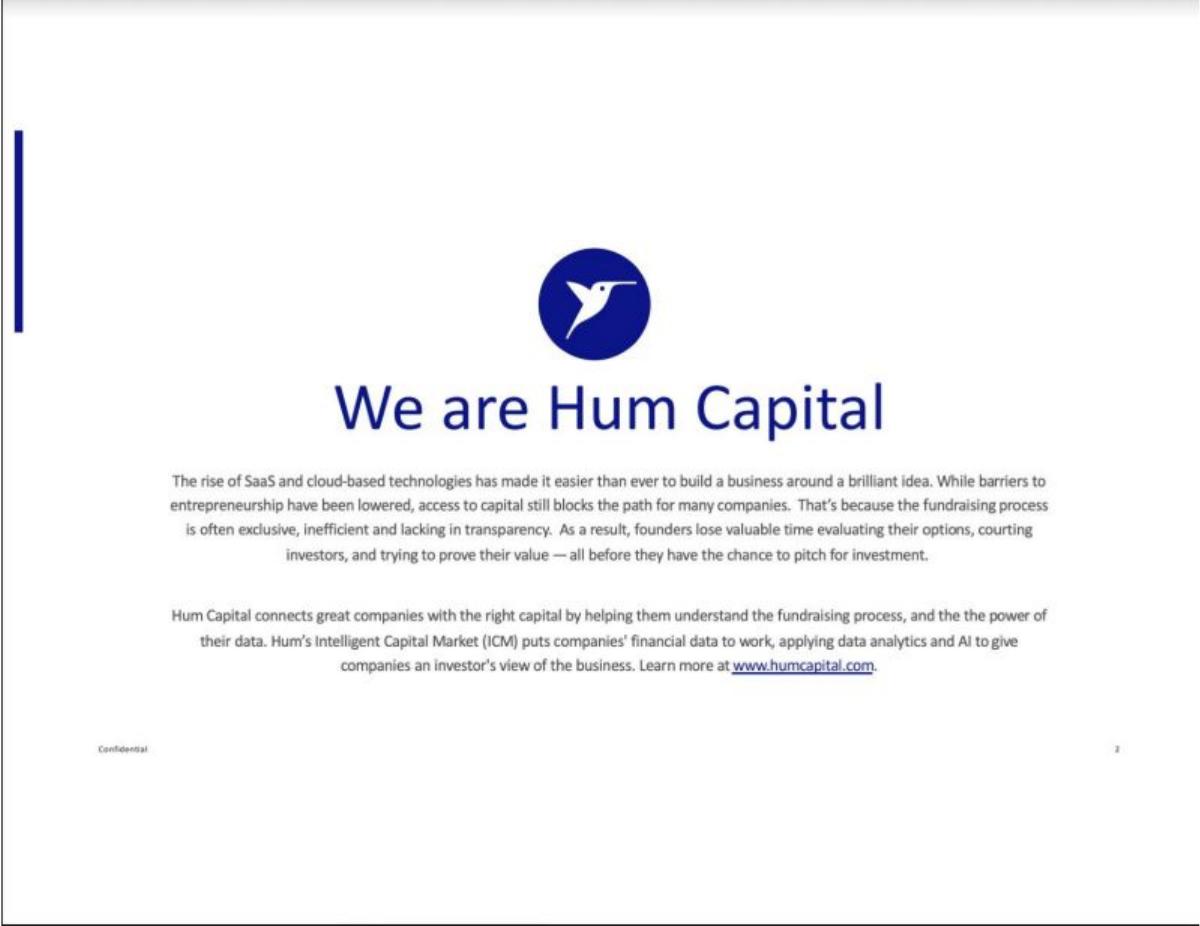
Slide 2: The Mission Statement
This slide provides the 'Why.' It acknowledges that while SaaS has made it easier to start a business, the 'access to capital still blocks the path.' It introduces the Intelligent Capital Market (ICM) as the tool that applies data analytics and AI to financial data. This is a crucial positioning move: they aren't a brokerage; they are a technology platform.
Slide 3: Market Size and Opportunity
Hum targets the private capital market, specifically the institutional credit market. The slide claims this market will reach $1.5T and produce $44B of fees by 2025 . The chart shows a steady growth in 'Gross Margin $' from $28B in 2021 to $44B in 2025. Interestingly, the chart includes a small blue sliver representing 'Hum' against the 'Rest of the market,' visually suggesting that even a tiny market share represents a massive revenue opportunity.
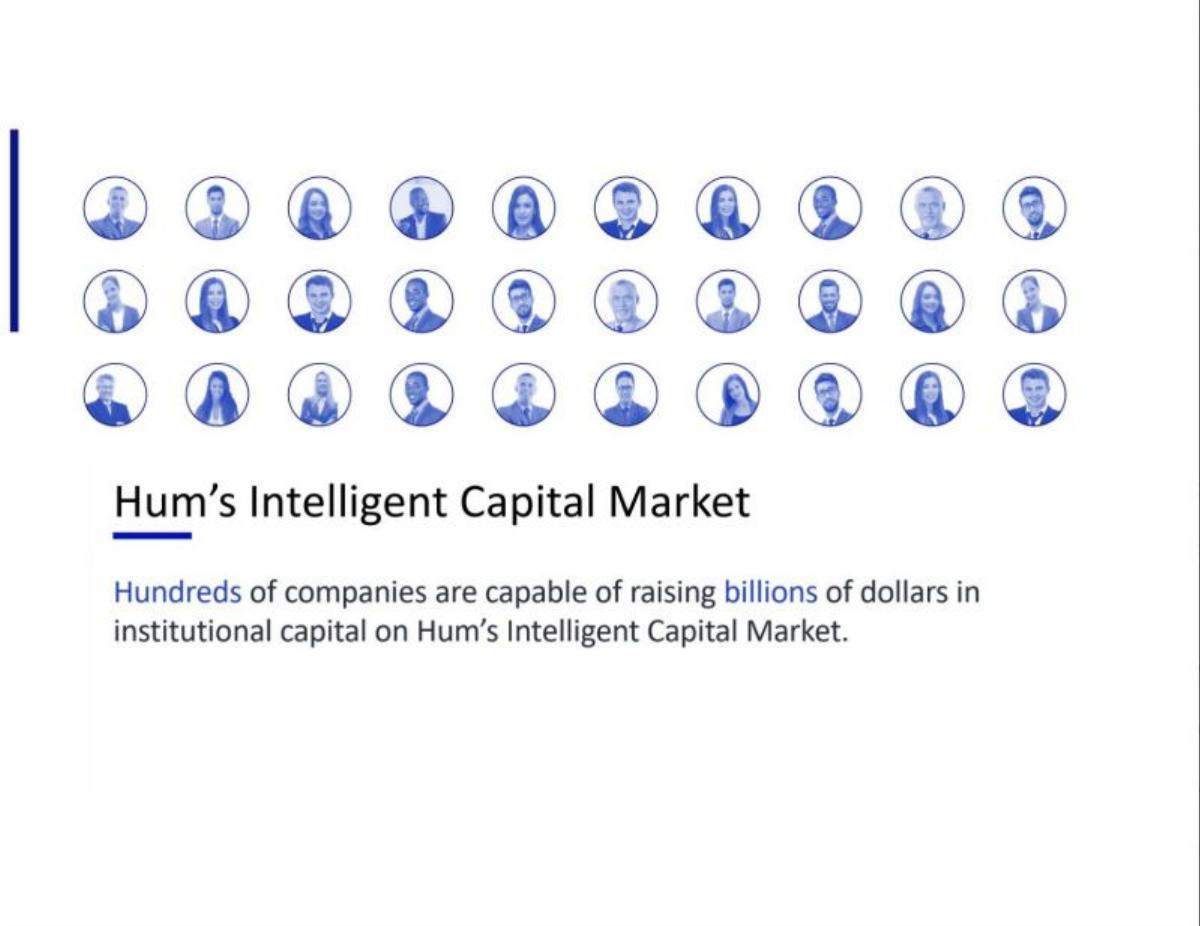
Slide 4: The Human Element
This slide features a grid of 30 diverse headshots under the header 'Hum’s Intelligent Capital Market.' The text notes that 'Hundreds of companies are capable of raising billions of dollars.' This slide serves as social proof, even if the individuals aren't named, by suggesting a large, active community of users already engaging with the platform.
Slide 5: Traction and Key Metrics
This is the 'meat' of the Series A pitch. Hum presents several high-impact figures:
2,000+ Total Companies on ICM · > 500 Daily active companies · > $10B Revenue of daily-active companies (TTM) · $3.5B Gross Monetary Value (GMV) of active financings · > $400M Closed Financings in 2021 (YTD) · 3.3 Avg. competitive term sheets per company · 250+ Active institutional investors on ICM · $11B+ Investor AUM specifically focused on Hum’s universe
These metrics are designed to show that the marketplace has reached a tipping point of liquidity.
Slide 6: The 'Kayak' Analogy
To explain their value proposition, Hum uses a 'Before vs. After' comparison. 'Without Hum' involves 'Hustling,' manual calls, and weeks of meetings. 'With Hum' involves uploading financials and matching with pre-qualified investors. Calling themselves the 'Kayak.com for Private Capital' is a powerful shorthand that helps investors immediately understand the business model: aggregation, transparency, and lead generation.
Slide 7: Product Interface and User Interaction
This slide shows a dashboard on a laptop, flanked by two users (a founder and an investor) with speech bubbles. The founder asks about debt safety and available offers, while the investor asks about up-sizing loans and peer performance. This illustrates the bilateral value of the platform: it’s a tool for founders to manage their balance sheet and a tool for investors to perform due diligence.
Slide 8: Network Effects
Hum explicitly labels itself a 'rare network effects business in the B2B fintech space.' The flywheel diagram shows how more businesses seeking analytics lead to more investors, which leads to more financing options, which lowers the cost of capital, which attracts more businesses. This is the 'moat' argument—that the platform becomes more valuable as it grows, making it harder for competitors to displace.
Slide 9: Technical and Data Moat
This slide dives into the 'how.' It describes a 'Deep Technical & Data Moat' consisting of a Data Acquisition Engine, a Cross-data Standardization Suite, and a Ground Truth Data Dictionary. By listing logos like NetSuite, Plaid, Salesforce, and Marketo , Hum demonstrates its ability to ingest 'millions of observed financial data points.' The claim that they analyze companies in > 220 industries suggests broad horizontal scalability.
Slide 10: The Team
The team slide is heavy on pedigree, divided between 'Silicon Valley technologists' and 'Wall Street investors.' Key highlights include:
Blair Silverberg (CEO): Stanford Engineering · Csaba Konkoly (President): Commonwealth · Chris Olivares (CTO): Stanford Engineering · Scott Brown (CMO): Google · Ken Eagle (CFO): KKR · Yotam Troim (CPO): Fundbox · Emily Stephens (Legal): Oaktree · Chris Dolezalek (Engineering): Twitch · David Wood (Quant): Credit Suisse
This mix of deep tech and high finance is essential for a company trying to disrupt institutional capital markets.
Slide 11: Conclusion
A simple 'Thank You' slide with the company logo and contact information, including their New York address at 530 7th Avenue.
Slide 12: BestPitchDeck.com Outro
This is a promotional slide for the source of the deck and is not part of the Hum Capital presentation.
What Works in This Deck
The Analogy: Comparing a complex financial engine to 'Kayak.com' is brilliant. It removes the friction of explaining a multi-sided marketplace and allows the investor to focus on the scale of the opportunity rather than the mechanics of the software.
The Flywheel: Explicitly calling out network effects (Slide 8) is a strong move for a Series A. Investors at this stage are looking for 'unfair advantages' that grow over time. By showing how data leads to better matching, which leads to more users, Hum builds a case for long-term defensibility.
The Traction Slide: Slide 5 is incredibly dense with the right kind of numbers. They don't just show 'users'; they show 'Daily Active Companies' and 'GMV of active financings.' The metric of 3.3 term sheets per company is particularly effective because it proves the platform actually works for the founders.
What Is Missing
Revenue Model: The deck is surprisingly silent on how Hum actually makes money. Do they take a percentage of the closed financings? Is there a SaaS subscription fee for the analytics? While the market fee opportunity is mentioned ($44B), Hum's specific take-rate is omitted.
The 'Ask': There is no slide detailing how much they are raising or what the funds will be used for. While the catalogue facts state they raised $9M, a standard pitch deck usually includes a slide on the primary use of proceeds (e.g., hiring, market expansion, R&D).
Competition: There is no competitive landscape slide. While the 'Without Hum' section on Slide 6 addresses the status quo, it doesn't address other fintech players or traditional investment banks that might be moving into the digital space.
What Founders Should Copy
The 'Silicon Valley + Wall Street' Framing: If you are building in Fintech, your team slide needs to reflect both worlds. Hum does this perfectly by pairing Stanford engineers with KKR and Credit Suisse veterans. It signals to investors that the team understands both the code and the compliance/capital side of the business.
Data as a Moat: Instead of just saying 'we have data,' Hum shows the infrastructure of their data (Slide 9). Listing the specific integrations (Plaid, NetSuite, etc.) makes the 'AI' and 'Analytics' claims feel grounded in reality rather than just buzzwords.
Simple Visuals: The deck uses a very clean, blue-and-white color palette with high-quality icons and clear charts. It looks like a professional financial tool, which builds trust before a single word is read.
Frequently asked questions
- How much did Hum Capital raise with this deck?
- According to the catalogue facts, Hum Capital raised $9M in a Series A round in 2021. The deck itself focuses on the scale of the market and the existing traction of the platform rather than the specific terms of the raise.
- What is Hum Capital's core product?
- The core product is the Intelligent Capital Market (ICM). As described on Slide 2 and Slide 7, it is a platform where companies upload financial data which is then analyzed by AI to provide an 'investor's view' of the business, connecting them with pre-qualified institutional investors.
- Who are the target customers for Hum Capital?
- The platform targets two sides: 'Great Companies' looking for institutional capital (Slide 1) and 'Institutional Investors' looking for data-validated investment opportunities. Slide 9 notes they analyze companies across more than 220 industries, from 'first dollar of revenue to IPO.'
- What is the 'Kayak for Private Capital' comparison?
- Found on Slide 6, this analogy explains that just as Kayak aggregates travel options, Hum aggregates fundraising options. It contrasts the 'Hustling' method (manual calls and weeks of meetings) with the 'Hum' method (uploading financials and matching with pre-qualified investors).
- What data sources does Hum Capital use?
- Slide 9 lists several integrations for their Data Acquisition Engine, including NetSuite, Plaid, Chase, Google Drive, Salesforce, Marketo, and Nortridge. This allows them to automatically structure and benchmark financial data from SaaS systems of record.