HumanForest's 2020 Seed deck is a fascinating example of a hardware-adjacent company pitching itself as a data and marketing platform. While most micromobility startups struggle with the high costs of fleet maintenance and low per-ride margins, HumanForest introduced a model offering 20 minutes of free daily riding, subsidized by corporate partners. The deck focuses heavily on the 'why now'—leveraging the post-COVID shift in urban transport and the global climate emergency. By framing the bike not just as a vehicle, but as a mobile billboard and a source of high-intent mobility data, the comp…
Key takeaways
- The core product offers 20 minutes of free daily riding on electric, dockless bikes, as stated on slide 3.
- HumanForest positions itself as a marketing platform, listing 14 different communication channels for brands on slide 8.
- The business model relies on partner companies funding the free minutes in exchange for access to the user platform, according to slide 7.
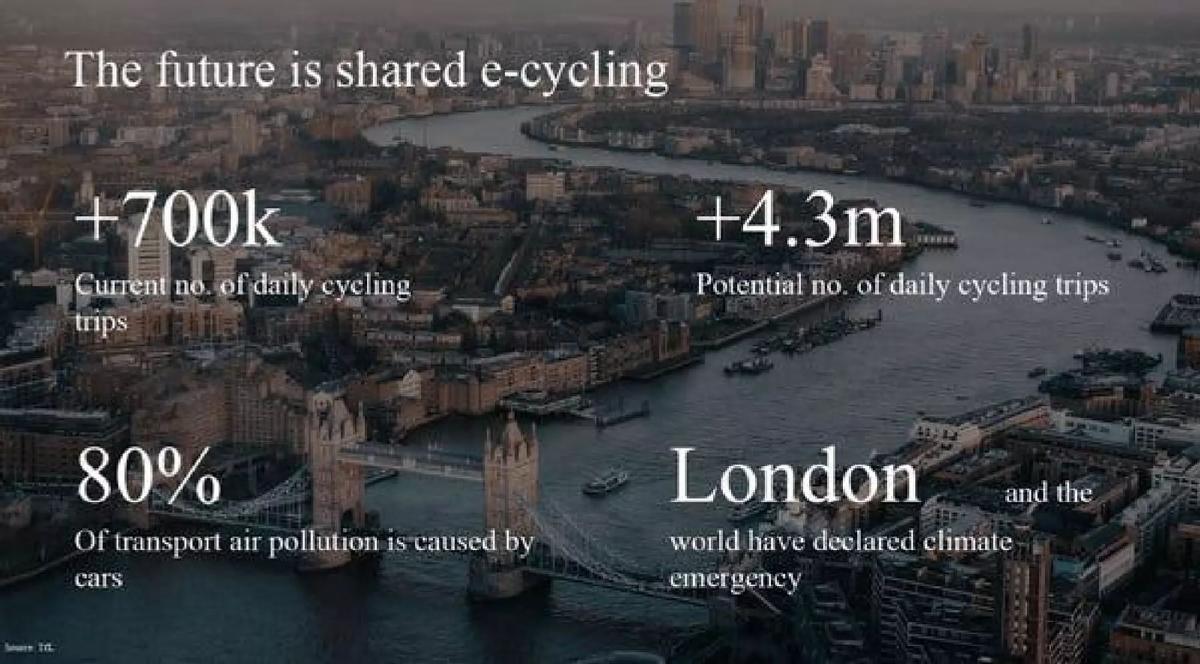
- The deck highlights a massive market gap in London, noting a potential for 4.3 million daily cycling trips compared to the current 700k on slide 5.
- Environmental impact is a key pillar, claiming cycling 5km daily for a year saves 1,356.54 GBP and reduces CO2 by 287kg on slide 9.
- The company claims micro-mobility is the fastest-growing sector in mobility investment with 176% growth, cited on slide 13.
- There is a complete absence of a dedicated team slide with names or professional backgrounds, despite 'Experienced management team' being listed as a reason to invest on slide 14.
- The deck lacks a specific 'Ask' slide detailing how the $5.4 million would be allocated across operations, hardware, or marketing.
The Ad-Tech Pivot of Micromobility
HumanForest entered the crowded micromobility space in 2020 with a distinct angle: making the ride free for the user by making the brand pay. This 14-slide deck was the vehicle for their $5.4 million Seed round. It is less a pitch for a bike-sharing company and more a pitch for a two-sided marketplace where commuters provide data and attention in exchange for carbon-neutral transport. The deck leans heavily into the macro-trends of 2020—specifically the climate emergency and the shift in urban mobility caused by the COVID-19 pandemic.
Slides 1-3: The Mission and the Product
Slide 1 is a minimalist title slide featuring the company name and the tagline: "Our commitment is to you and the planet." The visual style uses simple, white-line illustrations of stylized figures, establishing a friendly, non-corporate brand identity.
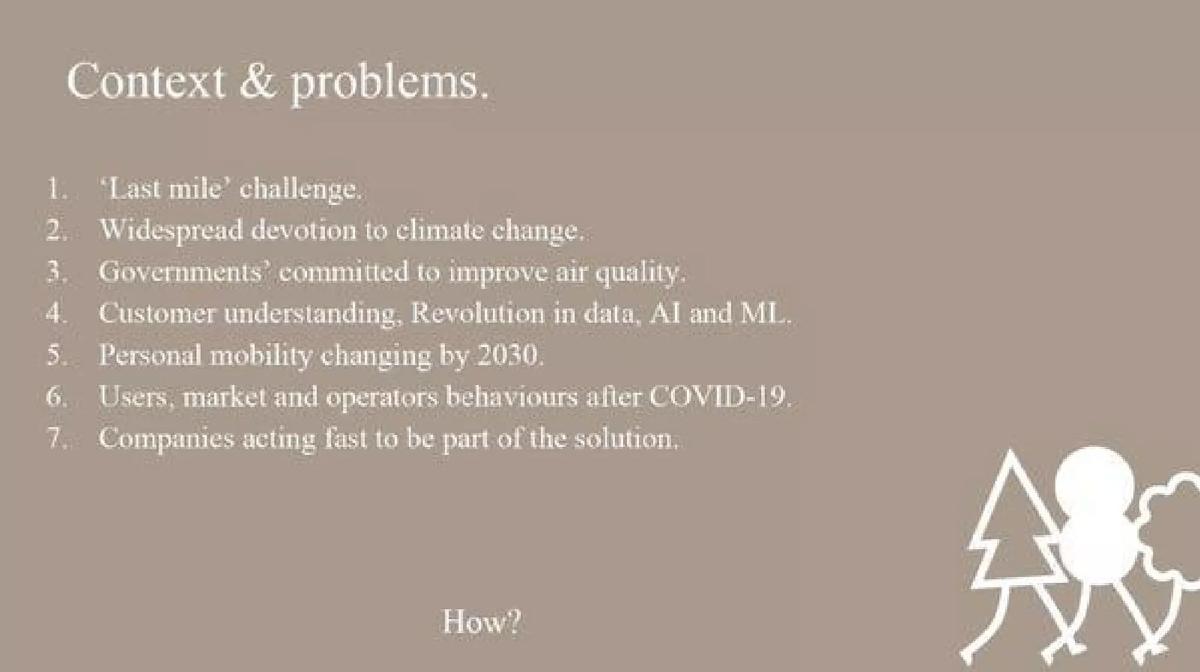
Slide 2 outlines the "Context & problems." It lists seven points, ranging from the "Last mile challenge" to "Personal mobility changing by 2030." Notably, it mentions the "Revolution in data, AI and ML," signaling early on that this is a technology play, not just a hardware play. The slide ends with a rhetorical "How?" leading into the solution.
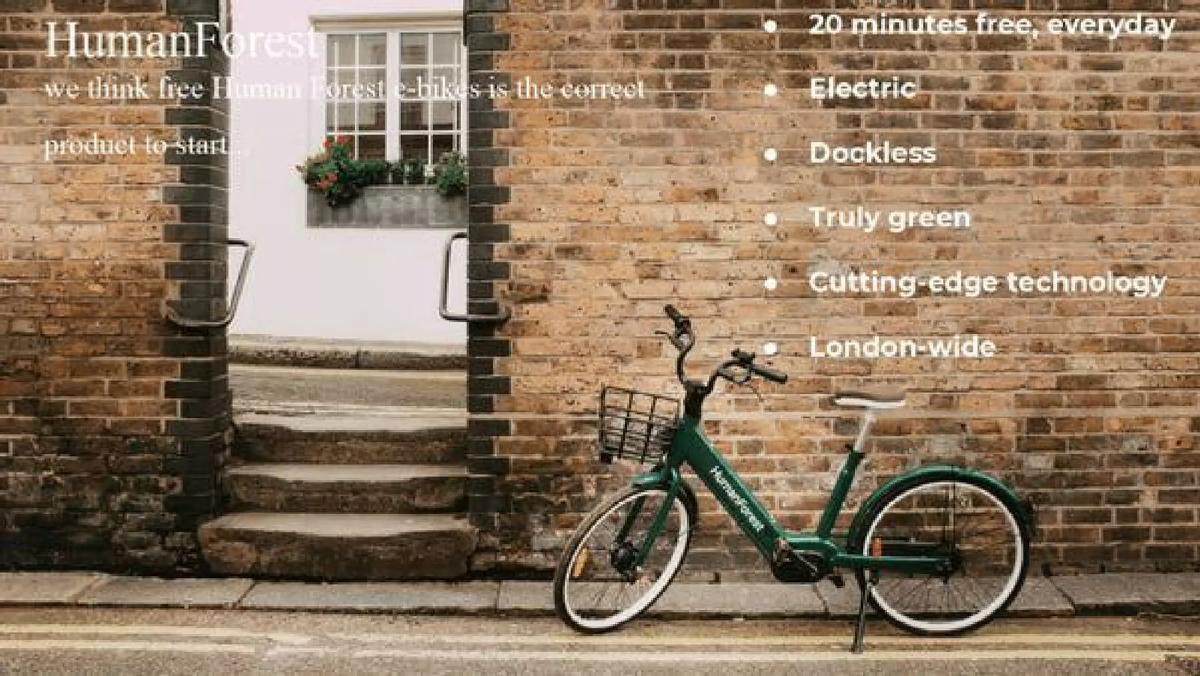
Slide 3 introduces the product. It features a high-quality photo of a green HumanForest e-bike against a brick wall. The key value propositions are listed clearly: 20 minutes free every day, electric, dockless, truly green, cutting-edge technology, and London-wide. This slide is effective because it immediately defines the user experience and the geographic focus.
Slides 4-5: The Market Timing and Opportunity
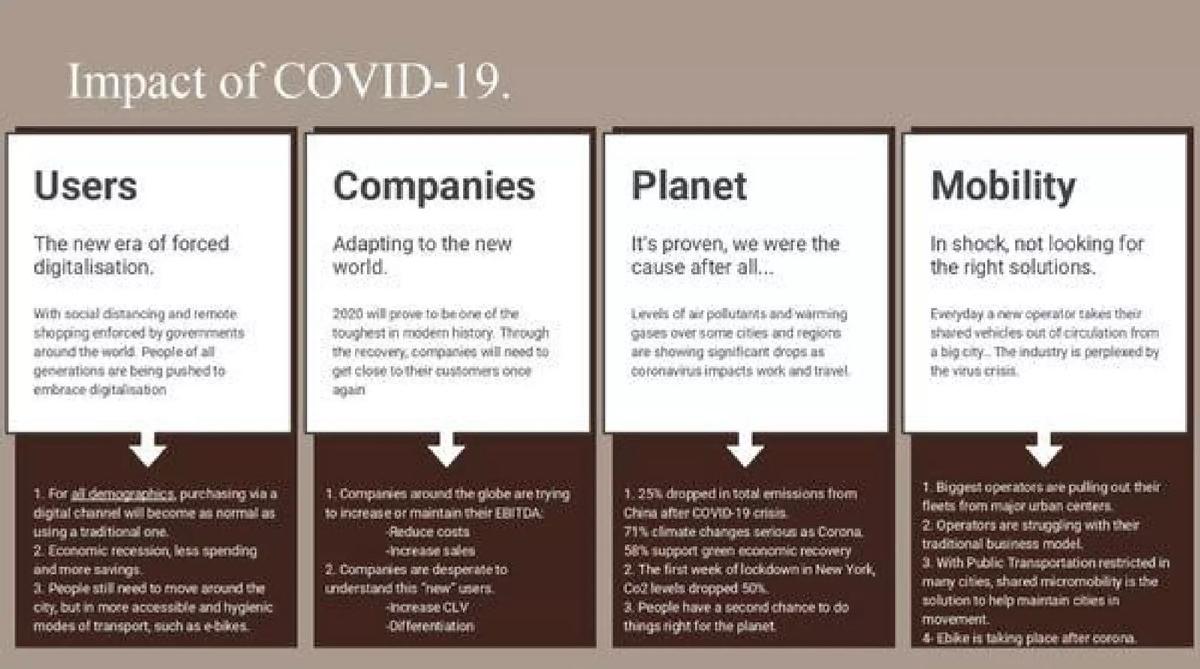
Slide 4 addresses the "Impact of COVID-19." It breaks this down into four categories: Users, Companies, Planet, and Mobility. The slide argues that the pandemic has pushed all generations toward digitalization and created a need for "accessible and hygienic modes of transport." It also highlights a 25% drop in total emissions from China as proof that environmental change is possible, framing HumanForest as a tool for a "green economic recovery."
Slide 5 focuses on the London market. It claims there are currently 700k daily cycling trips but a potential for 4.3 million. It also notes that 80% of transport air pollution is caused by cars. By contrasting the current state with the potential, the deck establishes a massive headroom for growth in a single city before even considering international expansion.
Slides 6-10: The Business Model and B2B Value Proposition
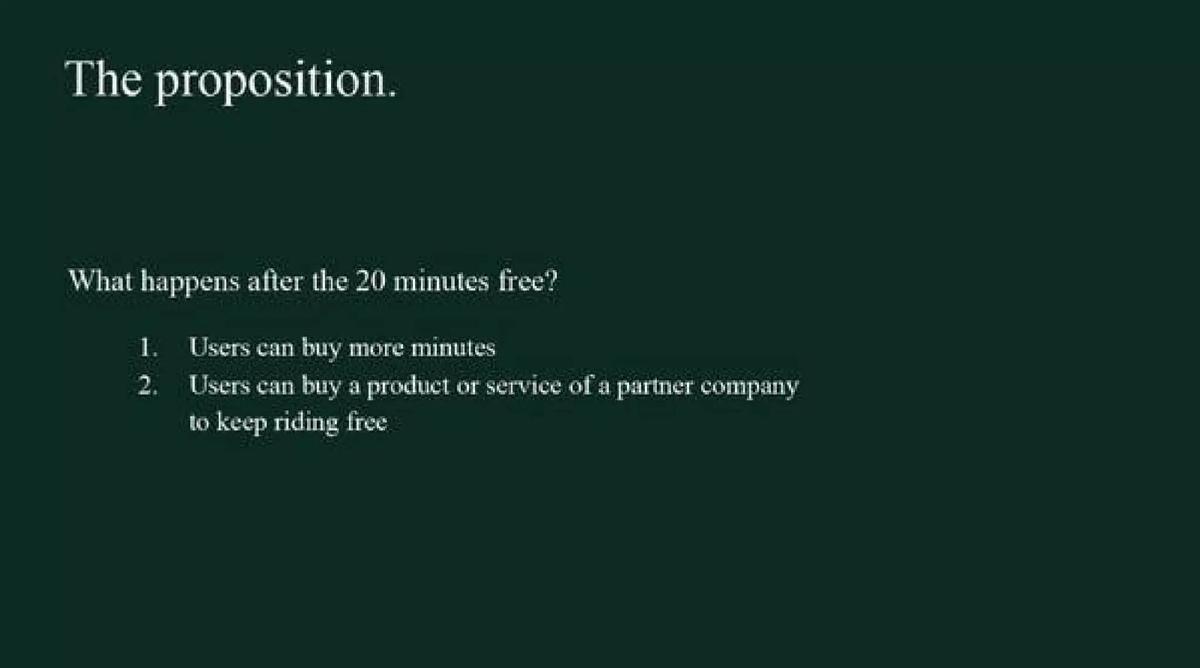
Slide 6 asks the critical question: "What happens after the 20 minutes free?" The answer is twofold: users can buy more minutes, or they can buy a product/service from a partner company to keep riding for free. This is the crux of the HumanForest model.
Slide 7 provides a "Partnership proposal overview." It shows a diagram where HumanForest sits between partner companies and consumers. The slide breaks the B2B offering into three platforms: Digital Marketing and Loyalty, ESG & Social Purpose, and Data Driven. This is where the deck transitions from a mobility pitch to an ad-tech pitch.
Slide 8 goes deeper into the "Digital marketing platform." It lists 14 communication channels, including direct methods like "Geo in-app notification" and "SMS," and indirect methods like "In-app presence" and "Events." The bottom of the slide shows a series of smartphone mockups displaying how ads appear to users, providing concrete proof of the advertising real estate.
Slide 9 focuses on "Environment CO2 - Social purpose." It provides a "Transport mode comparison" and a table showing the benefits of cycling 5km per day for a year. The figures are highly specific: 287kg of CO2 reduction and 1,356.54 GBP saved. This data is designed to help partner companies quantify their ESG (Environmental, Social, and Governance) contributions when they sponsor the fleet.
Slide 10 details the "Mobility data" offering. It promises partners "Thousands of daily relevant and meaningful interaction with your consumers." It mentions segmenting by demographics and psychographics and using machine learning for behavior prediction. A screenshot of a "Partners dashboard" is shown, visualizing heatmaps and usage charts.
Slides 11-14: The Investment Case
Slide 11 presents a "Marketing Offline benchmark." It compares the cost of a HumanForest partnership to traditional media, stating that a monthly investment is equal to 15 billboards, 1 to 3 newspaper ads, or 3 to 5 thirty-second TV ads. This slide attempts to justify the price point for B2B partners by showing the relative expense of legacy advertising.
Slide 12 summarizes the benefits for companies: "Increase your EBITDA in a sustainable way," "Bring your company direct to consumers' phones," and "Sector exclusivity." The mention of EBITDA (Earnings Before Interest, Taxes, Depreciation, and Amortization) is a strong appeal to corporate finance departments.
Slide 13 uses a third-party chart (Figure 3) to show growth in global capital investment in mobility. It highlights that "The biggest growth is in micro mobility, 176%." This slide serves to validate the sector to investors who might be wary of the capital-intensive nature of bike-sharing.
Slide 14 concludes with "Why invest in HumanForest?" It lists seven points, including "Positive EBITDA & high returns," "Multiple income streams," and "Experienced management team." The deck ends on this summary without a specific call to action or contact information on the final slide.
What Works in This Deck
The Value Proposition for Partners: Most mobility decks focus exclusively on the rider. HumanForest spends nearly half the deck (Slides 7-12) explaining exactly how a corporate partner extracts value. By framing the bike as a marketing expense for brands rather than just a transportation expense for users, they solve the primary hurdle of the industry: low consumer willingness to pay.
Clear Market Focus: Slide 5 does an excellent job of narrowing the focus to London. By providing specific stats for one city (+4.3m potential trips), they make the growth story feel tangible and achievable rather than chasing a vague global number.
Visual Consistency: The deck uses a consistent dark green and tan color palette that aligns with its environmental mission. The use of mockups for the app and the partner dashboard makes the technology feel "real" even at the Seed stage.
What Is Missing From This Deck
The Team: This is the most glaring omission. Slide 14 claims there is an "Experienced management team," but there are no bios, no names, and no track records provided. In a Seed round, the team is usually the most important factor. While the founders' backgrounds at Cabify were likely known to the investors, their absence from the deck is a breach of standard pitching practice.
The Ask: There is no slide stating how much money is being raised or how it will be spent. While we know from catalogue data that they raised $5.4 million, a founder using this deck as a template must include a slide detailing the use of funds (e.g., % for fleet expansion, % for software development, % for marketing).
Unit Economics: While the deck mentions "Positive EBITDA," it doesn't show the math. Investors in the mobility space are notoriously skeptical of unit economics due to the high cost of bike maintenance, battery charging, and theft. The deck lacks a breakdown of the cost per ride versus the revenue per ride (from both ads and user payments).
What a Founder Should Copy
The 'Why Now' Slide: Slide 4 is a masterclass in using a global crisis (COVID-19) to create urgency. It doesn't just say "the world changed"; it breaks down exactly how that change benefits each stakeholder (Users, Companies, Planet, Mobility).
Benchmarking Against Alternatives: Slide 11 is a clever way to handle pricing objections. If you are selling a new type of B2B service, don't just state your price—compare it to the legacy budget line items your customer is already paying for, like billboards or TV ads.
Quantified Social Impact: Slide 9 takes a vague concept ("being green") and turns it into hard numbers. If your startup has an ESG component, provide the specific CO2 or monetary savings your product generates. It makes the impact feel like a calculated ROI rather than a feel-good marketing claim.
Final Analysis
HumanForest's deck succeeded because it reclassified a hardware business as a software and advertising business. By doing so, they moved the conversation away from the "race to the bottom" pricing of Uber and Lime and toward the high-margin world of digital advertising and data. While the lack of team and financial detail is surprising for a $5.4M round, the strength of the macro-narrative and the unique B2B revenue model clearly resonated with their Seed investors.
Frequently asked questions
- How does HumanForest make money if the rides are free?
- HumanForest utilizes an ad-supported model. Slide 7 explains that partner companies fund the first 20 minutes of a user's daily ride. In exchange, these partners get access to a digital marketing and loyalty platform, ESG branding opportunities, and a data-driven dashboard to track consumer behavior. After the free 20 minutes, users must pay for additional time or engage with partner offers to continue riding for free.
- What is the 'Last Mile' challenge mentioned in the deck?
- The 'Last Mile' challenge, listed as the first problem on slide 2, refers to the difficulty of transporting people from a hub (like a train station) to their final destination. HumanForest positions its dockless e-bikes as the solution to this gap, especially in a post-COVID world where users are seeking more hygienic and accessible modes of transport than traditional public transit.
- What kind of data does HumanForest collect for its partners?
- According to slide 10, the company provides partners with a 'Mobility data' dashboard. This includes consumer knowledge and understanding, demographic and psychographic segmentation, and location-based usage patterns. They also claim to use machine learning models to predict consumer behavior patterns, allowing brands to target users with highly specific in-app and push notifications.
- Is the team behind HumanForest experienced?
- Slide 14 lists an 'Experienced management team' as a primary reason to invest. However, the deck provides no names, photos, or previous company affiliations for the founders or executives. Investors in 2020 likely relied on external due diligence or the catalogue fact that the company is led by former Cabify executives, though this is not explicitly stated in the slides.
- How does the deck address the impact of COVID-19?
- Slide 4 is dedicated entirely to the pandemic's impact. It argues that COVID-19 accelerated 'forced digitalisation' and made people seek more hygienic transport. It also notes that while traditional mobility operators were pulling fleets out of cities, the crisis created a 'second chance' for the planet due to dropped emission levels, positioning HumanForest as a timely solution for a green recovery.