Scientus Pharma (Hydrx Farms Ltd) positions itself as a pharmaceutical-grade cannabinoid company, distancing itself from the 'traditional' recreational cannabis market. The deck, dated July 2018, focuses heavily on the science of decarboxylation—the process of activating cannabinoids for physiological activity. By highlighting a proprietary extraction apparatus and citing systematic reviews on the 'opioid-sparing' effects of cannabinoids, the company targets the medical community and institutional investors. The presentation is notable for its transparency regarding its cap table and legal ri…
Key takeaways
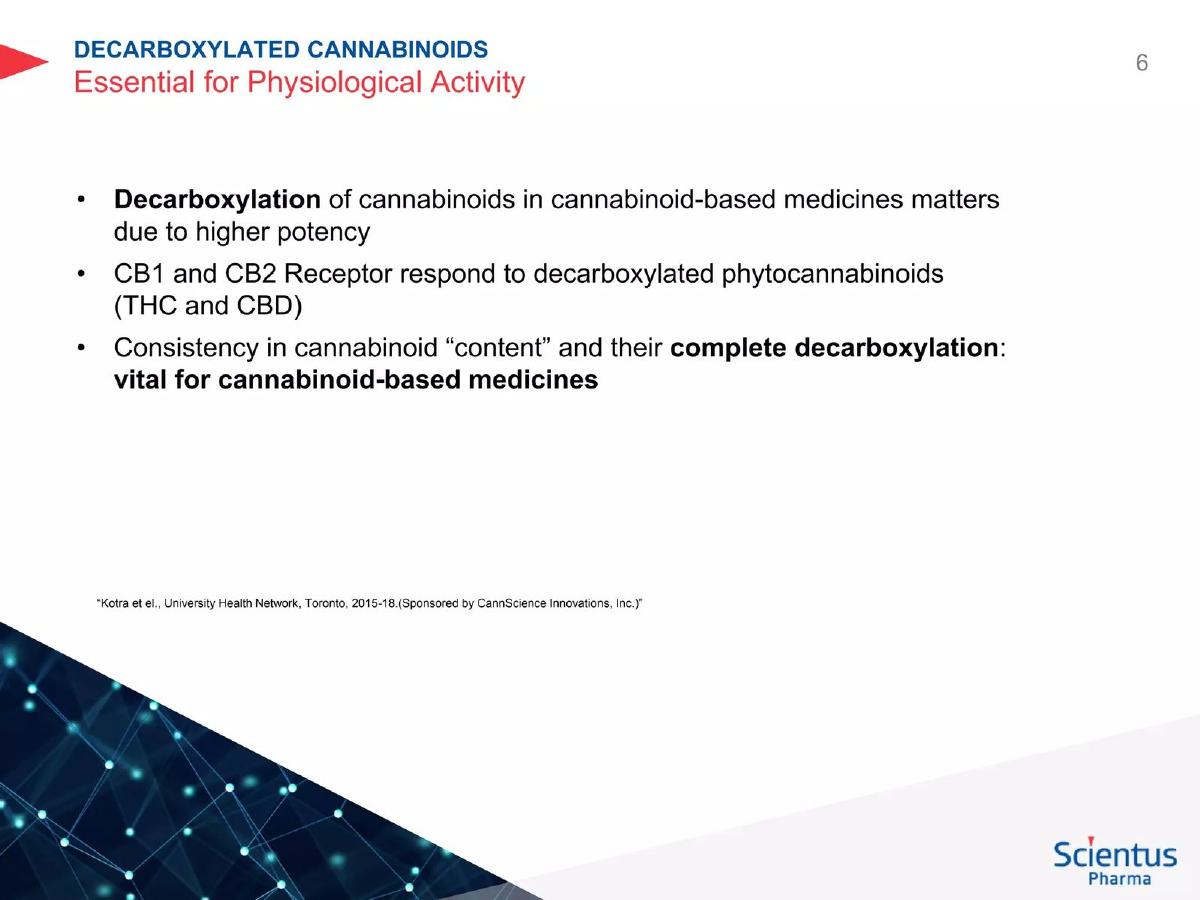
- The company emphasizes 'complete decarboxylation' as the vital metric for pharmaceutical-grade cannabinoid medicines on slide 6.
- Scientus claims to have achieved industrial scale-up with 99.5% decarboxylation consistently reproduced, citing US Patent Application# 62/609,708 from December 2017 on slide 11.
- The deck leverages clinical evidence, specifically a 2017 meta-analysis on the opioid-sparing effects of cannabinoids, to position its products as alternatives to traditional pain management on slide 16.
- Six 'Brand Levers' are identified to 'filter out the noise,' including product differentiation, credible associations with the University Health Network (UHN), and a disease-specific clinical development plan on slide 21.
- A detailed cap table as of July 30, 2018, shows 56,566,071 fully diluted shares, with insiders holding 29.8% of the company on slide 26.
- The presentation includes a legal disclosure regarding a 'Precursor Issuance' of 863,905 shares ordered by a court judgment dated July 10, 2018, on slide 26.
- Comparative data on slide 31 illustrates 'incomplete decarboxylation' in various competitor samples, showing high ratios of inactive acids (like THCA) to active compounds (THC).
- Extensive risk factors are disclosed in Appendix B, including the admission that the company was not currently revenue-producing at the time of the presentation on slide 36.
Introduction: The Pharmaceutical Pivot
Scientus Pharma, operating under the legal name Hydrx Farms Ltd, presents a deck that is less about the 'green rush' and more about biochemical precision. In a 2018 market saturated with recreational branding, this presentation attempts to carve out a niche in the medical and pharmaceutical space. The visual language is clinical, using white backgrounds, technical diagrams, and citations from medical journals to signal to investors that this is a life-sciences play rather than a consumer packaged goods (CPG) play.
Slide 1: Title and Positioning
The cover slide establishes the brand identity: 'Innovative, Pharma-Grade Cannabinoid-Based Medicine.' The date, July 2018, is significant as it immediately preceded the legalization of recreational cannabis in Canada, a time when many companies were pivoting toward the medical market to secure higher margins and institutional credibility. The imagery of hikers suggests a 'wellness' outcome, but the subtitle keeps the focus on the science.
Slide 6: The Science of Decarboxylation
This slide serves as the 'Problem/Solution' bridge. It explains that decarboxylation is 'Essential for Physiological Activity.' The company argues that for cannabinoids to interact with CB1 and CB2 receptors, they must be fully decarboxylated. The key claim here is that consistency in 'content' and 'complete decarboxylation' are the missing links in current cannabinoid medicines. By framing this as a 'vital' requirement, they set the stage for their proprietary technology to be the solution.
Slide 11: Industrial Scale-Up and IP
Scientus moves from theory to execution on slide 11. They showcase a technical schematic of their 'Apparatus for extraction and decarboxylation of phytocannabinoids.' The headline 'Scale-up Accomplished' is a major de-risking statement. They claim a 99.5% decarboxylation rate that is 'consistently reproduced.' Crucially, they cite US Patent Application# 62/609,708 (Dec 22, 2017), providing the legal foundation for their competitive advantage.
Slide 16: Clinical Evidence and Market Validation
To justify the medical necessity of their product, Scientus points to the opioid crisis. They cite a 2017 systematic review in Neuropsychopharmacology regarding the 'Opioid-Sparing Effect of Cannabinoids.' By including a press release from the New York State Department of Health adding opioid use as a qualifying condition for medical marijuana, they demonstrate a clear regulatory tailwind and a massive addressable market of patients looking for pain management alternatives.
Slide 21: Brand Levers and Differentiation
This slide outlines how the company intends to 'Filter Out The Noise.' The six levers are:
Product Differentiation: Focusing on full decarboxylation and safety. · Credible Associations: Leveraging the University Health Network (UHN) scientific team. · Unique Brand Attitude: Co-creation with the medical community. · Clinical Development Plan: Using disease-specific steering committees. · Unique Pipeline Assets: Mentioning 'Extended Release' formulations. · Superior Service Model: A focus on patient management and education.
This is a comprehensive strategy that targets the physician-patient relationship rather than the retail dispensary shelf.
Slide 26: The Cap Table and Legal Disclosures
Slide 26 is unusually transparent for a pitch deck. It provides a full breakdown of Hydrx Securities as of July 30, 2018. The fully diluted share count is 56,566,071. A significant detail is found in note (4), which mentions a 'Precursor Issuance' of 863,905 shares ordered by a court judgment against Hydrx Farms Ltd in favor of Precursor Capital Corp. This level of disclosure is rare in early-stage decks and suggests the company was preparing for a high level of due diligence or a public listing.
Slide 31: Competitive Technical Analysis
Scientus uses slide 31 to attack the status quo. They present a table of 'Major Cannabinoids in Various LP (Licensed Producer) Samples.' The data shows high ratios of inactive acids (THCA, CBDA) compared to active compounds (THC, CBD). For example, Strain 3 shows a ratio of 45.5 THCA to only 1.6 THC. This slide visually proves their earlier point: other producers are selling 'incomplete' products, whereas Scientus technology ensures the medicine is 'active.'
Slide 36: Risk Factors
Appendix B is a dense list of risks. The most critical admission is that 'Scientus is not currently revenue producing and may never be profitable.' They also acknowledge the uncertainty of clinical trials and the dependency on a single facility in Whitby. For an analyst, this slide is the most honest part of the deck, outlining the steep climb required to reach commercial viability in a highly regulated industry.
Slides 41 & 46: Purchaser's Rights
These slides are standard legal boilerplate for Canadian private placements, detailing statutory rights of action for misrepresentation across different provinces (Ontario, Alberta, Prince Edward Island, etc.). They reinforce that this was a formal offering document intended for sophisticated investors.
What Works in This Deck
Technical Superiority: The deck does an excellent job of turning a complex chemical process (decarboxylation) into a clear value proposition. By using comparative data (Slide 31), they make the 'invisible' quality of their product visible to investors.
IP and Scale: Citing a specific patent application and showing a schematic of the industrial apparatus (Slide 11) moves the company out of the 'ideas' phase and into the 'infrastructure' phase.
Clinical Alignment: By tying their product to the opioid crisis (Slide 16), they tap into a high-priority social and medical issue, which helps justify the 'Pharma' in their name.
What Is Missing
Financial Projections: While the deck is heavy on science, it is light on economics. There are no slides in this selection showing projected revenue, cost per gram, or EBITDA margins. Investors need to know how 99.5% decarboxylation translates into a 99.5% better bottom line.
The Ask: The provided slides do not include a specific funding request. We see the cap table, but we don't know how much capital they are currently seeking or how those funds will be allocated (e.g., R&D vs. commercialization).
Team Slide: Although 'Credible Associations' are mentioned, a dedicated slide featuring the bios and track records of the management team and board of directors is missing from this selection. In pharma, the pedigree of the leadership is often as important as the patent.
Founder's Playbook: What to Copy
Use Comparative Data: If your product is technically superior, don't just say it—show it. Slide 31 is a masterclass in using a table to make competitors look inadequate without naming them directly.
Address the 'So What?': Scientus doesn't just talk about decarboxylation; they explain why it matters for the CB1/CB2 receptors (Slide 6). Always link your technical features to a biological or functional benefit.
Transparency on Legal/Cap Table: Including the court-ordered share issuance (Slide 26) builds trust. It shows that the company is not hiding its 'skeletons' and is prepared for professional-grade due diligence.
Conclusion
Scientus Pharma's deck is a rigorous, science-first presentation that successfully distances the company from the 'lifestyle' cannabis sector. It positions the company as a technology provider and a pharmaceutical manufacturer. However, the lack of financial forecasting and a clear 'ask' in these slides suggests that the deck relies heavily on the strength of its IP to attract investors. For founders in deep tech or life sciences, this deck provides a strong template for how to communicate technical differentiation in a crowded market.
Frequently asked questions
- What is the core technology Scientus Pharma is pitching?
- The core technology is a proprietary apparatus for the extraction and decarboxylation of phytocannabinoids. According to slide 11, this system has achieved a 99.5% decarboxylation rate at industrial scale. This process is critical because raw cannabinoids (like THCA) must be converted into their neutral forms (like THC) to be physiologically active in the body's CB1 and CB2 receptors.
- How does Scientus Pharma differentiate itself from other cannabis companies?
- Scientus differentiates itself through 'pharmaceutical-grade' standards and clinical rigor. On slide 21, they list 'Product Differentiation' (full decarboxylation and batch consistency) and 'Credible Associations' (specifically with the University Health Network scientific team) as primary brand levers. They aim to move beyond 'traditional' users to serve the global medical community with standardized dosing and pharmacokinetics.
- What is the status of the company's intellectual property?
- As of the July 2018 deck, the company cited US Patent Application# 62/609,708, filed on December 22, 2017, for their extraction and decarboxylation apparatus (slide 11). The deck relies heavily on this IP to justify its claims of superior product consistency and potency compared to other Licensed Producers (LPs) in the Canadian market.
- What does the cap table reveal about the company's structure?
- Slide 26 shows a complex capital structure with 45.8 million common shares and a total fully diluted count of 56.5 million. It includes $11.5 million in convertible debentures maturing in August 2019 and nearly 2.8 million warrants. Notably, it discloses a court-ordered issuance of shares to Precursor Capital Corp., indicating prior legal or financial disputes.
- What are the primary risks identified in the deck?
- The risks are extensive, as detailed on slide 36. Key concerns include the fact that the company was not yet revenue-producing, the uncertainty of clinical trial results, the dependency on Health Canada licenses, and the potential for intense competition from other LPs with longer operating histories and more resources. It also notes risks related to their specific facility in Whitby.