Lusabo Group (PTY) LTD is seeking $35,415,206 (R666,000,187) to develop a large-scale agricultural operation in KwaZulu-Natal, South Africa. The project aims to convert a 333ha sugar cane farm into 20ha of hydroponic greenhouses and 30ha of shade-net open-field farming. The business model is heavily reliant on international trade, with 95% of produce intended for export to the USA, Canada, and the EU through a secured 5-year off-take agreement with Sunfed Perfect Produce. While the deck provides granular detail on capital inputs and infrastructure, it suffers from significant geographic incon…
Key takeaways
- The total financing sought is exactly $35,415,206, which converts to R666,000,187 (Slide 3).
- The project is located on a 333ha site currently planted with sugar cane in Empangeni, South Africa (Slide 3).
- Lettuce is the primary crop by volume, accounting for 71% of the production quantity per annum (Slide 7).
- A 5-year off-take agreement is reportedly secured with Sunfed Perfect Produce to buy 95% of the produce for export (Slide 7).
- The capital input breakdown allocates $13,567,927 to operating plant and equipment and $12,261,593 to start-up and related costs (Slide 3).
- Strategic partnerships include Israeli Orgil-Profiline for greenhouses and Dryers for Africa for agro-processing (Slide 3).
- The competitive analysis lists three farms located in Plymouth, Wisconsin, USA, despite the project being located in South Africa (Slide 11).
- The deck omits a team slide, financial projections (beyond the initial ask), and a clear timeline for development.
Lusabo Group: A High-Capital Agricultural Infrastructure Play
The Lusabo Group (PTY) LTD pitch deck represents a specific sub-genre of fundraising: the large-scale agricultural project finance. Unlike software startups that seek seed capital to find product-market fit, Lusabo is seeking a massive $35.4 million injection to build physical infrastructure on a specific 333-hectare plot in South Africa. The deck is characterized by high specificity regarding capital requirements and off-take agreements, but it falters significantly in its competitive analysis and team presentation.
Slide 1: Title Slide
The cover slide identifies the company as Lusabo Group (PTY) LTD and labels the presentation as a "High-End Solution Project." The background imagery of green wheat or grass sets a clear agricultural tone, though it doesn't specifically hint at the hydroponic nature of the business mentioned later.
Slide 3: Introduction and Capital Requirements
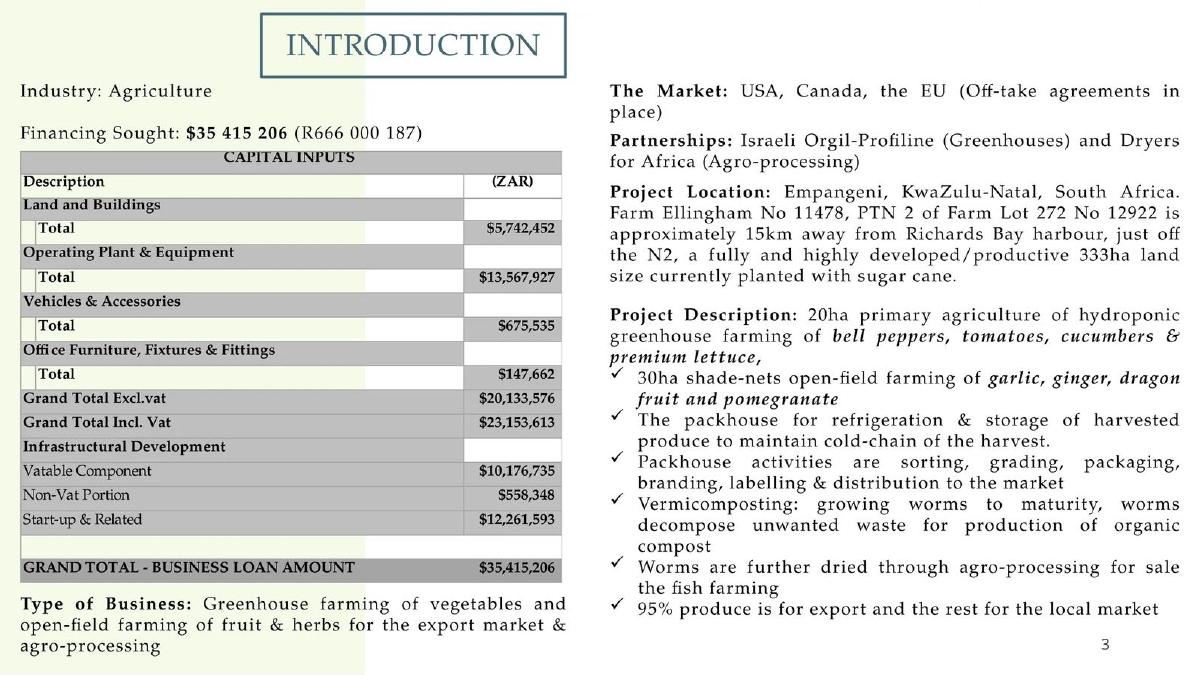
This is arguably the most important slide in the deck, acting as a combination of an Executive Summary and a Use of Funds slide. It explicitly states the financing sought: $35,415,206 (R666,000,187) . The slide provides a granular table of "Capital Inputs," which includes:
Land and Buildings: $5,742,452 · Operating Plant & Equipment: $13,567,927 · Vehicles & Accessories: $675,535 · Infrastructural Development: $10,176,735 · Start-up & Related: $12,261,593
The project location is identified as Farm Ellingham No 11478 in Empangeni, KwaZulu-Natal, South Africa, situated 15km from the Richards Bay harbour. This proximity to a major port is a critical logistical detail for a business that intends to export 95% of its produce. The slide also mentions partnerships with Israeli Orgil-Profiline for greenhouses and Dryers for Africa for agro-processing.
Slide 5: Solution
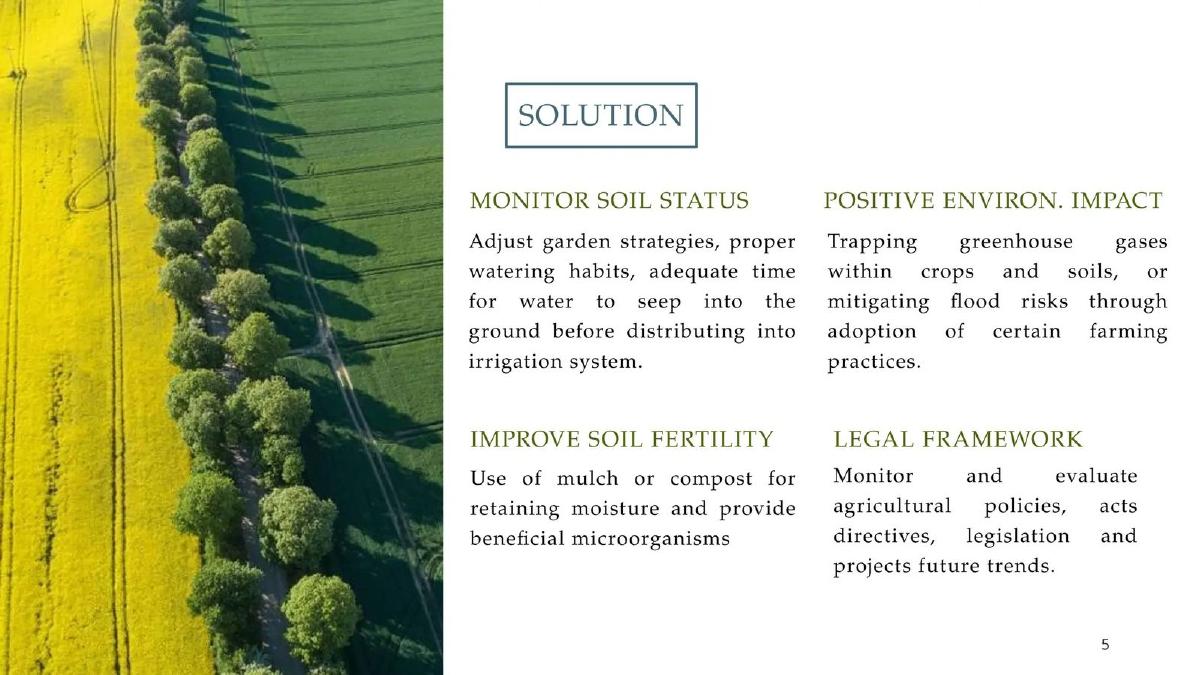
The "Solution" slide is somewhat generic, focusing on agricultural best practices rather than a unique proprietary technology. It lists four pillars: Monitor Soil Status, Positive Environ. Impact, Improve Soil Fertility, and Legal Framework. The text discusses trapping greenhouse gases in crops and soils and mitigating flood risks. Given that the project is primarily hydroponic (which often uses soil-less substrates), the heavy emphasis on "soil status" and "soil fertility" feels slightly disconnected from the core greenhouse value proposition.
Slide 7: Product Overview
This slide provides a breakdown of production by crop volume. A 3D pie chart shows that Lettuce dominates the output at 71% , followed by Tomato (17%), Cucumber (5%), and Greenhouse Pepper (3%). Minor crops include Ginger (2%), Dragon Fruit (1%), Pomegranate (1%), and Garlic (0%).
The text on this slide is a major de-risking element: it claims a secured 5-year off-take agreement with Sunfed Perfect Produce in the USA. The agreement covers 95% of production for the USA, Canada, and EU markets. The remaining 5% is allocated to a local off-take agreement with The Fruitspot . For an investor, a secured buyer for 100% of the inventory is a significant strength, provided the contracts are enforceable and the pricing is viable.
Slide 9: Distribution Channels
This slide features a complex flowchart titled "Distribution Channels." It maps the journey from Inputs (seeds, fertilizers, equipment) through Production and Packing to Processing and finally Distribution. It distinguishes between farms for processed food and farms for fresh consumption. While the chart is professional, it appears to be a general industry diagram rather than one specific to Lusabo’s internal operations, as it includes "Small-scale retailers" and "Supermarkets" which contradicts the previous slide's claim that 95% goes to a single international distributor.
Slide 11: Our Competition
This slide presents a significant analytical flaw. While the "Competitive Advantage" section lists logical points—Israeli expertise, off-season production, and climate management—the "Competitors" list is highly confusing. It lists three farms: Backyard Bounty , Eilert's Acres , and Springdale Farms . All three are located in Plymouth, Wisconsin, USA .
While Lusabo exports to the USA, these small, family-owned Wisconsin farms are not direct competitors to a 333-hectare industrial operation in South Africa. The deck fails to identify local South African competitors or large-scale global hydroponic players (like AppHarvest or BrightFarms) that would actually compete for market share in the EU or North American import markets.
Slide 13: Summary
The summary slide uses emotive language, stating the company believes in "giving our all" and using "ethical farming methods." It mentions a "great team behind our product," yet the deck (in the provided slides) contains no biographies, names, or track records for the leadership team. In a $35 million project, the absence of team credentials is a glaring omission.
What Works in This Deck
Granular Financial Ask: The deck doesn't just ask for a round number; it asks for a specific figure down to the dollar, backed by a categorized table of inputs. · Logistical Awareness: Identifying the specific farm plot and its distance to a major export harbor (Richards Bay) shows that the founders have considered the supply chain. · Off-take Agreements: Stating that 95% of the produce is already under contract for five years is the strongest selling point in the deck. It transforms the investment from a speculative venture into an infrastructure execution play. · Diversification: The mix of hydroponic greenhouses and open-field farming, along with vermicomposting and agro-processing, suggests a plan to maximize the utility of the 333ha land.
What is Missing or Flawed
Geographic Disconnect in Competition: Listing Wisconsin family farms as the primary competition for a South African export giant is a major red flag. It suggests a lack of market research or a templated approach to the slide. · No Team Slide: For a project requiring $35 million, investors need to know who is managing the money. The lack of founder profiles or agricultural expert bios is a critical failure. · Unit Economics: While the capital costs are clear, the deck does not show the expected revenue per ton, the cost of production, or the projected EBITDA. An investor cannot calculate a return on the $35M investment without these figures. · Hydroponic vs. Soil Focus: The "Solution" slide focuses heavily on soil health, which is inconsistent with a project where the majority of production (by volume and greenhouse space) is hydroponic. · Timeline: There is no indication of how long the build-out will take or when the first harvest is expected.
Founder Takeaways
Align your competition with your scale. If you are building a multi-million dollar industrial farm, do not list local "mom and pop" shops in a different country as your competitors. Identify the other industrial exporters who are vying for the same shelf space in the EU or USA.
Show the team. In capital-intensive projects, the "who" is just as important as the "what." Investors are betting on your ability to manage a massive construction and biological project. You must highlight your experience in large-scale agriculture or project management.
Bridge the gap between capital and return. It is excellent to show exactly how you will spend $35 million, but you must also show what that $35 million generates. A slide on projected annual revenue based on the off-take agreement prices would make this deck much more compelling.
Ensure consistency in your solution. If your primary value proposition is high-tech hydroponics, your "Solution" slide should focus on water efficiency, yield per square meter, and climate control, rather than generic soil mulching techniques.
Frequently asked questions
- What is the primary revenue driver for Lusabo Group?
- Revenue is driven by the export of hydroponic vegetables (peppers, tomatoes, cucumbers, lettuce) and open-field fruits (garlic, ginger, dragon fruit, pomegranate). According to slide 7, 95% of the produce is committed to an export off-take agreement with Sunfed Perfect Produce for the USA, Canada, and EU markets, while the remaining 5% is sold locally to The Fruitspot.
- How is the $35.4 million investment distributed?
- The capital is split across several categories detailed on slide 3: $5.7M for land and buildings, $13.5M for operating plant and equipment, $675k for vehicles, $147k for furniture, and $10.1M for infrastructural development. A significant portion, $12.2M, is categorized as 'Start-up & Related' costs, bringing the total loan amount to $35,415,206.
- What is the scale of the physical infrastructure?
- The project utilizes a 333ha land parcel. The specific agricultural footprint includes 20ha of primary hydroponic greenhouse farming and 30ha of shade-net open-field farming. It also includes a packhouse for refrigeration, storage, and distribution, as well as a vermicomposting facility for waste management (Slide 3).
- Why does the competition slide list American farms for a South African project?
- This appears to be a significant error or a misunderstanding of market scope. Slide 11 lists Backyard Bounty, Eilert's Acres, and Springdale Farms, all located in Plymouth, Wisconsin. While these may be competitors in the US market where Lusabo exports, they are not local competitors for land, labor, or South African retail space.
- What technology or expertise is being leveraged?
- Lusabo Group cites a strategic partnership with Israeli firm Orgil-Profiline for greenhouse technology and expertise. They also mention using 'Dryers for Africa' for agro-processing and a vermicomposting system to produce organic compost and dried worms for fish farming (Slide 3 and 11).