Humane’s Series B deck is an anomaly in the fundraising world. Spanning just seven slides, it contains zero mentions of revenue, market size, competition, or team biographies. Instead, it relies on a stark, high-contrast aesthetic and dense technical descriptions to sell a vision of a 'cloud connected sight enabled AI platform.' The deck focuses heavily on the hardware's physical form—detailing mounting options like magnetic and interlocking pin backs—and the 'Platform' capabilities, such as senior monitoring and memory recall. By omitting standard financial slides, Humane leveraged the pedig…
Key takeaways
- The deck contains no financial data, user metrics, or growth projections across its 7 slides.
- Slide 2 provides a comprehensive technical overview, including a 180 FOV Camera with OIS and LiDAR/TOF sensors.
- Humane positions the device as a 'server side app echo system' rather than a traditional local-processing wearable (Slide 3).
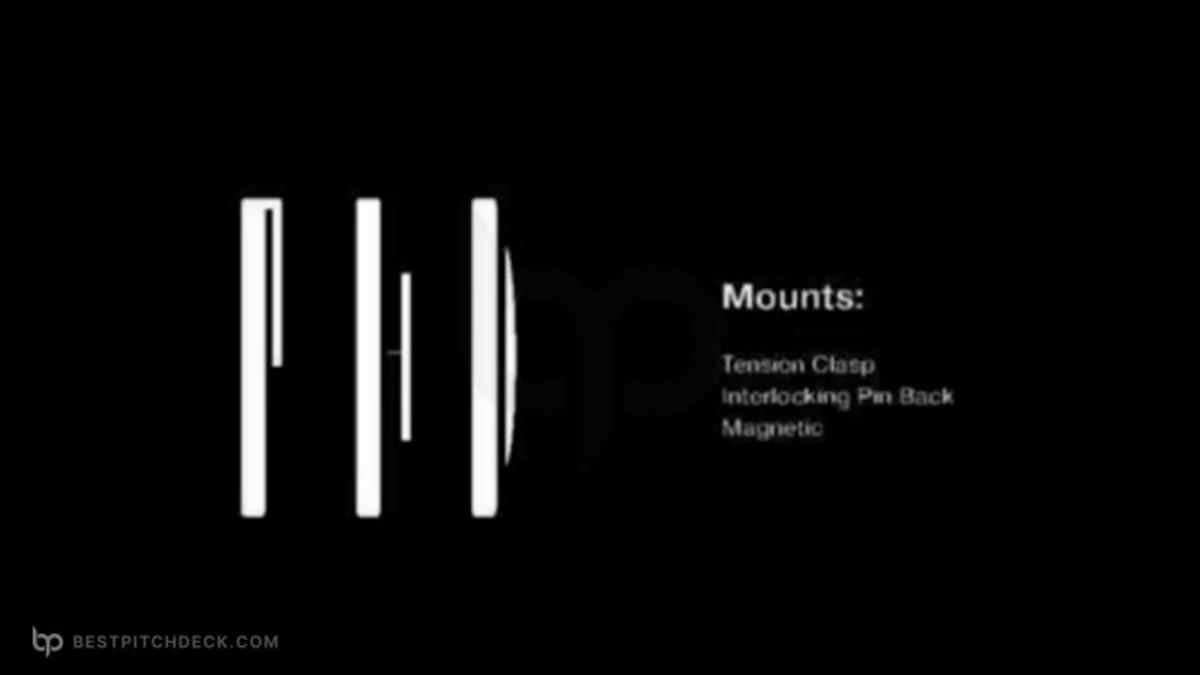
- The hardware design emphasizes versatility with three specific mounting options: Tension Clasp, Interlocking Pin Back, and Magnetic (Slide 4).
- The camera system is designed for passive capture, allowing users to 'recall moments you didn't think to capture' (Slide 5).
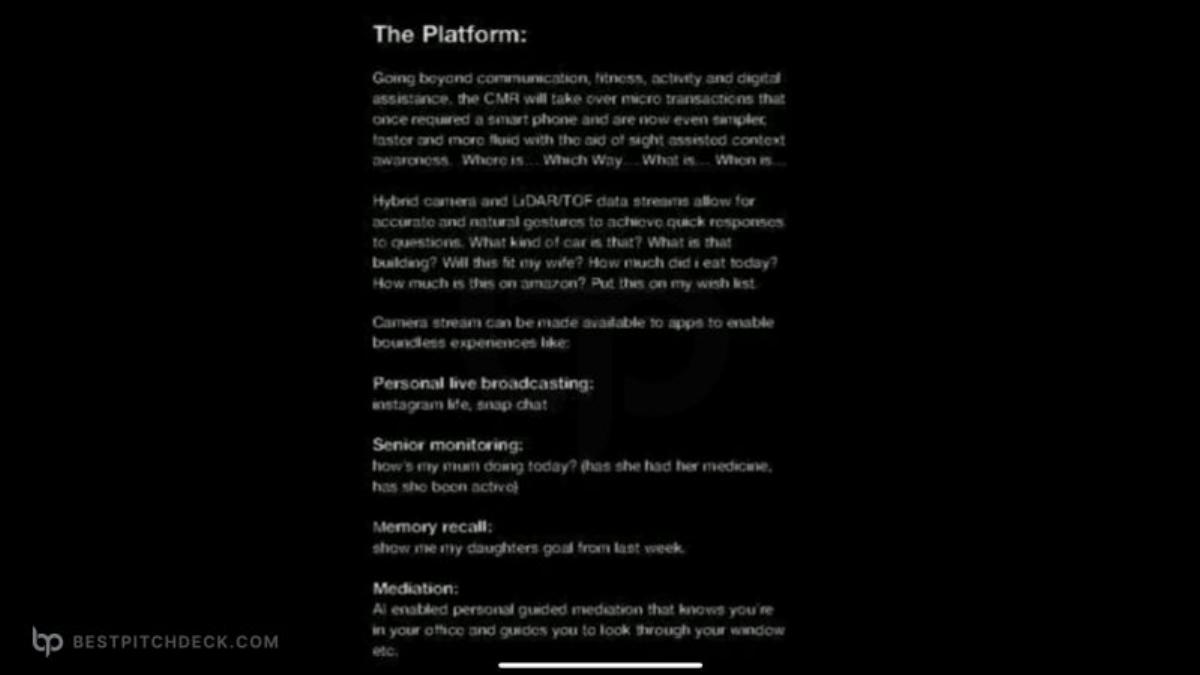
- The 'Platform' vision extends into healthcare and social utility, specifically mentioning 'Senior monitoring' and 'Memory recall' (Slide 6).
- The company raised $100M in 2021 based on this deck, led by Tiger Global (Catalogue facts).
- There is no 'Team' slide, though the catalogue facts note high-profile investors like Sam Altman and Lachy Groom.
The Minimalism of a $100M Vision
The Humane AI Series B pitch deck is one of the most unconventional documents in the StartupFundraising.com archive. While most Series B companies are expected to show rigorous unit economics, churn rates, and a clear path to profitability, Humane’s 2021 deck contains none of these. Instead, it presents a stark, black-and-white technical blueprint for a device intended to redefine the human relationship with computing. With only seven slides—one of which is a cover and another a third-party promotional slide—the actual content is condensed into just five pages of technical specifications and philosophical use cases.
Slide 1: Brand Identity
The deck opens with a minimalist cover slide featuring the Humane logo—a stylized eclipse or crescent shape—and the company's URL: hu.ma.ne. There is no tagline, no date, and no mention of the investment round. This sets a tone of extreme confidence and 'stealth' branding, signaling that the company believes its name and visual identity carry enough weight to command attention without introductory fluff.
Slide 2: The Technical Blueprint
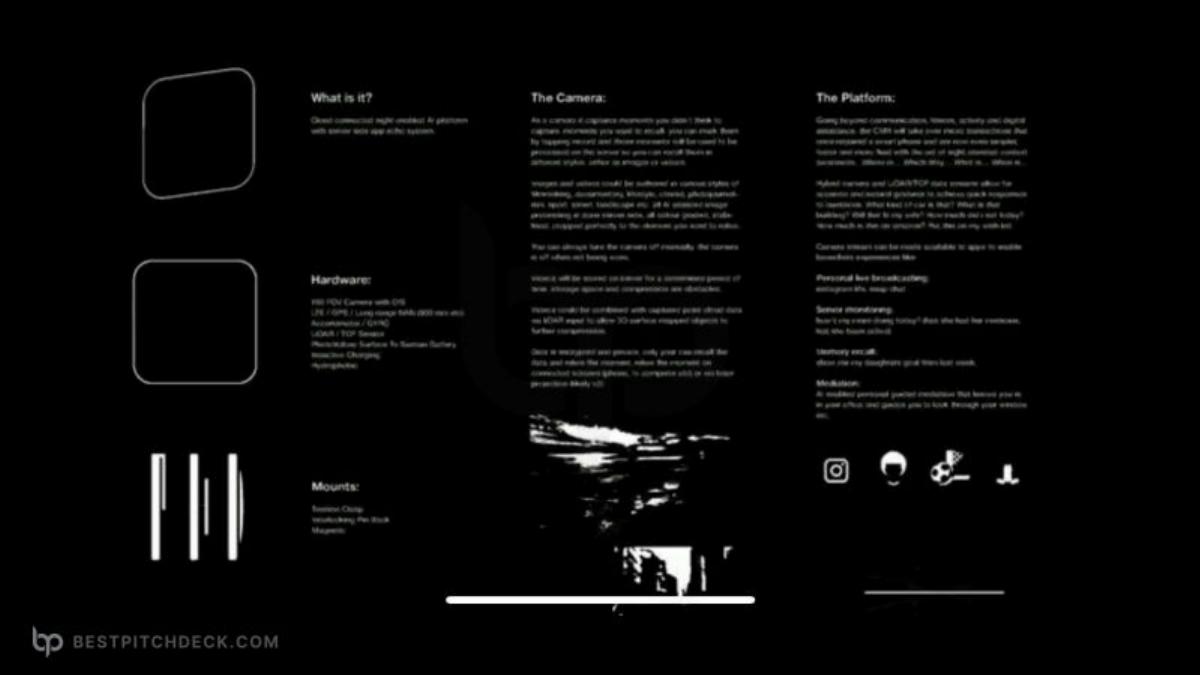
Slide 2 serves as a summary of the entire product ecosystem. It is divided into four main sections: What is it? , Hardware: , Mounts: , and The Platform: . This slide is the most information-dense in the deck, listing specific components that suggest a high-end hardware build. Notable specs include a 180 FOV Camera with OIS, LTE/GPS, and a LiDAR/TOF sensor. This indicates the device is not just a camera but a spatially aware computer. The mention of 'Inductive Charging' and a 'Hydrophobic' exterior points toward a device intended for all-day, all-weather wear.
Slide 3: Defining the Category
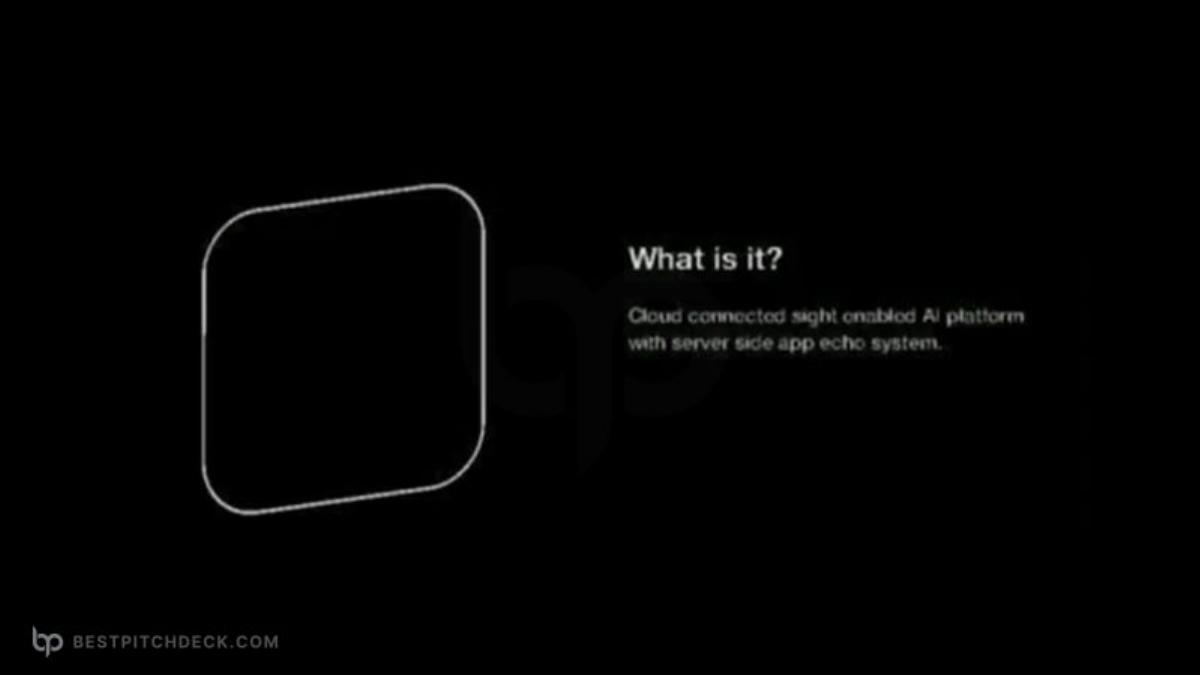
Slide 3 isolates the question 'What is it?' and provides a single-sentence answer: 'Cloud connected sight enabled AI platform with server side app echo system.' This is a critical distinction. Humane is not pitching a 'smart camera' or a 'wearable phone.' They are pitching a platform where the heavy lifting (the 'app echo system') happens on the server, while the hardware serves as the 'sight enabled' interface. This architectural choice suggests a bet on high-speed connectivity (LTE) to overcome the thermal and battery limitations of on-device AI processing.
Slide 4: The Physical Form Factor
Slide 4 focuses on 'Mounts,' illustrating three distinct ways the device can be worn: Tension Clasp , Interlocking Pin Back , and Magnetic . The inclusion of an interlocking pin back is particularly telling of the design philosophy; it suggests a permanent or semi-permanent attachment to clothing, moving away from the 'pocketable' nature of the smartphone. The visual representation shows three thin profiles, emphasizing the device's slimness and its ability to blend into the user's attire.
Slide 5: The Camera and Passive Capture
Slide 5, titled 'The Camera:', outlines a shift in photography from active to passive. It states that the device 'captures moments you didn't think to capture.' This is a bold privacy and utility claim. The slide explains that users can 'mark' moments by tapping record, but the AI also assists in image processing, color grading, and cropping perfectly to the element the user wants to relive. Crucially, it addresses privacy by stating, 'You can always turn the camera off manually' and 'the camera is off when not being worn.' The mention of 3D surface mapping via LiDAR for 'further compression' highlights the technical sophistication of their data storage strategy.
Slide 6: The Platform and Use Cases
Slide 6 expands on 'The Platform:', moving beyond hardware into the software's utility. It introduces the concept of the 'CMR' (likely referring to their core system) taking over 'micro transactions that once required a smart phone.' The use cases listed are diverse: Personal live broadcasting (referencing Instagram and Snapchat), Senior monitoring (checking if a parent has taken medicine), Memory recall (finding a specific sports goal from the previous week), and Mediation (AI-guided sessions). This slide attempts to prove that the device is a general-purpose computer rather than a niche accessory.
Slide 7: External Reference
The final slide in this set is a promotional slide for bestpitchdeck.com, which is not part of the original Humane presentation. Therefore, the actual pitch concludes on the 'Platform' vision, leaving the investor with a list of potential lifestyle and health applications rather than a financial 'ask' or a roadmap.
What Works in the Humane AI Deck
1. Extreme Focus on Vision: By stripping away the standard 'Market Size' and 'Competitor' slides, Humane forces the investor to engage solely with their vision of the future. This works for Series B rounds where the 'Big Idea' is already validated by the caliber of the early investors and the founding team.
2. Technical Specificity: Listing '180 FOV Camera with OIS' and 'LiDAR/TOF Sensor' provides a level of hardware credibility. It shows that this is not a conceptual mockup but a product with a defined bill of materials and engineering requirements.
3. Solving the 'Why Now?': The deck leans heavily into the 'server-side' nature of the platform. This implicitly answers why this device is possible now: the convergence of high-speed LTE, cloud AI processing, and miniaturized sensors.
What is Missing from the Humane AI Deck
1. The Team: There is no slide detailing the founders. For a company like Humane, which was founded by high-profile ex-Apple veterans, this omission is a deliberate choice, likely because the investors being pitched already knew the pedigree. However, for any other founder, omitting the team slide is a fatal error.
2. Business Model: The catalogue facts list the business model as 'Other.' The deck never explains how Humane intends to make money. Is it a hardware sale? A subscription for the 'server side' processing? A percentage of the 'micro transactions' mentioned on Slide 6? The deck is silent on revenue.
3. Market Validation: There are no user testimonials, beta test results, or waitlist numbers. The deck assumes the market exists and is ready to replace the smartphone, a massive assumption that usually requires significant data to back up at the Series B stage.
4. Competition: The deck ignores the existence of the iPhone, Android, or other wearable competitors like Ray-Ban Meta or Oura. It positions Humane in a vacuum.
What Founders Should Copy
1. High-Contrast Visuals: The use of white text and line art on a black background is visually striking and professional. It creates a 'premium' feel that suits a high-end hardware product.
2. Use-Case Storytelling: Instead of listing features, Slide 6 lists 'experiences.' Asking 'How much did i eat today?' or 'show me my daughters goal from last week' makes the technology relatable and demonstrates immediate value to a human user.
3. Addressing Privacy Head-On: For any device with a camera, privacy is the first objection. Humane addresses this on Slide 5 by explaining manual shut-offs and 'off when not worn' sensors. Proactively answering the 'creep factor' is a smart move for any hardware startup.
Conclusion
The Humane AI Series B deck is a 'prestige' deck. It is designed for a very specific audience of elite VCs who are already sold on the founders and are looking for the technical manifesto of the product. While its minimalist approach and lack of metrics are not recommended for the average startup, it serves as a powerful example of how to sell a 'platform' vision rather than just a 'gadget.' It successfully pivots the conversation from 'what does this device do?' to 'how will this device change your life?'
Frequently asked questions
- How did Humane raise $100M with only 7 slides and no metrics?
- Humane’s fundraise was driven by the 'founder-market fit' and the pedigree of its leadership (ex-Apple executives), which is not explicitly detailed in the slides but is reflected in the high-profile investor list. The deck functions as a product manifesto rather than a business plan, betting that the technical ambition of a 'sight enabled AI platform' would outweigh the need for early-stage revenue proof.
- What are the core hardware specs mentioned in the deck?
- According to Slide 2, the device features a 180-degree Field of View (FOV) camera with Optical Image Stabilization (OIS), LTE/GPS connectivity, a long-range microphone array (800mm+), an accelerometer/gyroscope, and a LiDAR/TOF sensor. It also specifies a 'Hydrophobic' finish and 'Inductive Charging' capabilities.
- Does the deck explain how the AI actually works?
- The deck describes a 'server side' architecture. Slide 5 explains that images and videos are processed on the server to allow for AI-assisted grading, stabilization, and cropping. Slide 6 suggests that the AI uses 'sight assisted context awareness' to answer questions like 'What kind of car is that?' or 'How much is this on Amazon?'
- What use cases does Humane propose for the device?
- Slide 6 outlines several 'boundless experiences,' including personal live broadcasting (Instagram/Snapchat), senior monitoring (checking if a parent has taken medicine), memory recall (finding specific past events), and AI-enabled guided mediation.
- What is missing from this pitch deck compared to a standard Series B?
- Almost everything standard is missing. There is no Market Size (TAM/SAM) slide, no Competitor Matrix, no Go-To-Market strategy, no Team slide, and no Financial Ask or Use of Funds. It is a pure product-vision deck.