HPQ Silicon Resources presents a technical and market-driven case for their proprietary PUREVAP process, aimed at disrupting the silicon supply chain for the battery and energy storage sectors. The deck identifies a critical bottleneck: while electronics have scaled exponentially, battery energy storage has lagged due to chemistry limits. By transforming raw quartz into high-purity nano silicon, HPQ aims to replace or augment graphite in anodes, which currently only contains about 5% silicon by weight. The company demonstrates significant commercial traction, citing a firm order from a major…
Key takeaways
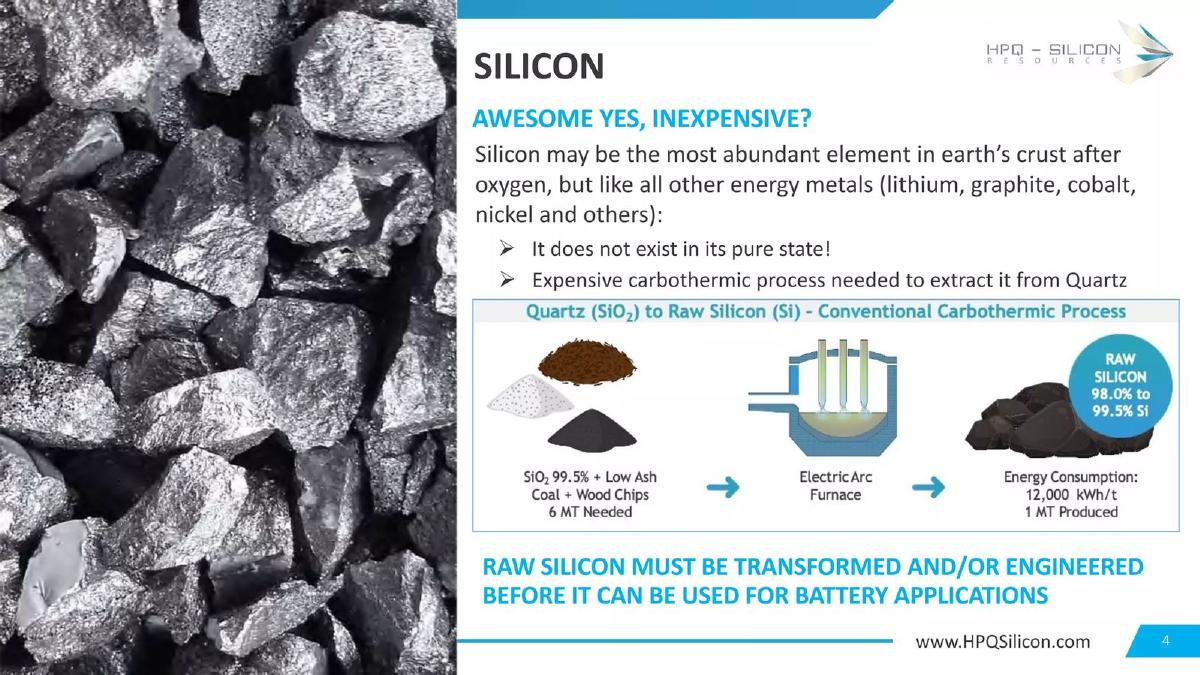
- The conventional carbothermic process for silicon extraction is energy-intensive, requiring 12,000 kWh per 1 MT produced (Slide 4).
- HPQ has already secured a firm order for Silicon Nanopowders from a major car manufacturer (Slide 7).
- The global silicon market demand is projected to reach 3.8 M MT, worth approximately US$10 billion by 2025 (Slide 10).
- Current silicon material solutions are economically unviable, with Silicon Nanowires costing over $30,000/kg compared to graphite at $10-$20/kg (Slide 16).
- The PUREVAP NSiR scaling pathway outlines a transition from 30 kg/month bench tests to a 200 MT/month commercial plant (Slide 19).
- UBS estimates the US energy storage market could grow to $426 billion over the next ten years (Slide 22).
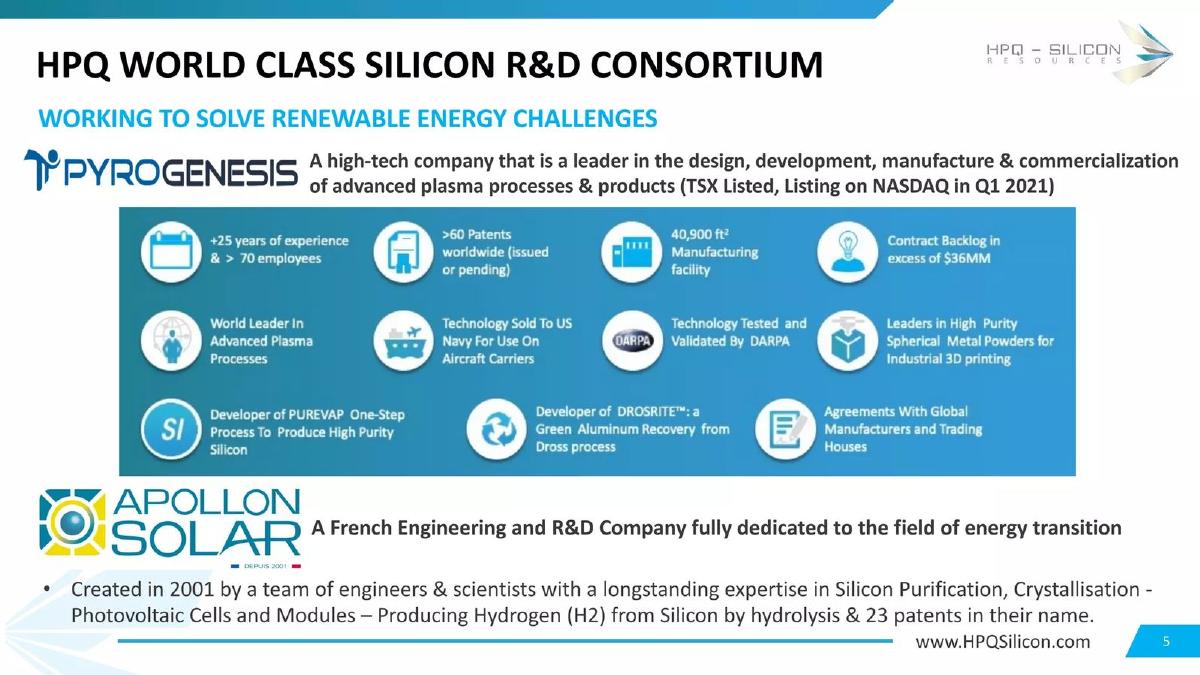
- The company has a diverse investor base, including PyroGenesis (9.8%) and Investissement Québec (9.0% FD) (Slide 25).
- Management and the Board hold approximately 9.0% of the company (Slide 25).
Executive Summary: The Silicon Pivot
HPQ Silicon Resources presents a highly technical, industrially focused pitch deck that centers on a single thesis: the global transition to renewable energy and electric vehicles is being throttled by battery chemistry. The deck, dated December 2020, positions the company not just as a raw material supplier, but as a technology provider capable of transforming low-value quartz into high-value nano silicon materials. By leveraging their proprietary PUREVAP process, HPQ seeks to bridge the massive cost gap between current experimental silicon materials and the commodity graphite currently used in battery anodes.
Slide 1: Title and Vision
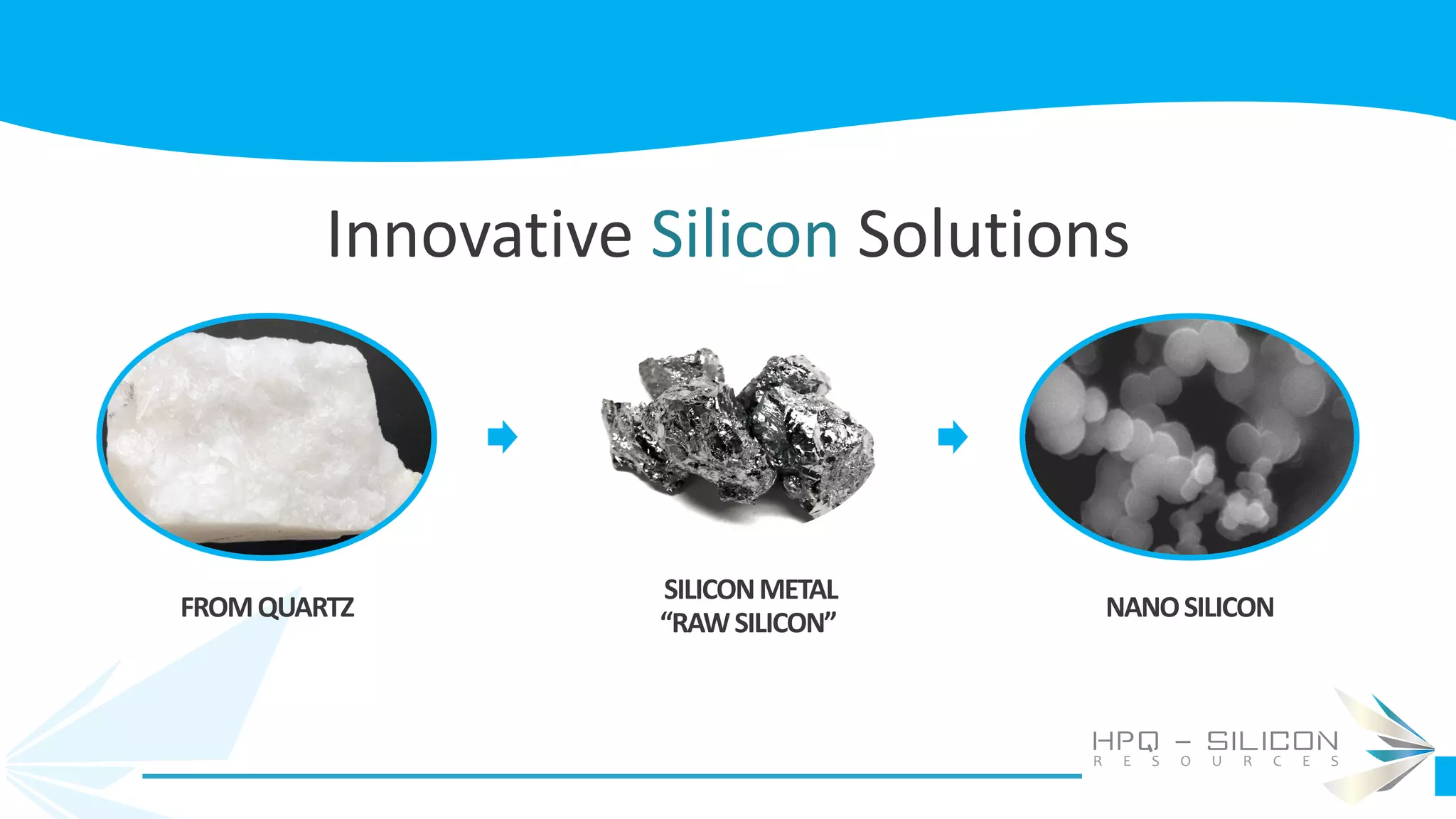
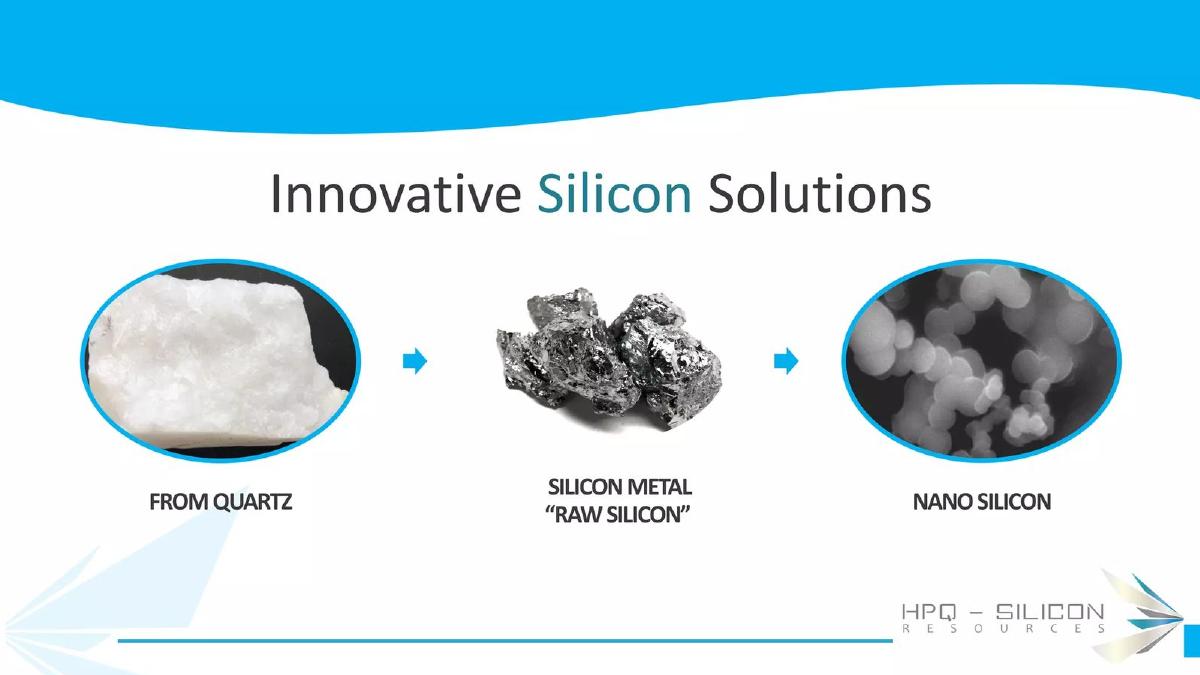
The opening slide establishes the core value chain: "Innovative Silicon Solutions." It uses a simple three-step visual progression: From Quartz to Silicon Metal ("Raw Silicon") to Nano Silicon. This immediately tells the investor that the company is involved in value-added processing rather than just basic mining. The branding is clean, though the "HPQ - Silicon Resources" logo suggests a legacy in mining that is now evolving into high-tech materials.
Slide 4: The Problem with Conventional Silicon
Slide 4 provides the technical justification for HPQ's existence. It notes that while silicon is abundant, it does not exist in a pure state. The slide critiques the "Conventional Carbothermic Process," noting it is expensive and energy-intensive, requiring 12,000 kWh to produce just 1 metric ton of 98.0% to 99.5% pure silicon. The key takeaway here is the bolded footer: "RAW SILICON MUST BE TRANSFORMED AND/OR ENGINEERED BEFORE IT CAN BE USED FOR BATTERY APPLICATIONS." This sets the stage for HPQ’s proprietary technology as the necessary bridge.
Slide 7: Implementation Plan and Traction
This is a critical "traction" slide. HPQ outlines that lab-scale and proof-of-concept tests are finished, and they are moving into a "fully funded QRR pilot plant." The most significant data points are the bulleted achievements: "Material potential already generated NDA's with battery manufacturers" and "Received a firm order for Si Nanopowders from major car manufacturer." For a pre-commercial industrial company, a firm order from an OEM is the strongest possible validation of the technology's relevance.
Slide 10: Market Opportunities and Megatrends
Slide 10 contextualizes the demand. It cites CRU data projecting demand to reach 3.8 M MT worth approximately US$10 billion by 2025. The slide breaks down the market into Metallurgical Grade (98.0-98.9%) and Chemical Grade (99.0-99.5%). It links these to global megatrends like population growth, urbanization, and energy efficiency. Importantly, it notes that new plants are needed to meet this growth, positioning HPQ as a necessary addition to global capacity.
Slide 13: The Battery Performance Gap
This slide uses a compelling chart to show that while processors, hard disks, and memory have seen exponential improvements (up to 16x over 6 years), battery energy storage has remained nearly flat. The slide quotes Alexander Girau of Advano: "The problem is not 'Can we get a battery that is powerful?', It's: 'Can we make that battery cheap enough to build trillions of them?'" This shifts the investor's focus from pure performance to the economics of manufacturing, which is where HPQ claims its advantage lies.
Slide 16: The Economic Barrier
Slide 16 is perhaps the most honest slide in the deck. It lists the current costs of silicon materials: Silicon Structured in SIO Glass (>$2,000/kg), Silicon Structured in Graphite (>$3,000/kg), Silicon Nanowires (>$30,000/kg), and Silicon Nanopowders (>$20,000/kg). It contrasts these with the cost of graphite at $10 to $20 per kg. This clearly defines the "moat" HPQ must build: they don't just need to make nano silicon; they need to make it 1,000x cheaper to reach parity with graphite.
Slide 19: The PUREVAP Scaling Pathway
To address the cost issue, Slide 19 shows the "Indicative Scaling-up Pathway." It moves through four phases: Phase 1 (Bench Tests, 30 kg/month), Phase 2 (Proof of Commercial Scalability, 300 kg/month), Phase 3 (Pilot Plant, 4,000 kg/month), and Phase 4 (Commercial Plant, 200 MT/month). By showing the transition from batch processes to semi-continuous processes, the deck illustrates how they intend to achieve the economies of scale necessary to disrupt the market.
Slide 22: The Investment Thesis
Slide 22 summarizes the "Why Invest?" argument. It cites a UBS estimate that the US energy storage market could reach $426 billion. It reiterates the product lineup—nanopowders, nanowires, and porous silicon—and mentions that the company is supported by "two (2) world class technology partners." However, it does not name these partners on this slide, which is a missed opportunity for name-brand validation.
Slide 25: Management and Cap Table
The final substantive slide introduces the team and the major investors. The management team is led by Bernard J Tourillon (Chairman, President, CEO). The cap table is particularly interesting for a company at this stage: PyroGenesis holds 9.8% , and Investissement Québec holds 9.0% . Having a provincial investment arm (Québec) and a strategic technology partner (PyroGenesis) on the cap table provides significant credibility regarding the company's regional support and technical foundation.
What Works in This Deck
Technical Clarity: The deck does an excellent job of explaining a complex chemical engineering problem in simple terms. The comparison between processor scaling and battery scaling (Slide 13) is a classic, effective way to illustrate market pain.
Honest Benchmarking: Many startups hide the fact that their product is currently 1,000x more expensive than the incumbent. HPQ puts those numbers front and center on Slide 16, which builds trust with sophisticated investors who know the industry economics.
Clear Traction: Mentioning a firm order from a major car manufacturer (Slide 7) is the ultimate "de-risking" signal for an industrial tech company.
What Is Missing
Financial Projections: While the deck mentions market sizes and current material costs, it lacks a slide showing HPQ's projected revenue, EBITDA, or the specific capital expenditure (CapEx) required to reach the Phase 4 commercial plant. Investors need to know how much money is required to get to that 200 MT/month milestone.
Competitive Landscape: The deck compares silicon to graphite, but it does not compare HPQ to other silicon startups (e.g., Sila Nanotechnologies, Group14 Technologies, or Enovix). A slide detailing HPQ's specific IP or cost advantages over other silicon-anode competitors is absent.
Detailed Unit Economics: We see the cost of the competition ($20,000/kg), but we don't see HPQ's projected cost of goods sold (COGS) at scale. Without this, the claim of "low-cost" is an assertion rather than a demonstrated fact.
Founder Takeaways
Use the 'Performance Gap' Visual: If you are working in a sector that has lagged behind the rest of the tech world (like energy, construction, or agriculture), use a comparison chart like Slide 13 to show how much 'catch-up' growth is available.
Phase Your Roadmap: For hardware or industrial tech, a single "launch" date is unrealistic. The four-phase scaling pathway on Slide 19 is a great template for showing how you will move from the lab to the factory while managing risk at each step.
Highlight Strategic Backers: If you have government-backed investors (like Investissement Québec) or strategic industry partners, give them their own section or highlight them on the cap table slide. It signals that you have passed rigorous due diligence that individual investors might not have the resources to perform.
Frequently asked questions
- What is the primary problem HPQ Silicon is trying to solve?
- HPQ Silicon addresses the 'slow pace' of battery evolution compared to processors and memory. As shown on Slide 13, battery energy storage has improved at a fraction of the rate of electronics. The bottleneck is chemistry; current graphite anodes are reaching their limits. HPQ aims to provide high-purity nano silicon that can replace graphite, offering higher energy density at a commercially viable price point.
- Does the company have any validated commercial interest?
- Yes. Slide 7 explicitly states that the company has received a firm order for Silicon Nanopowders from a 'major car manufacturer.' Additionally, they have generated NDAs with other battery manufacturers and advanced material companies. This suggests that their lab-scale and proof-of-concept tests have met the technical requirements of Tier-1 industry players.
- How does HPQ Silicon plan to compete with existing graphite anodes?
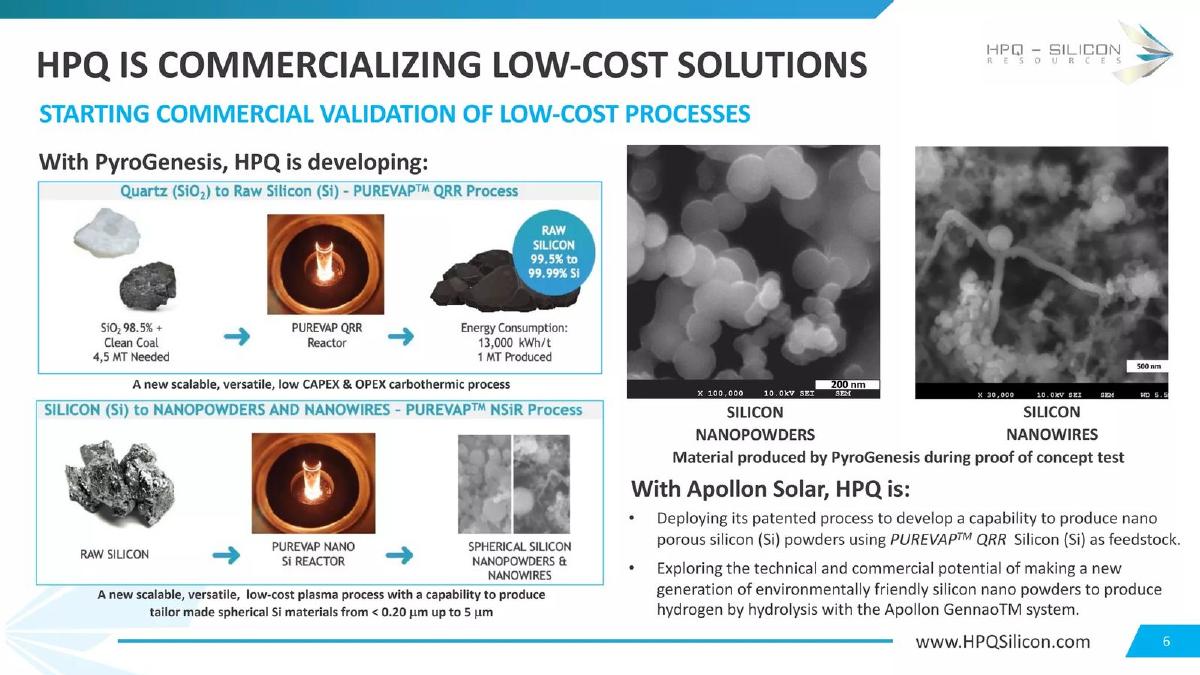
- The deck acknowledges that current silicon solutions are too expensive, with nanopowders costing over $20,000/kg while graphite costs only $10-$20/kg (Slide 16). HPQ's strategy relies on their PUREVAP NSiR process to achieve cost parity. They are moving through a four-phase scaling pathway to reach a commercial capacity of 200 metric tons per month to drive down unit costs.
- Who are the key stakeholders and investors in HPQ Silicon?
- The company is backed by both strategic and institutional investors. According to Slide 25, PyroGenesis is a major holder at 9.8%, and Investissement Québec holds 9.0% on a fully diluted basis. Management and the Board own 9.0%, and a group of 'Key Investors' holds 17.5%, indicating a relatively distributed cap table with significant institutional support.
- What are the specific applications for HPQ's silicon products?
- Beyond Li-ion batteries (nanopowders, nanowires, and porous silicon), Slide 7 and Slide 10 identify several other high-value applications. These include spherical silicon nanopowders for Hydrogen (H2) production, chemical grade silicon for silicones and polysilicon (solar cells), and specialty applications requiring 99.99% purity raw silicon.