Humaans secured $15M in Series A funding in 2022 by presenting a deck that leans heavily on institutional and individual social proof. Rather than spending time on the 'why' of HR software, the deck assumes the market need and focuses on the 'how'—specifically through a rapid product shipping cadence and deep integrations. The deck is notable for its transparency in metric categories, even in its redacted form, showing a sophisticated approach to segmenting ACV and sales cycles. By showcasing a roster of blue-chip angel investors and glowing testimonials from high-growth startups like Pleo an…
Key takeaways
- The deck positions the company as the foundation of the HR tech stack rather than just another point solution (Slide 1).
- Humaans highlights its Y Combinator W21 pedigree and a $5M Seed round raised in February 2021 to establish immediate credibility (Slide 3).
- The metrics slide uses sophisticated segmentation, tracking ACV, sales cycles, and closing rates across three distinct employee-count tiers (Slide 3).
- Product velocity is a core selling point, with 17 major items shipped in the preceding 12 months, including deep integrations with Google, Microsoft, and Pento (Slide 7).
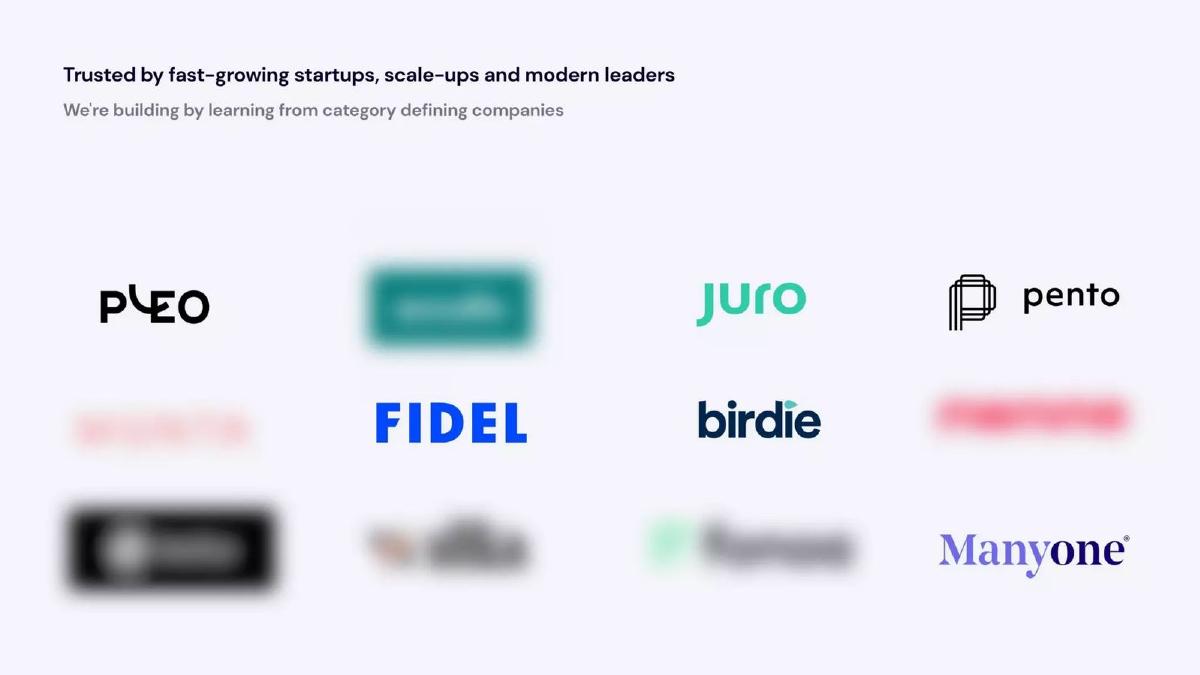
- Social proof is prioritized through a dedicated slide featuring logos of fast-growing startups like Pleo, Fidel, and Juro (Slide 5).
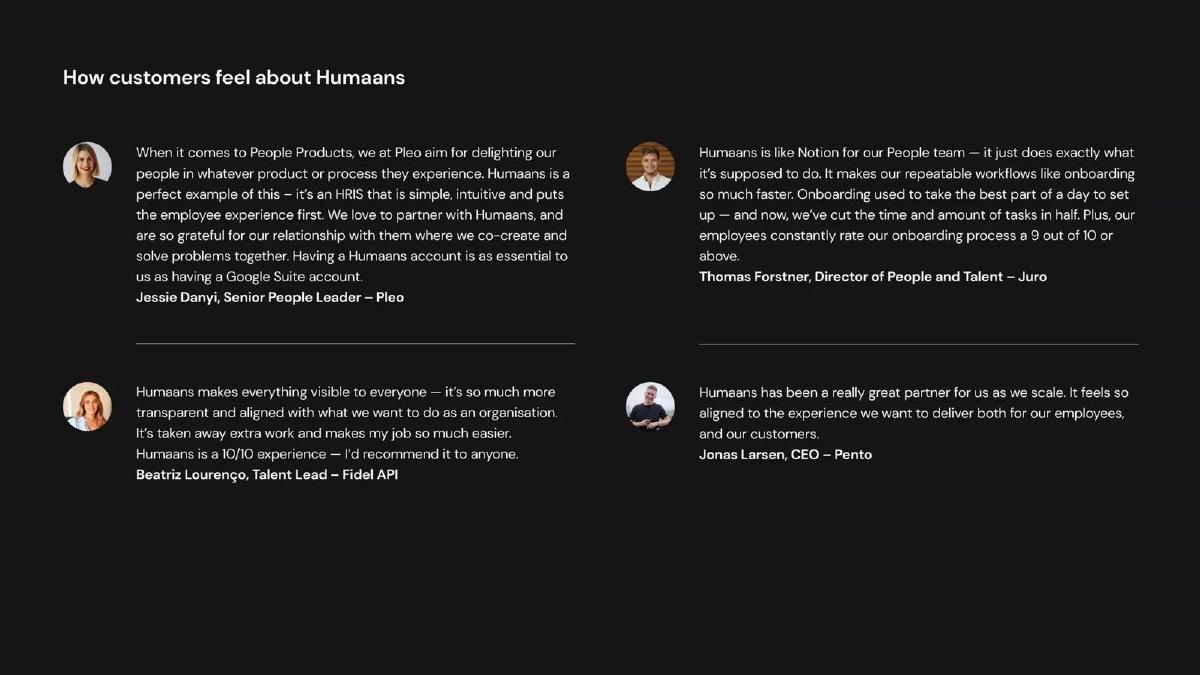
- The deck includes long-form testimonials that compare the product to Notion and G Suite, framing it as essential infrastructure (Slide 6).
- The investor slide is exceptionally strong, featuring the CEOs of Figma and LinkedIn, and the COOs of Notion and Stripe (Slide 8).
- The deck lacks a traditional 'Problem' slide, choosing instead to lead with the product interface and traction (Slide 2, Slide 3).
The Infrastructure Play: Humaans Series A Teardown
Humaans raised $15 million in 2022 to build what they describe as the foundation of the HR tech stack. In a crowded market filled with legacy giants and modern incumbents like Rippling or Gusto, Humaans chose a narrative of deep integration and design excellence. This deck is a masterclass in using social proof to overcome market saturation concerns.
Slide 1: Title and Positioning
The cover slide is minimalist, featuring only the company name and the tagline: The foundation of your HR tech stack . This is a strategic choice. By calling themselves a 'foundation,' they are signaling that they aren't just another HR tool, but the underlying infrastructure that other tools plug into. This positioning is critical for a SaaS company looking to achieve high net retention rates.
Slide 2: The Product Interface
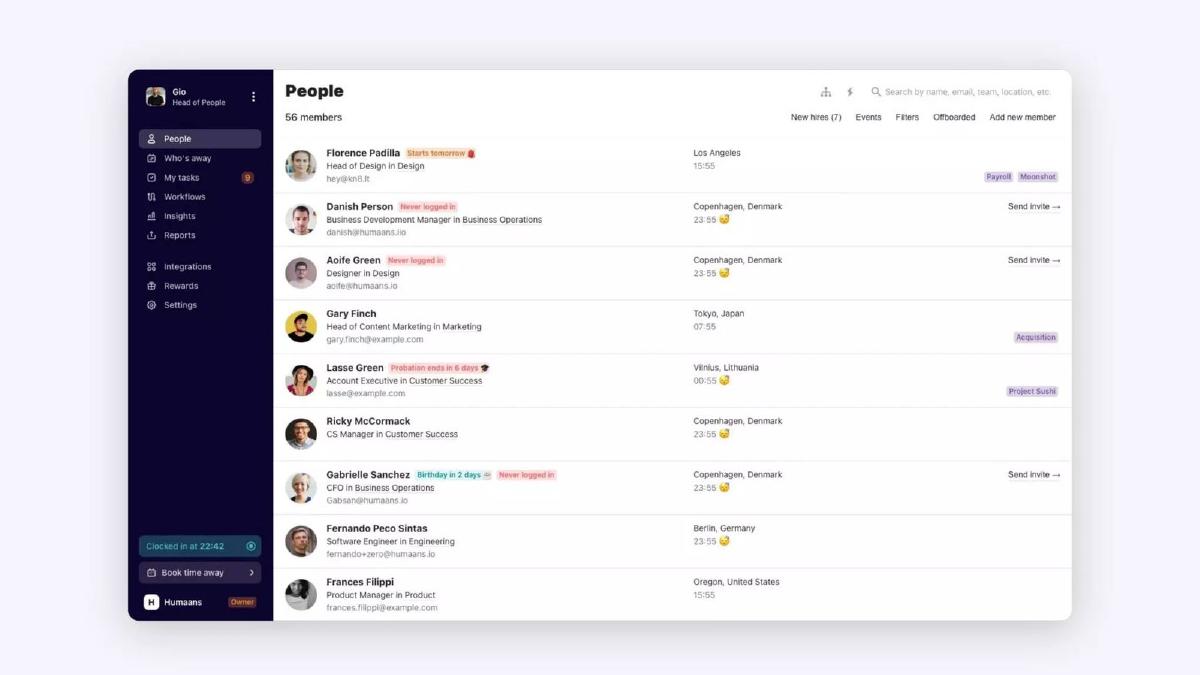
Humaans leads immediately with a product screenshot. The UI is clean, modern, and looks more like a productivity tool (like Notion or Slack) than a traditional HR database. The sidebar shows features like Who's away, Workflows, Insights, and Integrations . By showing the product on slide two, they are letting the design speak for the 'modern' aspect of their value proposition without needing a slide full of bullet points.
Slide 3: At a Glance Metrics
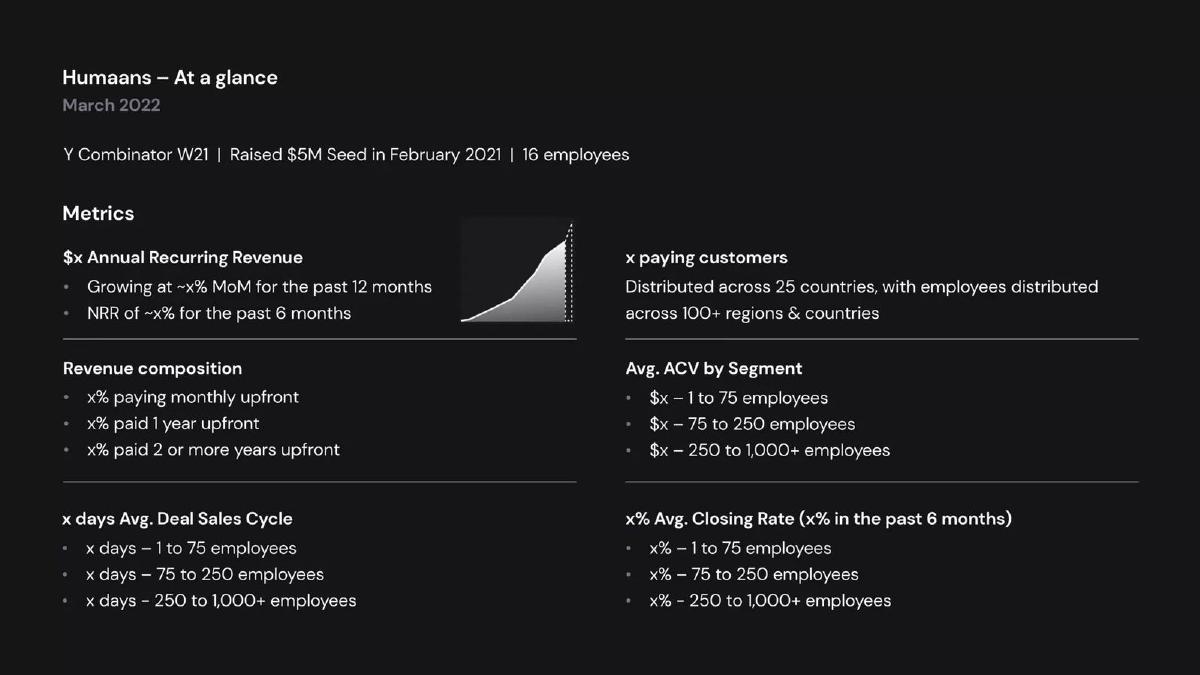
This slide provides a snapshot of the company as of March 2022. It notes they were part of Y Combinator W21 and raised a $5M Seed in February 2021 . The metrics section is highly structured, even with the specific figures redacted. They track:
Annual Recurring Revenue (ARR): Including MoM growth and NRR (Net Revenue Retention). · Paying Customers: Distributed across 25 countries. · Revenue Composition: Breaking down how many customers pay monthly vs. 1 or 2 years upfront. · ACV by Segment: Segmented by 1-75, 75-250, and 250-1,000+ employees. · Sales Cycle and Closing Rate: Also segmented by company size.
This level of segmentation is rare in Series A decks and demonstrates a very high level of operational maturity. It shows investors that the founders aren't just 'winging it'—they have a data-driven understanding of their sales funnel.
Slide 4: Goals and Ambition
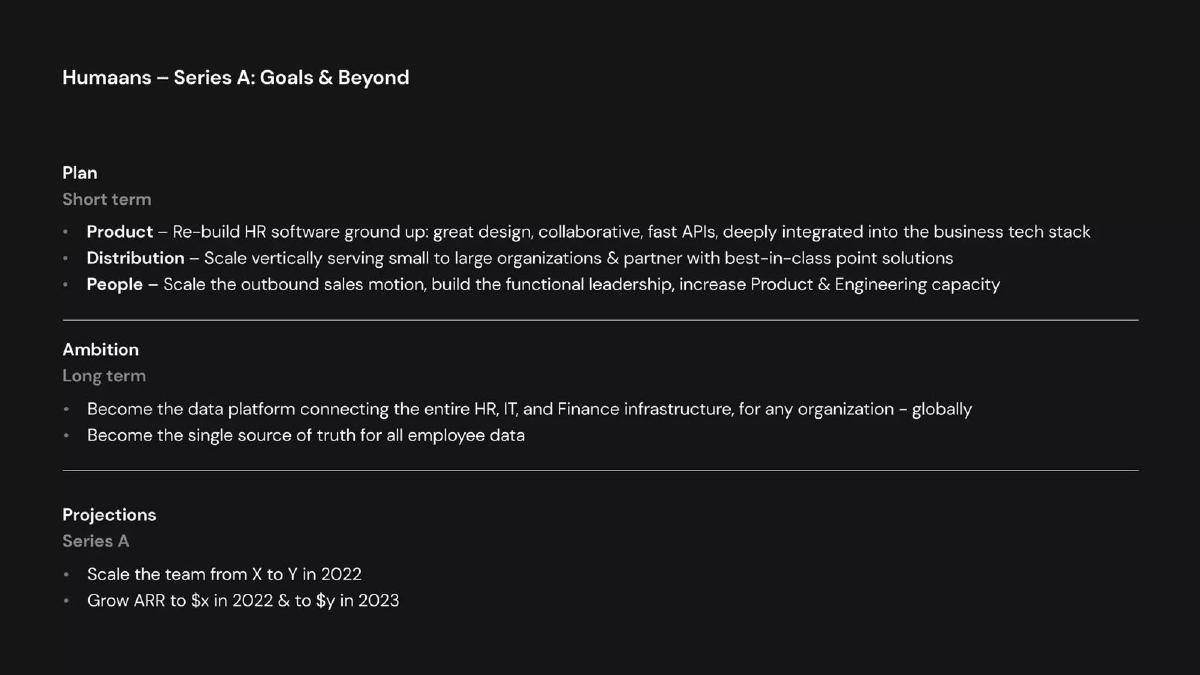
Slide 4 transitions from the past to the future. The short-term plan focuses on Product (re-building HR software from the ground up), Distribution (scaling vertically), and People (scaling outbound sales). The 'Ambition' section is the most important part of this slide: Become the data platform connecting the entire HR, IT, and Finance infrastructure . This reinforces the 'foundation' narrative from the cover slide.
Slide 5: Customer Social Proof
This slide features logos of 'fast-growing startups' and 'modern leaders.' Visible logos include Pleo, Juro, Pento, Fidel, Birdie, and Manyone . Several other logos are blurred. By focusing on high-growth tech companies as their initial customer base, Humaans is following the 'Stripe model'—winning the most demanding, fastest-growing users first to build a brand that eventually trickles down to the mainstream market.
Slide 6: Detailed Testimonials
Instead of short blurbs, Humaans provides four substantial quotes from People Leaders and CEOs. Jessie Danyi from Pleo compares Humaans to Google Suite , and Thomas Forstner from Juro calls it Notion for our People team . These are high-value comparisons. If an investor believes Humaans can be as essential as G Suite or Notion, the valuation ceiling disappears.
Slide 7: Product Velocity
This slide is a simple list of 17 major items shipped in the last 12 months . It includes technical milestones like Google Accounts Provisioning , Microsoft SSO , and integrations with Ashby, Ledgy, and Workable . This slide addresses the 'execution risk.' It proves the engineering team is capable of shipping complex integrations at a rapid pace, which is vital for a company claiming to be an 'infrastructure' layer.
Slide 8: The Investor Roster
This is perhaps the strongest slide in the deck. Humaans lists an incredible array of angel investors and VCs, including:
Lachy Groom (ex-Stripe) · Jeff Weiner (Former LinkedIn CEO) · Dylan Field (Figma CEO) · Claire Johnson (Stripe COO) · Akshay Kothari (Notion COO) · Scott Belsky (Adobe/Benchmark) · Des Traynor (Intercom co-founder)
For a Series A investor, this list is a massive green flag. It shows that the leaders of the most successful 'modern' software companies all believe in Humaans' vision.
Slide 9: Closing Slide
The final slide is a standard placeholder for a library of pitch decks. In the original presentation, this would likely have been a contact slide or a Q&A prompt.
What Humaans Got Right
1. Segmentation of Data: By breaking down ACV and sales cycles by company size, Humaans proved they have a repeatable sales motion. They aren't just getting lucky; they know exactly how long it takes to close a 50-person company versus a 500-person company.
2. Borrowed Authority: The deck is light on 'why' because the 'who' is so strong. When the CEO of Figma and the COO of Notion are on your cap table, and the People Lead at Pleo says your product is as essential as G Suite, you don't need to spend five slides explaining why HR software is important.
3. Focus on Velocity: In SaaS, the speed of development is a competitive advantage. The list of 17 shipped features in one year is a concrete way to show that the team is out-executing the competition.
What is Missing
1. The Team Slide: Surprisingly, this version of the deck does not include a slide dedicated to the founders' backgrounds. While the investor slide hints at their network, a dedicated team slide showing previous experience at scale would have been standard.
2. Competitive Landscape: There is no mention of Rippling, HiBob, or Workday. While Humaans positions itself as a 'foundation,' they are still competing for budget against these giants. A slide explaining their specific 'wedge' or how they coexist with legacy systems would have added clarity.
3. Financial Projections: While they mention growing ARR to '$x' and '$y,' there is no detailed breakdown of burn rate, margins, or the path to profitability. This information was likely moved to a separate data room, but a high-level summary is often expected in a Series A deck.
Founders: Copy These Tactics
1. Use the 'Velocity List': If you have a high-performing engineering team, list every major feature you've shipped in the last year. It turns an abstract claim of 'we move fast' into a documented fact.
2. Segment Your Metrics: Don't just show one average for your CAC or ACV. Break it down by customer size or industry. It shows you have a deep understanding of your business model.
3. Lead with the Product: If your UI is a differentiator, don't hide it at the end. Put it on slide two. Let the investor visualize using the tool before you start talking about the numbers.
Frequently asked questions
- Why does the Humaans deck skip the traditional problem slide?
- Humaans operates in a well-understood market (HRIS). By the Series A stage, and given their Y Combinator background, they likely assumed investors were already familiar with the pain points of legacy HR software. Instead of re-explaining the problem, they used the space to prove they have the best solution and the momentum to capture the market.
- How does Humaans demonstrate product-market fit in this deck?
- They demonstrate fit through three primary methods: a metrics slide showing MoM growth and NRR (Slide 3), a list of 17 major features shipped in one year (Slide 7), and high-quality testimonials from 'category-defining' customers like Pleo and Juro (Slide 6). This combination shows that the product is both functional and rapidly evolving.
- What is unique about their metrics reporting?
- Unlike many early-stage decks that provide a single blended CAC or ACV, Humaans segments their data by company size: 1-75, 75-250, and 250-1,000+ employees. This tells investors that the company understands its unit economics across different market segments and has a predictable sales motion for each.
- How important is the investor slide in this $15M raise?
- Extremely. Slide 8 features 'the brightest minds in tech,' including Dylan Field (Figma CEO) and Jeff Weiner (Former LinkedIn CEO). For a Series A lead investor, seeing that the leaders of the world's most successful SaaS and professional networking companies have put their own money in acts as a massive signal of quality.
- What is the primary 'Ask' in the deck?
- The deck does not include a specific 'Ask' slide with a dollar amount or valuation. Instead, Slide 4 outlines the 'Series A: Goals & Beyond,' focusing on scaling the team and growing ARR. This suggests the deck was used as a narrative tool for a round where the terms were being negotiated or were already understood by the target VCs.