HTEC’s growth deck is a masterclass in positioning a services firm as a high-value product engineering partner rather than a commodity staff augmentation vendor. By emphasizing their 'Deep Tech Capability' (Slide 6) and a dominant talent acquisition engine in South East Europe (Slide 9), the company justifies its premium market fit. The deck successfully integrates the acquisition of Momentum to bolster its design credentials, reporting $41B+ in value created (Slide 5). While it lacks traditional venture metrics like churn or CAC, it compensates with scale indicators: 1,200+ professionals and…
Key takeaways
- The deck positions HTEC between high-level strategy consultants and low-cost staff augmentation vendors (Slide 4).
- HTEC highlights the acquisition of Momentum, a firm with 19 years of experience and 650+ projects (Slide 5).
- The company claims a dominant position in South East Europe with 1,200+ professionals across multiple development centers (Slide 9).
- Talent acquisition is a core metric, with a stated goal to move from 80 to 200 monthly hires by the end of 2022 (Slide 9).
- Operational structure is defined by three internal units: Tech Excellence Office (TEO), Product Innovation Office (PIO), and Project Management Office (PMO) (Slide 11).
- Deep tech capabilities are explicitly listed, covering Machine Learning, Robotics, and Large Cloud Infrastructures (Slide 6).
- The deck lacks a specific 'Ask' slide or financial projections, typical of late-stage growth decks focused on capabilities and scale.
- Geographic reach is emphasized through 'Centers of Excellence' in major global hubs like London, New York, and Stockholm (Slide 8).
The Growth Narrative: Scaling Engineering Excellence
HTEC’s 2022 pitch deck is a focused presentation designed for a growth-stage investment. Unlike seed or Series A decks that must prove a market exists, HTEC’s deck assumes the market for digital transformation is established and focuses entirely on their ability to capture it through scale, specialized talent, and high-end design integration. The $140M raised following this period suggests that investors were bought into the 'talent engine' narrative presented here.
Slide 1-3: The Value Proposition
The deck opens with a minimalist aesthetic. Slide 1 introduces the tagline: "Delight, not just deliver. Where creativity meets deep engineering." This sets the tone for a premium service offering. Slide 2 expands this into a mission statement, claiming they are "architecting the next generation of world changing products."
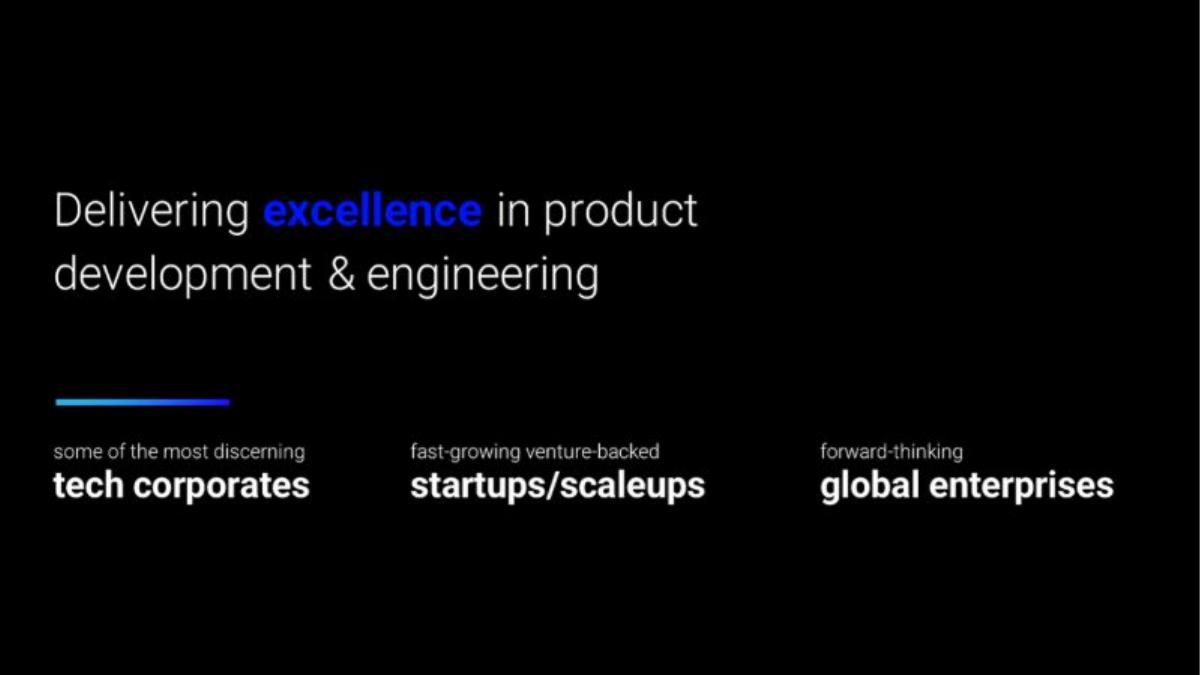
Slide 3 identifies their three core customer segments: "discerning tech corporates," "venture-backed startups/scaleups," and "forward-thinking global enterprises." By segmenting their market this way, HTEC signals that they are not a generalist shop but a partner for high-growth and high-complexity organizations.
Slide 4: Market Positioning and Engagement Models
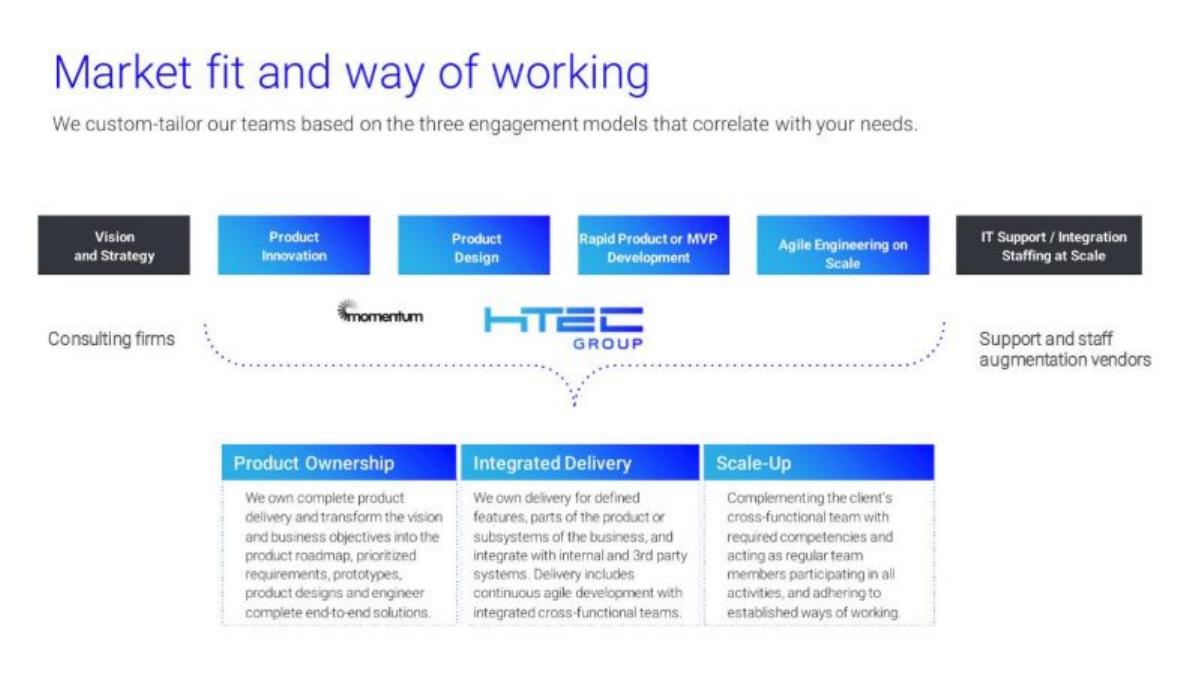
This is one of the most critical slides in the deck. Slide 4 uses a spectrum to position HTEC. On the left are "Consulting firms" (Vision and Strategy), and on the right are "Support and staff augmentation vendors" (IT Support / Integration). HTEC places itself in the middle, covering Product Innovation, Product Design, Rapid MVP Development, and Agile Engineering at Scale.
The slide also introduces their three engagement models: Product Ownership , Integrated Delivery , and Scale-Up . This transparency regarding how they work helps potential investors understand the stickiness of their revenue—moving from simple staffing to full product ownership increases both margins and client dependency.
Slide 5: The Momentum Acquisition
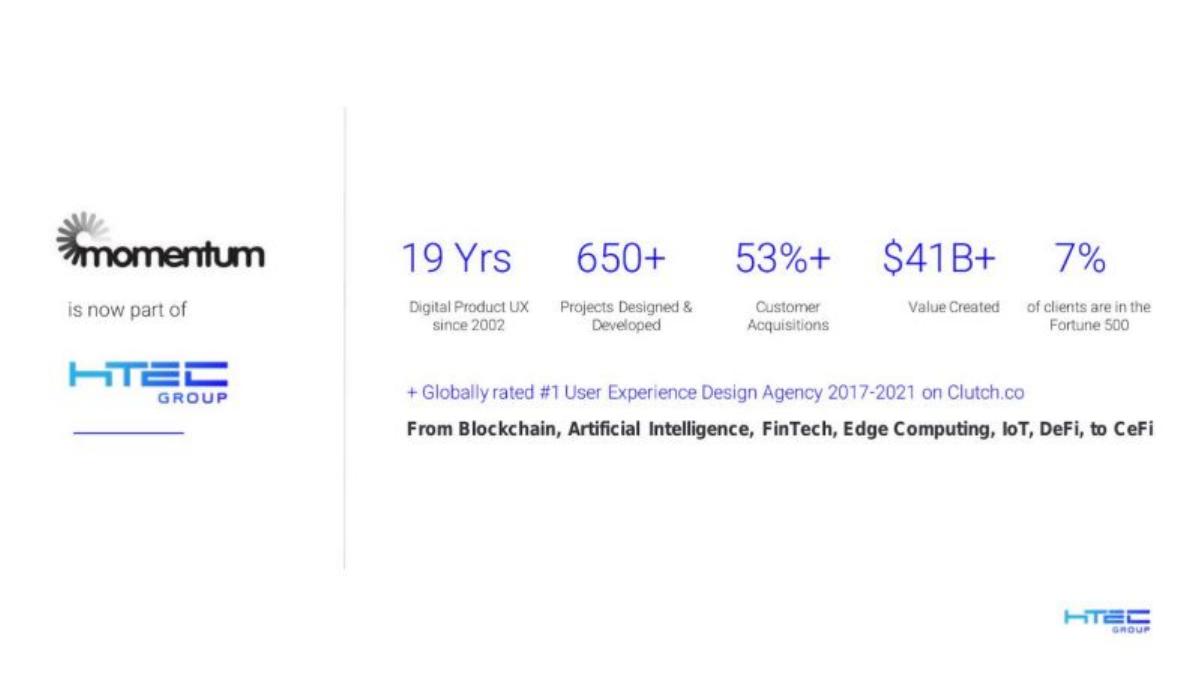
Slide 5 highlights the strategic acquisition of Momentum. The metrics here are impressive: 19 years in Digital Product UX, 650+ projects, and a claim of $41B+ Value Created . Notably, they mention that 7% of clients are in the Fortune 500. This slide serves to bolster the "creativity" side of their value proposition, ensuring they aren't viewed merely as a back-end engineering firm.
Slide 6-9: Technical Capability and Global Footprint
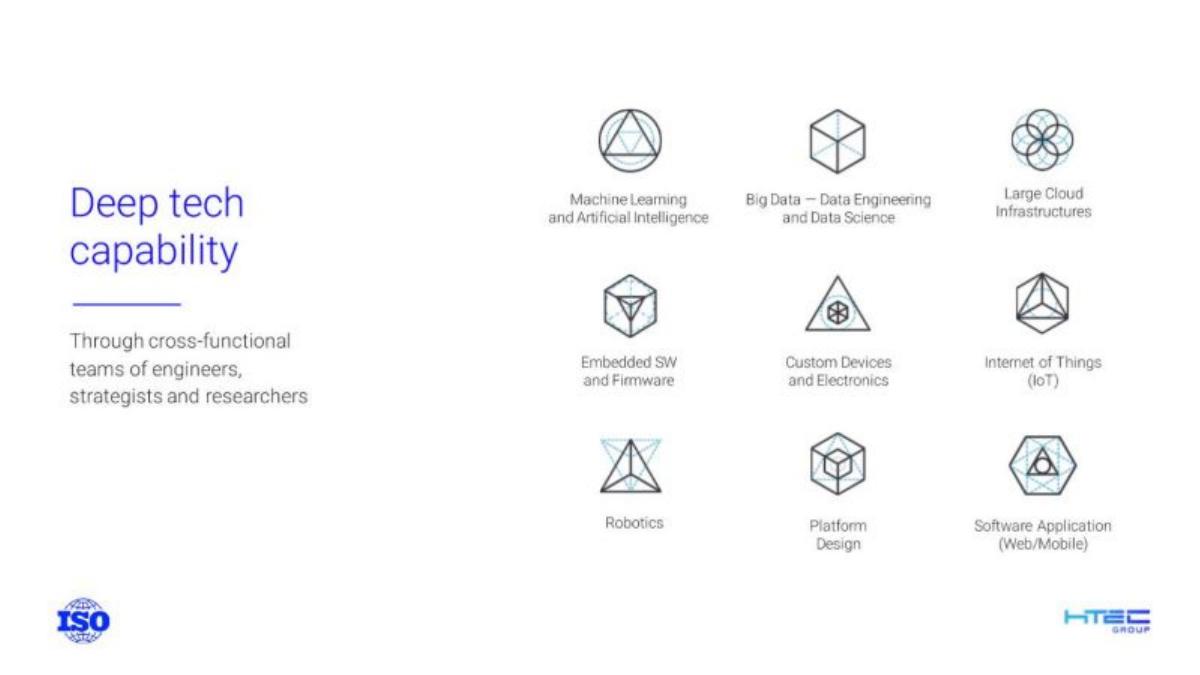
Slide 6 lists their "Deep tech capability," ranging from Robotics to Machine Learning. The inclusion of an ISO logo at the bottom left adds a layer of enterprise-grade credibility. Slide 7 and Slide 8 establish their global presence, with a headquarters in San Francisco and "Centers of Excellence" in cities like London, Stockholm, and Belgrade.
Slide 9 is the 'power slide' for a services business. It focuses on their Development Centers in South East Europe. The slide claims a "Dominant position" in the region and showcases a workforce of 1,200+ professionals . The most telling metric is the "Talent acquisition dynamic," showing a jump from 80 monthly hires to a goal of 200 monthly hires by EOY 2022. For a services firm, headcount growth is the primary driver of revenue growth.
Slide 10-12: Operational DNA
Slide 10 moves from 'what' they do to 'how' they solve problems. It mentions 10+ years of experience and specific case studies like "optimizing routes for all the ships in the Pacific" and "crunching petabytes of data."
Slide 11 explains their internal structure, which is divided into three 'Offices':
TEO (Tech Excellence Office): Senior engineers and architects defining tech standards. · PIO (Product Innovation Office): Product managers and designers supporting strategic decisions. · PMO (Project Management Office): Ensuring quality and efficiency across delivery.
This structure suggests a mature, repeatable process for handling large-scale enterprise projects, which reduces the perceived risk for investors.
Slide 13-15: The Closing Argument
Slide 13 , titled "We choose our battles," emphasizes domain expertise and long-term partnerships. Slide 14 reiterates the core theme of creativity meeting deep engineering, accompanied by a high-quality lifestyle photo of a team at work. Slide 15 provides contact information for their San Francisco office.
What Works in the HTEC Deck
1. Clear Differentiation: The spectrum on Slide 4 is a brilliant way to show exactly where they sit in the market. It avoids the trap of being "everything to everyone" by explicitly stating they are not just a staffing agency.
2. The Talent Engine: In a services business, your product is your people. By showing a clear, aggressive hiring goal (Slide 9), HTEC demonstrates a path to scaling revenue that is grounded in regional dominance.
3. Proof of Sophistication: The mention of specific complex engineering tasks (Slide 10) like medical devices and microchip algorithms elevates them above standard web development shops.
What is Missing
1. Financial Performance: There is no mention of ARR, EBITDA, or revenue growth rates. While common in private growth rounds, their absence makes it hard to judge the efficiency of the business.
2. Competitive Landscape: The deck doesn't name competitors. While Slide 4 shows categories of competitors, it doesn't explain why a client would choose HTEC over a firm like EPAM or Globant.
3. Executive Team: There are no bios for the founders or key leadership. Investors in services businesses usually want to see the pedigree of the people running the 'Offices' described on Slide 11.
Founder Takeaways
Focus on the 'How': If you are a services-based startup, don't just list your services. Explain your operational structure (like HTEC's TEO/PIO/PMO) to show that your quality is a result of a system, not just lucky hiring.
Visualize Your Scale: HTEC’s map of South East Europe (Slide 9) makes their regional dominance feel tangible. Use maps and headcount growth charts to prove you have the 'supply' to meet market 'demand.'
Bridge the Gap: HTEC successfully bridges the gap between design (Momentum) and engineering. If your company has two distinct strengths, use a slide like Slide 14 to show how they synthesize into a single value proposition.
Frequently asked questions
- What is HTEC's primary business model?
- HTEC operates as a high-end product development and engineering services firm. According to Slide 4, they offer three engagement models: Product Ownership (end-to-end delivery), Integrated Delivery (owning specific features or subsystems), and Scale-Up (complementing a client's existing cross-functional team). They explicitly distance themselves from basic IT support or staff augmentation vendors.
- How does HTEC justify its $140M growth round?
- The justification lies in their massive scale and talent pipeline. Slide 9 shows a workforce of over 1,200 professionals and an aggressive talent acquisition dynamic, aiming for 200 new hires per month. This regional dominance in South East Europe, combined with high-value design capabilities from their Momentum acquisition, presents a scalable engine for enterprise digital transformation.
- What role does the Momentum acquisition play in the deck?
- Momentum provides the 'creativity' to match HTEC's 'deep engineering.' Slide 5 highlights Momentum's 19-year history and its status as a top-rated UX agency. By integrating Momentum, HTEC can claim $41B+ in value created and a client list where 7% are Fortune 500 companies, moving them up the value chain toward 'Product Innovation' (Slide 4).
- What technical domains does HTEC specialize in?
- Slide 6 lists nine specific deep tech capabilities: Machine Learning/AI, Big Data/Data Science, Large Cloud Infrastructures, Embedded SW/Firmware, Custom Devices/Electronics, IoT, Robotics, Platform Design, and Web/Mobile Software Applications. They emphasize solving complex problems like optimizing Pacific shipping routes or building medical devices (Slide 10).
- What is missing from this pitch deck?
- As a growth-stage deck, it omits early-stage staples like a 'Problem' slide or a specific 'Ask.' There are no detailed financial statements, revenue growth charts, or margin breakdowns. It also lacks a traditional team slide featuring individual executive bios, opting instead to describe the functional 'Offices' (TEO, PIO, PMO) that manage their delivery (Slide 11).