Humanz, an Israeli-based advertising technology firm, utilized this 28-slide deck to secure $15M in venture funding in 2025. The presentation shifts the narrative from a standard SaaS platform to a market consolidator, explicitly detailing an acquisition-led growth strategy. The deck highlights a dual-revenue model—a $1,500 monthly SaaS fee paired with a 20% transaction take rate—and claims a 250% year-over-year growth rate. While the deck leans heavily on product feature walkthroughs, its core strength lies in its clear business model and the disclosure of high-profile clients like Meta, Goo…
Key takeaways
- The deck projects the influencer marketing market will grow to $45B by 2027, up from $2B in 2016 (Slide 4).
- Humanz operates a dual-revenue model: a $1,500 monthly fee plus a 20% share of advertiser payments to influencers (Slide 19).
- The company claims a 250% year-over-year growth rate and supports over 1 million creators (Slide 22).
- M&A is a core pillar of their strategy, citing the acquisition of Ubiquitous and Bambassadors with three more planned for 2026 (Slide 22).
- The platform targets three distinct user personas: Creators, Talent Managers, and Campaign Managers (Slide 10).
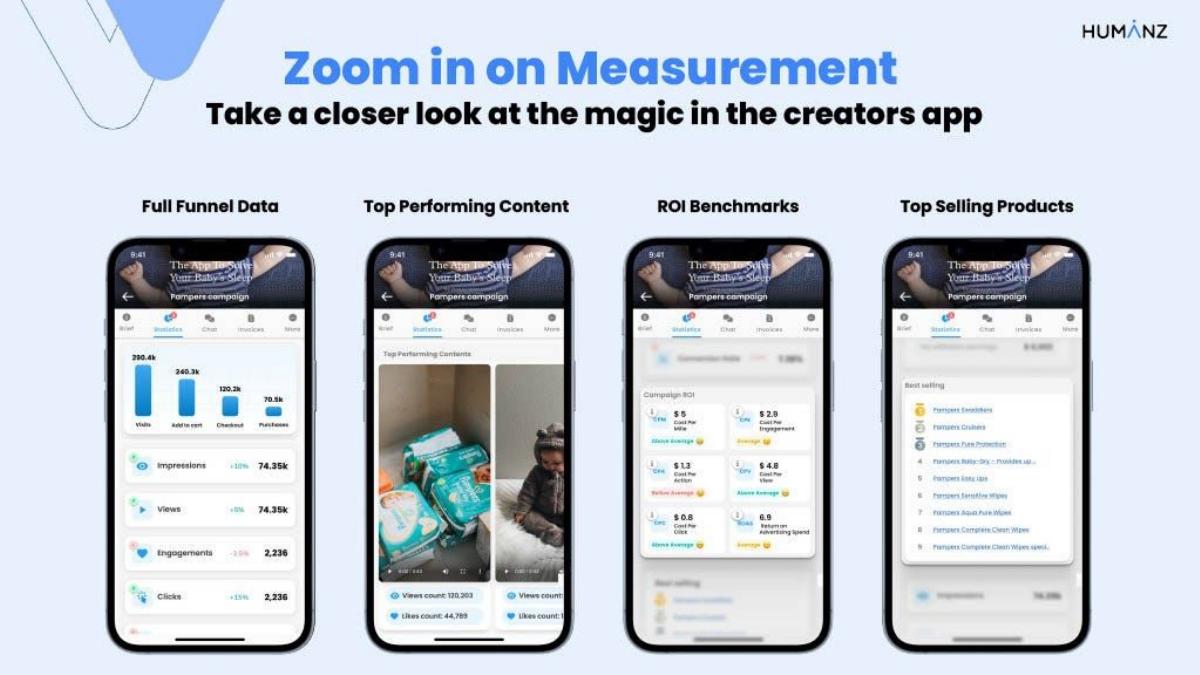
- Measurement features include full-funnel data, ROI benchmarks, and tracking of top-selling products (Slide 16).
- The deck lists an extensive roster of blue-chip clients including Meta, TikTok, Visa, Disney, and Google (Slide 20).
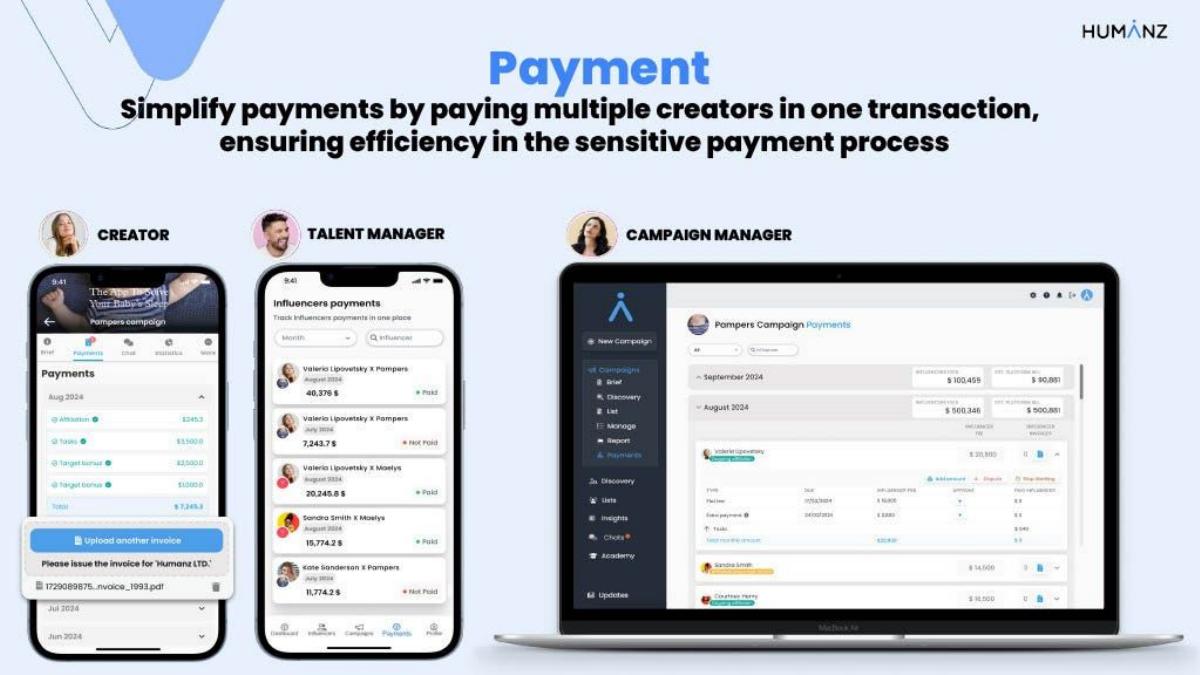
- The platform aims to streamline payments by allowing brands to pay multiple creators in a single transaction (Slide 17).
Introduction: The Consolidator's Playbook
Humanz, an Israeli influencer marketing platform, raised $15M in 2025 to fuel an aggressive expansion strategy. The deck is a 28-slide narrative that attempts to bridge the gap between a standard marketing SaaS and a high-growth M&A vehicle. By focusing on the 'inefficiency' of the current creator economy, Humanz positions itself as the necessary infrastructure to bring order to a fragmented $250B ecosystem. The following teardown examines how they structured this argument across their presentation.
Slides 1-2: The Vision and Value Proposition
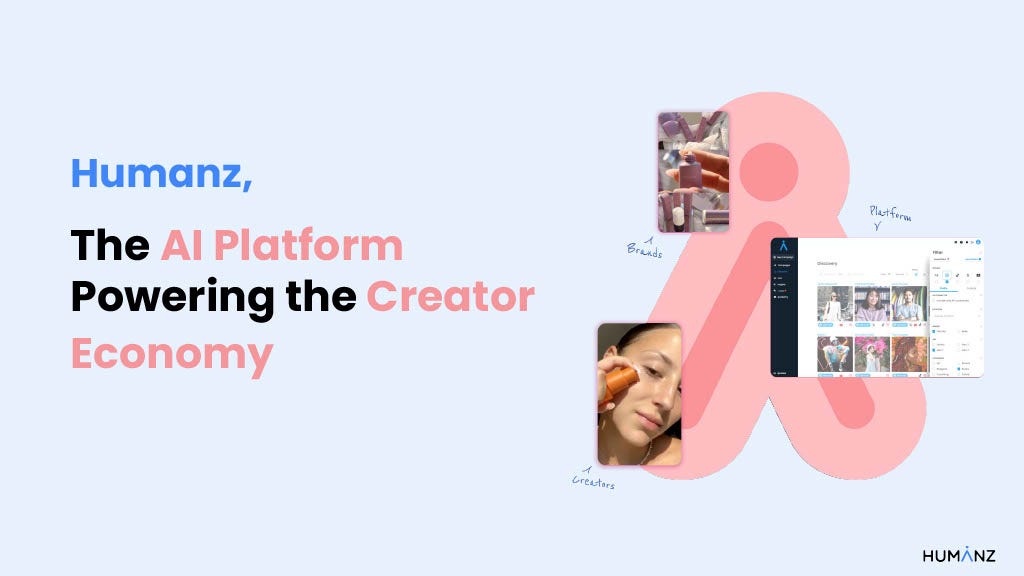
The deck opens with a bold claim on Slide 1 : 'The AI Platform Powering the Creator Economy.' The visual identity is clean, utilizing a soft pink and blue palette. Slide 2 defines the core mission: building 'successful, long-term, authentic collaborations between creators & brands.' By leading with 'AI' and 'Authenticity,' the company hits the two most important keywords in the current advertising technology landscape.
Slides 3-6: Market Size and the 'Inefficiency' Gap
Slide 4 provides the macro-economic justification for the business. It cites Statista data showing the influencer marketing market growing from $2B in 2016 to a projected $45B by 2027. This 21.15% CAGR is the 'why now' for investors. Slide 5 and 6 pivot to the problem: the ecosystem has become an 'Inefficient Market.' They identify five key challenges, though the specific list is summarized as 'Market Complexity.' This sets the stage for a solution that isn't just a tool, but a corrective layer for the entire industry.
Slides 7-10: The Three-Way Ecosystem
The 'Humanz Solution' is introduced on Slide 7 , leading into a structural breakdown of their ecosystem. A critical differentiator appears on Slide 10 : 'Building Trust to Connect the Industry.' Unlike competitors that often bypass agents, Humanz explicitly includes the 'Talent Manager' alongside the 'Creator' and 'Campaign Manager.' This recognition of the industry's actual power structure—where top creators are rarely unmanaged—suggests a higher level of market maturity than self-service platforms.
Slides 11-15: Feature Walkthrough
The deck spends five slides (11-15) detailing the platform's functional pillars: Discovery, Management, Communication, Goals & Incentives, and Measurement. Slide 11 emphasizes intuitive discovery, while Slide 12 focuses on 'two-sided campaign planning.' Slide 13 highlights direct communication via the platform, which is a key retention feature (keeping users off WhatsApp or email). Slide 14 addresses the 'Goals & Incentives'—a common pain point in influencer marketing where KPIs are often vague.
Slide 16: The Data Deep Dive
Slide 16 , titled 'Zoom in on Measurement,' is one of the most important for proving value. It shows mobile screenshots of the creator app, displaying 'Full Funnel Data,' 'ROI Benchmarks,' and 'Top Selling Products.' By showing that they can track from top-of-funnel impressions down to specific product sales, Humanz moves from being a 'brand awareness' tool to a 'performance marketing' tool. This is a crucial distinction for securing larger enterprise budgets.
Slide 17: Solving the Payment Friction
Slide 17 addresses the 'sensitive payment process.' It claims to simplify payments by allowing brands to pay multiple creators in one transaction. In a global market where creators may be in different tax jurisdictions, this fintech-lite feature is a significant operational moat.
Slides 18-19: The Business Model
Humanz is transparent about its pricing on Slide 19 . They employ a hybrid model: a $1,500 monthly fee and a 20% share of advertiser payments to influencers. This is a 'best of both worlds' approach. The flat fee ensures a baseline of high-margin SaaS revenue, while the 20% take rate allows the company to scale its revenue directly with the growth of the influencer marketing budgets it manages. For a $15M round, this clarity on unit revenue is essential.
Slide 20: Social Proof and Traction
Slide 20 displays an impressive list of 'Top Clients.' The logos include Meta, TikTok, Visa, Disney, Google, Nestlé, McDonald's, Adidas, L'Oréal, BBC, Zara, Lenovo, Microsoft, and Heineken. Listing both Meta and TikTok—the very platforms where the creators live—as clients is a powerful signal of platform utility and trust.
Slides 21-22: The M&A Growth Strategy
Slide 22 , 'Hyper Growth Strategy for Market Dominance,' reveals the real reason for the $15M raise. The company is not just building; it is buying. They cite the acquisitions of Ubiquitous and Bambassadors and state that three more acquisitions are planned for early 2026. They also claim a 250% YoY growth rate and that the platform has facilitated 'hundreds of millions in sales.' This slide transforms the company from a software startup into a market consolidator.
Slides 23-28: AI and Team
The final section touches on the 'AI Transformation' (Slides 23-24) and the team (Slides 25-26). Slide 26 introduces the Humanz team, and Slide 27 notes their global presence with multiple offices. The deck concludes with a contact slide for CEO Liran Liberman.
What Works in the Humanz Deck
1. Clear Revenue Model: Many ad-tech decks hide their take rates or subscription costs in the appendix. Humanz puts the $1,500/month + 20% commission front and center on Slide 19. This transparency builds immediate trust with investors regarding the path to profitability.
2. The 'Three-Legged Stool' Persona Strategy: By including Talent Managers as a first-class citizen in their UI (Slide 10), they solve a major friction point. Most platforms try to 'disrupt' managers out of the equation; Humanz embraces them, which likely aids in onboarding high-tier creators.
3. Performance-First Measurement: Slide 16’s focus on 'Top Selling Products' and 'ROI Benchmarks' moves the conversation away from 'likes' and 'comments' toward 'dollars' and 'cents.' This is what enterprise brands (like the ones on Slide 20) actually care about.
4. M&A as a Feature: The explicit mention of an acquisition strategy (Slide 22) shows a sophisticated understanding of market dynamics. In a crowded space, being the 'consolidator' is often a more attractive investment than being just another 'competitor.'
What Is Missing from the Humanz Deck
1. Unit Economics: While we see the revenue model, we don't see the efficiency. There is no mention of Customer Acquisition Cost (CAC), Lifetime Value (LTV), or Net Revenue Retention (NRR). For a $15M round, these are usually expected metrics.
2. Competitive Landscape: The deck identifies 'market complexity' as the enemy, but it doesn't name a single competitor. In a space with players like Grin, Impact, or CreatorIQ, failing to position against them is a notable omission.
3. Technical AI Depth: Despite calling themselves an 'AI Platform' on Slide 1, there is very little technical detail on what the AI actually does. Is it predictive modeling for ROI? Computer vision for content analysis? Natural language processing for brand safety? The deck stays at a high level.
4. The 'Ask': The provided slides do not include a specific 'Ask' slide detailing how the $15M will be allocated (e.g., % to M&A, % to R&D, % to Sales). While the publisher reports the amount raised, the deck itself should ideally outline the use of funds.
Founder Takeaways: What to Copy
1. The Hybrid Revenue Slide: If you have a multi-stream revenue model, copy the layout of Slide 19. It’s simple, bold, and leaves no room for ambiguity.
2. Persona-Based UI Walkthroughs: Instead of just showing a dashboard, show how different users (Creator vs. Brand vs. Manager) interact with the same data. Slide 17 is a great example of this, showing the different views for different stakeholders.
3. Growth Through Consolidation: If your industry is fragmented, don't be afraid to pitch a 'Roll-Up' strategy. Slide 22 shows how to frame acquisitions as a core competency rather than a distraction.
4. High-Value Social Proof: If you have big clients, don't just list them—group them. Slide 20’s use of recognizable logos across different sectors (Tech, FMCG, Entertainment) proves the platform's versatility.
Frequently asked questions
- What is the primary revenue driver for Humanz?
- Humanz uses a hybrid model. According to slide 19, they charge a flat $1,500 monthly subscription fee for platform access and take a 20% commission on all payments made from advertisers to influencers. This allows them to capture both predictable SaaS revenue and upside from high-volume marketing spend.
- How does Humanz plan to achieve market dominance?
- The strategy is twofold: organic growth and aggressive M&A. Slide 22 notes they have already acquired Ubiquitous and Bambassadors, with three additional acquisitions slated for early 2026. They are leveraging these acquisitions to maintain a reported 250% YoY growth rate.
- Who are the target users of the Humanz platform?
- Unlike many platforms that focus only on the brand-creator relationship, Humanz includes the 'Talent Manager' as a primary stakeholder. Slide 10 and 17 show a three-way ecosystem involving the Creator, the Talent Manager, and the Campaign Manager (Brand).
- What specific AI capabilities does the deck mention?
- While the deck brands itself as an 'AI Platform' on slide 1, specific AI details are sparse in the provided images. Slide 24 mentions leveraging AI across products, likely for discovery, fraud detection, and ROI benchmarking, though the technical implementation is not detailed.
- Does the deck include financial projections?
- Slide 21 is titled '3 year plan,' but the specific financial figures for future years were not detailed in the provided text. However, slide 22 does confirm current performance metrics, including facilitating 'hundreds of millions in sales' and supporting over 1 million creators.