Huntly App presents a PropTech solution centered on immersive 3D mapping and AI personalization to solve the 'context gap' in online real estate listings. The deck outlines a multi-pronged revenue model targeting both consumers ($9.99/month) and professionals (starting at $99/month). While the visual presentation is modern, the company sets extremely high bars for its inaugural year, projecting $953,760 in revenue against $850,000 in expenses to achieve immediate profitability. The deck relies heavily on beta user feedback, citing a 92% improvement in property visualization. However, the tran…
Key takeaways
- The core problem identified is that 80% of homebuyers struggle to understand a property's context through traditional online listings (Slide 02).
- Huntly claims a 35% faster match rate compared to incumbents like Zillow and Redfin by using 3D mapping instead of 2D photos (Slide 14).
- The revenue model is diversified across B2C subscriptions, B2B professional partnerships, and targeted advertising with a $20 CPM (Slide 16).
- Financial projections for Year 1 are aggressive, targeting $953,760 in revenue and $103,760 in profit immediately upon launch (Slide 30).
- By Year 3, the company expects to reach $1,594,056 in revenue with a 40% growth rate and $694,056 in profit (Slide 32).
- The 'Use of Funds' slide allocates $400,000 to product development and $300,000 to marketing, but does not state the total capital being raised (Slide 34).
- The team slide includes a placeholder name, 'John Doe, Real Estate Mogul,' suggesting the advisory board or final team member may not be finalized (Slide 36).
- Beta testing results show strong early sentiment, with 87% of users stating AI recommendations matched their needs (Slide 22).
Executive Summary and Value Proposition
Huntly App enters the crowded PropTech market with a specific technical hook: the replacement of static 2D imagery with immersive 3D mapping and AI-driven discovery. The deck is structured to move quickly from a broad market pain point to a specific technical solution, backed by early beta data and aggressive financial modeling.
Slides 01-04: The Problem and The Solution
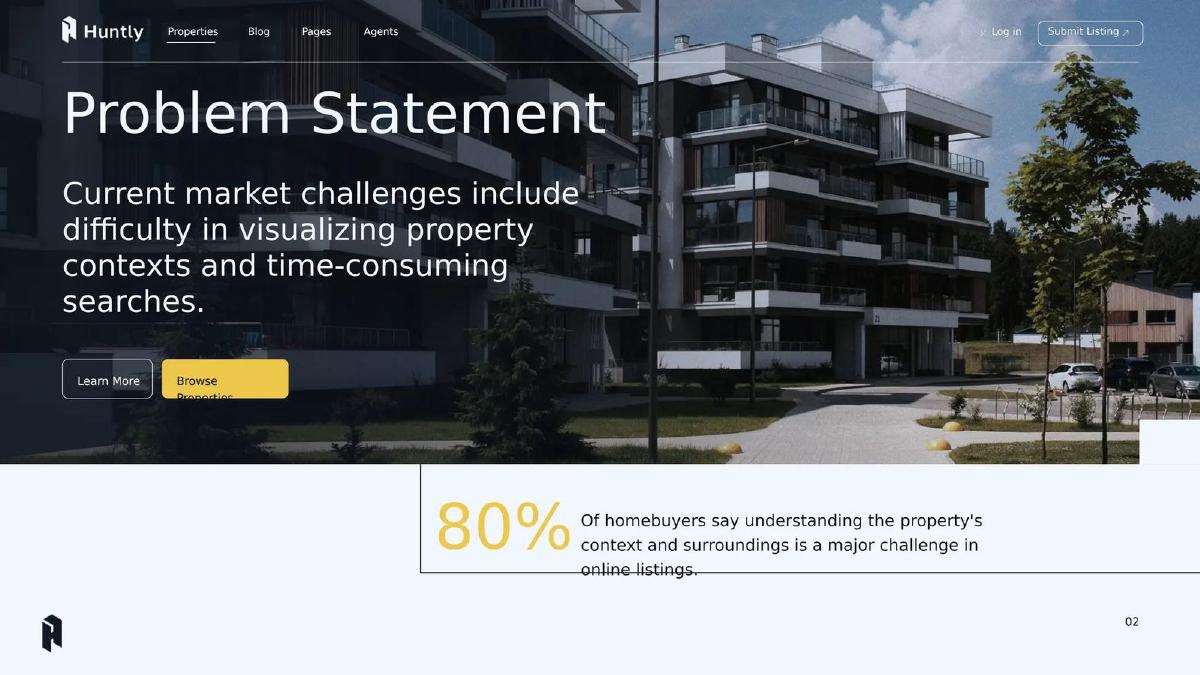
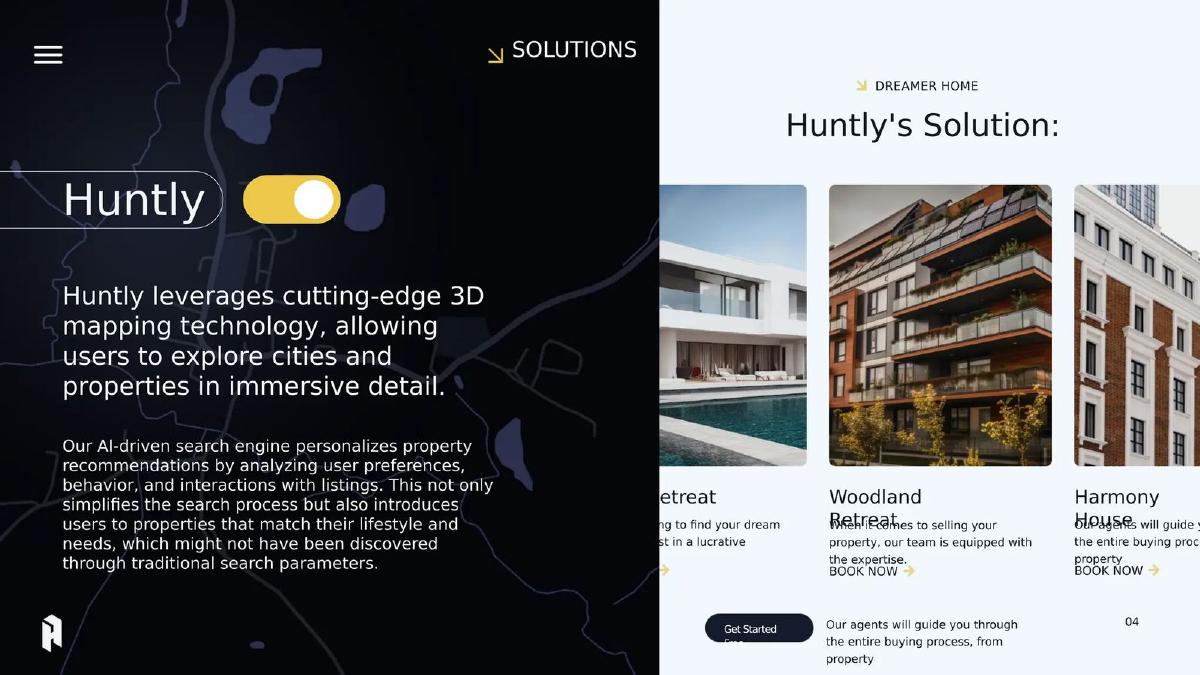
The deck opens by identifying a significant friction point in the home-buying process. On Slide 02 , the company cites that 80% of homebuyers find understanding a property's context and surroundings to be a major challenge in online listings. This sets the stage for Slide 04 , where Huntly introduces its solution: a platform that leverages 3D mapping to allow users to explore cities and properties in 'immersive detail.' The solution also highlights an AI-driven search engine that moves beyond 'traditional search parameters' to match listings with user lifestyles and behaviors.
Slides 06-12: Product Features and Market Segmentation
Slide 06 provides a visual representation of the interface, showing a 3D-rendered city map with property pins, star ratings (4.83), and price ranges ($150,000 - $350,000). This visual emphasizes the 'context' mentioned in the problem statement. The deck then segments its audience. Slide 10 defines the primary target as households earning $50,000 to $150,000 , looking for homes between $200,000 and $1,000,000 . Slide 12 identifies the B2B side of the marketplace: agents and brokers looking for innovative listing tools. By addressing both sides of the market, Huntly establishes the foundation for its dual-revenue model.
Slides 14-16: Competitive Analysis and Revenue Model
On Slide 14 , Huntly takes a direct shot at industry giants Zillow and Redfin. The company claims that while incumbents focus on 2D photos, Huntly's 3D approach offers a 35% faster match rate . This is a bold metric, though the deck does not specify the methodology used to calculate 'match rate' speed. Slide 16 breaks down the monetization strategy. The company projects $1.2 million from $9.99/month consumer subscriptions, another $1.2 million from $99/month professional partnerships, and $120,000 from advertising. These figures appear to be Year 1 targets, based on an estimated 500,000 monthly active users .
Slides 18-26: Growth Strategy and KPIs
Slide 18 explicitly states the Year 1 goal: to position Huntly as the leading real estate app using AI and 3D tech. To achieve this, Slide 24 outlines a growth strategy involving social media campaigns aiming for 20 million impressions and influencer partnerships targeting a 15% conversion rate from views to downloads. Slide 26 establishes the Key Performance Indicators (KPIs) for the first year: securing 20,000 property listings , maintaining a 60% user retention rate after six months, and achieving a 5% premium conversion rate . These are high-performance benchmarks for a new platform.
Slides 28-34: Financial Projections and Use of Funds
The financial section is notably optimistic. Slide 30 projects Year 1 revenue of $953,760 against expenses of $850,000 , resulting in a profit of $103,760 . By Year 3 ( Slide 32 ), revenue is expected to climb to $1,594,056 with a profit of $694,056 . Slide 34 details the 'Use of Funds,' totaling $1,000,000 : $400,000 for product development, $300,000 for marketing, $200,000 for operations, and $100,000 for a contingency fund. While the allocation is clear, the deck does not explicitly state if this $1M is the total amount being raised in the current round.
Slide 36: The Team
The team slide features three named individuals with strong credentials: Alex Rivera (CEO, two successful exits), Jamie Chen (CTO, Ph.D. in CS), and Priya Kumar (CMO, digital marketing strategist). However, the fourth slot is occupied by 'John Doe, Real Estate Mogul,' which serves as a placeholder for a future advisor or partner. This indicates that while the core tech and marketing leadership is in place, the company is still seeking to solidify its industry-specific advisory board.
What Works in This Deck
Visual Consistency: The deck uses high-quality 3D renders and a consistent color palette that reinforces the 'high-tech' nature of the product. The UI mockups on Slides 06 and 14 effectively communicate the product's unique selling point without requiring extensive text.
Clear Monetization: Unlike many early-stage apps that rely on vague 'future monetization,' Huntly clearly defines three distinct revenue streams with specific price points ($9.99, $99, $20 CPM) on Slide 16.
Beta Validation: Including quantitative feedback from beta users (Slide 22) provides a necessary counterweight to the aggressive future projections. Citing a 92% improvement in visualization ability gives investors a reason to believe the technology actually solves the stated problem.
What Is Missing or Needs Improvement
The 'Ask' Specificity: While Slide 34 shows how $1 million would be spent, the deck never explicitly asks for a specific investment amount or mentions the terms of the round. A clear 'The Ask' slide is a standard requirement that is omitted here.
Year 1 Feasibility: The jump from a beta test to 500,000 monthly active users and $1M in revenue within 12 months is extremely steep. The deck would benefit from a more detailed month-by-month 'Go-to-Market' roadmap to explain how $300,000 in marketing spend (Slide 34) can realistically generate 20 million impressions and half a million active users.
Competitive Depth: Slide 14 mentions Zillow and Redfin, but it ignores the significant 3D investments those companies have already made (e.g., Zillow 3D Home tours). A more nuanced competitive landscape that acknowledges existing 3D solutions would increase the deck's credibility.
Founder's Takeaway: What to Copy
The Problem-to-Metric Link: Huntly does an excellent job of identifying a specific problem (context gap) and immediately following it with a metric (80% of buyers struggle with this). This makes the problem feel validated and urgent.
KPI Transparency: Listing specific targets for retention (60%) and conversion (5%) on Slide 26 shows that the founders understand the unit economics required to make the business viable. Even if the targets are ambitious, having them in the deck demonstrates a data-driven mindset.
Segmented Audience Profiles: Clearly separating the primary (homebuyer) and secondary (agent) audiences on Slides 10 and 12 allows the investor to see the full scope of the marketplace without getting confused by overlapping value propositions.
Frequently asked questions
- What is Huntly's primary competitive advantage?
- Huntly differentiates itself through the integration of 3D mapping technology and AI-driven personalization. According to Slide 14, the company claims this combination results in a 35% faster 'match rate' for users compared to the 2D photo-based approach used by market leaders Zillow and Redfin. The focus is on providing immersive environmental context that traditional listings lack.
- How does Huntly plan to generate revenue?
- The company employs a three-tier revenue strategy detailed on Slide 16. This includes a $9.99/month premium subscription for consumers, a B2B model charging real estate professionals $99/month for enhanced listings and analytics, and a targeted advertising stream for home-related services (moving, renovation) with an estimated $20 CPM.
- Are the financial projections realistic for a Year 1 startup?
- The projections are highly ambitious. Slide 30 forecasts nearly $1 million in revenue and immediate profitability ($103,760) in the first year. Achieving this requires scaling to 500,000 monthly active users (Slide 16) and securing 20,000 property listings (Slide 26) within 12 months, which represents a very high velocity for a new PropTech entrant.
- What is missing from the Huntly pitch deck?
- The deck lacks a specific 'Ask' amount; while it details how $1,000,000 would be spent on Slide 34, it doesn't explicitly state the total investment sought or the valuation. Additionally, the team slide (Slide 36) contains a placeholder for a 'Real Estate Mogul' named John Doe, indicating the team or advisory board is incomplete.
- Who is the target audience for the Huntly app?
- Huntly targets two distinct groups. The primary audience is homebuyers with annual household incomes between $50,000 and $150,000 looking for properties in the $200,000 to $1,000,000 range (Slide 10). The secondary audience consists of real estate agents and brokers seeking tools to enhance listings and close deals (Slide 12).