Hyphen’s 2015 Series A deck is a study in restraint, utilizing only nine slides to communicate a high-growth narrative. The company addresses the massive problem of employee disengagement, citing that 7 out of 10 employees are disengaged. The deck leans heavily on visual storytelling rather than dense text, using a three-step solution framework: anonymous opinions, real-time insights, and better actions. Despite the lack of detailed financial projections or a formal 'ask' slide, the deck succeeds by showcasing impressive traction—specifically a 34% month-over-month ARR growth and a jump from…
Key takeaways
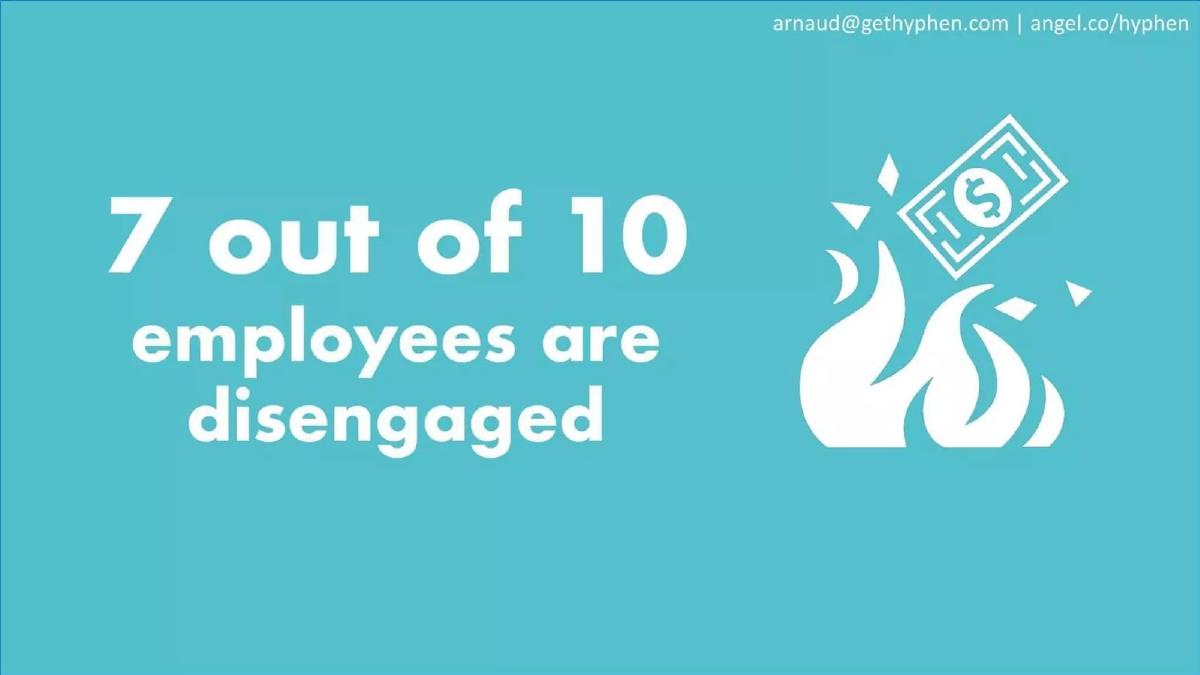
- The deck identifies a specific, massive pain point: 7 out of 10 employees are disengaged (Slide 2).
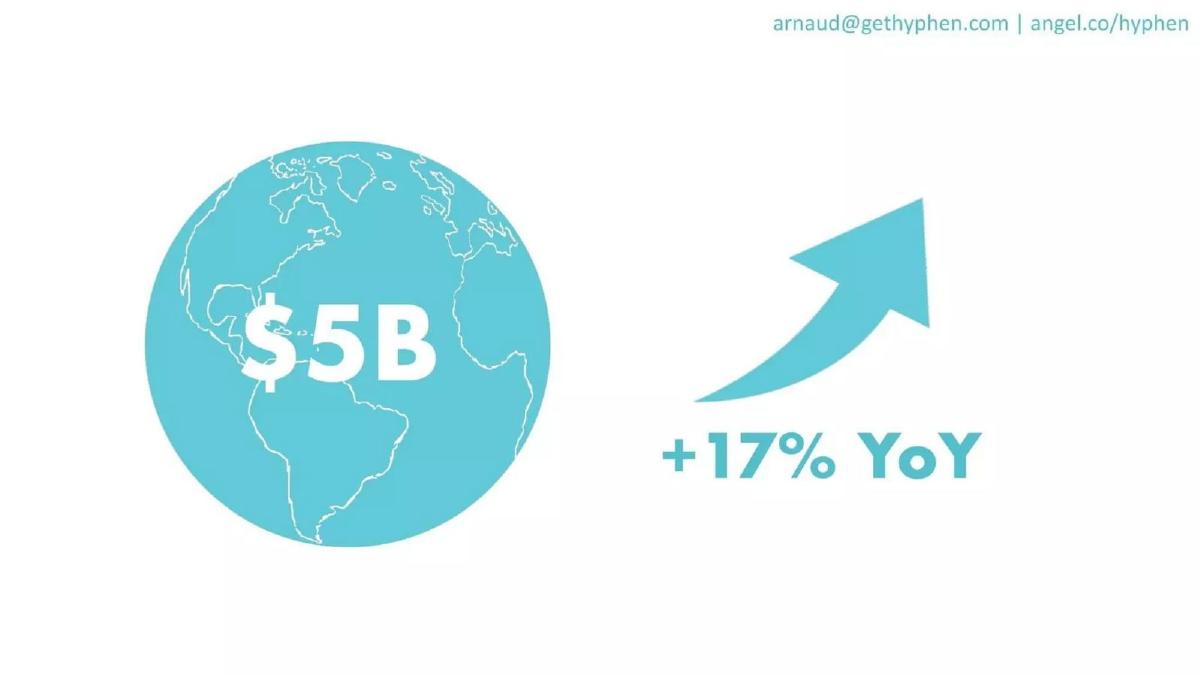
- It targets a $5B market growing at 17% Year-over-Year (Slide 3).
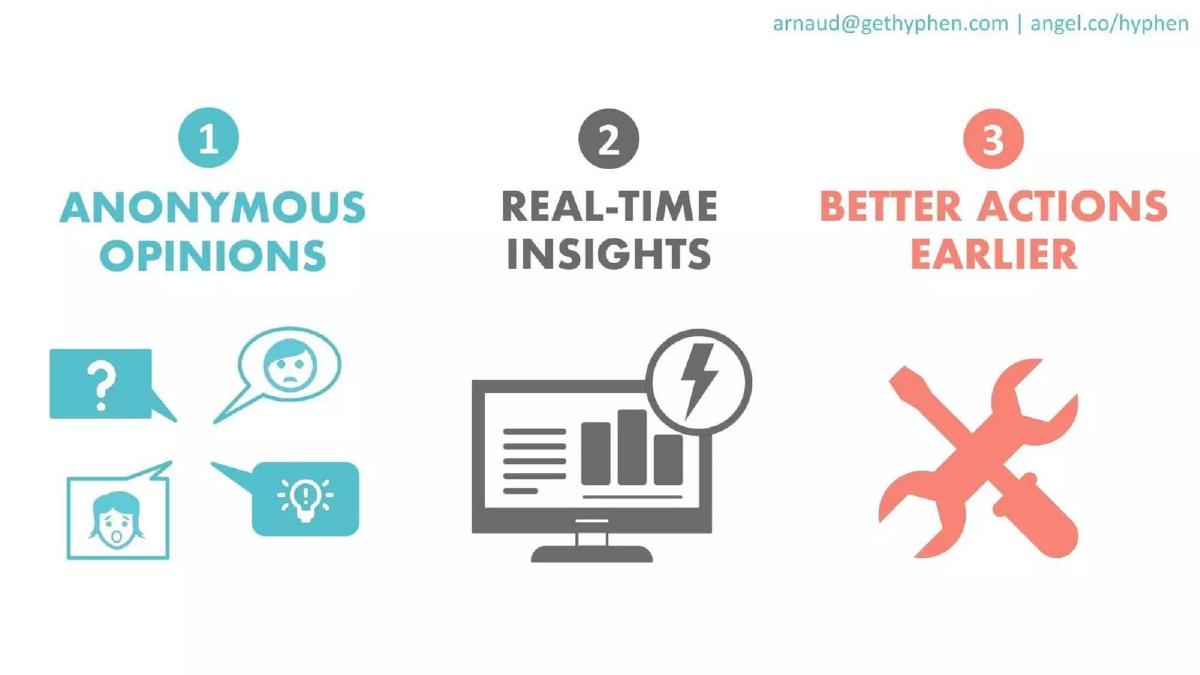
- The product is positioned through a simple three-step value proposition: Anonymous Opinions, Real-time Insights, and Better Actions Earlier (Slide 5).
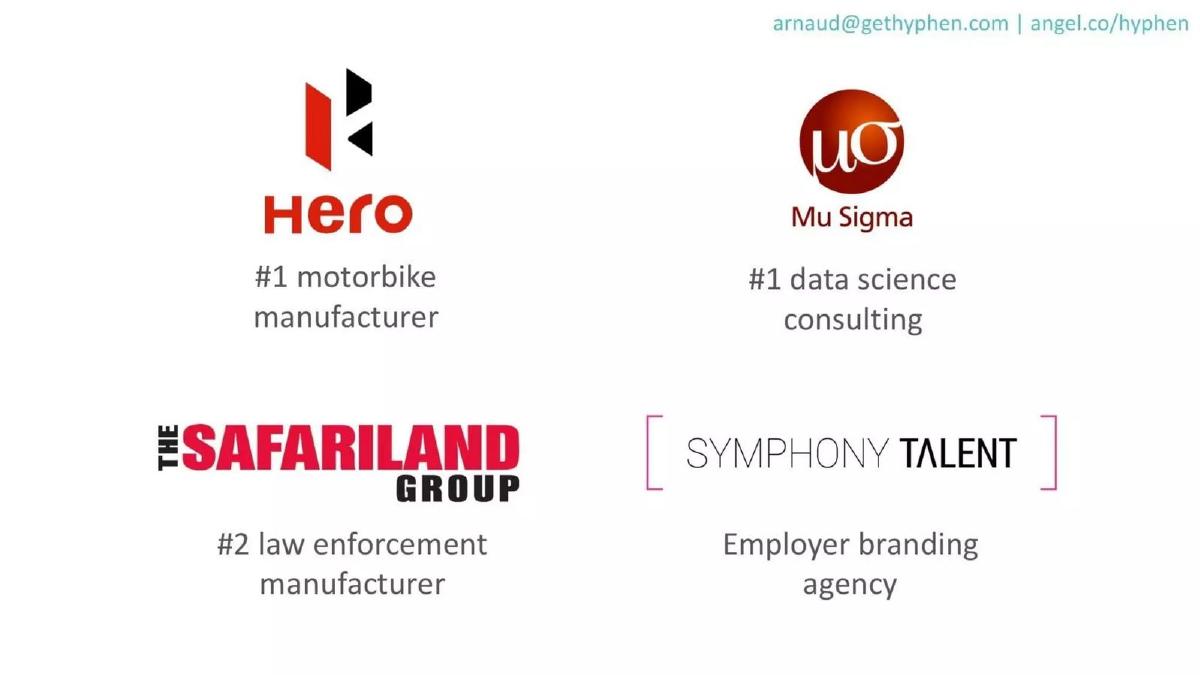
- Hyphen demonstrates early enterprise validation with logos like Hero, Mu Sigma, and Safariland Group (Slide 6).
- Financial traction is the centerpiece, showing ARR growth from $18k in Q3 to $120k in Q1 (Slide 7).
- The company reports a strong 34% Month-over-Month ARR growth rate (Slide 7).
- The founding team highlights a 5-year working history and a previous $7MM SaaS exit (Slide 8).
- The deck completely omits a formal 'Ask' slide, valuation, or use of funds breakdown.
The Power of Brevity: Hyphen’s 9-Slide Series A
In the world of venture capital, there is a persistent myth that a Series A deck needs to be a 25-page exhaustive tome covering every possible edge case of the business. Hyphen’s 2015 deck, which secured $2.8 million, is a direct rebuttal to that notion. With only nine slides, the deck is a masterclass in minimalist storytelling. It doesn't get bogged down in technical architecture or complex pricing tiers; instead, it focuses on a singular, painful problem and the undeniable momentum the team has generated in solving it.
Hyphen positions itself as a mobile-first employee voice platform. In 2015, the transition from annual 'pulse surveys' to real-time, anonymous feedback was a significant trend in HR tech. This deck captures that zeitgeist by emphasizing speed, anonymity, and actionable insights. Let’s walk through the slides to see how they built a compelling case with so little text.
The Hook: Problem and Market Scale
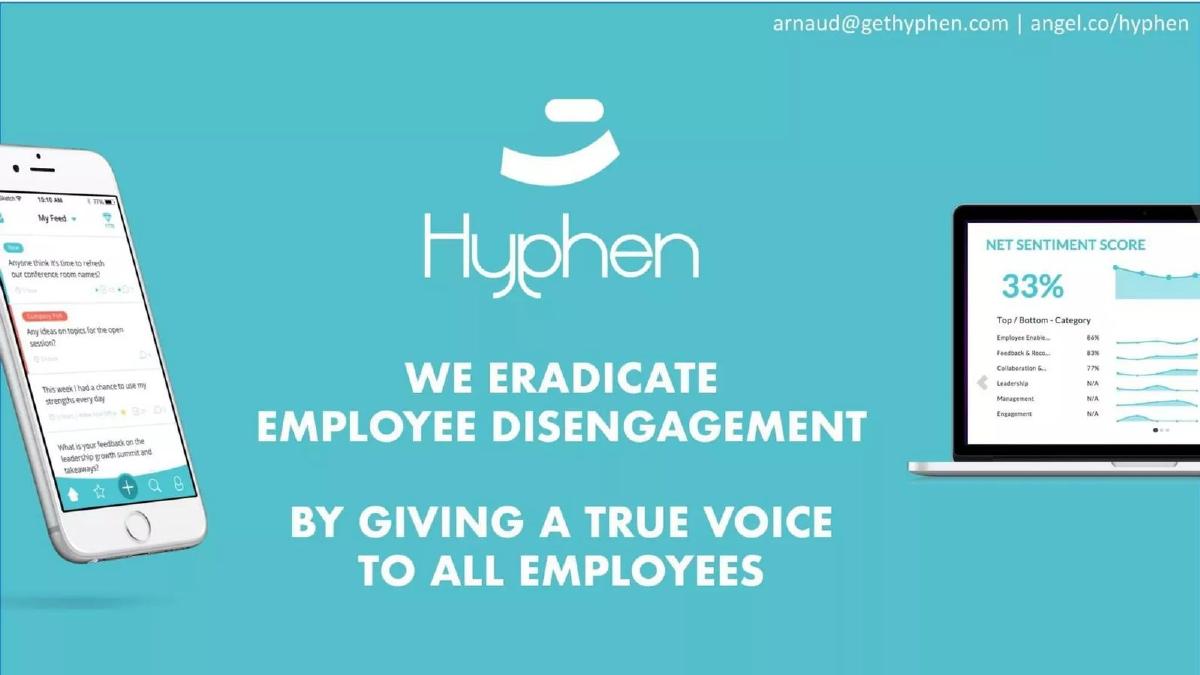
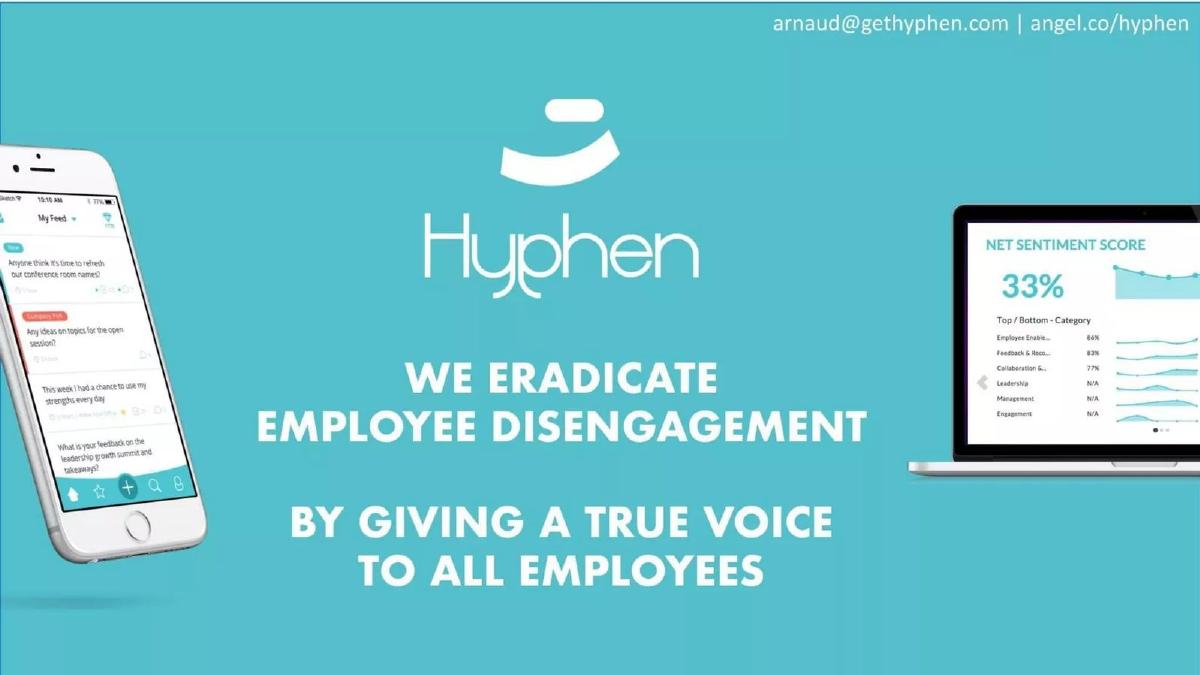
Slide 1: Title Slide The deck opens with a clear mission statement: "We eradicate employee disengagement by giving a true voice to all employees." The slide features a smartphone showing a feed of employee questions and a laptop displaying a 'Net Sentiment Score' of 33%. This immediately establishes the product as a dual-sided platform: a mobile app for employees and a dashboard for management. The contact email and AngelList link are prominently displayed in the top right corner.
Slide 2: The Problem This is a classic 'shock' slide. It features a graphic of a burning dollar bill and the text: "7 out of 10 employees are disengaged." By quantifying the problem so simply, Hyphen avoids a long-winded explanation of HR dynamics. The burning money icon suggests that disengagement isn't just a cultural issue; it's a financial drain on the enterprise.
Slide 3: Market Opportunity Hyphen identifies a "$5B" market opportunity on a global scale, noting that this market is growing at "+17% YoY." This slide is light on sources, but it serves its purpose: proving that the pond is big enough for a billion-dollar fish. The upward-swinging arrow reinforces the theme of growth that permeates the rest of the deck.
The Solution: Product and Workflow
Slide 4: Product in Context This slide is a full-bleed lifestyle image of a professional woman using the Hyphen app on a city street. The screen of the phone shows a conversation: "Why did we not talk about the 2 recent big losses in yesterday's all-hands??" This is a strategic choice. It shows the product's 'edge'—the ability for employees to ask the uncomfortable questions that they wouldn't ask in person. It highlights the 'anonymous' nature of the platform without needing a bullet point to say it.
Slide 5: The Three Pillars Hyphen breaks its value proposition into three numbered steps: 1. Anonymous Opinions, 2. Real-Time Insights, and 3. Better Actions Earlier. Each step is accompanied by a simple icon. This slide explains the 'how' of the business. It moves from the raw data collection (opinions) to the processing (insights) to the business outcome (actions). It’s a logical flow that justifies why a CEO would pay for the software.
Validation: Traction and Social Proof
Slide 6: Customer Logos Social proof is critical for enterprise SaaS. Hyphen lists four diverse customers: Hero (#1 motorbike manufacturer), Mu Sigma (#1 data science consulting), Safariland Group (#2 law enforcement manufacturer), and Symphony Talent (Employer branding agency). This selection is clever because it shows the product isn't just for tech startups; it works in manufacturing, consulting, and agency environments. It proves the 'Cross-Industry' claim made later in the deck.
Slide 7: The 'Money' Slide This is the most important slide in the deck. It shows a steep revenue curve. The ARR (Annual Recurring Revenue) starts at $18K in Q3, grows to $49K in Q4, and hits $120K in Q1. Beside the chart, they highlight "ARR +34% MoM," "Cross-Industry," and "Cross-Geo." For a Series A investor in 2015, a 34% month-over-month growth rate is an incredibly strong signal of product-market fit. This slide alone likely did 80% of the work in closing the round.
The Team and The Close
Slide 8: The Team The team slide features Arnaud Grunwald (CEO), Ranjit Jose (CMO), and Janssen Choong (CTO). Rather than listing individual resumes, they focus on their collective history: "Worked together for 5 years," "Built, marketed & sold into Enterprise," and "Created $7MM SaaS biz in 3 years." This is a powerful way to de-risk the investment. Investors aren't just betting on an idea; they are betting on a proven unit that knows how to scale an enterprise software company.
Slide 9: Contact The deck ends as simply as it began, with the logo and the CEO’s email address. There is no 'Ask' slide, no mention of the $2.8M they were seeking, and no breakdown of how they would spend the money. In a high-demand round, the 'Ask' is often handled in the verbal pitch or the follow-up data room, allowing the deck to remain a pure narrative tool.
What Works in This Deck
Clarity of Purpose: You can read this entire deck in 60 seconds and understand exactly what Hyphen does, who they sell to, and how fast they are growing. In an environment where analysts see dozens of decks a day, this brevity is a competitive advantage.
Focus on Momentum: Slide 7 is the heart of the deck. By showing a 6.6x increase in ARR over just three quarters, the founders create a sense of urgency. It suggests that the 'train is leaving the station' and investors need to act quickly to get on board.
Founder-Market Fit: The team slide doesn't just show faces; it shows a track record of specific, relevant success. The fact that they have already built a $7M SaaS business together effectively eliminates the 'can they execute?' question that plagues many early-stage startups.
What Is Missing
The Business Model: There is no mention of how much Hyphen costs. Is it a per-seat license? An enterprise flat fee? Without this, it’s hard to judge the quality of the ARR. For example, $120k ARR could be one large pilot or 100 small customers.
The Competitive Landscape: The HR tech space was already crowded in 2015. By omitting competitors, Hyphen misses the chance to explain why their 'mobile-first' or 'anonymous' approach is superior to incumbents like Gallup or newer rivals like Culture Amp.
The 'Ask': While common in 'teaser' decks, the absence of a funding goal or a roadmap for the next 18 months is a notable omission for a Series A pitch. It leaves the investor wondering what the $2.8M will actually be used for—hiring, sales expansion, or product R&D?
What a Founder Should Copy
The 'Three Pillars' Framework: Slide 5 is a perfect example of how to explain a complex software workflow. If your product has many features, group them into three high-level benefits. It makes the solution memorable.
Visual Storytelling: Use full-screen images of your product in use (like Slide 4) rather than just screenshots. It helps investors visualize the 'user journey' and the emotional context of the problem you are solving.
Quantified Team Success: Don't just list where you went to school. List what you built and how much revenue it generated. "Created $7MM SaaS biz in 3 years" is a much stronger credential than "Former VP at [Big Corp]."
Minimalist Design: Hyphen uses a consistent color palette (teal and white) and very little text. This forces the presenter to actually speak and engage with the audience rather than reading off the slides. It also makes the deck feel modern and 'tech-forward.'
Frequently asked questions
- How much did Hyphen raise with this deck?
- According to the catalogue facts, Hyphen raised $2,800,000 in 2015. This was a Series A round, which is notable given that the deck only contains nine slides. The raise was likely supported by the strong traction shown on Slide 7, where they demonstrated a rapid climb to $120k in ARR and a 34% month-over-month growth rate.
- What is the core problem Hyphen is solving?
- Hyphen focuses on 'Employee Disengagement.' Slide 2 explicitly states that 7 out of 10 employees are disengaged, implying a massive loss in productivity and capital for enterprises. They frame their solution as a way to give a 'true voice' to all employees to eradicate this disengagement, as seen on the title slide.
- Does the deck include a competitive analysis?
- No. The deck entirely omits a competitor slide. There is no mention of other employee engagement platforms like Glint, Culture Amp, or TinyPulse. Instead, the founders chose to focus exclusively on their own growth metrics and the specific workflow of their product, perhaps betting that their 34% MoM growth was enough to prove they were winning the space.
- What is the background of the founding team?
- The team consists of Arnaud Grunwald (CEO), Ranjit Jose (CMO), and Janssen Choong (CTO). As per Slide 8, the trio has worked together for five years. Their most significant credential is having previously built, marketed, and sold into the enterprise to create a $7MM SaaS business in just three years, providing them with significant 'second-time founder' credibility.
- What are the biggest omissions in this deck?
- This deck is missing several standard elements: a detailed business model/pricing slide, a competitive landscape, a go-to-market strategy, and a formal 'Ask' slide. It also lacks unit economics like CAC or LTV. It functions more as a 'Traction Teaser' than a comprehensive business plan, relying on the strength of the ARR growth curve to drive investor interest.