Hypatos is a process automation startup that utilizes language processing AI and computer vision to accelerate financial document processing. Their 9-slide Series A deck, used to secure a $15.5 million round, focuses heavily on the technical architecture and the massive scale of the back-office efficiency problem. By positioning their solution as a bridge between simple Robotic Process Automation (RPA) and complex human understanding, Hypatos targets high-volume use cases like invoices and insurance claims. The deck is notable for its brevity and technical density, prioritizing the 'how' of t…
Key takeaways
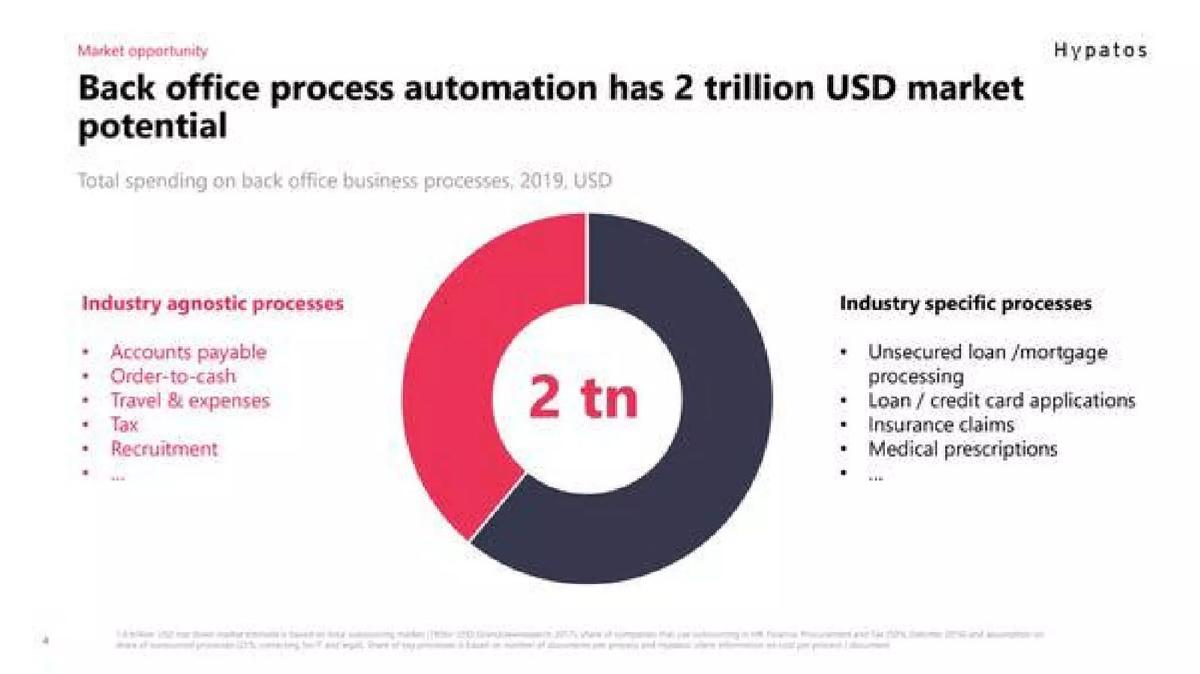
- The deck identifies a total spending of over $2 trillion on annual corporate back-office tasks on slide 3.
- Hypatos differentiates its solution from standard RPA by using Machine Learning for complex human processing tasks on slide 3.
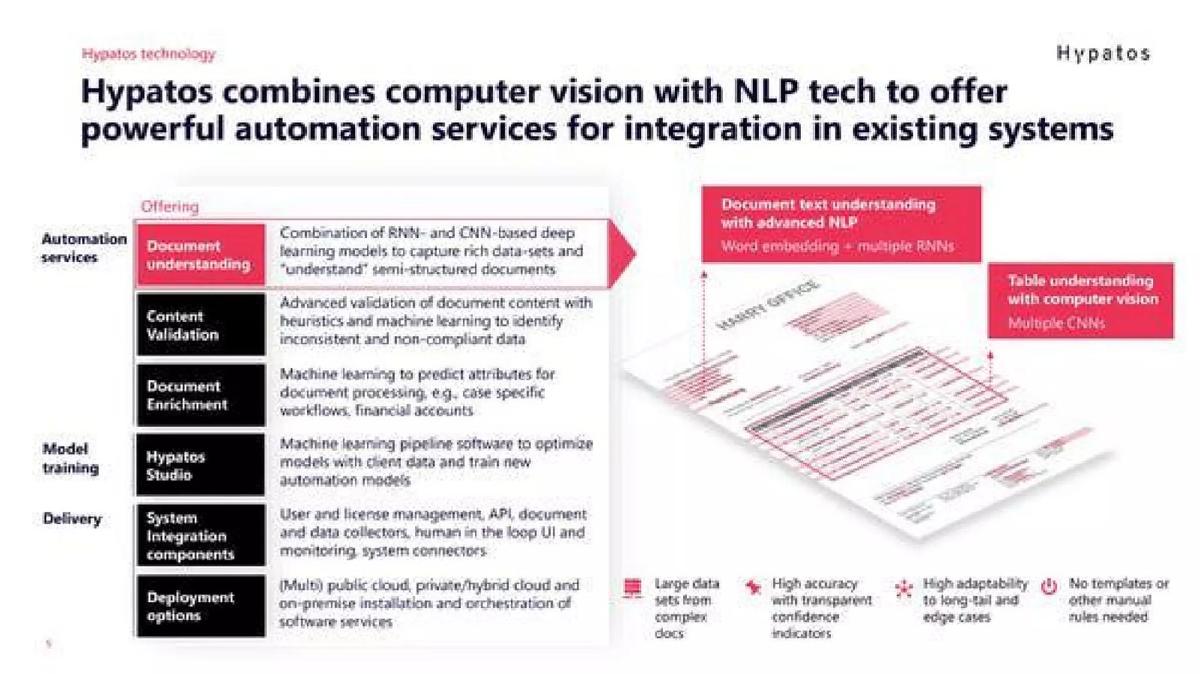
- The technology stack combines Recurrent Neural Networks (RNN) and Convolutional Neural Networks (CNN) for document and table understanding on slide 5.
- The company specifically targets industry-agnostic processes like accounts payable and industry-specific ones like medical prescriptions on slide 4.
- Hypatos sought a EUR ~10 million round to fund 24 months of operations, as stated on slide 9.
- The team slide highlights 150 years of cumulative tech work experience and a staff of 40+ professionals on slide 8.
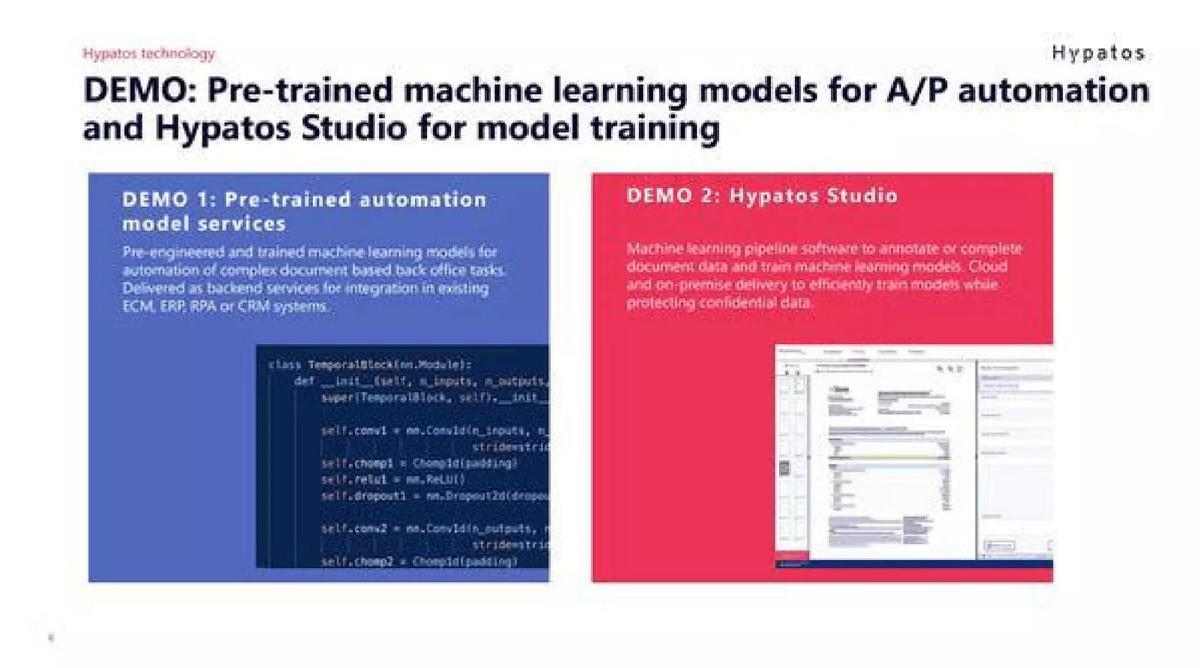
- The deck includes a specific 'Hypatos Studio' demo slide to showcase their model training pipeline on slide 6.
- Client logos are present but heavily blurred on the application areas slide, indicating a focus on use-case categories over specific brand names on slide 7.
Introduction: The $2 Trillion Efficiency Play
Hypatos entered the market at a time when Robotic Process Automation (RPA) was reaching a plateau. While RPA could move data between systems, it struggled with the 'understanding' part of document processing. The Hypatos Series A deck, which helped secure $15.5 million, is a masterclass in technical positioning. It doesn't just promise automation; it promises 'cognitive' automation. This teardown explores how a 9-slide deck successfully communicated a complex AI value proposition to investors.
Slide 1: Title and Positioning
The cover slide is minimalist, featuring the company name and a clear subtitle: "Cognitive process automation for document-based back office tasks." The use of the word 'cognitive' is a deliberate choice to separate the company from legacy OCR (Optical Character Recognition) and basic RPA competitors. The date, June 2020, indicates this version of the deck was likely used for follow-on discussions or updated during the Series A period.
Slide 2: The Value Proposition
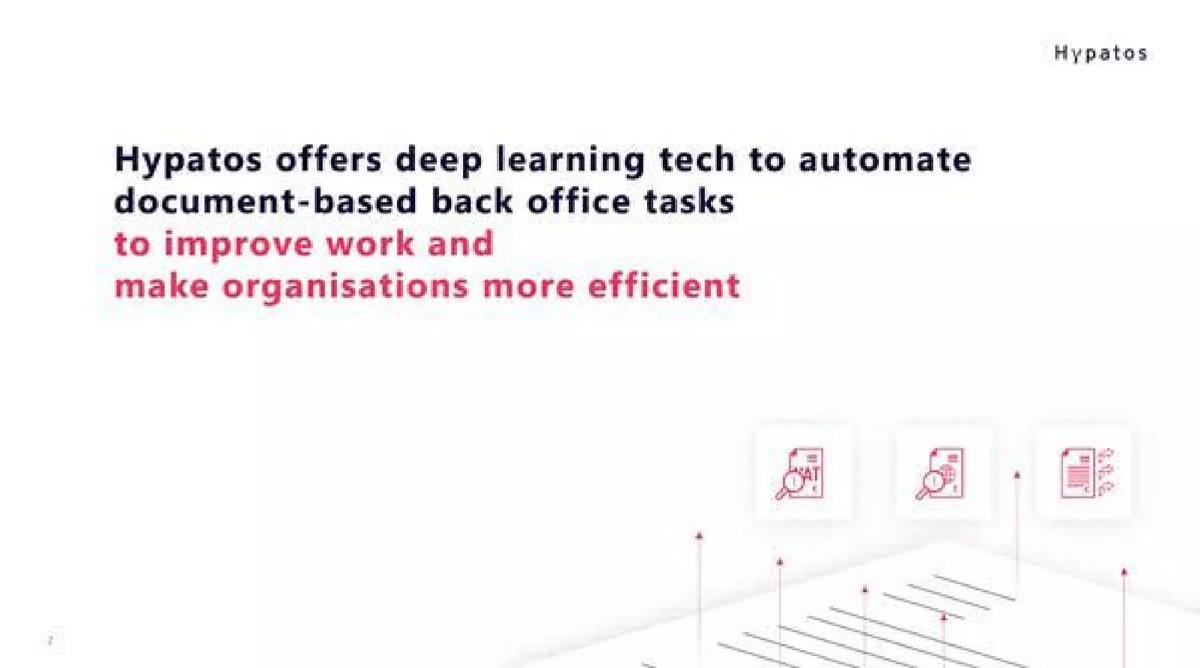
Slide 2 serves as an executive summary. It states that Hypatos offers "deep learning tech to automate document-based back office tasks to improve work and make organisations more efficient." The visual elements are sparse, showing stylized icons of documents being analyzed, which reinforces the focus on the document-to-data pipeline.
Slide 3: Problem & Solution Framework
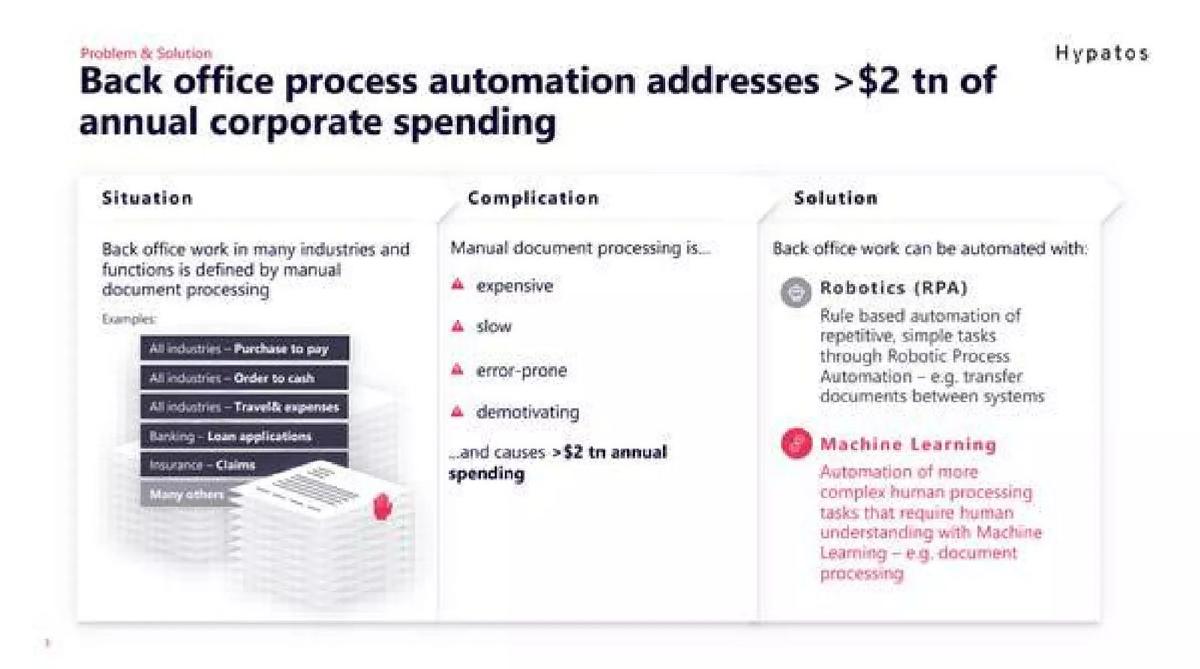
This slide uses a classic 'Situation-Complication-Solution' framework. Under Situation, it notes that back-office work is defined by manual document processing across all industries. The Complication is that manual processing is "expensive, slow, error-prone, [and] demotivating," leading to ">$2 tn of annual corporate spending." The Solution column is the most important part of this slide, as it contrasts 'Robotics (RPA)'—which it defines as rule-based automation for simple tasks—with 'Machine Learning.' Hypatos positions itself in the latter category, claiming to handle "complex human processing tasks that require human understanding."
Slide 4: Market Opportunity
Hypatos quantifies the market potential at "2 trillion USD." The slide breaks this down into two categories. Industry agnostic processes include accounts payable, order-to-cash, travel & expenses, tax, and recruitment. Industry specific processes include unsecured loan/mortgage processing, insurance claims, and medical prescriptions. By showing both, Hypatos demonstrates a massive Total Addressable Market (TAM) that isn't limited to a single vertical like Finance or Healthcare.
Slide 5: Technical Architecture
This is the 'meat' of the deck. Slide 5 explains how Hypatos combines "computer vision with NLP tech." It details three levels of automation services: Document Understanding, Content Validation, and Document Enrichment. The technical specifics mentioned include "RNN- and CNN-based deep learning models" and "word embedding + multiple RNNs." A visual diagram of a document shows how the tech identifies tables and text blocks. Crucially, the slide highlights "No templates or other manual rules needed," which is the primary pain point for users of older automation software.
Slide 6: Product Demos
Rather than just talking about the tech, slide 6 introduces "Hypatos Studio." It shows two components: pre-trained automation model services and the studio software used for model training. The inclusion of a code snippet (Python/PyTorch style) and a UI screenshot of the studio helps ground the high-level AI claims in a tangible product that investors can visualize as a scalable SaaS platform.
Slide 7: Application Areas and Roadmap
Slide 7 features a matrix of 'Automation Level' vs. 'Use Case.' The use cases are grouped by timeline: 2020 focuses on Finance, HR, and Financial Services, while 2021+ moves into Public Admin, Logistics, and Audit. While there are many logos in the background of the chart, they are heavily blurred, likely for confidentiality reasons. This slide shows a clear path from simple data capturing to high-value document enrichment.
Slide 8: The Team
The team slide focuses on three key leaders: Dr. Uli Erxleben , Cem Dilmegani , and He Zhang, PhD . The pedigree is strong, citing McKinsey, Rocket Internet, and Max-Planck-Institut. The slide also highlights a total headcount of "40+" and "150 years of cumulative tech work experience." This emphasizes that the company has the human capital necessary to build the complex AI they've described.
Slide 9: The Ask
The final slide is the financing round request. Hypatos was looking for a "EUR ~10mn round to continue with product work, client acquisition and delivery for next 24 months." The use of funds is broken into four clear buckets: Machine Learning, Engineering, Delivery team, and Go-to-Market. This provides a clear roadmap for how the capital will be deployed to reach the next milestone.
What Works in the Hypatos Deck
The deck's greatest strength is its clarity of technical differentiation . In a crowded AI market, Hypatos successfully explains why their approach (combining CNNs and RNNs) is superior to standard RPA. They don't shy away from technical terms, which builds credibility with sophisticated Series A investors. The market sizing is also effective; by anchoring the problem in a $2 trillion spending figure, they make the opportunity feel urgent and massive. Finally, the team slide is excellent, balancing business leadership (McKinsey) with deep technical expertise (PhD in Physics, Max-Planck).
What is Missing from the Hypatos Deck
Despite its technical strengths, the deck has several notable omissions. There is no competition slide . In the process automation space, names like UiPath, Blue Prism, or specialized players like Rossum are significant, and failing to address them is a risk. There are also no unit economics or revenue metrics . While the catalogue facts state this was a Series A, the deck reads more like a seed-stage product pitch. We don't see CAC (Customer Acquisition Cost), LTV (Lifetime Value), or even a basic growth chart. Lastly, the client logos are blurred ; while this protects privacy, it weakens the social proof that a Series A deck usually relies on.
What a Founder Should Copy
Founders building deep-tech or AI-heavy products should copy the technical breakdown on slide 5 . It manages to be detailed without being overwhelming, using a visual aid to show exactly what the AI 'sees.' The 'Situation-Complication-Solution' structure on slide 3 is also a perfect template for any B2B startup. It forces you to articulate the pain point in business terms (cost, speed, errors) before jumping into the technology. Finally, the clear 'Use of Funds' on slide 9 is a model of transparency, showing exactly which roles will be hired and what the 24-month objective is.
Frequently asked questions
- What is the primary problem Hypatos aims to solve?
- Hypatos targets the inefficiency of manual document processing in back-office functions. According to slide 3, manual processing is expensive, slow, error-prone, and demotivating. They estimate this inefficiency contributes to over $2 trillion in annual corporate spending. Their goal is to move beyond simple rule-based automation (RPA) to handle complex tasks requiring human-like understanding through machine learning.
- How does Hypatos describe its technical advantage?
- The deck emphasizes a multi-layered technical approach on slide 5. It combines computer vision (using multiple CNNs) for table understanding with advanced Natural Language Processing (using word embedding and multiple RNNs) for text understanding. This allows them to process semi-structured documents without needing manual templates or rules, which is a significant step up from traditional OCR tools.
- What are the specific use cases mentioned in the deck?
- Slide 4 and slide 7 categorize use cases into industry-agnostic and industry-specific groups. Key areas include accounts payable (P2P), order-to-cash (O2C), travel and expenses, tax, recruitment, and loan/mortgage processing. They also highlight insurance claims and medical prescriptions as high-value targets for their automation level, which ranges from simple data capturing to complex content validation.
- Who are the key leaders behind Hypatos?
- The leadership team featured on slide 8 includes Dr. Uli Erxleben (Founder & MD), who has a background at McKinsey and Rocket Internet; Cem Dilmegani (Chief Commercial Officer), also a McKinsey alumnus; and He Zhang, PhD (VP of Machine Learning), who previously led data science at HelloFresh and Lesara. The team claims a combined 150 years of technical experience.
- What was the intended use of the funds raised?
- On slide 9, Hypatos requested approximately EUR 10 million to cover a 24-month runway. The funds were earmarked for four areas: Machine Learning (hiring data scientists), Engineering (building the 'Human in the Loop' tool-set and ERP integrations), Delivery (hiring solution architects), and Go-to-Market (hiring a marketing manager and sales reps).