AI Startup Problem Slide: Real Pitch Deck Examples
How AI startups describe the problem in a pitch deck: name the task, measure where today's tools fall short, and say who pays for the gap.
AI Startup Problem Slide: Real Pitch Deck Examples
Eight problem slides from AI startups, shown in full, compare how each names the task that goes wrong, measures the gap left by current tools, and makes clear who pays for it.
TL;DR
An AI startup's problem slide should describe a task that goes wrong today, not the technology. Name the task and the person doing it, measure where current tools (including existing AI) fall short, and say what the gap costs. Deepgram does this with three numbers: speech recognition reaches "93%" accuracy on consumer commands but "71%" on phone calls and "65%" on meetings. Hypatos names the task (manual document processing in purchase-to-pay, claims and loan applications) and its cost. The weaker Quahog Life Sciences slide, titled "Problems we solve", lists techniques such as "back propagation scoring" and "collaborative filtering" instead of any problem.
AI problem slides from real pitch decks
Each example shows the exact stored slide above its analysis and links to the full teardown. Claims are as shown on the slides; we have not verified them.
Deepgram problem slide — slide 4
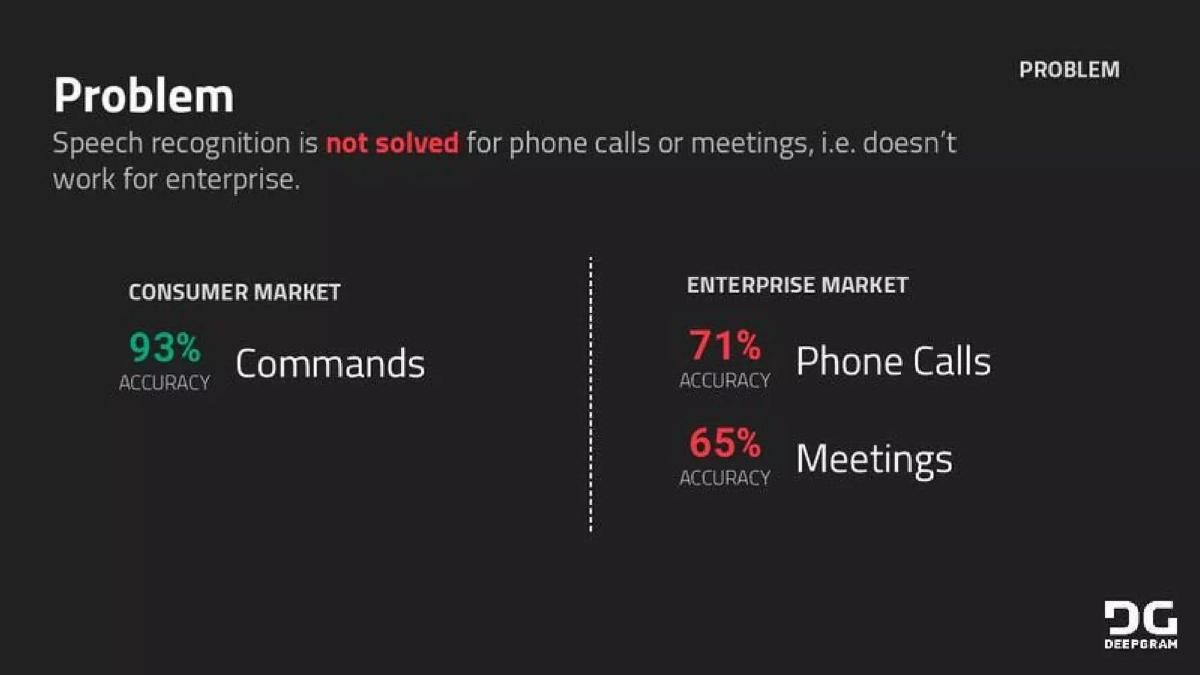
Speech recognition for businesses. Three accuracy figures split into consumer and enterprise.
Deepgram deck, slide 4. Exact stored slide matched to this analysis.
Our analysis: It concedes that speech recognition works in one setting, then measures exactly where it fails.
Evidence and limitation: Three accuracy figures; no source, benchmark or date given on the slide.
What a founder can adapt: Show today's best result where it works and where it doesn't, with the same measure.
Supporting analysis
What the deck claims: "Speech recognition is not solved for phone calls or meetings, i.e. doesn't work for enterprise." Consumer market: "93% accuracy — Commands." Enterprise market: "71% accuracy — Phone Calls"; "65% accuracy — Meetings."
Presentation choice: The investor sees the gap is specific (enterprise audio) and measurable, so progress can be measured too.
When it does not fit: Say whose system produced the 71% and 65%, and on what test data.
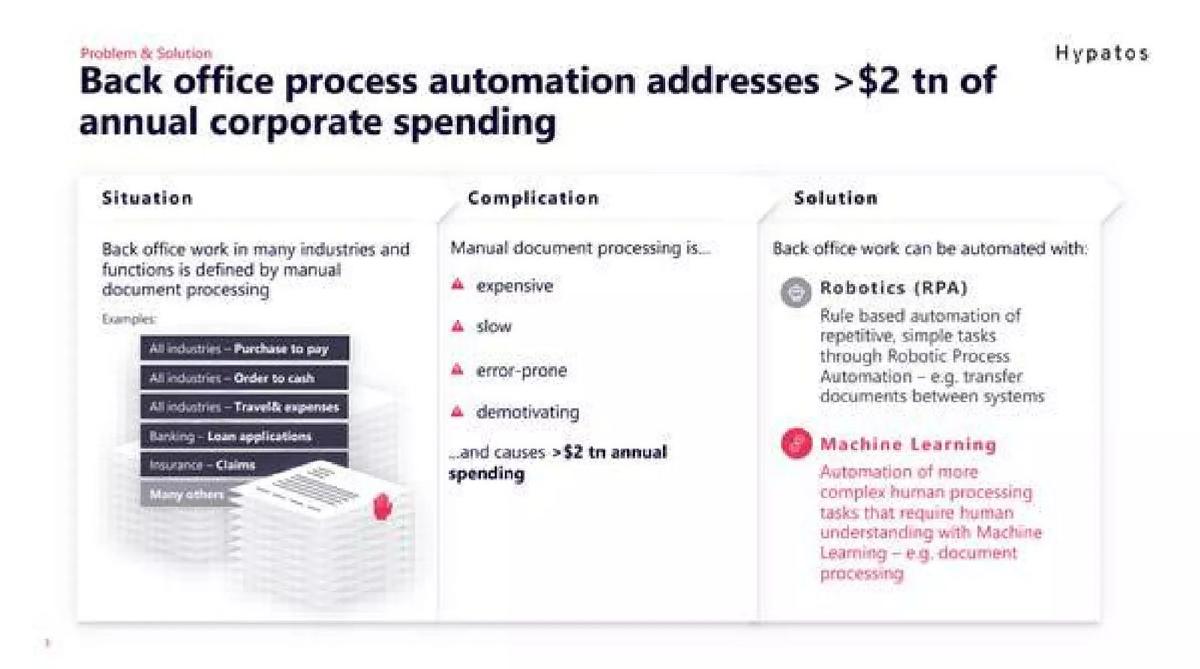
Back-office document automation. A three-column Situation, Complication, Solution layout.
Hypatos deck, slide 3. Exact stored slide matched to this analysis.
Our analysis: It names concrete tasks and places machine learning after rule-based automation, which implies where RPA stops.
Evidence and limitation: A spending figure (">$2 tn") with no source; named processes.
What a founder can adapt: List the specific workflows you take over and say why the existing automation doesn't reach them.
Supporting analysis
What the deck claims: "Back office process automation addresses >$2 tn of annual corporate spending." Situation: "Back office work in many industries and functions is defined by manual document processing", with examples "Purchase to pay", "Order to cash", "Travel & expenses", "Loan applications" (banking), "Claims" (insurance). Complication: manual processing is "expensive", "slow", "error-prone", "demotivating". Solution: rule-based robotics (RPA) for simple tasks; machine learning for "more complex human processing tasks".
Presentation choice: Listing the processes lets an investor picture the buyer (finance, insurance and banking operations teams).
When it does not fit: Source the $2 tn and say what share of it is the complex work only machine learning handles.
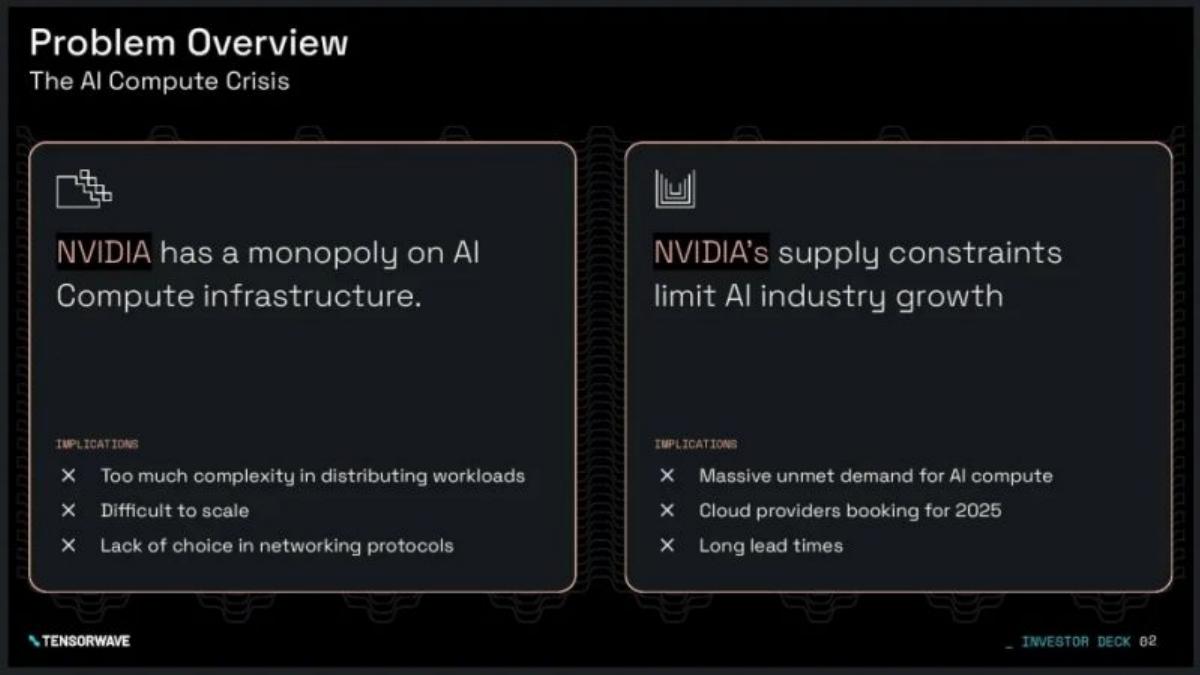
AI compute cloud built on AMD chips. Two cards naming the incumbent.
TensorWave deck, slide 2. Exact stored slide matched to this analysis.
Our analysis: It names the single supplier that its customers depend on and frames the problem as supply.
Evidence and limitation: No figures; "booking for 2025" is the only concrete detail.
What a founder can adapt: If one incumbent causes the problem, name it plainly.
Supporting analysis
What the deck claims: "Problem Overview: The AI Compute Crisis." "NVIDIA has a monopoly on AI Compute infrastructure." Implications: "Too much complexity in distributing workloads", "Difficult to scale", "Lack of choice in networking protocols." "NVIDIA's supply constraints limit AI industry growth." Implications: "Massive unmet demand for AI compute", "Cloud providers booking for 2025", "Long lead times."
Presentation choice: An investor immediately understands the bet: an alternative to one dominant supplier.
When it does not fit: Add one number: lead time in weeks or the price buyers pay today.
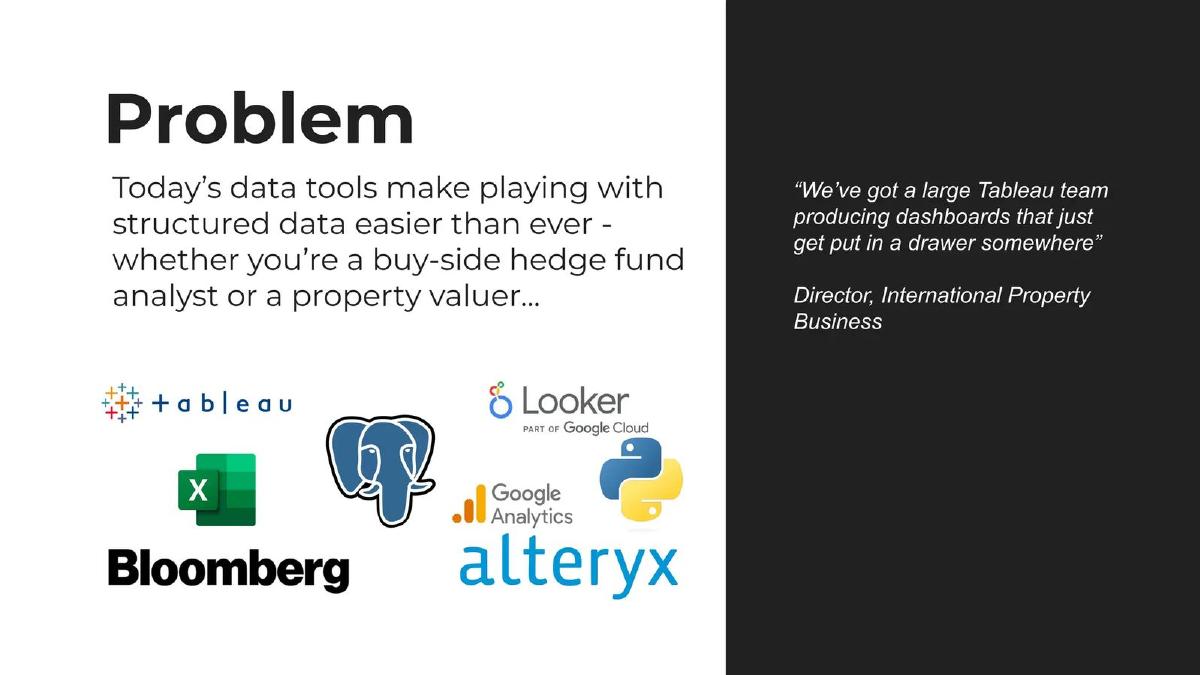
AI for real-estate analysis. A sentence, logos of existing data tools and a customer quote.
Fifth Dimension deck, slide 2. Exact stored slide matched to this analysis.
Our analysis: It concedes that structured data is well served, which leaves unstructured documents as the implied gap.
Evidence and limitation: One quote from an unnamed director; no figures.
What a founder can adapt: Show the tools your buyer already pays for and a buyer's words about what they still can't do.
Supporting analysis
What the deck claims: "Today's data tools make playing with structured data easier than ever - whether you're a buy-side hedge fund analyst or a property valuer..." Logos: Tableau, Looker, Excel, PostgreSQL, Google Analytics, Python, Bloomberg, Alteryx. Quote: "We've got a large Tableau team producing dashboards that just get put in a drawer somewhere" – Director, International Property Business.
Presentation choice: The quote shows a buyer already paying for analysis that goes unused.
When it does not fit: State the gap outright; the slide ends on "..." and leaves the reader to guess.
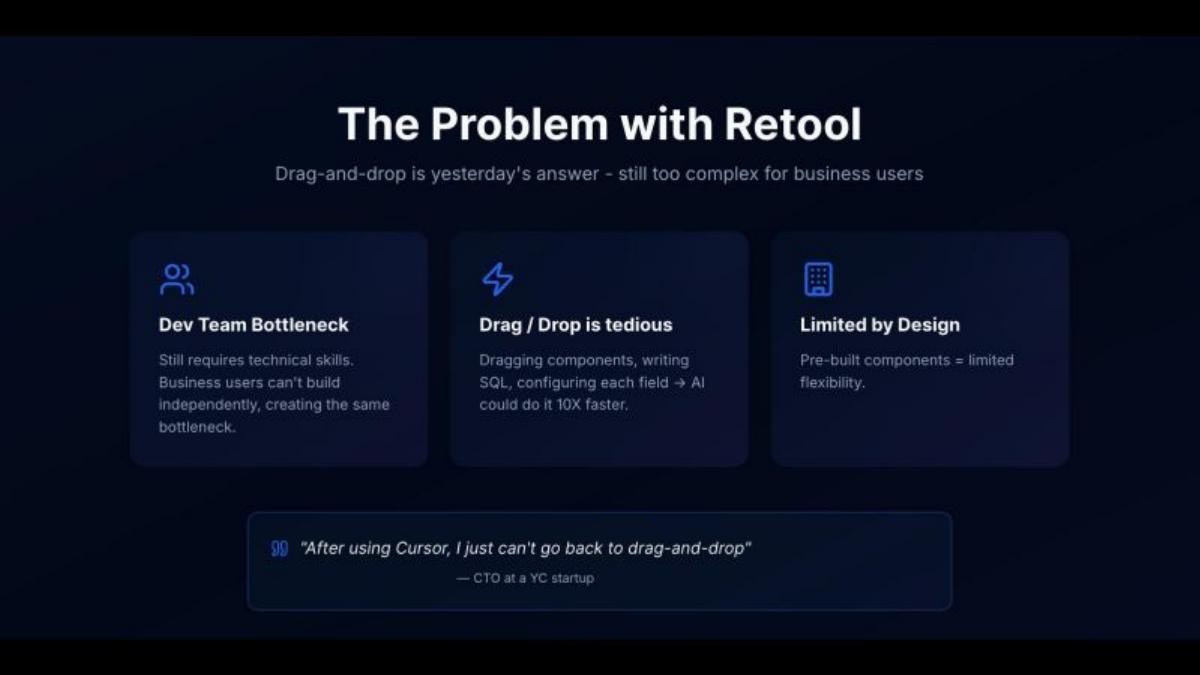
AI tool for building internal apps. Titled after the incumbent, with three cards and a quote.
Vybe deck, slide 4. Exact stored slide matched to this analysis.
Our analysis: It defines the problem as the shortcoming of a named, successful product.
Evidence and limitation: "10X faster" is asserted, not measured; one anonymous quote.
What a founder can adapt: If buyers already pay for a tool, name it and show what it still asks of them.
Supporting analysis
What the deck claims: "The Problem with Retool: Drag-and-drop is yesterday's answer - still too complex for business users." "Dev Team Bottleneck: Still requires technical skills. Business users can't build independently, creating the same bottleneck." "Drag / Drop is tedious: Dragging components, writing SQL, configuring each field → AI could do it 10X faster." "Limited by Design: Pre-built components = limited flexibility." Quote: "After using Cursor, I just can't go back to drag-and-drop" – CTO at a YC startup.
Presentation choice: Naming Retool tells investors the budget already exists; the question is only who captures it.
When it does not fit: Measure the "10X": time to build one internal app with Retool versus with your product.
Online research participants and human data for AI. A headline and two short points.
Prolific deck, slide 2. Exact stored slide matched to this analysis.
Our analysis: It names two causes (participants and tools) of one outcome (bad data).
Evidence and limitation: No figures, examples or named alternatives.
What a founder can adapt: Name the cause and the outcome, then measure the outcome.
Supporting analysis
What the deck claims: "Running research online to obtain high quality data is challenging." "Low participant experience: Low participant experience leading to low quality data." "Poor infrastructure and tools: Infrastructure and tools for researchers are hard to use exacerbating this problem."
Presentation choice: Linking cause to outcome is right; the slide stops before showing how bad the data is.
When it does not fit: Add a figure such as the share of responses rejected for low quality, and name who is running the research.
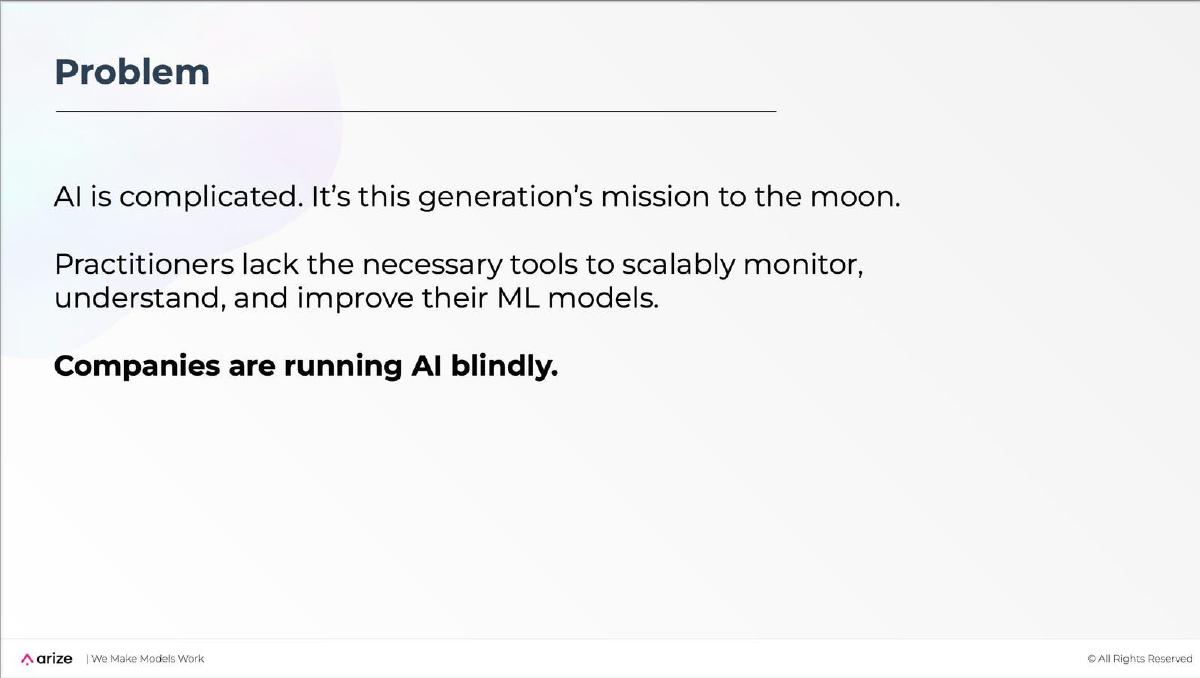
Monitoring for machine-learning models. Three sentences on a plain slide.
Arize AI deck, slide 3. Exact stored slide matched to this analysis.
Our analysis: The middle sentence names the user (practitioners) and the missing capability (monitoring models); the first sentence is framing.
Evidence and limitation: No figures or examples.
What a founder can adapt: Keep the sentence that names the user and what they can't do; cut the rest.
Supporting analysis
What the deck claims: "AI is complicated. It's this generation's mission to the moon." "Practitioners lack the necessary tools to scalably monitor, understand, and improve their ML models." "Companies are running AI blindly."
Presentation choice: It shows a clear buyer statement surrounded by lines that could open any AI deck.
When it does not fit: Add one example of a model failing unnoticed and what it cost.
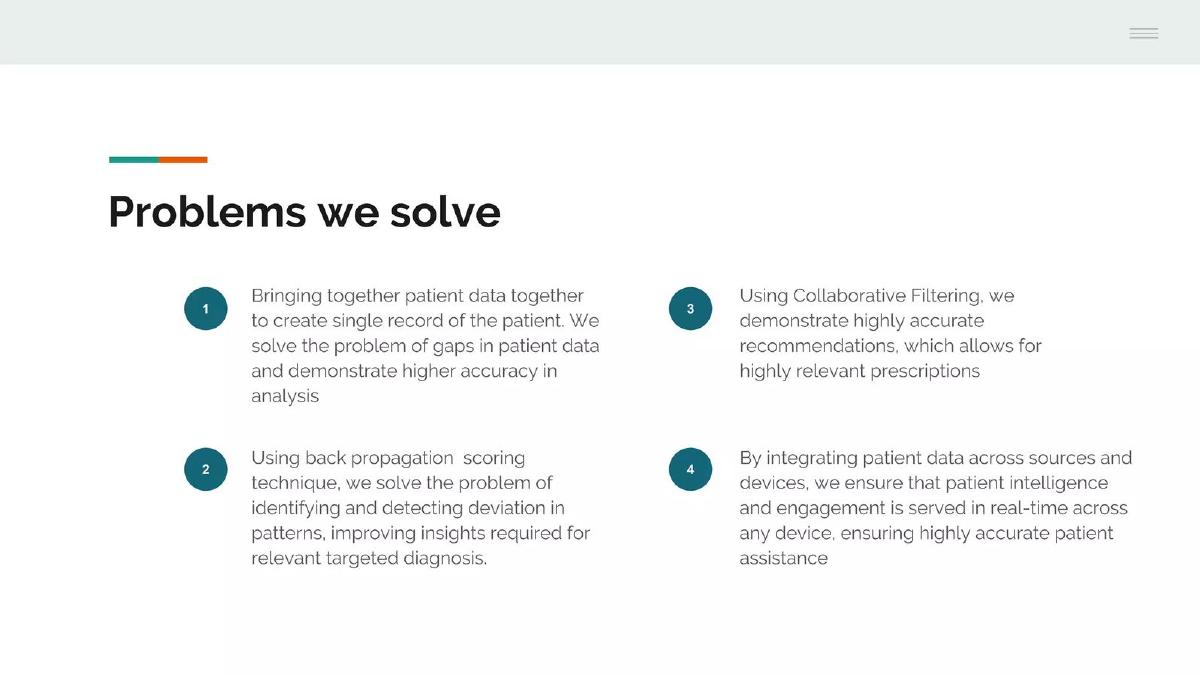
AI for patient data and diagnosis. A weaker example, included on purpose: four numbered paragraphs.
Quahog Life Sciences deck, slide 4. Exact stored slide matched to this analysis.
Our analysis: Every point starts from a technique or a feature; no clinician, patient or cost is named.
Evidence and limitation: No figures, users or examples.
What a founder can adapt: Start from one clinical task that fails today (who, how often, what it costs), then move techniques to the technology slide.
Supporting analysis
What the deck claims: "Problems we solve." (1) "Bringing together patient data together to create single record of the patient. We solve the problem of gaps in patient data..." (2) "Using back propagation scoring technique, we solve the problem of identifying and detecting deviation in patterns..." (3) "Using Collaborative Filtering, we demonstrate highly accurate recommendations, which allows for highly relevant prescriptions." (4) "By integrating patient data across sources and devices, we ensure that patient intelligence and engagement is served in real-time..."
Presentation choice: It shows how a problem slide turns into a technology list when the task and user are missing.
When it does not fit: Drop "back propagation" and "collaborative filtering" from the problem slide entirely.
Whether each slide names the task, measures the gap against current tools, and says what the gap costs.
Example
Task and user named
Gap measured or incumbent named
Cost stated
Deepgram
Yes (enterprise calls, meetings)
Yes (93% vs 71% and 65%)
No
Hypatos
Yes (named back-office processes)
Partly (RPA limits implied)
Partly (>$2 tn, unsourced)
TensorWave
Partly (AI compute buyers)
Partly (NVIDIA named, no figures)
No
Fifth Dimension
Yes (analysts, property valuers)
Partly (tools named, gap implied)
No
Vybe
Yes (business users)
Partly (Retool named, 10X unmeasured)
No
Prolific
Partly (researchers)
No
No
Arize AI
Yes (ML practitioners)
No
No
Quahog Life Sciences
No
No
No
Key Takeaways
Describe the task that fails, not the model you built: "AI" is not the problem.
Measure the gap against today's best tool, as Deepgram does with accuracy by use case.
Name the incumbent or workaround you replace: Retool, NVIDIA, Tableau, RPA.
Say who pays for the gap and roughly how much.
Keep techniques (neural networks, filtering, fine-tuning) for the technology slide.
Build your AI problem slide
Start from the task, not the model.
Task. Which task goes wrong today, and who does it?
Current tool. What do they use now: people, rules, software, another AI product?
Gap. Where exactly does that fall short, measured the same way you'll measure yourself?
Cost. What does the gap cost the buyer in time, money or errors?
Copyable framework: [User] does [task] with [current tool]. It reaches [measure] on [easy case] but only [measure] on [hard case], which costs [amount] per [period].
Illustrative example 1 — written by us
Before: Businesses struggle to leverage AI. Our proprietary neural network solves the problem of unstructured data.
After: Claims handlers at mid-size insurers read every medical invoice by hand. Current extraction software reads 90% of typed invoices correctly but 55% of handwritten ones, so each handler spends about 11 hours a week re-keying fields.
What improved: Our illustrative rewrite; figures are invented for the example. It names the user, task, current tool, a measured gap and its cost.
What this guide adds
The general problem slide guide covers any business. AI decks face a specific trap: investors have seen hundreds of slides where the problem is really a description of the model, or a claim that "AI is complicated". This guide compares slides that avoid the trap with slides that fall into it.
It pairs with the data moat guide (what makes an AI product defensible) and the technology slide guide (where the techniques belong). Deepgram and Fifth Dimension appear in the data moat guide with different slides, so you can see each company's problem next to its defensibility argument.
Three parts of an AI problem slide
Task: the work that goes wrong and who does it (Hypatos, Fifth Dimension).
Measured gap: where today's tools fall short, with a number (Deepgram) or a named incumbent (Vybe, TensorWave).
Cost: what the gap costs the buyer (Hypatos' ">$2 tn" spending figure, though unsourced).
Strong slides cover all three. Most real slides cover one or two.
Common mistakes
AI as the problem. "AI is complicated" describes the industry, not a buyer's task.
Techniques on the problem slide. Model names and methods belong on the technology slide.
No baseline. Say how well today's best tool performs before claiming you do better.
Unmeasured multipliers. "10X faster" needs a measured example.
Unsourced market figures. A trillion-dollar spending number needs its source.
Diagnostic checklist
The task and the person doing it are named.
Today's tool or incumbent is named.
The gap is measured the same way you will measure your product.
The cost of the gap is stated, with its source.
No model names or techniques appear on the slide.
Frequently asked questions
How we chose these examples
Corpus: published pitch deck teardowns on StartupFundraising.com. Founder-uploaded private decks are excluded.
Selection (2026-09-25): we searched extracted text of slides 2–6 for slides beginning with "problem" in decks whose recorded sector includes AI or artificial intelligence. About thirty-five candidates were read. Slides already used in other guides (Code Four, Charta Health) were not reused; slides marked "confidential" on the slide itself (Cerebrium, Mustard) were set aside; decks where AI is incidental to a consumer, travel or edtech problem were left to their sector guides. Quahog Life Sciences is kept as a weaker contrast.
Overlap check: none of these eight slides appears in another guide. Deepgram (slides 2 and 6) and Fifth Dimension (slide 5) appear in the data moat and flywheel guides with different slides.
Review: all eight stored slide images were inspected on 2026-09-25 and matched to company, deck and slide number (editorial model review). No person has yet completed an editorial review of this page.
Claims are as shown on the slides; we have not verified them. We make no claim that any slide caused a fundraising outcome.