Deepgram's 19-slide Series A deck is a focused argument for technical superiority in a crowded market. By identifying that enterprise customers value accuracy above all other features, Deepgram uses head-to-head performance data to justify its existence. The deck highlights a 90% accuracy rate for trained models compared to 71% for big tech competitors on phone call audio. It avoids the common trap of listing generic features, instead emphasizing a 'data flywheel' and a proprietary GPU-based architecture. While the deck is light on financial history, it sets a bold target of $10M ARR in 18 mo…
Key takeaways
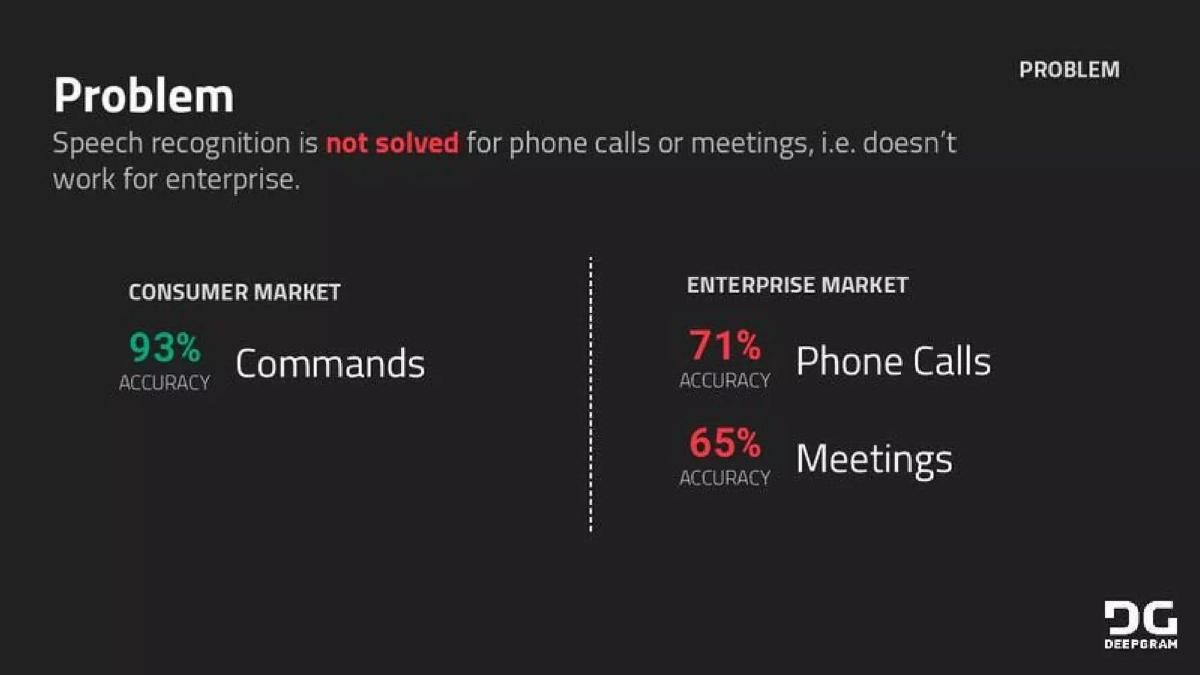
- The deck identifies a specific performance gap, noting that speech recognition accuracy drops from 93% for consumer commands to 65-71% for enterprise phone calls and meetings (Slide 4).
- Deepgram positions its 'Trained Expert' model as achieving 80-95% accuracy, significantly outperforming the 'One-Size-Fits-All' legacy models that plateau at 65-75% (Slide 10).
- Technical differentiation is rooted in a proprietary architecture that hosts models and infers entirely on GPUs to provide massive throughput and lower costs (Slide 7).
- The 'Data Flywheel' concept is central to the pitch, illustrating how in-house labeling and end-to-end deep learning create a unique, valuable dataset (Slide 16).
- The team slide highlights a unique founder-market fit, featuring two PhDs with backgrounds in particle physics and dark matter research (Slide 18).
- Deepgram explicitly targets the Enterprise and Medical sectors, noting that while consumers need 95% accuracy but have no willingness to pay, medical users need 99% accuracy and have a high willingness to pay (Slide 9).
- The deck claims a 120x speedup in transcription, stating that a one-hour transcript can be completed in 30 seconds compared to 1,800 seconds for competitors (Slide 10).
- The fundraising ask is framed by a goal to reach $10M ARR within 18 months of the Series A (Slide 19).
Deepgram: The Physics of Speech Recognition
Deepgram’s 2020 Series A deck is a masterclass in technical positioning. At a time when speech-to-text was dominated by giants like Google and Amazon, Deepgram raised $12M by arguing that these 'one-size-fits-all' solutions were fundamentally broken for enterprise needs. The deck is stark, data-heavy, and unapologetically technical, reflecting the founders' backgrounds in particle physics.
The Opening Hook and Problem Definition
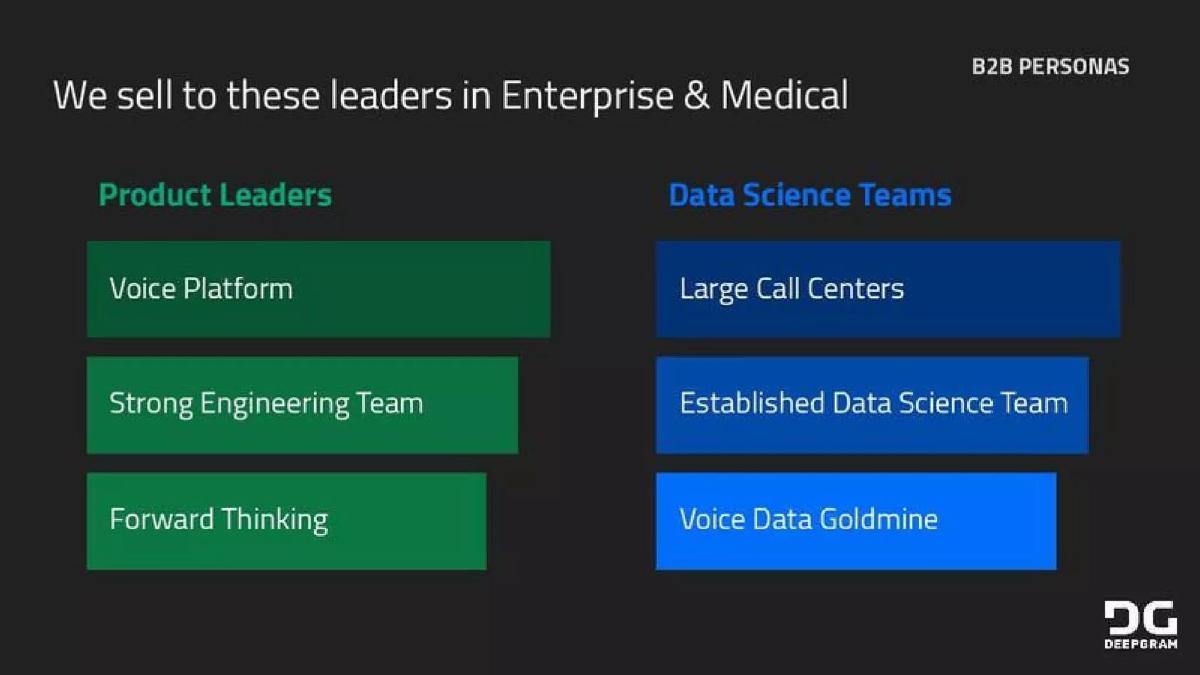
Slide 1 to 3: The deck opens with a clear value proposition: 'Next Gen Speech Recognition for Enterprise.' Slide 2 introduces the founders' narrative arc, calling themselves 'physicist outsiders' fixing a 'rut' in speech recognition. This is a classic disruption framing. Slide 3 identifies the B2B personas they target: Product Leaders and Data Science Teams in large call centers, emphasizing that these groups sit on a 'Voice Data Goldmine.'
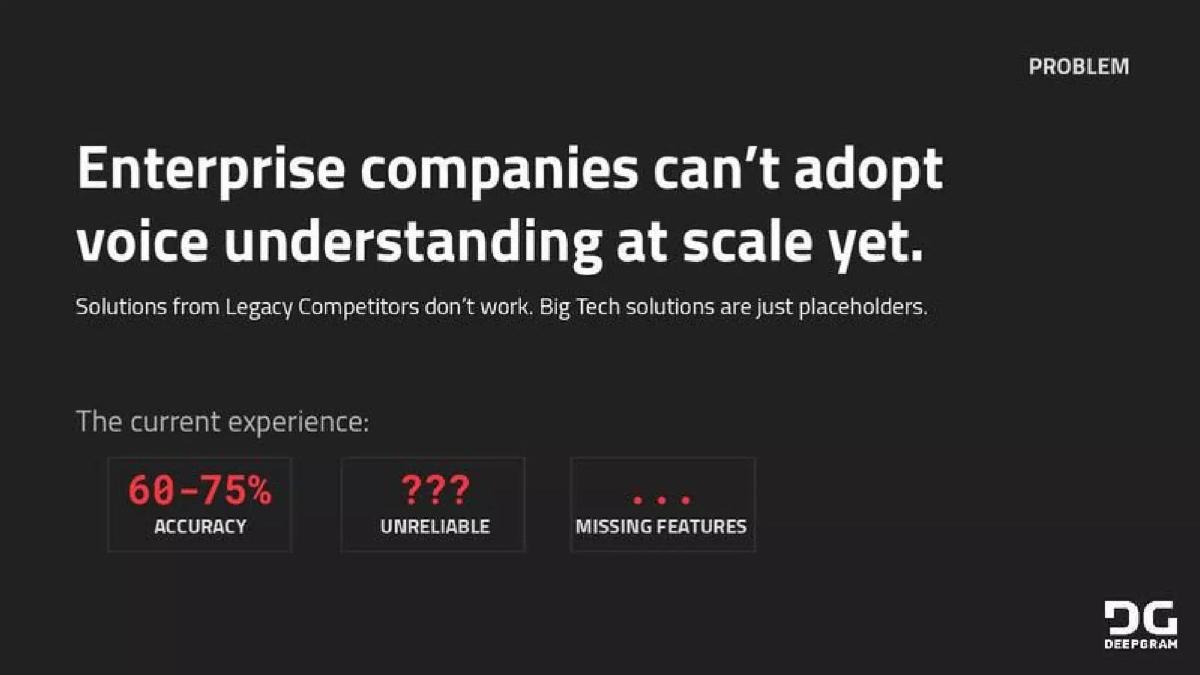
Slide 4 to 5: These slides define the 'Problem' with precision. Deepgram doesn't just say speech recognition is bad; they quantify it. Slide 4 shows that while consumer commands have 93% accuracy, enterprise phone calls drop to 71% and meetings to 65%. Slide 5 reinforces this by stating that 'Big Tech solutions are just placeholders,' plagued by unreliability and missing features. By focusing on the 20-30% accuracy gap, Deepgram creates a clear space for their solution to exist.
The Solution and Technical Moat
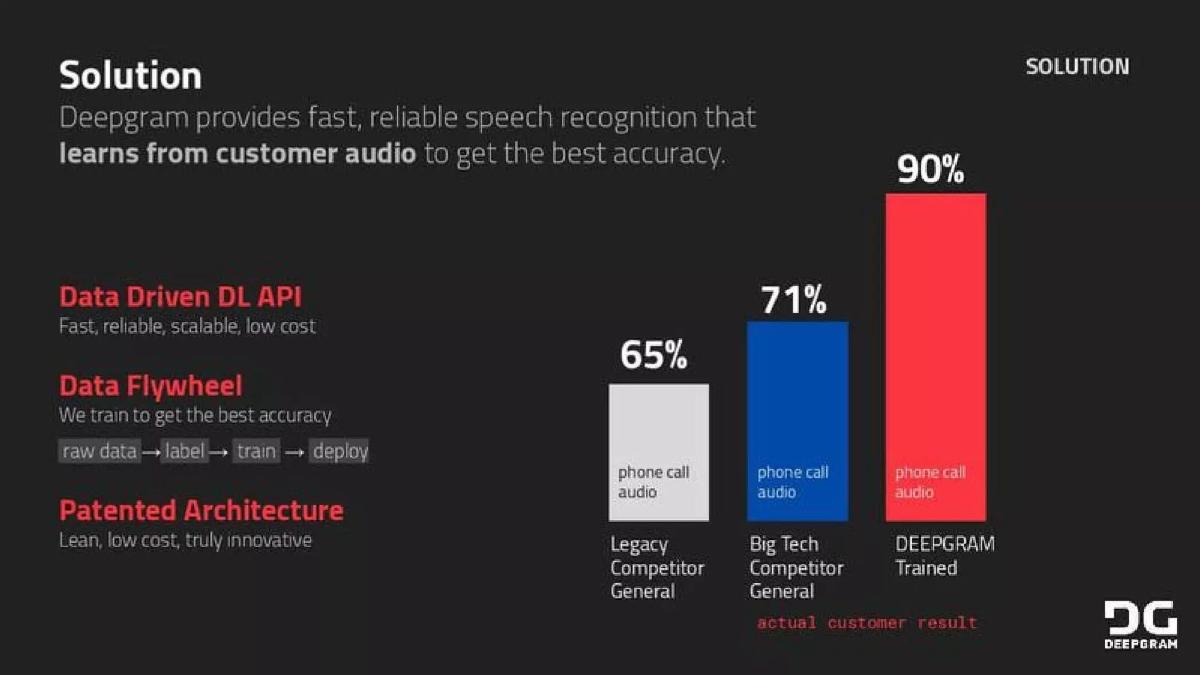
Slide 6 to 8: The 'Solution' section is built on head-to-head comparisons. Slide 6 features a bar chart showing Deepgram's 'Trained' model hitting 90% accuracy on phone call audio, compared to 71% for Big Tech and 65% for legacy competitors. Slide 7 explains the 'How': a combination of in-house data labeling, end-to-end deep learning, and a GPU-only inference architecture. They claim this reduces system complexity and cost. Slide 8 expands the scope, claiming their architecture is 'universal' and can learn new languages at 10x speed, detect demographics, and gauge sentiment.
Market Strategy and Competitive Landscape
Slide 9: This is a critical strategic slide. It maps accuracy needs against 'willingness to pay.' It dismisses the consumer market (high accuracy needed, no willingness to pay) and focuses on Enterprise and Medical. This shows investors that the founders understand where the actual revenue resides, rather than chasing vanity metrics in the consumer space.
Slide 10 to 13: Slide 10 provides a detailed 'One-Size-Fits-All' vs. 'Trained Expert' comparison. The metrics here are aggressive: 120x speedup and a 99.9% SLA. Slide 11 doubles down on the accuracy differentiation, showing a '65% reduction in errors' when moving from general models to Deepgram-trained models. Slide 12 is a standard feature checklist, but it includes 'On-Premises' and 'Dedicated Cloud VPC,' which are high-value requirements for enterprise security. Slide 13 simplifies the message: customers care about accuracy first, then everything else.
Validation and The Flywheel
Slide 14 to 17: Slide 14 provides a testimonial from Randall-Reilly, citing 4M minutes transcribed and 90% accuracy. This social proof is essential for a Series A. Slide 15 and 16 introduce the 'True AI Flywheel.' This is a conceptual diagram showing how labeling data, training models, and attracting more data create a self-reinforcing loop. Slide 17 visualizes the training workflow, showing the path from raw data to a 90% accurate API.
Team and The Ask
Slide 18: The team slide is a highlight. With 30+ years of AI experience and three Physics PhDs, the pedigree is high. The logos at the bottom (Amazon, Y Combinator, Stanford, NYU) provide institutional credibility. The mention of building with '5 engineers capital efficient' suggests a lean culture.
Slide 19: The final slide outlines the 'Raise A.' It notes a $3.6M Seed already raised from NVIDIA, Slack, and others. The roadmap is clear: grow the team and infrastructure to hit $10M ARR in 18 months. It also lists upcoming features like lead qualification and compliance scoring, showing the path from a transcription tool to a broader 'Speech Understanding' platform.
What Works in the Deepgram Deck
Quantified Pain Points: By citing specific accuracy percentages (71% vs 90%), the deck moves beyond vague promises to measurable outcomes. · Strategic Focus: The 'willingness to pay' matrix on Slide 9 is a sophisticated way to justify their go-to-market strategy. · Technical Authority: The founders lean into their physics backgrounds to explain why their architecture is fundamentally different, rather than just 'better AI.' · Speed Metrics: The claim of transcribing an hour of audio in 30 seconds (Slide 10) is a powerful, tangible benefit for enterprise scale.
What is Missing from the Deepgram Deck
Historical Financials: The deck mentions a $10M ARR goal but does not state the current ARR at the time of the raise. · Unit Economics: While they claim to be 'low cost' and 'capital efficient,' there is no data on Customer Acquisition Cost (CAC) or Lifetime Value (LTV). · Churn and Retention: For a Series A, investors usually look for net dollar retention or churn rates, which are absent here. · Pipeline Detail: While they have one strong testimonial, a slide showing the breadth of their current pilot programs or sales pipeline would have added weight to the $10M ARR projection.
What a Founder Should Copy
The 'Head-to-Head' Slide: Slide 6 is a perfect example of how to visualize technical superiority against industry giants. · The Persona Slide: Slide 3 clearly identifies who the buyer is and what their specific 'goldmine' is, which helps investors visualize the sales process. · The 'Accuracy First' Hierarchy: Slide 13 is a great way to show that you understand the customer's priorities. It prevents the deck from becoming a 'feature soup' and keeps the focus on the primary value driver. · The Flywheel Visualization: Slide 16 effectively explains how the product gets better with scale, a key requirement for any AI-centric venture.
Frequently asked questions
- How does Deepgram define its competitive advantage?
- Deepgram defines its advantage through 'Trained Expert' models. Unlike the 'One-Size-Fits-All' approach of big tech competitors, Deepgram trains models specifically for each customer's audio environment. This results in a jump from 71% accuracy to 90% accuracy for phone call audio, as shown on Slide 6. They also cite a 120x speed advantage and a 99.9% SLA.
- What market segments does the company prioritize?
- The company focuses on Enterprise (Sales & Support) and Medical sectors. Slide 9 explains that these segments have a high 'willingness to pay' and critical accuracy requirements (85% for enterprise and 99% for medical). They explicitly deprioritize the consumer market, noting that while accuracy needs are high, there is no willingness to pay.
- What is the 'Data Flywheel' mentioned in the deck?
- The Data Flywheel is Deepgram's process for continuous improvement. As shown on Slide 16, they label data in-house to build unique datasets, train models to achieve world-leading accuracy, and use that performance to attract more data. This cycle is powered by end-to-end deep learning on GPUs, which they claim is a patented process.
- How does the team background influence the pitch?
- The founders lean heavily into their 'outsider' status as physicists. CEO Scott Stephenson has a PhD in Particle Physics and experience in dark matter research, while CTO Adam Sypniewski has a PhD in Dark Energy. This background is used to justify their 'groundbreaking, unmatched, and patented' technical approach to AI, as stated on Slide 7 and Slide 18.
- What are the projected milestones for this funding round?
- According to Slide 19, the Series A is intended to 'derisk tech, product, & sales' and fuel a go-to-market push. The primary financial milestone is reaching $10M ARR within 18 months. Operational goals include growing the team across marketing, sales, and engineering, and expanding features like sentiment analysis and topic classification.