Dorian LPG's investor presentation from December 2017 is a detailed overview of the Very Large Gas Carrier (VLGC) market. The deck emphasizes the company's position within a shifting global energy landscape, specifically the rise of U.S. LPG exports which grew from 15% of global supply in 2013 to 34% by YTD 2017 (Slide 13). The narrative is built on macro-demand drivers, particularly in China and Indonesia, where LPG imports saw a CAGR of 50.7% and 12.1% respectively (Slides 17, 21). While the deck is heavy on market data and balance sheet management, including a $758 million facility relaxat…
Key takeaways
- The U.S. emerged as a dominant force in LPG supply, increasing its global market share from 15% in 2013 to 34% by late 2017 (Slide 13).
- China represents a massive growth engine for the sector, with LPG imports growing at a 50.7% CAGR between 2013 and 2016 (Slide 17).
- Indonesia's demand is driven by a government-subsidized Kerosene-to-LPG conversion program, projected to reach nearly 12 million tons by 2025 (Slide 21).
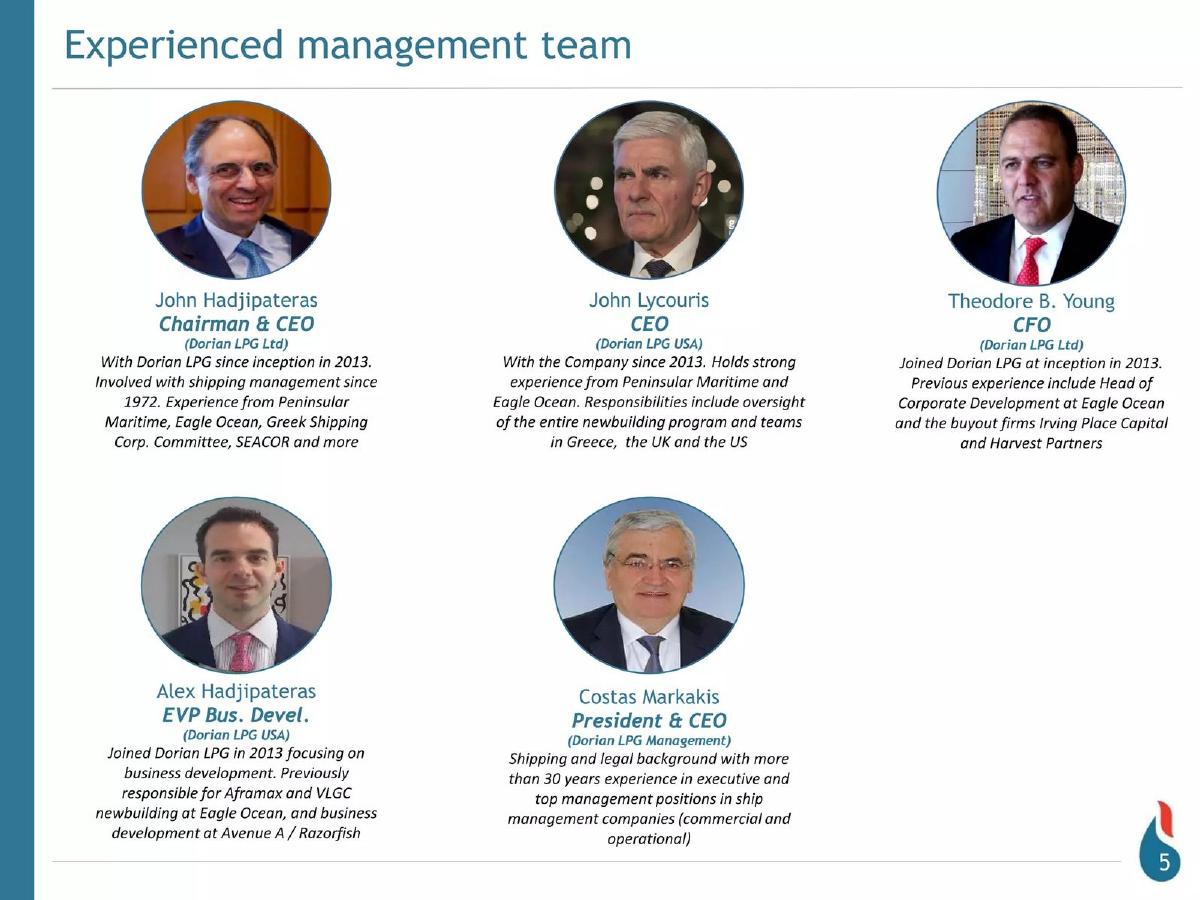
- The management team is highly experienced, with Chairman John Hadjipateras involved in shipping management since 1972 (Slide 5).
- The company actively manages a high-leverage balance sheet, including a $758 million debt facility and a $97 million bridge loan from DNB (Slide 29).
- Financial performance showed volatility, with a net loss of $18.6 million for the six months ended September 30, 2017, compared to a $129.6 million net income in the prior fiscal year (Slide 33).
- The deck utilizes a 'bareboat charter' strategy for vessel financing, exemplified by the $65 million valuation and refinancing of the vessel 'Corsair' (Slide 29).
- LPG is positioned as a 'cleaner' alternative to coal and oil, emphasizing its portability for remote areas (Slide 9).
Introduction: The Industrial Scale of Energy Logistics
The Dorian LPG investor deck from December 2017 is a comprehensive look at the macro-economics of the global energy trade. Unlike tech startup decks that focus on user acquisition or software features, this presentation is centered on physical assets, global trade routes, and complex capital structures. With 35 slides in the full version, it provides the depth required for a capital-intensive industry where a single asset (a ship) can be valued at $65 million.
Slide 1: Title and Visual Identity
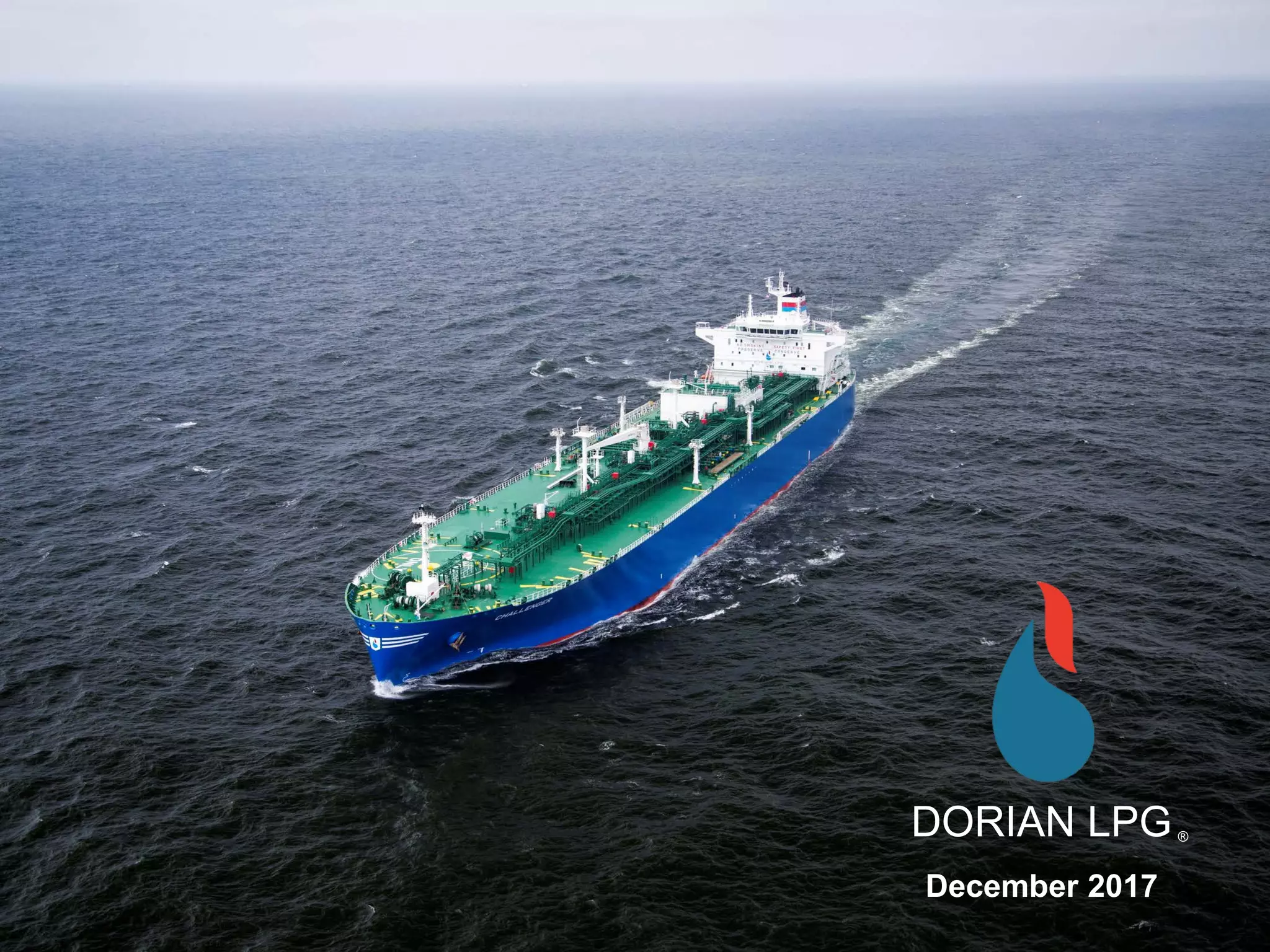
The cover slide features a high-resolution aerial photograph of a Very Large Gas Carrier (VLGC), the Challenger , cutting through open water. The branding is minimal, featuring the Dorian LPG logo and the date 'December 2017'. This sets an immediate tone of industrial scale and operational capability. There is no tagline; the image of the massive vessel serves as the primary value proposition.
Slide 5: Experienced Management Team
In a sector where operational errors can cost millions, the 'Team' slide is a critical trust-builder. Dorian LPG showcases five key executives. John Hadjipateras (Chairman & CEO) is highlighted for his involvement in shipping management since 1972, providing over four decades of industry context. The slide also details the specific roles of John Lycouris (CEO of Dorian LPG USA) and Theodore B. Young (CFO), noting their previous experience at firms like Eagle Ocean and Irving Place Capital. The inclusion of Costas Markakis , with over 30 years of experience, rounds out a team that emphasizes longevity and institutional knowledge over 'disruptive' youth.
Slide 9: LPG Fundamentals
This slide serves as a 'Problem/Solution' surrogate by explaining the utility of the product being transported. It defines Liquefied Petroleum Gas (LPG) as a fossil fuel byproduct of oil and gas refining. The slide uses icons to categorize use cases: At Home (cooking/heating), On the Go (automotive fuel), At the Farm (agricultural competitiveness), and At Work (businesses off the grid). Crucially, it positions LPG as a 'cleaner' alternative to coal and oil, generating fewer CO2 emissions, which was an early nod to the ESG (Environmental, Social, and Governance) criteria that would become dominant in the years following this deck.
Slide 13: The Shift in Global Supply
This is arguably the most important data slide in the deck. It illustrates a 'New Era of Supply' where the U.S. has emerged as the largest exporting nation. A bar chart titled 'Seaborne LPG by Source' shows the U.S. share of global supply growing from 15% in 2013 to 34% in YTD 2017 . Conversely, the Middle East's share dropped from 51% to 41% in the same period. This shift is vital because U.S.-to-Asia trade routes are longer than Middle East-to-Asia routes, increasing the 'ton-mile' demand for Dorian's shipping fleet.
Slide 17: Growing Markets - China
Focusing on the demand side, this slide uses a map and bar chart to show the explosive growth of LPG imports into China. The data indicates a CAGR of 50.7% from 2013 to 2016, with imports rising from 4 million tons to 16 million tons. Even the year-over-year (Y/Y) change from Sep 2016 to Sep 2017 shows a 16.2% increase. This slide justifies the company's focus on the trans-Pacific trade route.
Slide 21: Indonesia as a Demand Center
The deck continues its demand-side analysis by highlighting Indonesia. The growth here is attributed to a specific government policy: the 'subsidized Kerosene-to-LPG conversion program.' The chart projects demand reaching nearly 12 million tons by 2025 , with a CAGR of 12.1%. This slide demonstrates that Dorian LPG is not just watching market trends, but is tracking specific geopolitical and regulatory drivers that ensure long-term demand for their services.
Slide 25: Market Dynamics Transition
This is a simple section break titled 'VLGC Shipping Market Dynamics.' While it contains no data, it signals a shift in the presentation from macro-energy trends to the specific mechanics of the shipping fleet and industry-specific supply/demand for vessels.
Slide 29: Recent Financing Developments
This slide provides a dense update on the company's capital management. It lists four major events in 2017:
May 31: Agreement to relax covenants on a $758 million facility and release $26.8 million in restricted cash. · June 7: Repayment of an RBS debt facility using a $97 million bridge loan from DNB. · August 25: Filing to issue up to $40 million of equity via an 'at the market' (ATM) offering. · November 7: Refinancing of the vessel Corsair , valued at $65 million, through a 12-year bareboat charter agreement at a 4.9% interest rate.
This level of detail is intended for sophisticated investors who need to understand the company's liquidity and debt maturity profile.
Slide 33: Cash Flows Data
The final slide shown is a detailed financial table comparing six-month and one-year periods. It reveals a volatile financial performance: a net loss of $18,605,106 for the six months ended Sept 30, 2017, compared to a loss of $8,436,709 in the prior period. However, the audited year ended March 31, 2016, showed a massive net income of $129,688,382 . This highlights the cyclical and high-beta nature of the shipping industry, where profitability is highly sensitive to charter rates and fuel costs.
What Dorian LPG Does Well
The deck excels at providing macro-context . By the time an investor reaches the financial data, they have been thoroughly convinced that the U.S. is producing more LPG and Asia is consuming more LPG. This makes the company's role as the 'bridge' between these two regions seem inevitable. The use of third-party data sources like the EIA, Bloomberg, and FGE adds significant credibility to their claims.
Furthermore, the transparency regarding debt is a strength. In the shipping world, the balance sheet is often as important as the fleet itself. By detailing the specific terms of the 'Corsair' refinancing (4.9% interest, 16-year amortization), Dorian LPG demonstrates a disciplined approach to capital allocation and a strong relationship with lenders like DNB.
What is Missing from the Deck
The most glaring omission for a standard pitch deck is a clear 'Ask' or 'Use of Proceeds' slide. While the deck mentions a $40 million ATM offering, it doesn't explicitly state what the next round of funding will be used for—whether it's fleet expansion, debt reduction, or technology upgrades. This suggests the deck is a general 'investor relations' update rather than a specific fundraising pitch.
Additionally, there is no competitor analysis . The VLGC market is highly competitive, with other major players like BW LPG and Avance Gas. A slide comparing Dorian's fleet age, fuel efficiency, or cost per ton-mile against these peers would have provided a more complete picture of their competitive advantage.
What Founders Should Copy
1. Use Macro Trends to Justify Your Existence: Dorian doesn't just say 'we ship gas.' They show that the U.S. has become a global energy powerhouse (Slide 13) and that Asian governments are literally forcing a switch to their product (Slide 21). Founders should always frame their product as the logical solution to a massive, unstoppable global shift.
2. Detailed Management Bios: Slide 5 doesn't just list titles; it lists specific years of experience and previous company names. For startups in regulated or capital-heavy industries (FinTech, Energy, BioTech), this level of detail is non-negotiable.
3. Section Breaks for Narrative Flow: The use of Slide 25 as a transition helps the reader reset. In a long deck (35 slides), these 'breathers' are essential for maintaining the audience's attention and clearly delineating between 'The Market' and 'The Company.'
4. Specificity in Financials: Instead of vague 'revenue projections,' Slide 29 gives exact dollar amounts, interest rates, and dates. While early-stage startups won't have $758 million facilities, they should strive for this level of precision when discussing their burn rate, runway, and existing debt.
Frequently asked questions
- What is the primary business model of Dorian LPG based on this deck?
- Dorian LPG operates in the maritime logistics sector, specifically focusing on the transportation of Liquefied Petroleum Gas (LPG) via Very Large Gas Carriers (VLGCs). Their model relies on capturing the arbitrage and transport demand created by the geographic imbalance between major producers (like the U.S. and Middle East) and high-growth consumers in Asia (China and Indonesia).
- How does the company address environmental concerns?
- On Slide 9, the company positions LPG as a 'cleaner' alternative to coal and gasoline, noting it generates less air pollution and lower CO2 emissions. They frame LPG not just as a fuel, but as a sustainable alternative for industries like refrigeration and chemical feedstock, aligning the business with global shifts toward lower-emission energy sources.
- What are the key financial risks visible in the deck?
- The primary risks involve high capital expenditure and debt sensitivity. Slide 33 shows a significant swing from a $129.6 million profit in 2016 to a net loss in 2017. Additionally, the constant need for refinancing—such as the $97 million bridge loan and the $40 million 'at the market' equity offering mentioned on Slide 29—indicates a business highly dependent on favorable credit markets.
- Why is the U.S. market so important to Dorian LPG's strategy?
- As shown on Slide 13, the U.S. went from a minor player to providing 34% of global seaborne LPG supply in just four years. This 'New Era of Supply' forced price competition and changed trade routes, creating a massive need for the VLGC shipping capacity that Dorian LPG provides to move product to Asian markets.
- Who is the intended audience for this 35-slide presentation?
- This is not a seed-stage pitch deck. Given the detailed financial disclosures on Slide 33 and the specific debt facility updates on Slide 29, the audience is likely institutional investors, commercial banks (like DNB or RBS), and equity analysts who follow the energy and shipping sectors.