DealerHQ presents a platform designed to unify the fragmented landscape of automotive dealership software. By positioning itself as a digital marketplace and integration hub (DealerHQ HUB), the company seeks to eliminate the 'murky puzzle' of disconnected resources that lead to data risk and missed deals. The deck highlights a dual-sided marketplace model, offering vendors listing services and API integration tools while providing dealers with a centralized launchpad. With a stated goal of raising $1,145,000 at a $3-4MM pre-money valuation, the company reports early traction of approximately…
Key takeaways
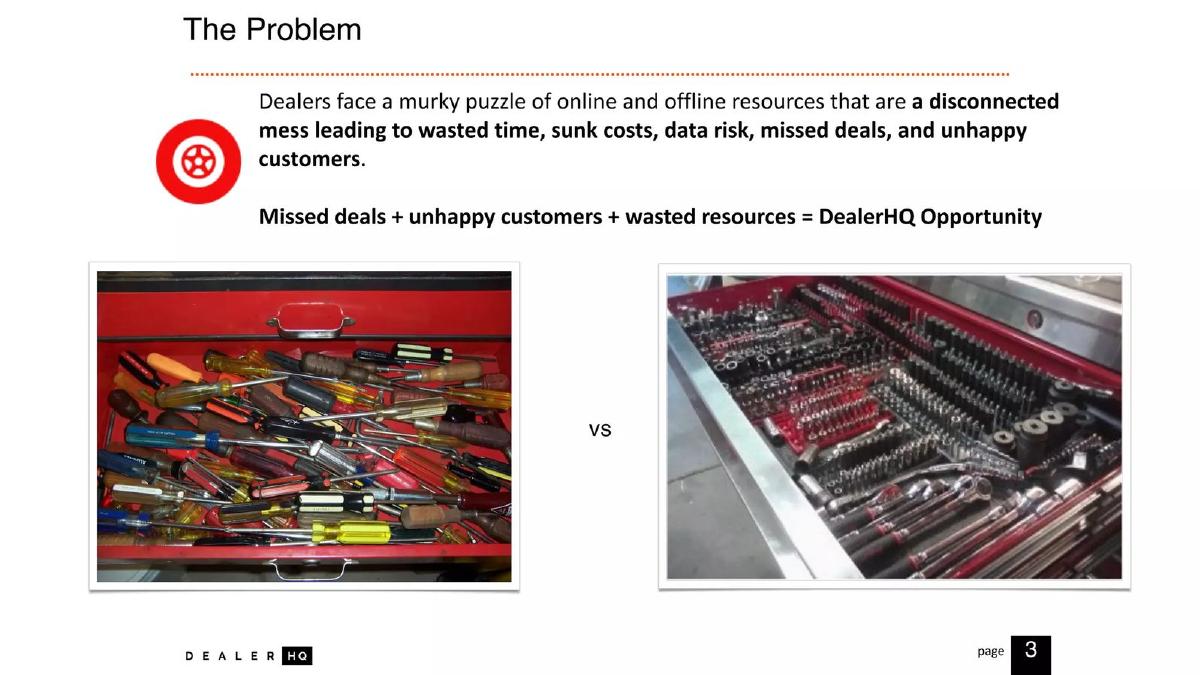
- The core problem is defined as a 'disconnected mess' of online and offline resources for dealers, illustrated by a comparison of a messy versus organized toolbox on slide 3.
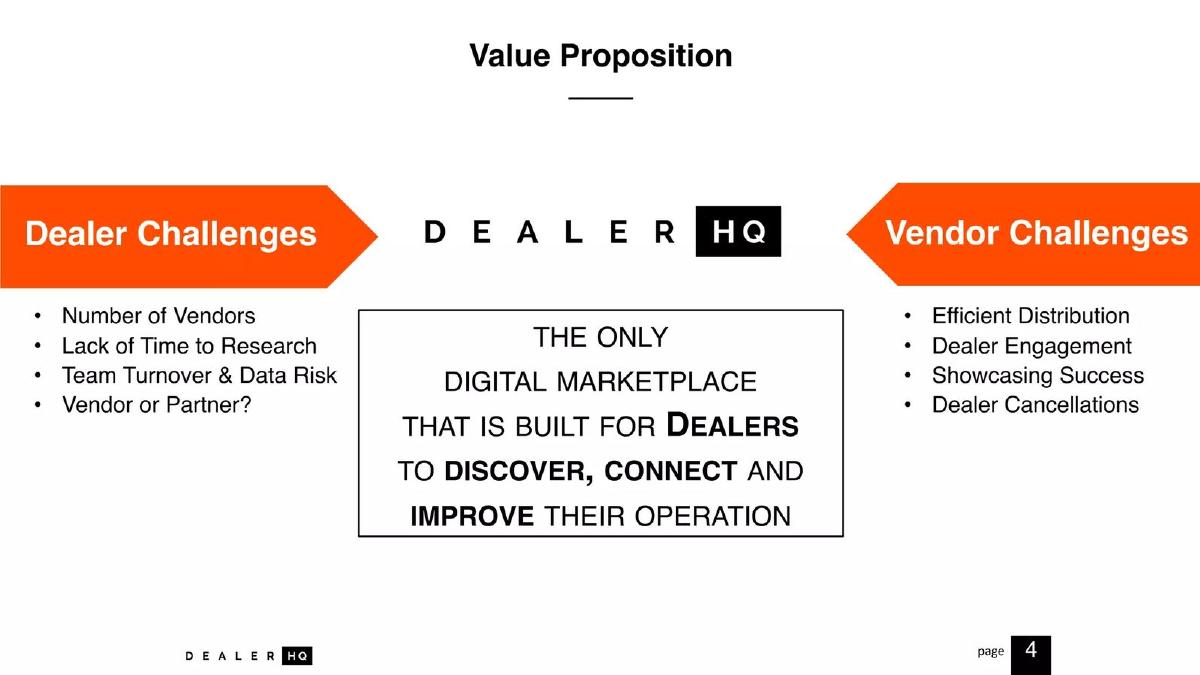
- DealerHQ positions itself as the 'only digital marketplace' built for dealers to discover, connect, and improve retail operations as shown on slide 6.
- The business model includes three vendor tiers: DealerHQ Listing, DealerHQ HUB for API integrations, and Add-ons like paid placement and email campaigns on slide 9.
- Traction is represented by a 16-month growth chart showing visitors reaching approximately 1,000 per month, with separate lines for dealers and vendors on slide 12.
- The company is seeking $1,145,000 in funding, having already raised $260,000, at a $3-4MM pre-money valuation according to slide 15.
- Marketing strategy relies heavily on industry partnerships, including NADA Dealer Academy and State Associations, as detailed on slide a1.
- The technical roadmap focuses on solving the 'too many usernames/passwords' problem through a security layer using HTTPS and HMAC-SHA1 on slide a4.
- The deck omits a dedicated team slide, leaving the background and expertise of the founders unaddressed in the provided materials.
DealerHQ: Consolidating the Automotive Retail Stack
DealerHQ enters a niche but high-value market: the automotive dealership back-office. Dealerships are notoriously fragmented, often running dozens of disparate software systems for inventory, CRM, financing, and marketing. The DealerHQ Investor Overview deck attempts to frame this fragmentation not just as an inconvenience, but as a significant financial drain due to missed deals and data risks. The deck follows a standard narrative arc, moving from the visual representation of chaos to a structured solution, though it leaves several critical investor questions unanswered regarding team and specific financial performance.
Slide 1: Title and Contact
The cover slide is minimalist, featuring the DealerHQ logo and the subtitle 'Investor Overview.' It includes a contact email for 'Brady' and the company website. While clean, it provides no immediate context regarding the industry or the specific problem being solved, requiring the viewer to move to the next slides to understand the business category.
Slide 3: The Problem Statement
Slide 3 uses a strong visual metaphor to define the problem. It compares a cluttered, disorganized red toolbox to a professional, organized mechanic's drawer. The text states that dealers face a 'murky puzzle' of resources that are a 'disconnected mess.' The slide explicitly links this disorganization to 'wasted time, sunk costs, data risk, missed deals, and unhappy customers.' By defining the 'DealerHQ Opportunity' as the sum of these pain points, the company establishes a clear reason for existence based on operational efficiency.
Slide 6: Product Demo and Platform Positioning
This slide showcases the interface across desktop and mobile devices. It positions DealerHQ as the 'only digital marketplace' for dealers to 'Discover, Connect, and Improve.' The desktop view displays a grid of recognizable automotive industry logos (such as Cars.com, DealerSocket, and Geico), suggesting that DealerHQ acts as a portal or dashboard. The callouts for 'Discover' and 'Connect' emphasize that the platform is intended to be the primary interface through which a dealer interacts with their entire vendor ecosystem.
Slide 9: Vendor Solutions and Monetization
Slide 9 breaks down the value proposition for the other side of the marketplace: the vendors. It categorizes offerings into three buckets: DealerHQ Listing (visibility and lead gen), DealerHQ HUB (technical integration via API and SDK), and Add-ons (advertising and marketing services). This slide is crucial because it demonstrates that DealerHQ isn't just a directory; it is an integration layer. The mention of an 'API Builder' and 'Software Development Kit' suggests a play for 'stickiness'—once a vendor integrates with the HUB, they are more deeply embedded in the dealer's workflow.
Slide 12: Traction and Growth
The traction slide features a line graph covering 16 months. The blue line represents 'Dealers' and the red line represents 'Vendors.' The graph shows a steady upward trend, culminating in approximately 1,000 monthly visitors. While the growth is consistent, the absolute numbers are relatively low for a marketplace, and the slide uses 'visitors' as the primary metric rather than 'active users' or 'contracted dealerships.' This suggests the company is in an early, top-of-funnel growth phase.
Slide 15: Funding Needs and Valuation
This slide provides the 'Ask.' DealerHQ is seeking a total of $1,145,000 , with $260,000 already raised. They disclose a $3-4MM pre-money valuation . The bullet points note that 'pre-revenue prospects are lined up' and meetings are scheduled with 'large dealer groups.' This confirms that the company is likely pre-revenue or at the very early stages of pilot programs. The use of funds is broadly defined as focusing on the 'Dealer Interface and Marketplace.'
Slide a1: Marketing Strategy
The marketing slide (labeled a1) outlines a circular ecosystem of acquisition channels. It moves beyond simple 'paid search' to focus on industry-specific authority. Key strategies include approaching Northwood University and the NADA Dealer Academy for speaking opportunities. It also mentions working with State Associations and Dealer 20 Groups . This indicates a sophisticated understanding of how the automotive industry buys software—through peer recommendations and established trade bodies rather than just digital ads.
Slide a4: Road Map Milestones
The final slide in the set details the technical roadmap. Phase 1 focuses on 'Application access and security,' specifically targeting the 'too many usernames/passwords' problem. It mentions 'Military grade security' using HTTPS / HMAC-SHA1 . Phase 2 moves into 'Data reporting and data access,' which involves deep-linking and reporting functionality for vendors. This roadmap reinforces the idea that DealerHQ wants to be the 'operating system' for the dealership, not just a website.
What DealerHQ Does Well
The deck excels at problem identification . The toolbox metaphor on slide 3 is an effective way to communicate a complex operational headache to investors who may not be familiar with the day-to-day frustrations of running a car dealership. By framing the problem as a 'disconnected mess,' they create an immediate need for an 'organizer.'
The dual-sided value proposition is also clearly articulated. Slide 9 shows that the founders have thought through how to extract value from vendors (through listings and API access) while providing value to dealers (through discovery and integration). This balance is essential for any marketplace business model.
Finally, the marketing strategy shows a deep understanding of the automotive vertical. Many tech startups fail in the auto space because they rely solely on SEO/SEM. DealerHQ’s plan to leverage NADA, State Associations, and Dealer 20 Groups shows they know where the decision-makers actually congregate.
What Is Missing from the Deck
The most glaring omission in the provided slides is a Team Slide . In early-stage fundraising (especially with a $3-4MM valuation and 'pre-revenue' status), the pedigree and experience of the founders are often more important than the product itself. Investors need to know if the team has previous exits, deep automotive industry ties, or technical expertise in building API hubs.
There is also a lack of Unit Economics . While the traction slide shows visitor growth, it does not explain the cost to acquire a dealer (CAC) or the expected lifetime value (LTV) of a vendor. Since the company is pre-revenue, these would be projections, but they are necessary to justify the $1.145M ask.
The Competitive Landscape is also missing. The deck claims to be the 'only digital marketplace,' but dealerships already use various dashboard tools and 'Digital Retailing' suites. A slide addressing how DealerHQ sits alongside or replaces existing tools like DealerSocket or CDK Global (which are shown as logos on the demo slide) would provide much-needed context on their defensibility.
Founder's Guide: What to Copy and What to Avoid
Copy the visual metaphors. If your startup solves an organizational or efficiency problem, use a 'Before vs. After' visual like the toolbox on slide 3. It reduces cognitive load for the investor and makes the pain point visceral.
Copy the specific channel strategy. Don't just say 'Social Media' or 'Sales.' List specific industry bodies, universities, or trade shows as DealerHQ did on slide a1. It proves you have a 'moat' in your go-to-market strategy.
Avoid hiding the team. Never send a deck to an investor without a team slide. Even if your team is small, highlight your relevant experience. If you are a first-time founder, highlight your advisors or your deep obsession with the problem space. Avoid 'Visitor' metrics as primary traction. For a B2B platform, 1,000 website visitors is a weak metric. It is better to show 'Letters of Intent' (LOIs), 'Pilot Agreements,' or 'Waitlist Signups' from actual dealerships. Visitors could be anyone; investors want to see evidence of intent from the target customer. Avoid vague 'Use of Funds.' DealerHQ lists 'Dealer Interface and Marketplace' as the use of funds. A better approach is to break the $1.145M into specific buckets: e.g., $500k for Engineering (3 hires), $300k for Sales/Marketing, and $345k for Operations/Runway. This shows a disciplined approach to capital allocation.
Frequently asked questions
- What is the primary value proposition for automotive dealers?
- According to slide 3 and slide 6, DealerHQ provides a centralized 'launchpad' to manage the numerous software vendors dealers use. It aims to reduce wasted time and data risk by organizing a 'murky puzzle' of resources into a single digital marketplace where dealers can discover and connect with vendors more efficiently.
- How does DealerHQ plan to generate revenue from vendors?
- Slide 9 outlines a multi-tiered revenue model for vendors. This includes 'DealerHQ Listing' for product visibility, the 'DealerHQ HUB' which offers an API builder and SDK for integrations, and various 'Add-ons' such as paid placement features, featured pitches, and pay-per-click advertising.
- What is the current stage of the company's funding and valuation?
- Slide 15 states that DealerHQ is seeking a total goal of $1,145,000. At the time of the deck's creation, they had raised $260,000. The founders have set a pre-money valuation range of $3 million to $4 million, noting that they have 'pre-revenue prospects' lined up.
- What specific technical problems does the roadmap address?
- Slide a4 details a two-part roadmap. The first phase focuses on an 'application access and security layer' to solve the issue of managing multiple credentials. The second phase focuses on a 'data reporting and access layer,' enabling deep-linking and embedded vendor reporting to strengthen the data flow between vendors and dealers.
- How does the company plan to acquire customers?
- The marketing strategy on slide a1 is multi-faceted. It includes traditional digital tactics like paid search and content development, but emphasizes industry-specific channels such as speaking engagements at the NADA Dealer Academy, partnerships with State Associations, and involvement with 'Dealer 20 Groups' at trade shows.