DCHQ’s pitch deck is an exercise in extreme brevity, consisting of only nine slides that rely heavily on visual analogies rather than dense data. The narrative centers on a specific market gap: while Docker saw explosive growth with 200 million downloads by April 2015, Fortune 500 companies were unable to adopt it due to a lack of governance and centralized deployment tools. DCHQ positioned itself as the solution to this 'IT Nightmare' by providing access controls and hybrid cloud deployment capabilities. The deck lacks traditional sections like a team slide, financial projections, or a speci…
Key takeaways
- The deck claims 6 Fortune 500 beta users as its primary traction metric on slide 2.
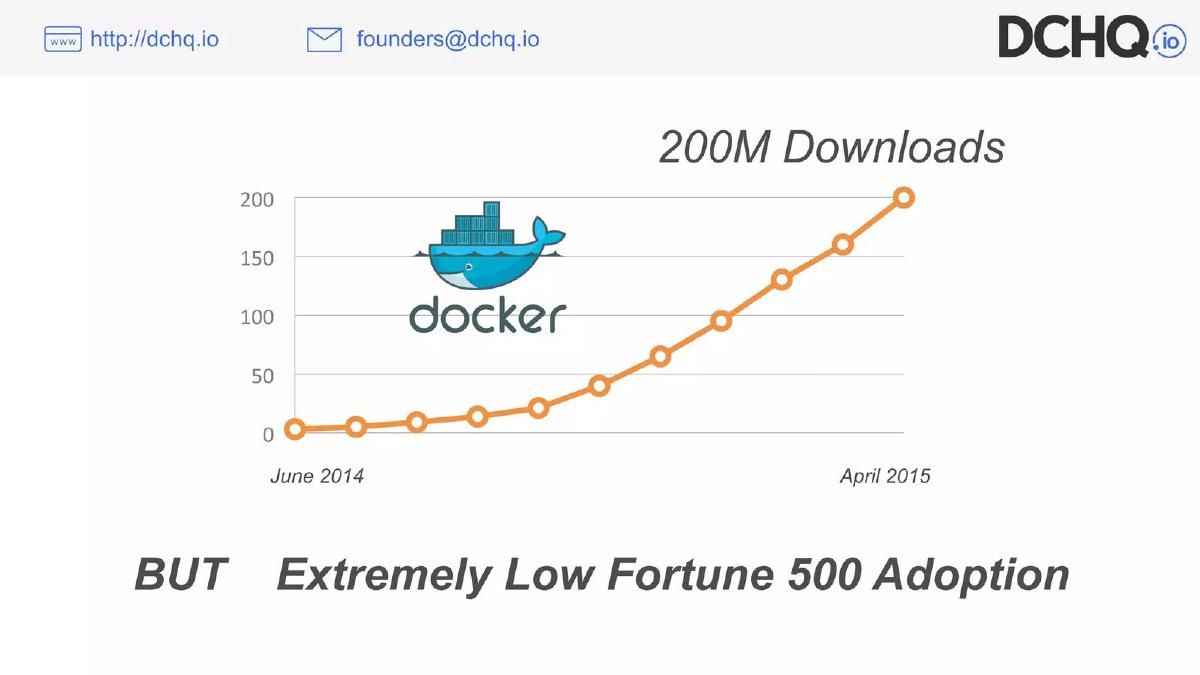
- Docker downloads grew from near zero in June 2014 to 200 million by April 2015, according to the chart on slide 3.
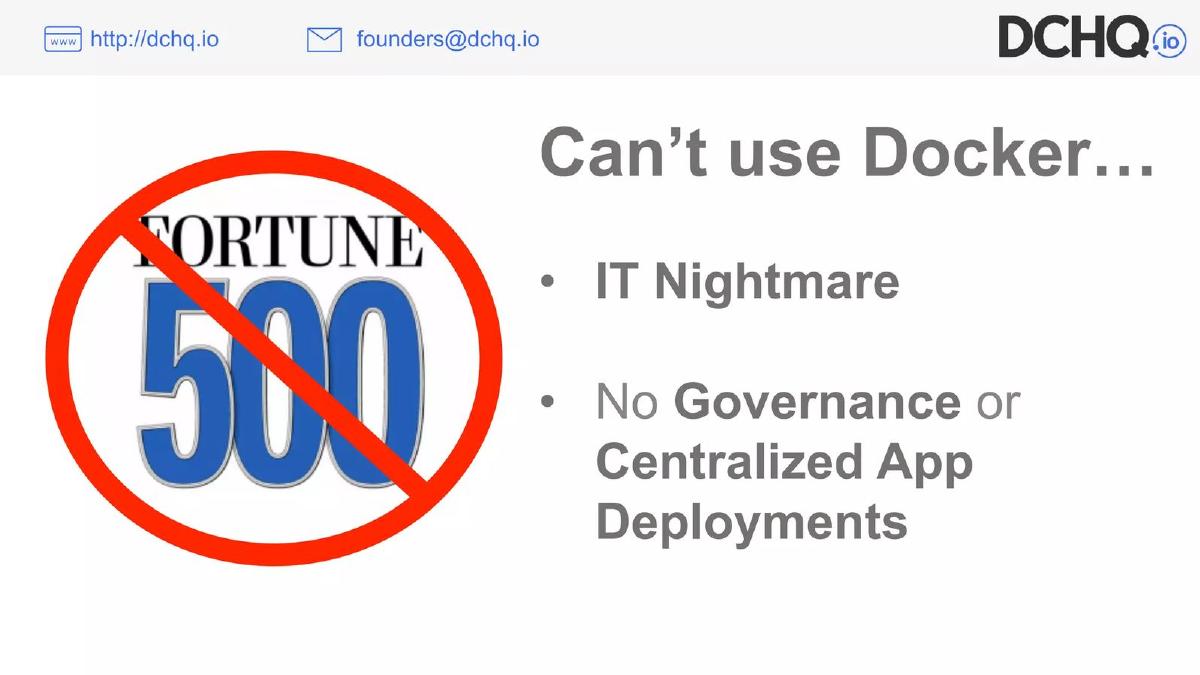
- The core problem identified is that Fortune 500 companies face an 'IT Nightmare' with Docker due to lack of governance (slide 4).
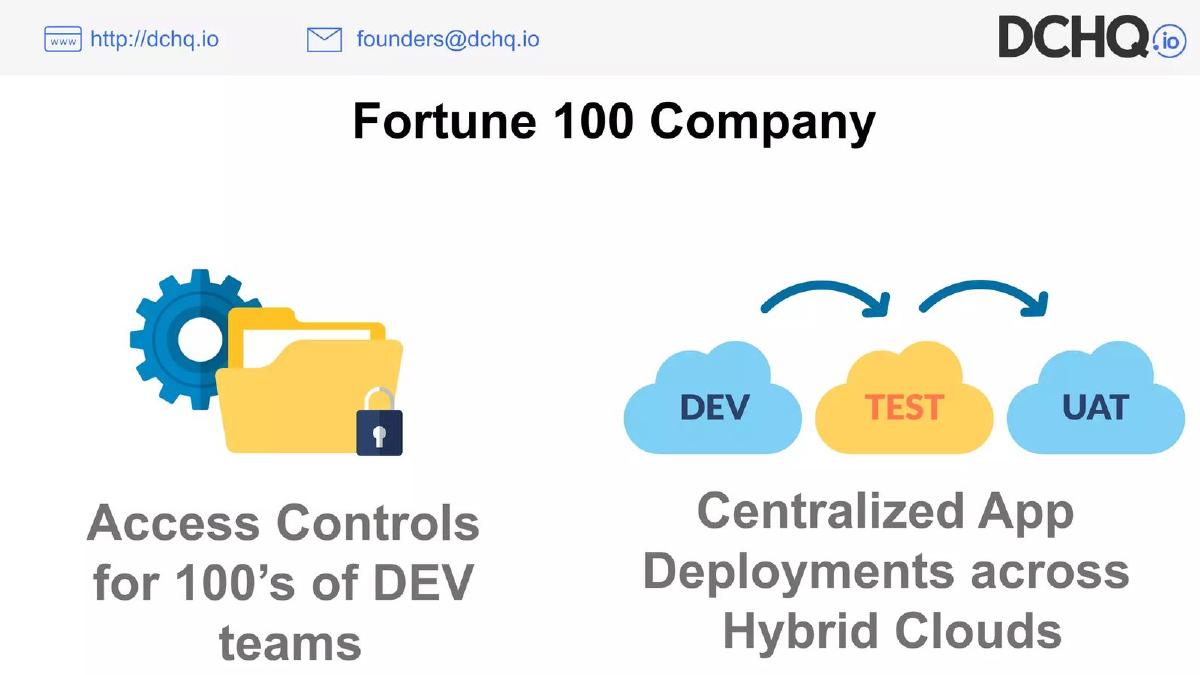
- DCHQ provides access controls for hundreds of development teams and centralized deployments across hybrid clouds (slide 5).
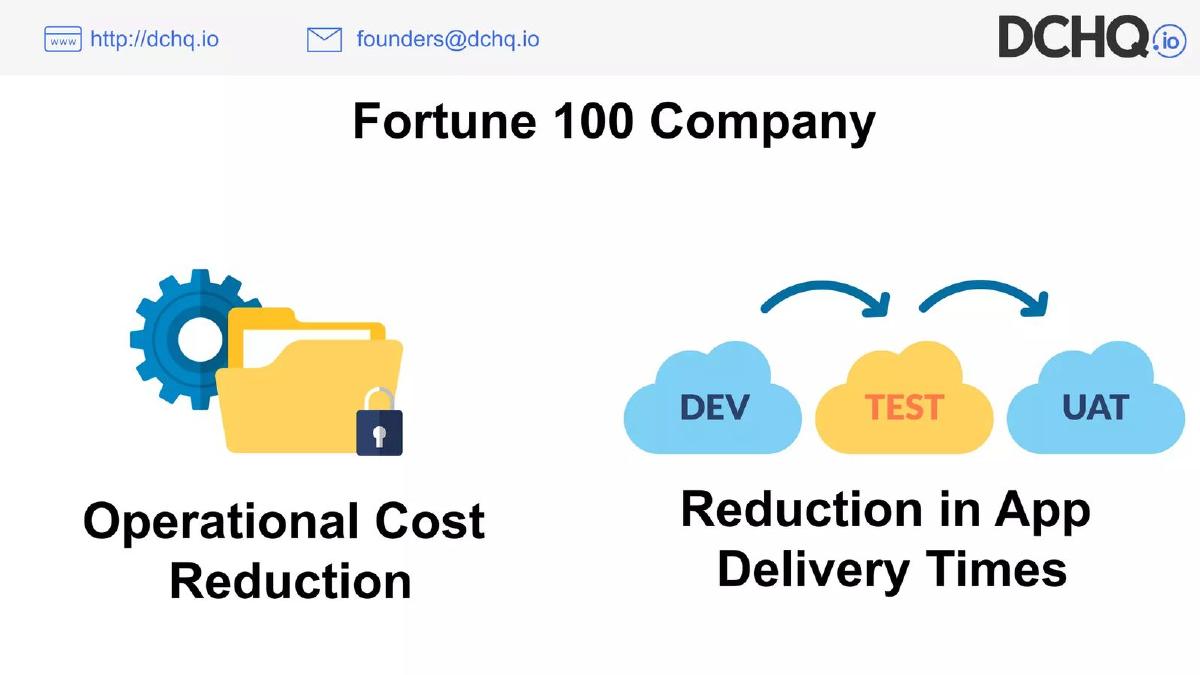
- The value proposition includes operational cost reduction and decreased application delivery times (slide 6).
- The company uses a direct analogy to Cloudera, noting its $4B valuation in relation to Hadoop, to frame its own potential with Docker (slides 7 and 8).
- There is no team slide, no business model slide, and no specific financial ask included in this 9-slide presentation.
- The deck focuses exclusively on the enterprise adoption gap rather than technical specifications of the container management software.
The DCHQ Pitch Deck: A Strategic Narrative for Enterprise Containers
The DCHQ pitch deck is a fascinating example of a 'less is more' approach to fundraising. In just nine slides, the company manages to identify a massive trend, a specific enterprise-grade blocker, and a clear path to value. While it lacks the granular detail typically found in a Series A deck, its focus on the 'governance gap' in the container market explains why it was eventually acquired by HyperGrid.
Slide 1: Title and Positioning
The cover slide is functional and direct. It identifies DCHQ as a Cloud Management Platform for Containers . The inclusion of the founders' email and the website URL immediately sets a tone of accessibility. The branding is clean, utilizing a blue and white color palette that is standard for enterprise SaaS companies.
Slide 2: Immediate Traction
DCHQ opens with a traction slide, which is a strong move for an early-stage company. It claims 6 Fortune 500 Beta Users . By leading with this, the company validates that its solution is not just a theoretical tool for developers, but a platform that has already caught the attention of the world's largest IT departments. This slide serves to de-risk the investment by showing early product-market fit in the enterprise segment.
Slide 3: The Market Opportunity
Slide 3 provides the macro context. It features a growth chart for Docker downloads, starting near zero in June 2014 and skyrocketing to 200M Downloads by April 2015 . However, the slide introduces a 'BUT'—noting Extremely Low Fortune 500 Adoption . This creates a tension that the rest of the deck must resolve: why is a technology this popular not being used by the companies with the most money?
Slide 4: The Problem Statement
This slide defines the 'IT Nightmare.' It explicitly states that the Fortune 500 Can’t use Docker because there is No Governance or Centralized App Deployments . By using a 'No' symbol over the Fortune 500 logo, the deck visually reinforces the idea of a blocked market. This is the core of the DCHQ thesis: the technology is ready, but the enterprise management layer is missing.
Slide 5: The Solution - Capabilities
DCHQ introduces its solution as the bridge for a Fortune 100 Company . It lists two primary functions: Access Controls for 100’s of DEV teams and Centralized App Deployments across Hybrid Clouds . The visual shows a progression from DEV to TEST to UAT (User Acceptance Testing), illustrating that DCHQ manages the entire application lifecycle, not just the initial launch.
Slide 6: The Solution - Outcomes
Following the capabilities, slide 6 focuses on the business outcomes. It promises Operational Cost Reduction and a Reduction in App Delivery Times . This shifts the conversation from technical features to the bottom-line benefits that a CIO or CFO would care about. It connects the 'how' of the previous slide to the 'why' of a purchasing decision.
Slide 7 and 8: The Business Analogy
These two slides function as a single unit to explain the company's potential scale. Slide 7 shows Cloudera positioned above Hadoop with a $4B valuation. Slide 8 then places DCHQ in the same relative position above Docker . This is a powerful visual shorthand. It tells the investor: 'You know how Cloudera made Hadoop usable for enterprises and became worth billions? We are doing the exact same thing for Docker.'
Slide 9: Contact Information
The deck concludes with a repeat of the contact information, adding a Twitter handle. There is no 'Ask' slide, no roadmap, and no team summary. The deck ends on the high note of the Cloudera analogy, leaving the investor to contemplate the market size rather than the specific terms of a deal.
What DCHQ Does Well
The DCHQ deck excels at narrative clarity . It follows a perfect logical flow: the market is exploding (Docker), but the big players are stuck (Fortune 500), because they lack control (Governance), which we provide (DCHQ), leading to massive value (Cloudera analogy). By keeping the slides sparse, the founders ensure that the audience stays focused on this single, compelling story rather than getting lost in technical specifications.
The use of the Cloudera/Hadoop analogy is particularly effective. In 2015-2016, the success of Cloudera was a well-understood benchmark in the venture community. By mapping their business model to a known success story, DCHQ bypassed the need for a complex 'how we make money' slide. The implication was clear: we will sell support, management tools, and proprietary enterprise features on top of an open-source core.
What is Missing from the DCHQ Deck
The most glaring omission is the Team Slide . In early-stage enterprise software, the pedigree of the founders is often as important as the product itself. Investors want to know if the team has the 'scar tissue' from working in large IT environments to actually build a governance platform. Without this, the deck feels somewhat anonymous.
Furthermore, there is a complete lack of Competitive Analysis . By 2015, the container orchestration space was becoming crowded with players like Mesosphere, CoreOS, and the early rise of Kubernetes. DCHQ does not explain how it differentiates from these other management layers, which would be a primary concern for a technical investor.
Finally, the lack of a Funding Ask or a Roadmap makes this feel more like a 'teaser' deck than a full pitch. It identifies the 'what' and the 'why,' but completely ignores the 'how much' and 'what's next.' This suggests the deck was likely used to open doors or initiate strategic acquisition talks rather than as a formal presentation for a priced venture round.
Founder Takeaways: The Power of the Gap
Founders can learn a great deal from how DCHQ identified a 'Governance Gap.' Many startups focus on making a technology better, faster, or cheaper. DCHQ focused on making a technology permissible for a specific, high-value customer segment. If you are building in a space with high open-source adoption, your best path to enterprise value is often building the 'boring' stuff—permissions, audits, lifecycle management, and cost reporting—that large corporations require before they can sign a check.
Additionally, the deck demonstrates the value of visual storytelling . There are very few words on these slides. The 'No' symbol over the Fortune 500 logo and the Cloudera comparison do more work than three paragraphs of text ever could. For founders in complex technical fields, the ability to simplify your value proposition into a single visual analogy is a superpower that can significantly shorten the path to an investor's 'yes.'
Frequently asked questions
- What is the primary value proposition of DCHQ according to the deck?
- DCHQ positions itself as the governance layer that makes Docker viable for large enterprises. Slide 4 explicitly states that large companies cannot use Docker because it is an 'IT Nightmare' without governance or centralized deployments. DCHQ solves this by offering access controls for hundreds of teams and managing deployments across hybrid cloud environments, as shown on slide 5.
- How does DCHQ demonstrate market demand?
- The deck uses a two-pronged approach to demand. First, slide 3 shows the massive growth of the Docker ecosystem, citing 200 million downloads by April 2015. Second, slide 2 highlights immediate enterprise interest by stating the company already has 6 Fortune 500 beta users, suggesting that the 'IT Nightmare' mentioned later is a pain point they are actively solving for major clients.
- What is the significance of the Cloudera comparison on slides 7 and 8?
- This is a classic 'X for Y' positioning strategy. By showing Cloudera sitting atop Hadoop with a $4B valuation, and then placing DCHQ in the same position atop Docker, the founders are telling investors that DCHQ is the essential enterprise management layer for the next great open-source technology wave. It simplifies a complex technical product into a proven multi-billion dollar business model.
- What critical information is missing from the DCHQ pitch deck?
- The deck is missing almost all standard 'operational' slides. There is no team slide to establish founder credibility, no business model slide explaining how they charge, no competitive landscape analysis, and no 'Ask' slide detailing how much capital they are raising or how it will be spent. It is a pure 'vision and problem' deck.
- Who acquired DCHQ and when?
- According to the editorial context from the listing, DCHQ (which later became known as HyperForm) was acquired by HyperGrid in 2016 for an undisclosed amount. The deck's focus on enterprise lifecycle management and service discovery likely made it an attractive tuck-in acquisition for a larger cloud management provider like HyperGrid.