Daydream's 16-slide Series A deck is a masterclass in narrative-driven fundraising for a service-software hybrid. By positioning themselves against the failure of both in-house teams (using tools like SEMRush) and traditional agencies, Daydream argues for a new category: AI-native growth as a service. The deck leans heavily on social proof from industry heavyweights like Lenny Rachitsky and Eli Schwartz to validate their technical approach to programmatic SEO. While specific revenue figures are redacted in the public version, the claim of scaling from six-figure to seven-figure ARR in under a…
Key takeaways
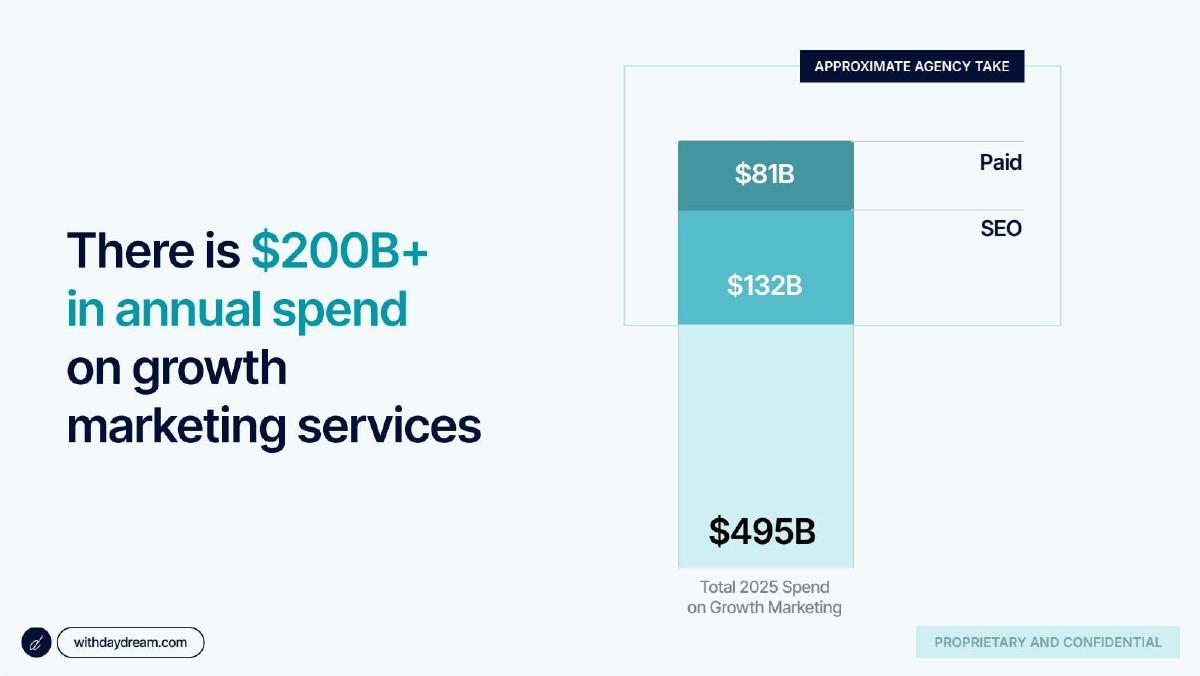
- The company targets a $200B annual spend on growth marketing services, as stated on Slide 4.
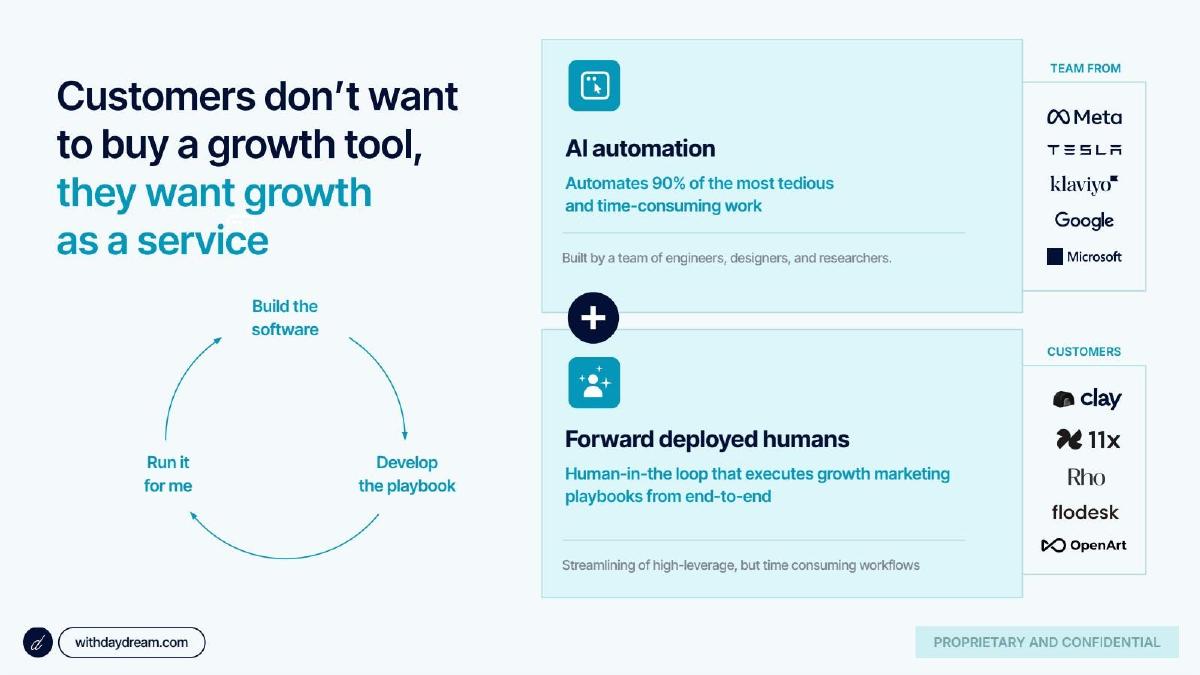
- Daydream positions itself as 'growth as a service' rather than a software tool, addressing a specific customer preference cited on Slide 6.
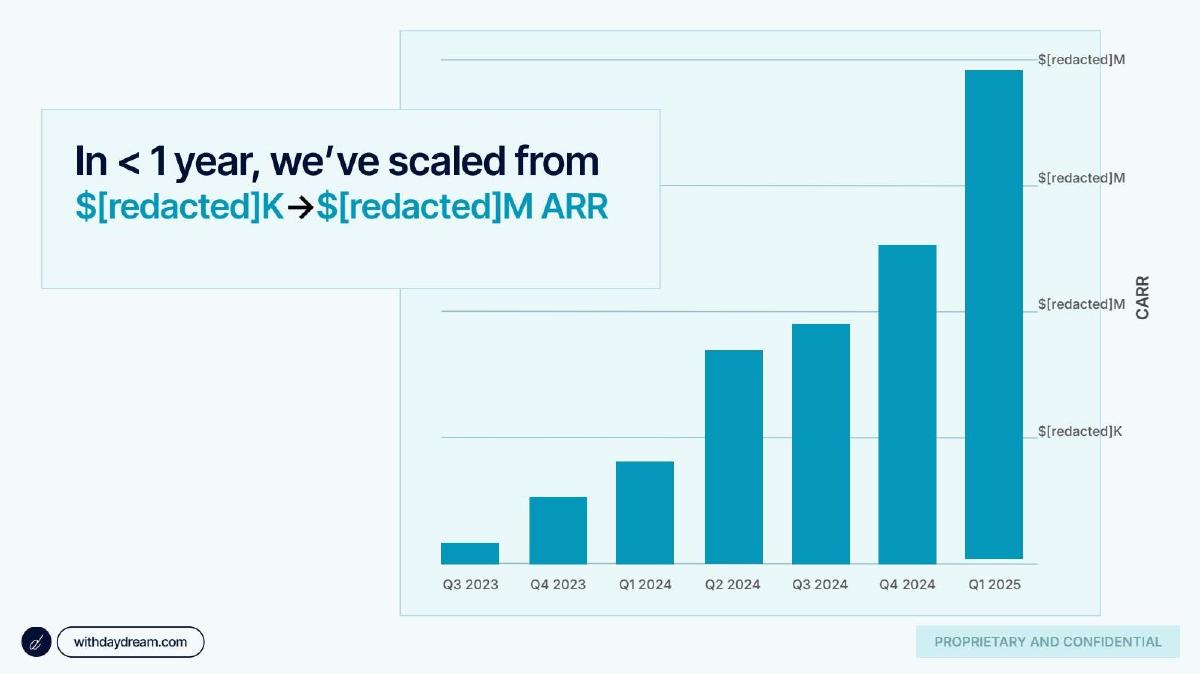
- The deck claims a rapid scale from [redacted]K to [redacted]M ARR in less than one year on Slide 2.
- Social proof is a core pillar, featuring testimonials from former SEO heads at Zapier and Zillow on Slide 9.
- The business model allows a single 'Growth Lead' to serve 10+ customers with strong margins, according to Slide 7.
- Daydream identifies a 'data moat' through cross-channel optimization and performance improvement across its customer base on Slide 11.
- The deck explicitly asks for a $15M Series A on Slide 12.
- The company views the rise of LLMs as a catalyst for a 'Golden Era' of organic search by shifting volume to mid and bottom-funnel inquiries on Slide 15.
The Narrative of AI-Native Growth
Daydream’s pitch deck for their $15M Series A is a concise, high-conviction document that focuses on market shift and execution speed. In an era where many investors are wary of 'AI wrappers,' Daydream builds a case for a structural shift in how growth marketing services are delivered. The deck avoids deep technical jargon in the main slides, opting instead to sell a superior business outcome: growth as a service that scales faster and performs better than traditional alternatives.
Slide 1: The Value Proposition
The title slide sets a bold tone: "daydream solves your hardest growth marketing problems." By using the word 'problems' rather than 'SEO' or 'software,' the company positions itself as a solution provider for C-suite objectives. The design is minimalist, featuring a clean grid pattern and the CEO’s direct contact information, signaling transparency and accessibility.
Slide 2: The Traction Hook
Slide 2 is the 'momentum' slide. It claims the company scaled from a six-figure ARR to a seven-figure ARR in less than one year. While the specific numbers are redacted in the public version, the magnitude of the jump (K to M) is the primary signal. This slide justifies the Series A timing; it demonstrates that the product-market fit is not just theoretical but is reflected in rapid revenue expansion.
Slide 3 & 4: Market Opportunity
Slide 3 utilizes a 'logo wall' strategy (though names are redacted in this version) to show that the world's fastest-growing companies are already users. This leads directly into Slide 4, which defines the Total Addressable Market (TAM). By citing a $200B annual spend on growth marketing services, Daydream isn't just pitching an SEO tool; they are pitching a replacement for a massive, established service category.
Slide 5 & 6: The Category Rejection
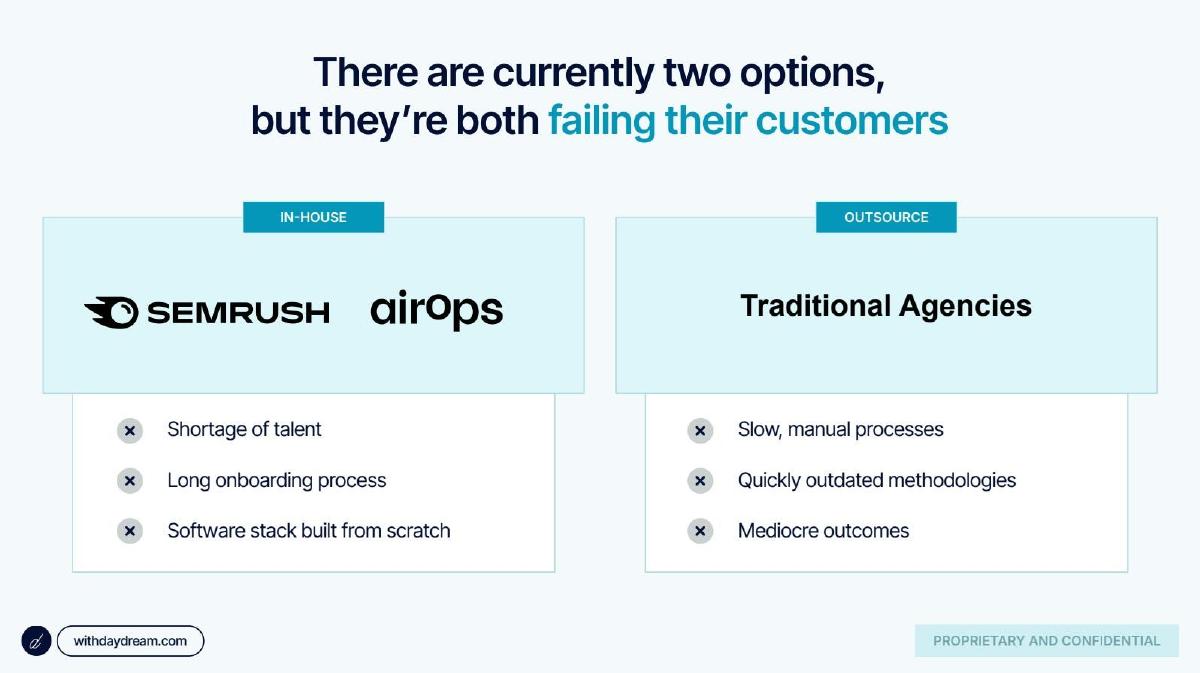
These slides are critical for positioning. Slide 5 attacks the status quo, listing the failures of in-house teams (shortage of talent, long onboarding) and traditional agencies (slow processes, mediocre outcomes). It specifically names competitors like SEMRush and AirOps as 'in-house' tools that are failing to meet customer needs. Slide 6 delivers the punchline: "Customers don't want to buy a growth tool, they want growth as a service." This is a direct challenge to the SaaS-only model, suggesting that the future of AI software is inextricably linked to service delivery.
Slide 7: The Unit Economics of AI
Slide 7 explains how Daydream wins economically. It highlights "Outlier performance results" through automation and, more importantly, a highly scalable service model. The slide states they can serve 10+ customers with a single 'Growth Lead' while maintaining strong margins. This addresses the typical investor concern regarding service-heavy businesses: that they don't scale like software. Daydream argues that AI agents provide the leverage necessary to achieve software-like scalability.
Slide 8 & 9: Social Proof and Authority
Slide 8 and 9 focus on validation. Slide 9 is particularly strong, featuring 'industry experts' rather than just customers. Testimonials from Matt Bowers (ex-Zapier/Zillow), Eli Schwartz (SEO author), and Lenny Rachitsky provide high-level credibility. When a figure like Rachitsky says a company understands a shift 'better than anyone,' it serves as a powerful proxy for technical due diligence.
Slide 10 & 11: The Moat
Slide 10 outlines the vision to "own the entire growth marketing stack," suggesting that SEO is just the wedge. Slide 11 defines their 'structural advantages.' They argue that in-house teams are 'stuck with a sample size of 1,' whereas Daydream’s 'data moat' allows for performance improvement across their entire customer base. This is the 'network effect' of data—a classic venture capital requirement.
Slide 12: The Ask
The deck concludes the main narrative with a clear ask on Slide 12: "We are raising a $15M Series A." There is no ambiguity here. The amount is substantial for a Series A in 2024, reflecting the high growth rate mentioned on Slide 2 and the pedigree of the team and advisors.
Slide 15 & 16: The Future of Search
The appendix slides (15 and 16) address the 'elephant in the room': the impact of LLMs on Google and organic search. Slide 15 reframes this threat as an opportunity, arguing that while top-of-funnel queries might move to LLMs, the 'Long-Tail Opportunities at Scale' are growing. This shows the founders are not just building for today’s search environment but are 'prepared for the next era of search' (Slide 16).
What Daydream Does Well
Clear Positioning: They don't call themselves a 'tool.' They explicitly reject the tool category in favor of 'growth as a service,' which justifies higher contract values and deeper integration with the client. · Aggressive Traction: Moving from K to M in ARR within a year is the strongest possible signal for a Series A. It proves that the 'service' isn't a bottleneck to growth. · Expert Validation: The testimonials are not generic; they speak to specific technical advantages like pSEO (programmatic SEO) implementation and AI-native strategies. · Addressing the AI Threat: By including an appendix on the 'Golden Era of organic search,' they proactively answer the most likely investor objection regarding the decline of traditional search engines.
What is Missing from the Deck
Team Slide: The public version of the deck lacks a dedicated team slide. While the CEO's email is present, the backgrounds of the 'engineering talent' mentioned on Slide 11 are not detailed. In a Series A, the pedigree of the technical team is usually a highlight. · Unit Economics Detail: While Slide 7 mentions 'strong margins,' it does not provide specific percentages or CAC/LTV ratios. For a service-hybrid model, investors typically want to see the exact gross margin to ensure it behaves more like a 70-80% margin software company than a 30-40% margin agency. · Product Visuals: The deck is very text-heavy and conceptual. There are no screenshots of the 'AI agents' or the dashboard that customers or Growth Leads use. This leaves the 'how' somewhat mysterious.
Founder Takeaways
Sell the Outcome, Not the Tool: Daydream succeeds by promising 'Growth' rather than 'SEO Software.' If your software requires a human to operate it to get results, consider if you are actually a 'Service' company powered by proprietary tech. This can often be a more lucrative and defensible position.
Use Social Proof to Bridge the Trust Gap: AI is a crowded space full of hype. Daydream uses specific, named experts to vouch for their technical superiority. Founders should seek out 'authority' figures in their niche to provide testimonials that go beyond 'we like this' and into 'this is technically better than what we could build.'
Proactively Defend Your Category: If your industry is being disrupted (like SEO by LLMs), don't ignore it. Create a 'Golden Era' narrative that explains why the disruption actually makes your specific approach more valuable. Control the narrative before the investor can form a negative bias.
Frequently asked questions
- What is Daydream's core product?
- Daydream is an AI-powered growth marketing platform that functions as a service. Unlike traditional SEO tools that require in-house talent to operate, Daydream combines AI agents with human expertise to execute programmatic SEO (pSEO) and growth strategies. Slide 6 emphasizes that customers prefer this 'as-a-service' model over buying another standalone software tool.
- How does Daydream differentiate itself from traditional agencies?
- According to Slide 5 and Slide 11, traditional agencies suffer from slow, manual processes and outdated methodologies. Daydream claims a structural advantage by productizing the 'hardest parts' of the workflow using engineering talent that agencies typically lack, allowing for outlier performance results that are highly scalable.
- What market size is Daydream targeting?
- Slide 4 identifies a $200B annual spend on growth marketing services. The deck suggests that current options—in-house teams and traditional agencies—are failing this market, leaving a massive opening for an AI-native alternative that can own the entire growth marketing stack.
- Who are the key industry experts endorsing Daydream?
- Slide 9 features testimonials from three major figures in the growth and SEO space: Matt Bowers (Ex-Head of SEO at Zapier and Zillow), Eli Schwartz (Author of Product-Led SEO), and Lenny Rachitsky (Author of Lenny's Newsletter). Their endorsements focus on Daydream's ability to execute technical pSEO better than in-house builds.
- How does Daydream view the impact of AI on search?
- Slide 15 argues that we are entering a 'Golden Era' of organic search. While LLMs are capturing top-of-funnel queries, Daydream believes this creates more valuable opportunities in mid-funnel, bottom-funnel, and long-tail niche searches, which their AI-native playbook is designed to capture at scale.