Calyoga’s deck is a straightforward brick-and-mortar expansion proposal. Founded in 2004, the company uses its ten-year operating history in San Francisco to argue for the viability of a multi-location model. The deck is notable for its transparency regarding historical financials, showing a steady climb in gross revenue from $87,812 in 2009 to $200,000 in 2013. However, it also reveals the thin margins of the boutique fitness industry, with 2012 expenses ($240,849) exceeding revenue ($198,724) due to a relocation and reconstruction project. The 'ask' is focused on transitioning the business…
Key takeaways
- The company was founded in 2004 by Brian Monnier and is based in San Francisco, CA (Slide 2).
- Historical gross revenue grew from $87,812 in 2009 to $200,000 in 2013 (Slide 5).
- The business model relies on a three-tier subscription pricing: $140 for a single month, $120/month for a 6-month contract, and $100/month for a 1-year contract (Slide 3).
- A previous investment of $50,000 was raised from friends and family in 2012 to fund a relocation and reconstruction (Slide 5).
- The expansion strategy involves adding strength training and Pilates equipment to transform into a 'mind/body fitness studio' (Slide 6).
- New locations are estimated to cost $200,000 each to open, with a projected 1-2 year payback period (Slide 6).
- The deck lacks a specific total funding amount requested, instead listing categories of need such as hiring marketing staff and purchasing equipment (Slide 4).
- The team slide lists four yoga teachers and two advisors but does not detail their professional backgrounds or prior business successes (Slide 2).
Executive Summary: A Decade of Stability Seeking Scale
The California Yoga Company (Calyoga) deck is a classic example of a small business looking to cross the chasm from a single-owner-operated studio to a regional brand. Founded in 2004, the company spent its first decade establishing a footprint in the competitive San Francisco market. The deck, likely produced around 2014 based on the 2013 financial data, seeks to capitalize on the 'mind/body' fitness trend by diversifying its service offerings and expanding its physical footprint.
Slide 1: Title and Branding
The cover slide introduces the 'California Yoga Company' with the tagline 'Claim Your Radiance.' It establishes the founder as Brian Monnier and notes the company's inception in 2004. The contact information is a generic 'info@' email address, which is standard for small business decks but less personalized than a direct founder email. The visual identity is consistent with the wellness industry, utilizing warm tones and floral motifs.
Slide 2: The Team and Advisors
Slide 2 introduces the human capital behind the business. It identifies Brian Monnier as the founder, yoga teacher, and day-to-day operator. The 'Lead Team Members' consist of four yoga teachers: Bill Mohler, Gerri Nuval, Emiko Oye, and Sarah Butler. The deck also lists two advisors: Alon Sagee (Consultant) and Brian Kram (Attorney). Critique: While the slide shows a functional team, it lacks professional credentials. Investors look for 'why' these people can scale a business, not just that they can teach a class. The inclusion of an attorney as an advisor is a common trait in early-stage decks to signal legal readiness, though it rarely influences the investment decision.
Slide 3: The Business Model and Pricing
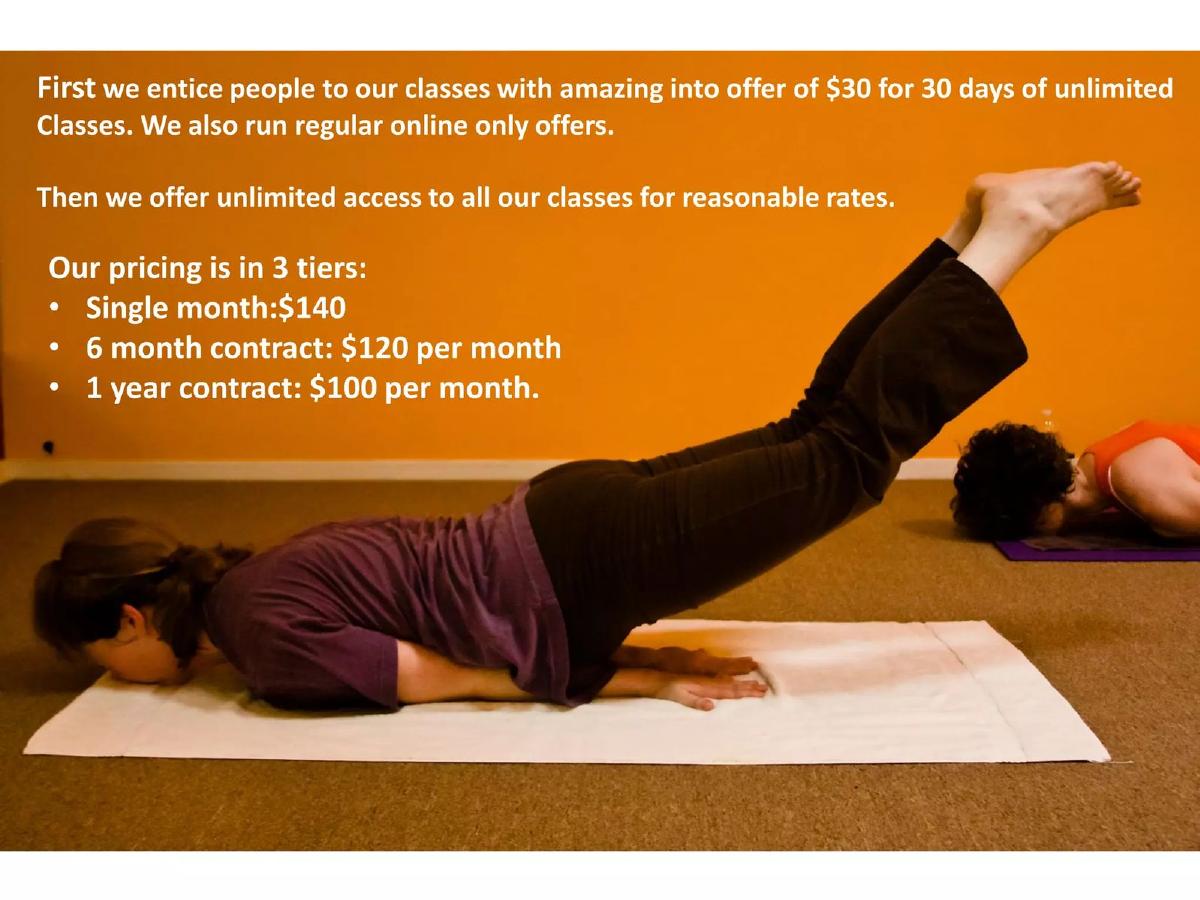
This slide details the revenue engine. Calyoga uses a 'freemium' style entry point: $30 for 30 days of unlimited classes. This is a standard industry tactic to lower the barrier to entry. The long-term revenue is driven by three tiers:
Single month: $140 · 6-month contract: $120 per month · 1-year contract: $100 per month
The emphasis on contracts suggests a focus on reducing churn and stabilizing cash flow, which is a positive signal for investors looking for predictable returns.
Slide 4: The Ask and Rationale
Slide 4 addresses 'What are we seeking?' and 'Why are we doing this?' The goals are categorized into three points: hiring staff for more classes, hiring marketing/management staff, and purchasing fitness equipment. The rationale is surprisingly candid: the founder needs to 'focus on what he does well, teach yoga.' Analysis: This is a double-edged sword. While it shows self-awareness, investors may worry about 'key man risk' if the founder wants to step back from management to teach, especially when the goal is to grow into a 'multi-location business.'
Slide 5: Historical Financials (2009-2013)
This is the most substantive slide in the deck. It provides a five-year look at Gross Revenue and Expenses.
2009: $87,812 Revenue / $75,000 Expenses · 2010: $103,558 Revenue / $75,000 Expenses · 2011: $172,888 Revenue / $150,000 Expenses · 2012: $198,724 Revenue / $240,849 Expenses · 2013: $200,000 Revenue / $183,631 Expenses
The slide explains the 2012 deficit as a result of relocation and reconstruction costs. It also notes a $50,000 friends and family investment in 2012. The transparency here is excellent, though the margins remain slim (roughly 8% in 2013), highlighting the high overhead of San Francisco real estate.
Slide 6: Future Strategy and Expansion
Slide 6 outlines the pivot from a yoga studio to a 'mind/body fitness studio.' This involves adding strength training and Pilates. The expansion plan targets opening additional locations within five years. The financial projection for these new units is a $200,000 setup cost with a 1-2 year payback period. Missing Information: The deck does not explain how they arrived at the $200,000 figure or where the first new location would be.
Slide 7: The Investment Thesis
The final slide summarizes the 'Why Invest?' argument. It points to the resilience of the mind-body market, the stability of the membership model, and the 'proven' 10-year track record. It concludes with the claim that multiple locations lead to 'consistent strong profits.' This slide serves as a summary of the previous points rather than introducing new data.
What Calyoga Does Well
Financial Transparency: Providing five years of actual revenue and expense data is rare in early-stage decks. It proves the business is a going concern and not just a concept. Clear Pricing: The pricing tiers are easy to understand and show a clear path to customer lifetime value. Operational History: A 10-year survival rate in the boutique fitness industry is a significant achievement that speaks to the founder's grit and product-market fit.
Weaknesses and Omissions
Lack of a Specific Ask: The deck mentions they need money for equipment and staff but never names a total dollar amount. Is it $200,000 for one location or $1,000,000 for five? No Market Analysis: There is no mention of the competitive landscape in San Francisco. Given the density of yoga studios in the Bay Area, investors would need to know how Calyoga differentiates itself from larger chains like CorePower or YogaWorks. Weak Team Bios: The team slide is essentially a staff directory. It needs to highlight business experience, specifically in scaling retail or hospitality brands.
Founder's Playbook: What to Copy
Founders should emulate Calyoga’s use of historical data to anchor their projections. If you have been operating, show the numbers—even the years where you lost money—and explain why. This builds trust. Additionally, the clear categorization of fund usage (Slide 4) is a good practice, as it shows the founder has thought through the operational requirements of growth beyond just 'marketing and sales.'
Final Verdict
The Calyoga deck is a solid 'Small Business Administration' (SBA) style pitch or a 'Friends and Family' round deck. It lacks the aggressive growth metrics and market dominance narrative required for traditional Venture Capital, but it presents a logical, evidence-based case for a strategic partner or an angel investor interested in the local fitness market. To improve, the founders would need to quantify the total market opportunity and provide a more detailed roadmap for the multi-location rollout.
Frequently asked questions
- What is the primary business model of California Yoga Company?
- The company operates on a membership-based subscription model. As shown on Slide 3, they offer an introductory rate of $30 for 30 days to acquire customers, then transition them into tiered monthly contracts. These contracts range from $100 to $140 per month, providing the business with a predictable recurring revenue stream typical of the fitness industry.
- How has the company performed financially over time?
- Slide 5 shows consistent revenue growth over a five-year period, more than doubling from $87,812 in 2009 to $200,000 in 2013. However, profitability has been tight; in 2012, the company spent $240,849 against $198,724 in revenue due to a studio relocation. By 2013, they returned to a slight surplus with $183,631 in expenses against $200,000 in revenue.
- What is the specific purpose of the funding they are seeking?
- According to Slide 4 and Slide 6, the funding is intended for three main areas: hiring additional staff (both teachers and management/marketing), purchasing fitness equipment for strength training and Pilates, and eventually opening new locations. They estimate that each new location requires approximately $200,000 in capital to launch.
- Does the deck identify any competitive advantages?
- The deck leans heavily on 'proven longevity' as its primary advantage. Slide 7 notes that the company has been in operation for 10 years, suggesting that their systems are stable and ready for duplication. They also highlight the 'mind/body' market's resilience to economic downturns, though they do not provide specific market data or competitor comparisons to support this.
- What critical information is missing from the Calyoga deck?
- The deck omits a formal 'Ask' slide with a specific dollar amount and equity offer. It also lacks a detailed market analysis, competitor landscape, and granular unit economics (such as customer acquisition cost or lifetime value). Furthermore, the team slide provides names and titles but lacks the professional bios necessary for investors to vet the leadership's ability to scale a multi-unit operation.