Call the Doc is a healthcare aggregator platform designed to connect users with doctors, hospitals, path labs, and blood banks via a mobile app. The deck, likely from late 2015, emphasizes a 'user-centric' approach to differentiate itself from established competitors like Practo. The founders report significant early momentum, claiming a 95% conversion rate for doctor registrations within the first month of marketing. The business model relies on listing fees and pharmaceutical advertising. While the deck provides specific financial targets—including a projected $650k year-end revenue—it reli…
Key takeaways
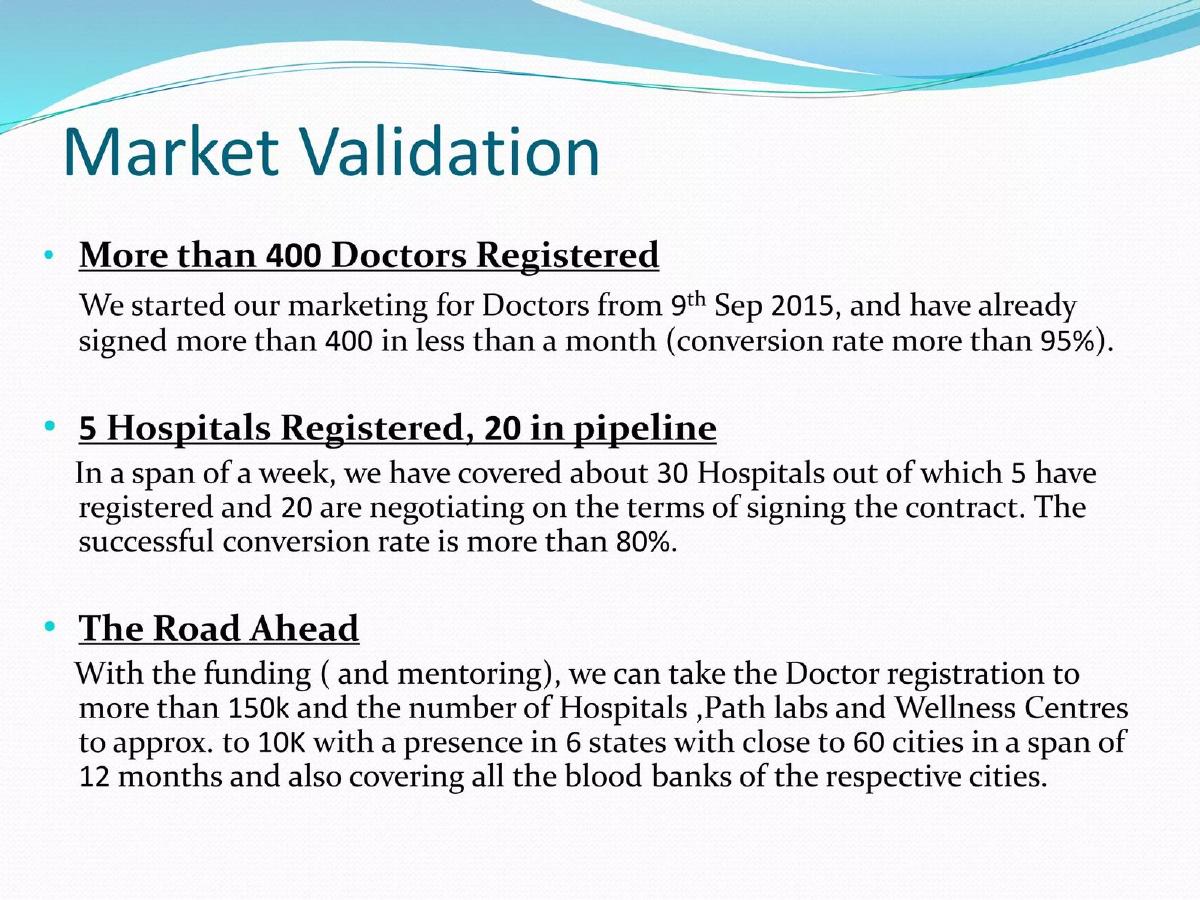
- The company claims to have registered more than 400 doctors in less than a month with a conversion rate exceeding 95% (Slide 4).
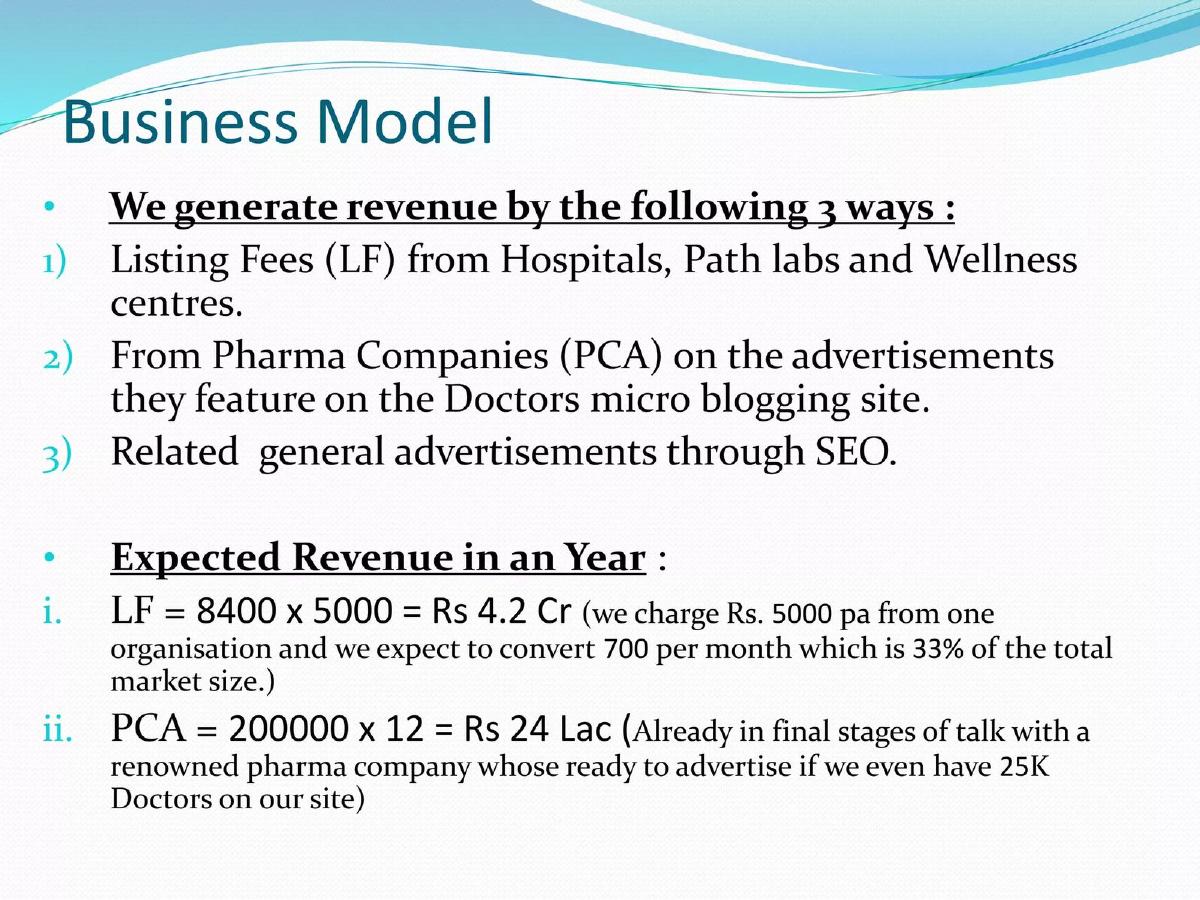
- The business model includes three revenue streams: listing fees, pharma advertisements on a micro-blogging site, and general SEO advertisements (Slide 6).
- Call the Doc explicitly positions itself against Practo, claiming a competitive advantage through cost comparison features and a focus on blood bank searches (Slide 8).
- The geographic strategy prioritizes Tier II and Tier III cities over metros to leverage lower viral marketing costs and first-mover advantage (Slide 8).
- The team includes a CEO who is a Chartered Accountant and mentions two 'Mentors & BOD' members, though specific backgrounds for most staff are omitted (Slide 9).
- The funding ask is $500k (3.25 Cr) for a 10% stake, implying a $5 million post-money valuation (Slide 10).
- Revenue projections are highly aggressive, estimating Rs 4.2 Cr ($650k) in the first year from 8,400 listing fees at Rs 5,000 each (Slide 6).
- Valuation logic is based on a 'Sector Multiplier Effect' of 80-100x, citing Practo's $500M valuation on $5M revenue as a benchmark (Slide 10).
Slide-by-Slide Analysis
Slide 1: Title Slide
The cover slide introduces the brand name 'Callthedoc' with the tagline 'for a better health care experience.' The logo incorporates a stethoscope forming the shape of a smartphone. A 'HEADSTART' logo is visible in the top right corner, suggesting this deck may have been presented at a Headstart Network event. The design is functional but dated, using a dark blue background with light blue accents.
Slide 2: Problem
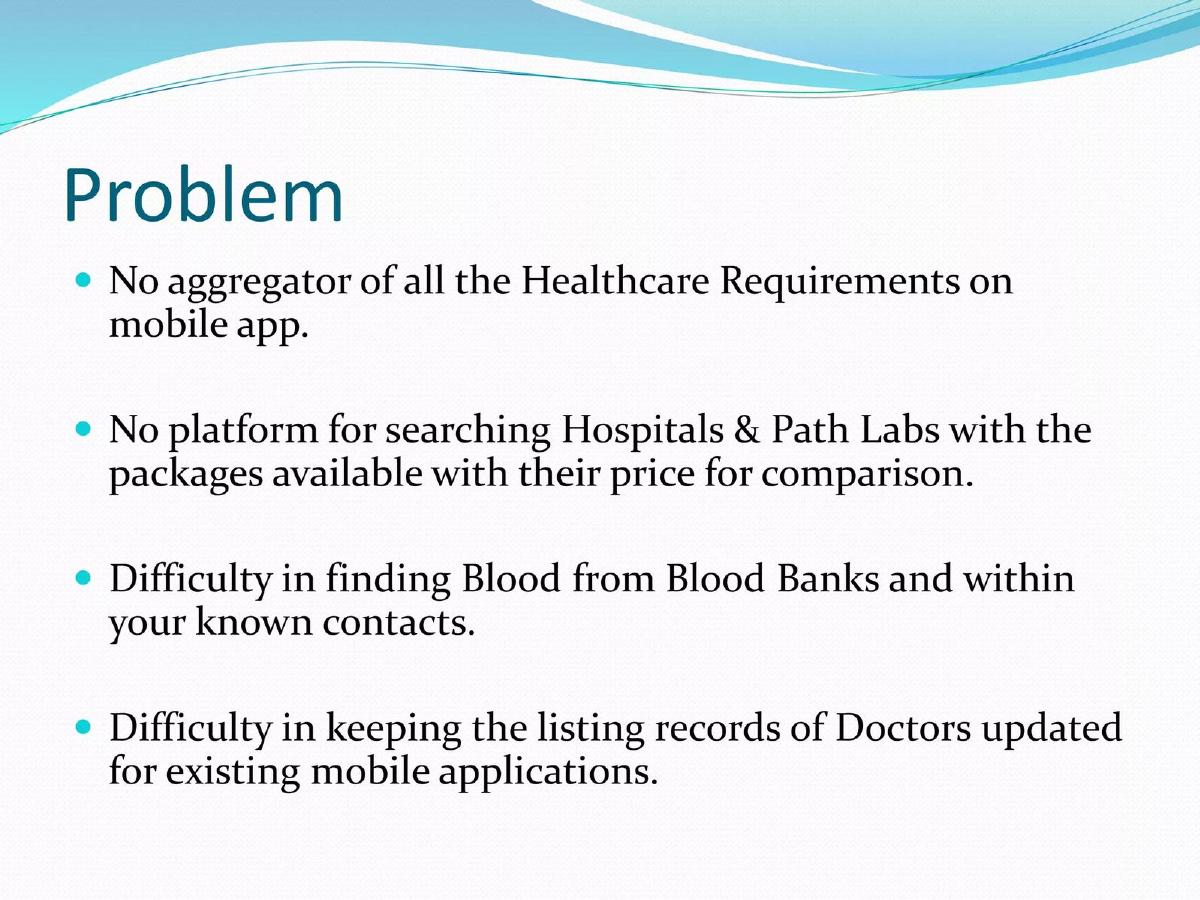
The problem slide lists four distinct pain points in the Indian healthcare market. First, it notes the lack of a comprehensive healthcare aggregator on mobile. Second, it highlights the inability to compare prices for hospitals and pathology labs. Third, it identifies the difficulty in sourcing blood from banks and personal contacts. Finally, it mentions that existing applications struggle to maintain updated doctor listings. This slide successfully identifies specific gaps rather than just broad industry issues.
Slide 3: Solution
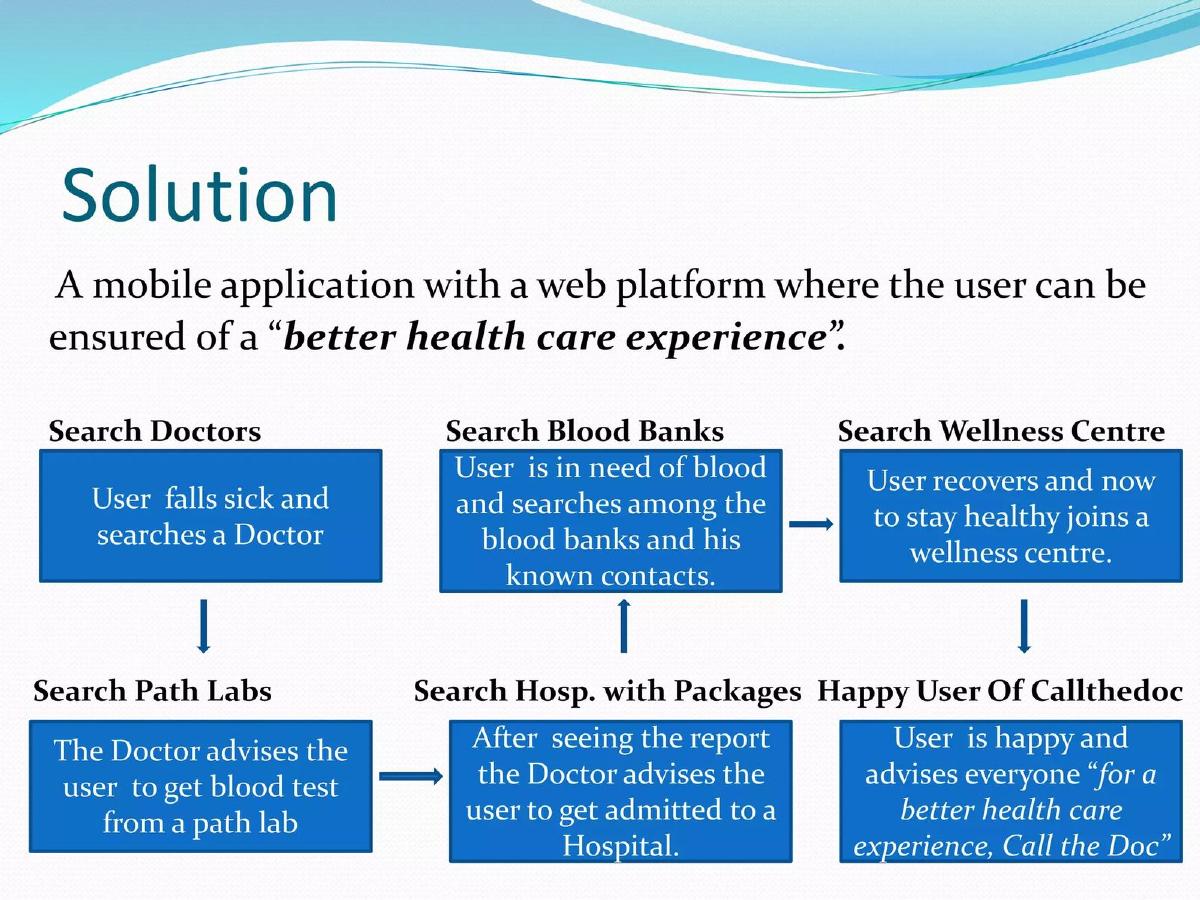
The solution is described as a mobile application and web platform. The slide uses a flow chart to illustrate the user journey: searching for a doctor, being advised to visit a path lab, searching for blood banks if needed, finding a hospital package, and finally joining a wellness center for recovery. The phrase 'Happy User Of Callthedoc' concludes the flow, emphasizing the full-cycle healthcare experience.
Slide 4: Market Validation
This slide provides specific traction metrics. The company claims to have started marketing to doctors on September 9, 2015, and registered over 400 within a month, citing a conversion rate of over 95%. They also report 5 hospitals registered and 20 in the pipeline. The 'Road Ahead' section sets a target of 150,000 doctor registrations and 10,000 hospitals/labs across 60 cities in 12 months. These are exceptionally high growth targets for a seed-stage company.
Slide 5: Market Size
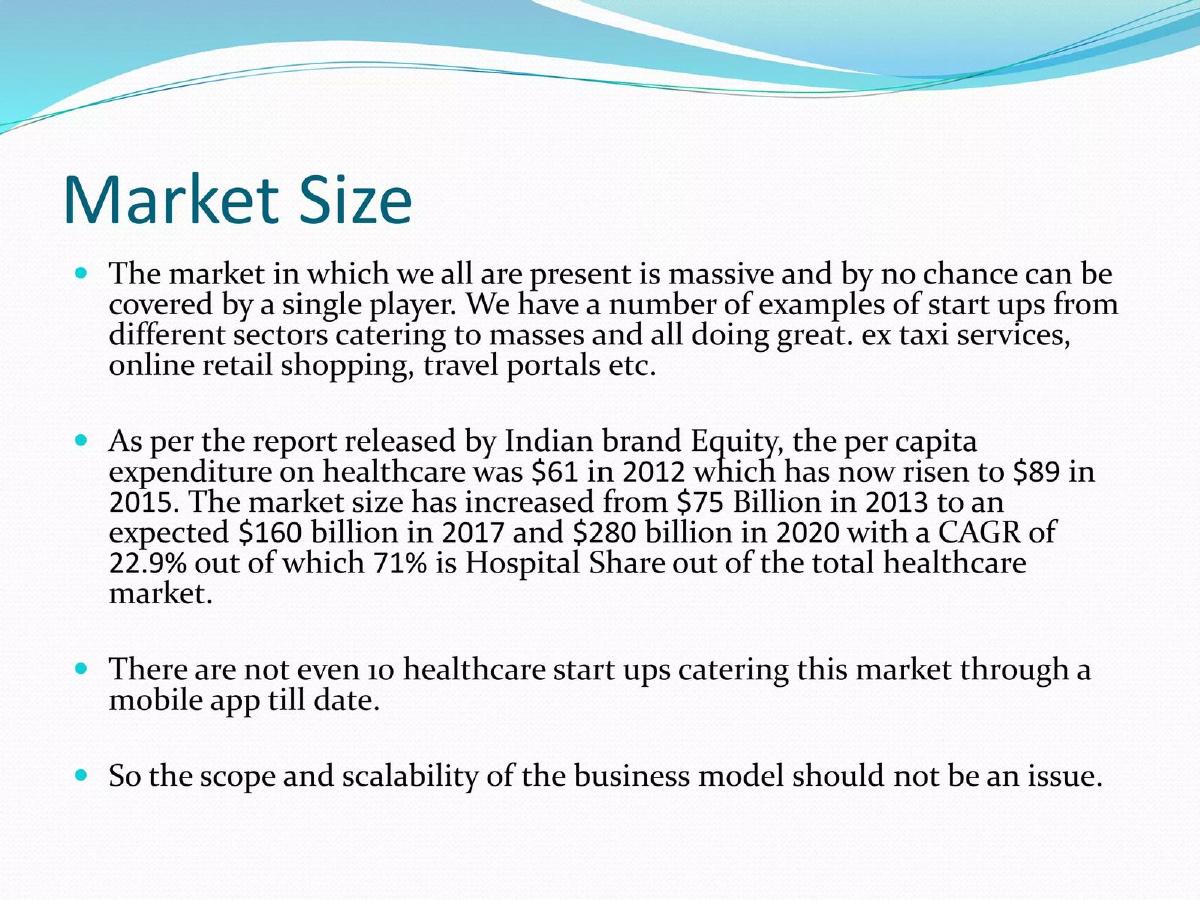
The deck cites a report by Indian Brand Equity, stating healthcare expenditure per capita rose from $61 in 2012 to $89 in 2015. It projects the total market size to grow from $75 billion in 2013 to $280 billion in 2020, with a CAGR of 22.9%. The slide claims that 71% of this market is the 'Hospital Share.' Crucially, it asserts that fewer than 10 healthcare startups were catering to this market via mobile apps at the time of the deck's creation.
Slide 6: Business Model
Revenue generation is split into three categories: 1) Listing Fees (LF), 2) Pharma Company Advertisements (PCA), and 3) General SEO ads. The financial projections are specific: they charge Rs 5,000 per year for listings and expect to convert 700 organizations monthly to reach Rs 4.2 Cr ($650k) annually. They also claim to be in final talks with a pharma company for a Rs 24 Lac ($37k) advertising contract, contingent on reaching 25,000 doctors.
Slide 7: Competitors
The slide lists Practo, Qikwell (noted as part of Practo), Helping Doc, and Ziffi. The founders make a bold claim that they 'practically think that there are no competitors' because they offer a 'complete health care package' that is user-centric, whereas others are doctor or hospital-centric. Dismissing competitors entirely is generally viewed as a red flag by investors, though they do acknowledge the prominent players.
Slide 8: Competitive Advantage
This slide elaborates on the differences from Practo. Key features include cost comparison for medical packages and a blood bank search engine. A significant strategic differentiator is the focus on Tier II and Tier III cities. The founders argue that the cost of viral growth is 'almost half' in these areas compared to metros and that these regions represent a 'huge untapped market.'
Slide 9: Team Structure
The team is led by Akshat Tiwari, a Chartered Accountant and CEO. The structure includes two 'Mentors & BOD' members, Sanjay Yadav and Dr. Saify Arsiwala. The rest of the list includes tech associates, marketing executives, and consultants. The mention of '3 Energetic Lads' as the marketing team lacks professional detail, and the slide does not provide the professional history or previous successes of the core team members.
Slide 10: Financial Plan, Funding & Stake Dilution
The final slide contains the 'Ask.' The company seeks $500,000 (3.25 Cr) for a 10% stake. It projects a year-end revenue of $650k and a net profit of $147k. The most controversial part of this slide is the valuation logic: it applies an 80x multiplier to its projected revenue to claim a $52 million valuation. It justifies this by pointing to Practo, which it claims had a $500M valuation on $5M in revenue (a 100x multiplier). This is a highly speculative way to present valuation to investors.
What Works
Specific Traction Metrics: The inclusion of exact dates (Sep 9, 2015) and specific registration numbers (400 doctors) provides a clear snapshot of early momentum. Niche Geographic Strategy: Focusing on Tier II and Tier III cities is a logical way to differentiate from well-funded competitors who typically fight for dominance in major metros like Mumbai and Bangalore. Clear Revenue Streams: The business model is not vague; it specifies exactly what they charge (Rs 5,000) and how many units they need to sell to hit their targets.
What is Missing
Product Screenshots: For a mobile-first solution, the total absence of app screenshots or UI/UX designs is a major omission. Investors cannot see the 'user-centric' experience the founders claim to have built. Team Pedigree: While titles are listed, there is no information on where the team worked previously or what they have built. Unit Economics: While they list total expenses, they do not break down the Customer Acquisition Cost (CAC) for doctors or hospitals, which is critical for a listing-based business. Risk Assessment: The deck assumes a 95% conversion rate will continue at scale, which is statistically unlikely, and does not address the regulatory hurdles of healthcare data in India.
Founder's Playbook
Avoid 'No Competitors' Language: Claiming there are no competitors (Slide 7) usually signals a lack of market research. It is better to acknowledge competitors and explain why your approach is better. Be Realistic with Multipliers: Using an 80x-100x revenue multiplier (Slide 10) to justify a valuation is extremely aggressive. Founders should base valuations on current market comparables and actual traction rather than projected 'multiplier effects.' Show, Don't Just Tell: If you claim to have a 'user-centric' application, you must show the interface. A flow chart of boxes (Slide 3) is not a substitute for a product demo. Clarify Team Roles: Listing 'Mentors' as the first two members of the team (Slide 9) can be confusing. Investors want to know who is working on the business full-time and what their specific qualifications are for the roles they hold.
Frequently asked questions
- What is the primary problem Call the Doc aims to solve?
- According to Slide 2, the company identifies a lack of a single mobile aggregator for all healthcare requirements. Specifically, it points to the absence of platforms for comparing hospital and lab prices, difficulty finding blood from banks or personal contacts, and the challenge of keeping doctor listings updated on existing apps.
- How does Call the Doc plan to generate revenue?
- Slide 6 outlines three revenue streams: annual listing fees of Rs 5,000 from hospitals, labs, and wellness centers; advertisements from pharma companies on a proprietary micro-blogging site for doctors; and general advertisements via SEO. They project converting 700 organizations per month to reach their targets.
- What is the company's specific geographic expansion plan?
- Slide 4 states the goal is to reach a presence in 6 states and close to 60 cities within 12 months. Slide 8 clarifies that they are intentionally avoiding Tier I metros, focusing instead on Tier II and Tier III cities where they believe the cost of viral growth is lower and the market remains untapped.
- Who are the key members of the leadership team?
- Slide 9 identifies Akshat Tiwari as the CEO, noting he is a Chartered Accountant. The team also includes Sanjay Yadav and Dr. Saify Arsiwala as Mentors and Board of Directors members. The rest of the team consists of tech and marketing associates, including a 'Marketing Team' described as '3 Energetic Lads.'
- What are the financial terms of the investment opportunity?
- As shown on Slide 10, the company is seeking $500,000 (equivalent to 3.25 Crore INR) in seed funding. In exchange, they are offering a 10% equity stake. They project a net profit of $147k (96 Lac) by the end of the first year following the investment.