CallTree Pro’s seed deck, dated July 2014, presents a solution for manual incident coordination within enterprise IT. The company positioned itself as a bridge between ITSM, ITOM, HRIS, and ITGRC, emphasizing the need for audit trails in a compliance-driven world. With a reported average MRR of $450+ per customer and a $400K+ ACV pipeline including names like Sungevity and AAA, the deck leans heavily on market segmentation and a detailed competitive matrix. Notably, the deck concludes with a very specific exit strategy, targeting a sub-$50M acquisition within 18-36 months. While the market si…
Key takeaways
- The company identifies a lack of automated coordination and audit trails during IT incidents as the core problem (Slide 5).
- CallTree Pro positions itself at the intersection of four enterprise silos: ITSM, ITOM, HRIS, and ITGRC (Slide 6).
- The deck claims a current pipeline of $400K+ ACV with interested customers like Sungevity, AAA, and Brown-Forman (Slide 8).
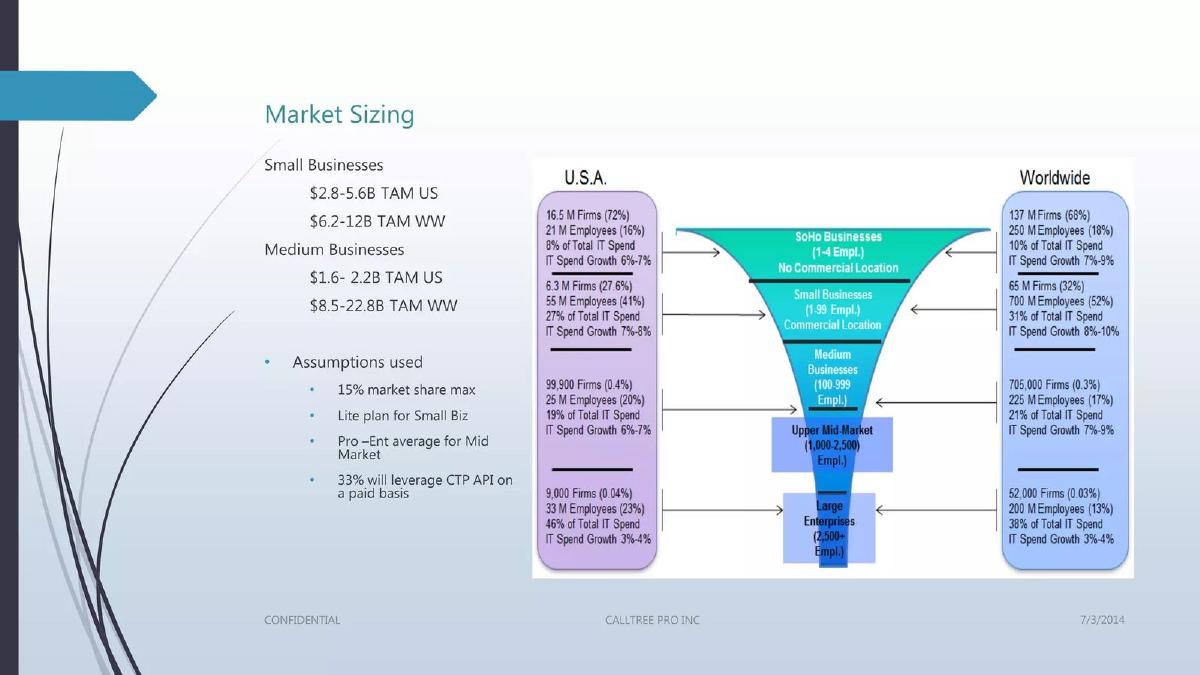
- Market sizing estimates a US Small Business TAM of $2.8-5.6B and a US Medium Business TAM of $1.6-2.2B (Slide 3).
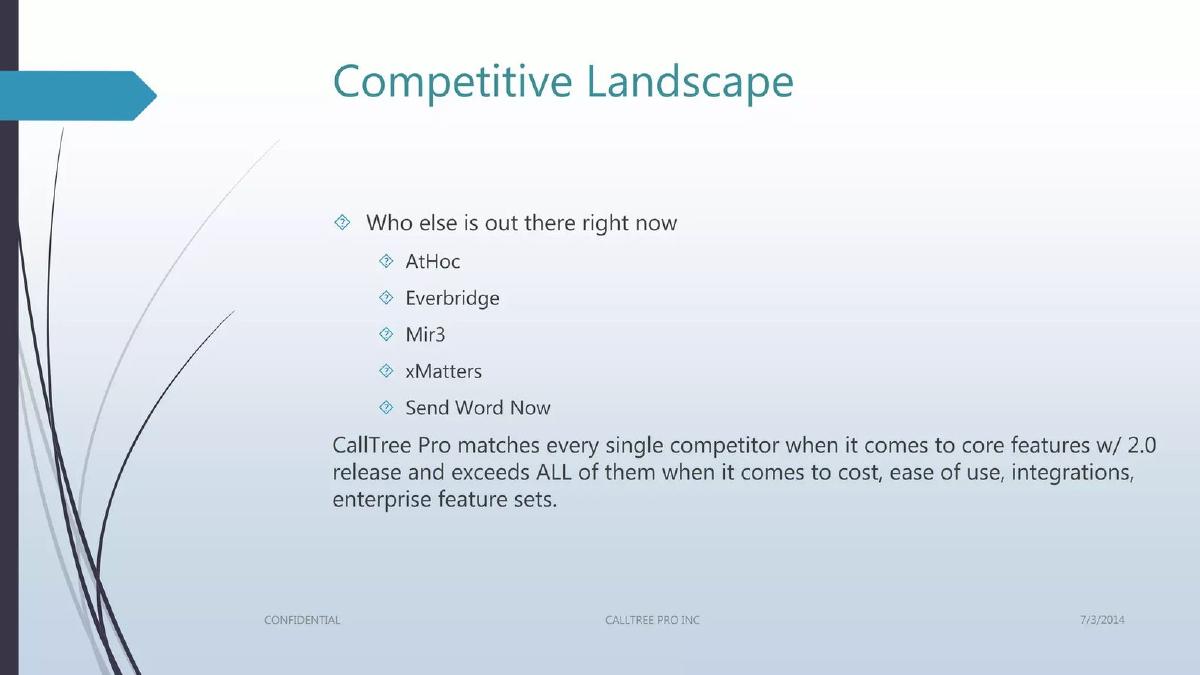
- A detailed competitive matrix compares CallTree Pro against incumbents like Athoc, xMatters, and Dell AlertFind (Slide 4).
- The product ecosystem relies on third-party integrations including Twilio, PubNub, and Skyhook (Slide 7).
- The exit strategy is unusually specific, aiming for a sub-$50M acquisition by players like Cisco or ServiceNow within 18-36 months (Slide 9).
- The deck lacks a team slide, a specific funding 'ask' amount, and detailed unit economics beyond a single MRR figure (Slides 1-9).
CallTree Pro Seed Deck Analysis
The CallTree Pro seed deck, dated July 3, 2014, is a product of its time, focusing on the transition from manual IT processes to automated, compliance-ready communication platforms. The deck is structured to move from broad market potential to specific product positioning within the enterprise stack. While it provides strong context on the 'why now' regarding compliance and audit trails, it leaves several critical investor questions unanswered, particularly regarding the team and the specific capital requirements.
Slide 1: Title Slide
The title slide is minimal, featuring the CallTree Pro logo—a tree icon—and the text 'Seed round deck.' It is explicitly marked as 'CONFIDENTIAL' and dated 7/3/2014. The footer establishes the legal entity as CALLTREE PRO INC. There is no tagline or one-sentence value proposition on this slide, requiring the viewer to proceed to understand the business model.
Slide 2: Market Segmentation
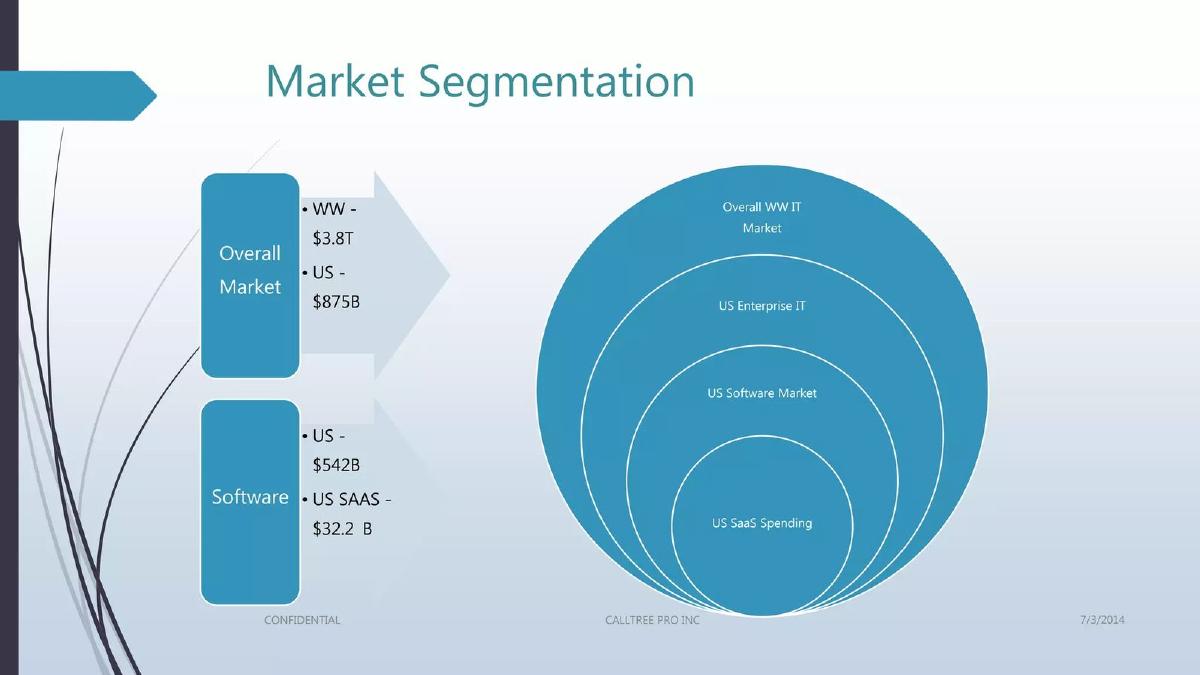
This slide uses a concentric circle diagram to visualize the market. It starts with the 'Overall WW IT Market' at $3.8T and narrows down to 'US SaaS Spending' at $32.2B. The data points provided are:
WW Overall Market: $3.8T · US Overall Market: $875B · US Software Market: $542B · US SAAS: $32.2B
While these numbers are large, they represent the total environment rather than the specific niche CallTree Pro occupies. This is a common 'top-down' market approach that VCs often find less compelling than a bottom-up calculation.
Slide 3: Market Sizing
Slide 3 attempts a more granular bottom-up approach. It breaks down firms by size (SoHo, Small, Medium, Upper Mid-Market, and Large Enterprises) and provides TAM figures for the US and Worldwide. Key figures include:
Small Businesses: $2.8-5.6B TAM US / $6.2-12B TAM WW · Medium Businesses: $1.6-2.2B TAM US / $8.5-22.8B TAM WW
The slide also lists 'Assumptions used,' such as a 15% maximum market share and the use of a 'Lite plan for Small Biz.' This level of transparency regarding their calculations is a positive trait, though a 15% market share assumption is quite aggressive for a seed-stage startup.
Slide 4: Competitive Matrix
The competitive matrix compares CallTree Pro against five competitors: Athoc, xMatters, Mission Mode, Guardly, and Dell AlertFind. The matrix tracks 11 features, ranging from 'Mass Notification' to 'Open API.' CallTree Pro claims to be the only provider (following their 'Fall Release') to check every box, specifically highlighting 'Real Time Analytics' and 'Open API' as their primary differentiators against the field. This slide effectively communicates their intent to be the most modern, integrated solution in the space.
Slide 5: The Problem
This slide articulates the pain points CallTree Pro aims to solve. It focuses on four main areas:
Manual coordination of activities after an incident occurs. · The 'nightmare' of audit reporting across disparate channels. · A lack of focus on the 'People side' of IT incidents. · The absence of communication backups beyond a second email server.
The emphasis on 'compliance driven world' and 'audit trails' suggests the company is targeting industries with high regulatory oversight, such as finance or healthcare.
Slide 6: Where CTP fits in the Enterprise IT Stack
This slide is a conceptual diagram showing CallTree Pro (CTP) at the center of four enterprise pillars:
ITSM (IT Service Management): Incident to Problem Escalation. · ITOM (IT Operations Management): 'Big Red Button' and CIRT/Ops. · HRIS (Human Resources Information System): Employee Safety and Location Compliance. · ITGRC (IT Governance, Risk, and Compliance): DR/BCP (Disaster Recovery/Business Continuity Planning) and Policy Acceptance.
This is a strong positioning slide because it shows how the product integrates with existing high-value enterprise software rather than trying to replace it.
Slide 7: Product Ecosystem
Slide 7 highlights the technical foundation of the product. It uses a honeycomb graphic to show 'partners, not just vendors.' The logos displayed include:
Twilio (likely for SMS/Voice) · PubNub (real-time messaging) · Skyhook (location services) · StrongLoop · Stormpath · VoltDB · newScale
This slide serves as a proxy for a technical architecture slide, showing that the platform is built on modern (for 2014) cloud infrastructure and APIs.
Slide 8: Traction & Validation
Paying Customers: Average MRR of $450+ per customer. · Pipeline: $400K+ ACV. · Interested Customers: Sungevity, Federal Home Loan Bank, EBMUD, AAA, and Brown-Forman. · Partnerships: Cisco, ServiceNow, and Qualcomm.
While the MRR is modest, the caliber of the 'interested' pipeline suggests the product had significant enterprise appeal. However, the deck does not specify how many paying customers they actually have, only the average revenue per customer.
Slide 9: Exit Strategy
The final slide in the provided set is an 'Exit Strategy.' It lists specific potential acquirers like Cisco, HP, and ServiceNow. Most notably, it defines a success metric: an acquisition at the 'sub $50M mark' within 18-36 months. While founders are often advised not to focus on the exit too early, this slide shows a very specific 'lifestyle' or 'tuck-in' acquisition ambition rather than a 'unicorn' or IPO ambition. This level of specificity can be polarizing for VCs who are looking for 100x returns.
What CallTree Pro Does Well
The deck excels at positioning. By placing the product at the intersection of ITSM, ITOM, HRIS, and ITGRC, the founders demonstrate a deep understanding of how enterprise IT departments are structured. They aren't just selling a 'notification tool'; they are selling a compliance and coordination layer. The competitive matrix is also well-executed, identifying specific technical gaps (like Open APIs and Real-Time Analytics) that were genuine pain points in 2014-era enterprise software.
What is Missing from the Deck
The most glaring omission in the provided slides is a Team Slide . In a seed round, the pedigree and experience of the founders are often more important than the initial traction. Without knowing who is building the technology, it is difficult to assess execution risk. Additionally, there is no Ask Slide . The deck mentions it is for a 'Seed round,' but it does not state how much capital is being raised, what the valuation expectations are, or how the funds will be allocated (e.g., hiring, sales, R&D). Finally, the deck lacks Unit Economics . While it mentions $450 MRR, it doesn't discuss Customer Acquisition Cost (CAC) or Churn, which are vital for evaluating a SaaS business model.
Founder Takeaways: What to Copy
Founders should look at Slide 6 ('Where CTP fits') as a masterclass in enterprise positioning. If you are building a tool that needs to live alongside giants like ServiceNow or Workday, showing exactly where you sit in that ecosystem is vital. It reduces the perceived 'friction' of adoption for a CIO. Additionally, the use of a 'Pipeline' list with recognizable brand names (Slide 8) is a highly effective way to build credibility when your actual revenue numbers are still in the early stages. It proves that large organizations are at least willing to take a meeting, which is a form of validation in itself.
Frequently asked questions
- What is the primary problem CallTree Pro is solving?
- According to slide 5, the company addresses the manual coordination of activities during IT incidents. They argue that most companies rely on disparate channels that lack the audit trails required for modern compliance. They specifically highlight that existing IT solutions focus on technical aspects rather than the 'People side' of incident management and communication.
- How does CallTree Pro define its market opportunity?
- The deck uses two slides (2 and 3) to segment the market. Slide 2 cites a massive $3.8T worldwide IT market, but slide 3 gets more granular, focusing on Small Businesses (1-99 employees) and Medium Businesses (100-999 employees). They assume a 15% maximum market share and calculate a US TAM of $2.8-5.6B for small firms and $1.6-2.2B for medium firms.
- What traction did the company have at the time of this deck?
- Slide 8 states the company has paying customers with an average MRR of $450+ per customer. It also lists a pipeline of over $400K in Annual Contract Value (ACV). Named 'interested' entities include Sungevity, Federal Home Loan Bank, EBMUD, AAA, and Brown-Forman. They also mention technology partnerships with Cisco, ServiceNow, and Qualcomm.
- Who are the main competitors identified in the deck?
- Slide 4 features a competitive matrix listing Athoc, xMatters, Mission Mode, Guardly, and Dell AlertFind. CallTree Pro differentiates itself by claiming to offer 'Real Time Analytics' and an 'Open API,' features which it suggests are missing from several of its competitors' offerings as of their 'Fall Release.'
- What is the proposed exit strategy for investors?
- Slide 9 outlines a clear exit path, identifying potential buyers in the Enterprise market (Cisco, HP, CA, EMC) and the Mid Market (ServiceNow, Cherwell). The founders set a specific target for an acquisition at the 'sub $50M mark' within an 18-36 month timeline, driven by momentum, technology, and integration.