Caleon AI’s 21-slide pre-seed deck presents a focused case for an AI-driven receptionist tailored to small businesses. The company identifies a significant pain point: 62% of callers to SMBs won't leave a voicemail, leading to lost revenue. By positioning itself as a 'finished product' rather than developer infrastructure, Caleon targets non-technical owners in healthcare, legal, and home services. The deck reports early traction with three paid pilots and a 30-business waitlist. Seeking $750K via a SAFE, the founder aims to scale to 100 locations within 12 months. The narrative is driven by…
Key takeaways
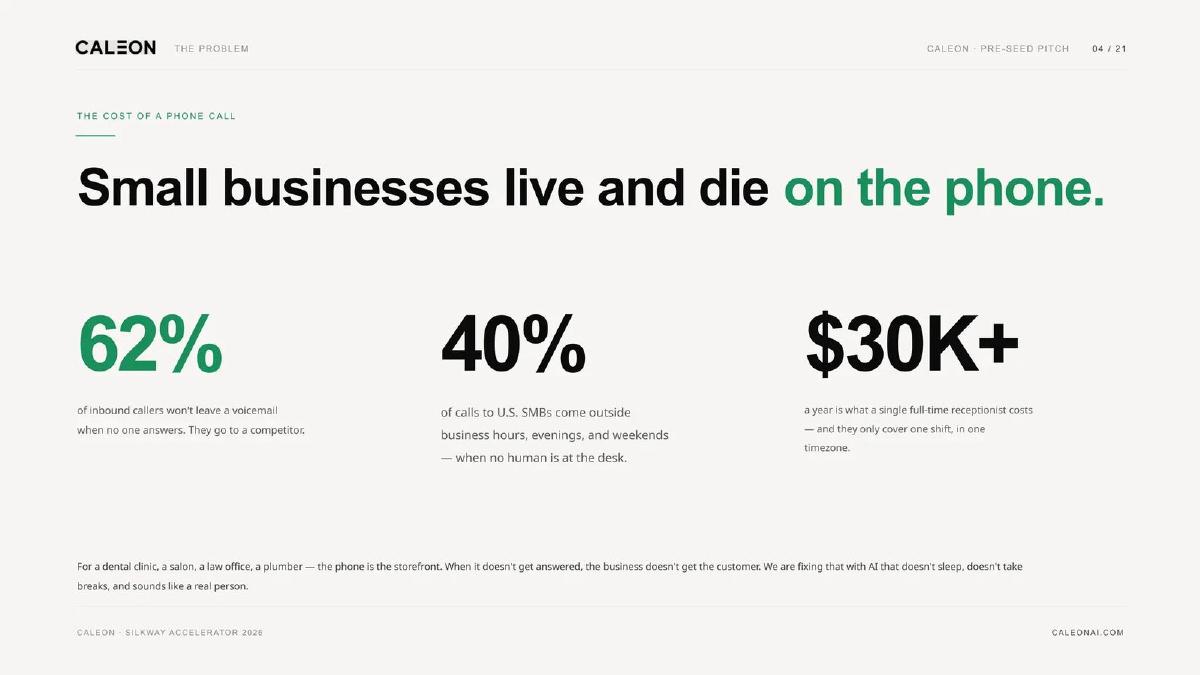
- Caleon identifies that 62% of inbound callers to SMBs will not leave a voicemail, representing a direct loss of revenue to competitors (Slide 4).
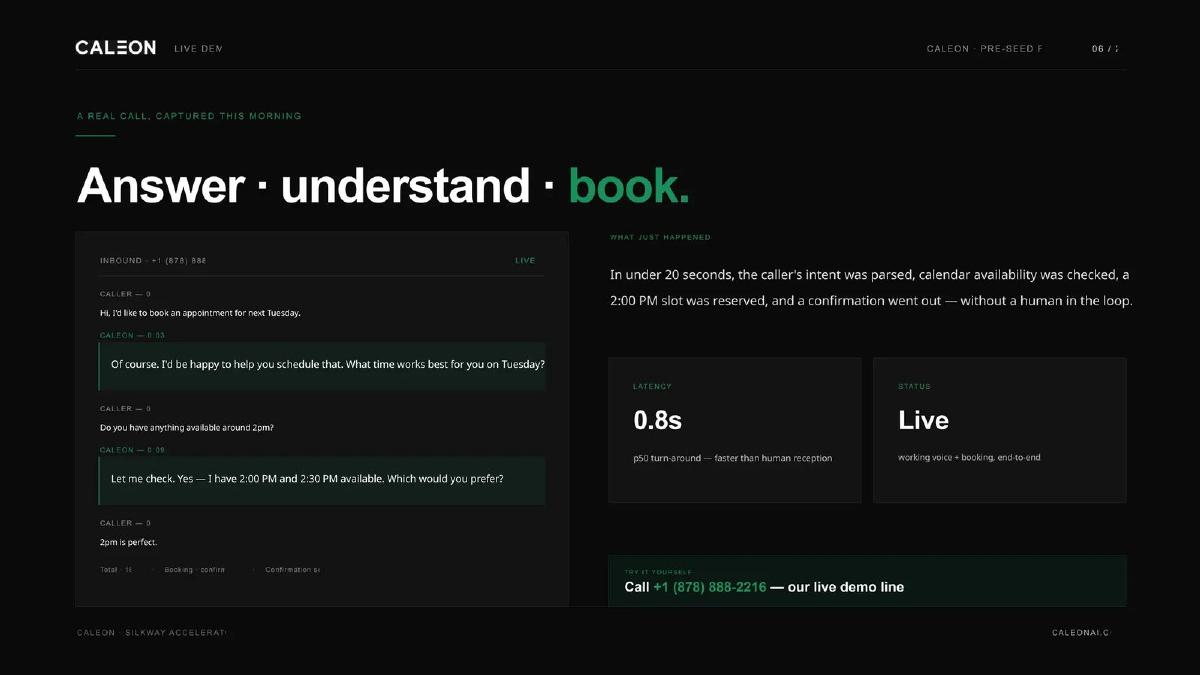
- The product achieves a p50 turn-around latency of 0.8 seconds, which the deck claims is faster than human reception (Slide 6).
- The company differentiates itself from infrastructure providers like Vapi and Retell by offering a 'finished product' for non-technical SMB owners (Slide 14).
- Caleon is targeting a $15B+ U.S. TAM within the appointment-economy receptionist spend (Slide 13).
- The initial pricing wedge is set at $150 per month per location (Slide 13).
- The platform is built to be HIPAA-compliant from day one, including signed BAAs and PHI isolation (Slide 12).
- Traction includes 3 paid design partners and a waitlist of approximately 30 SMBs generated in one week (Slide 17).
- The $750K pre-seed ask is intended to provide 18 months of runway and reach 100 paying locations (Slide 20).
Executive Summary and Thesis
Slides 1-2
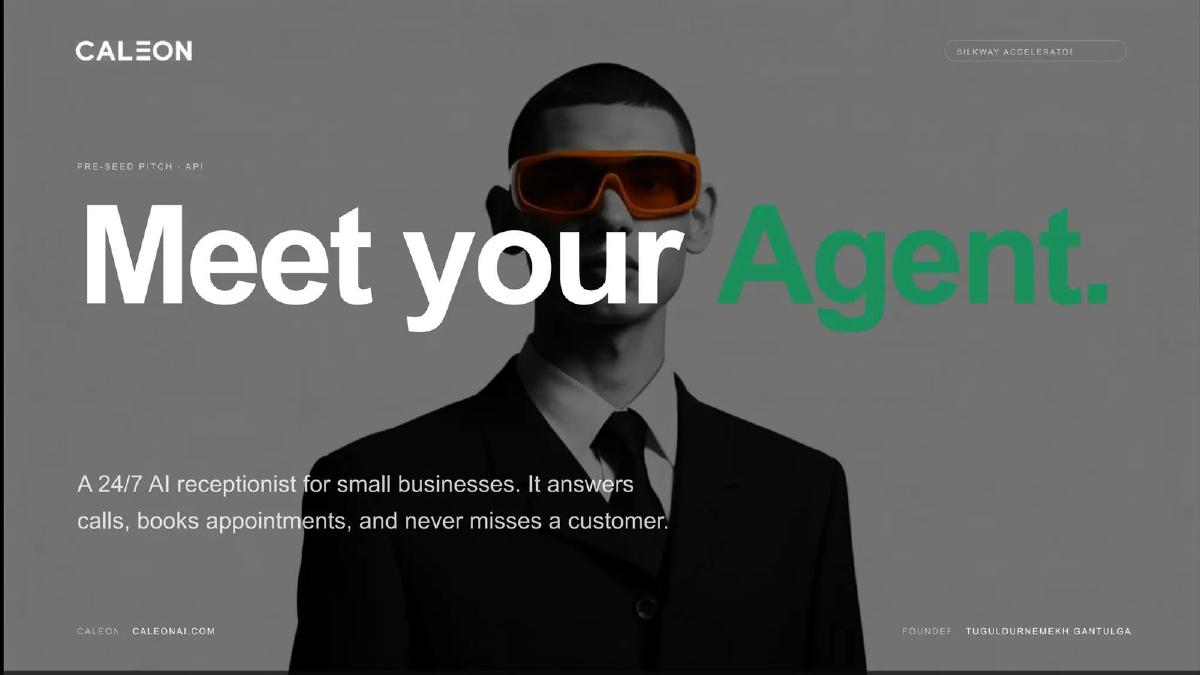
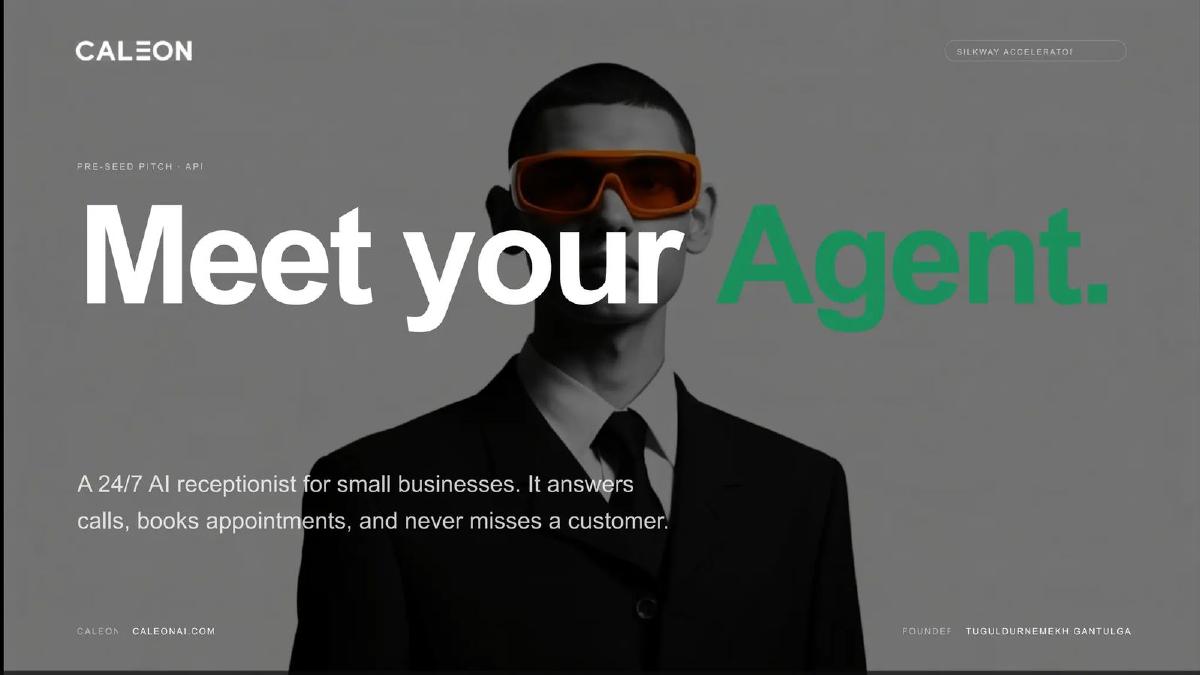
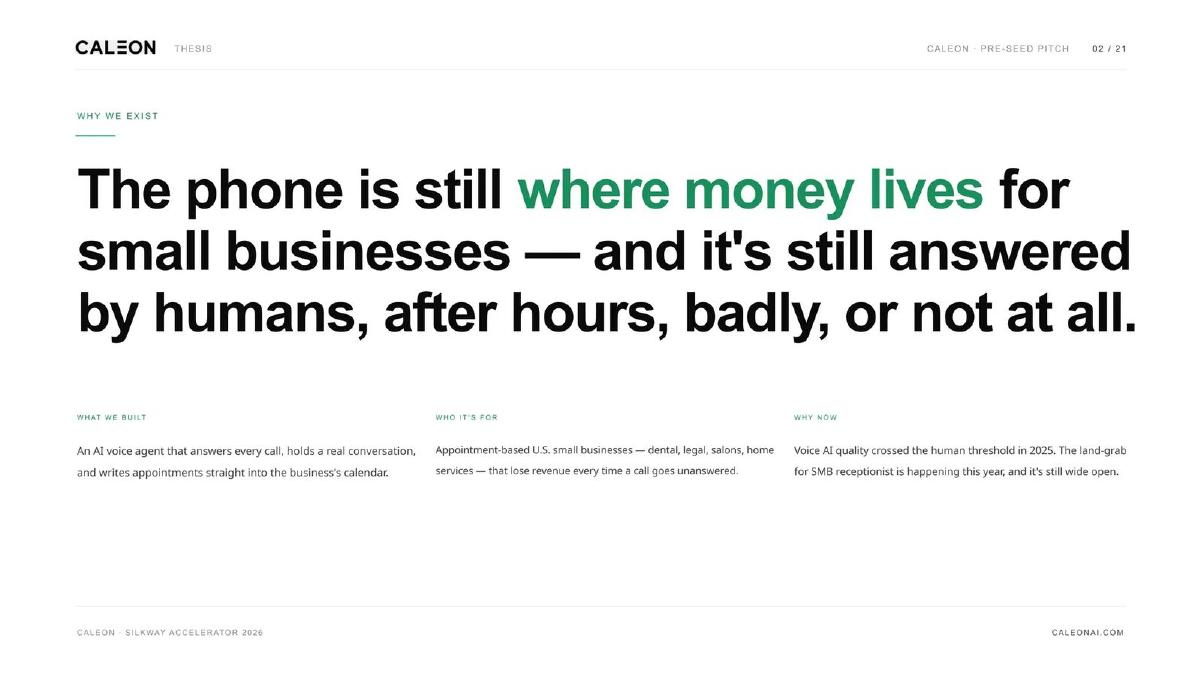
Caleon AI introduces itself as a 24/7 AI receptionist for small businesses. The cover slide establishes a clean, professional aesthetic and introduces the founder, Tuguldurnemekh Gantulga. The 'Thesis' slide (Slide 2) identifies the core problem: the phone is the primary revenue driver for SMBs, yet calls are often handled poorly or missed entirely. The company positions its solution as a voice AI agent that holds real conversations and manages calendar bookings. Crucially, it notes that voice AI quality 'crossed the human threshold in 2025,' suggesting that the technology is finally ready for mass SMB adoption.
The Problem: The Cost of Silence
Slides 3-4
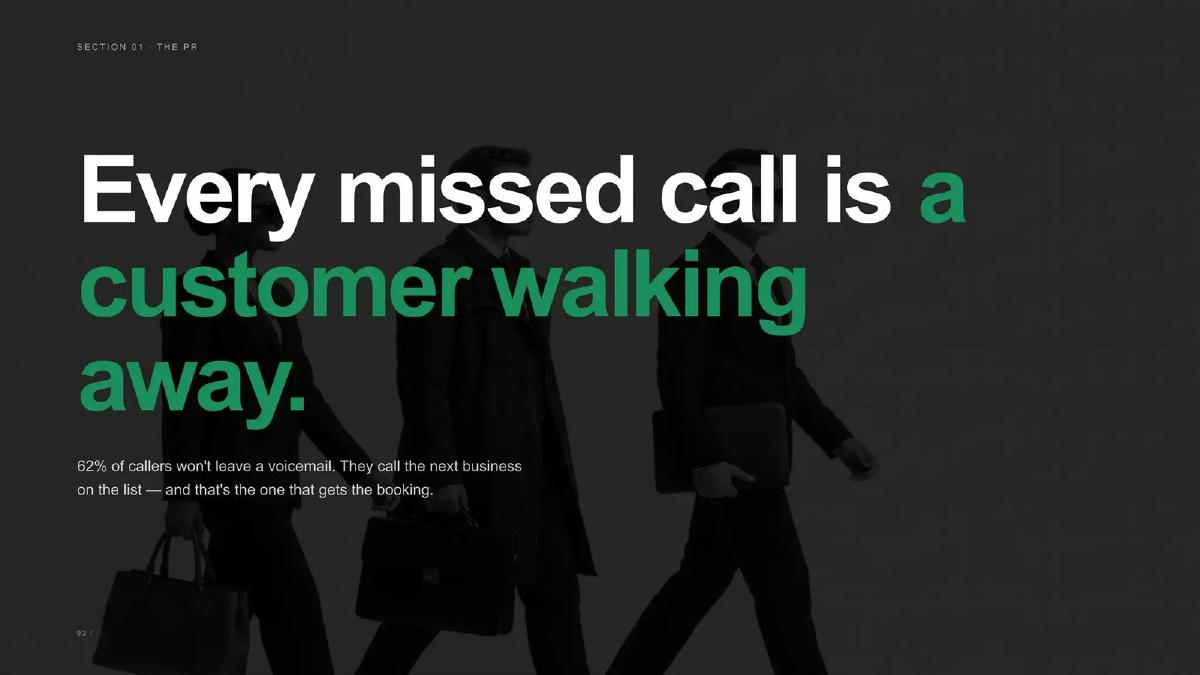
The deck quantifies the pain point for small businesses. Slide 3 states that 62% of callers will not leave a voicemail and will instead call a competitor. Slide 4 expands on this, noting that 40% of calls to U.S. SMBs occur outside of standard business hours. It also highlights the high cost of human labor, citing $30K+ as the annual cost for a single full-time receptionist who can only cover one shift. By framing the phone as the 'storefront,' Caleon emphasizes that an unanswered call is a lost customer.
Product Capabilities and Live Demonstration
Slides 5-7
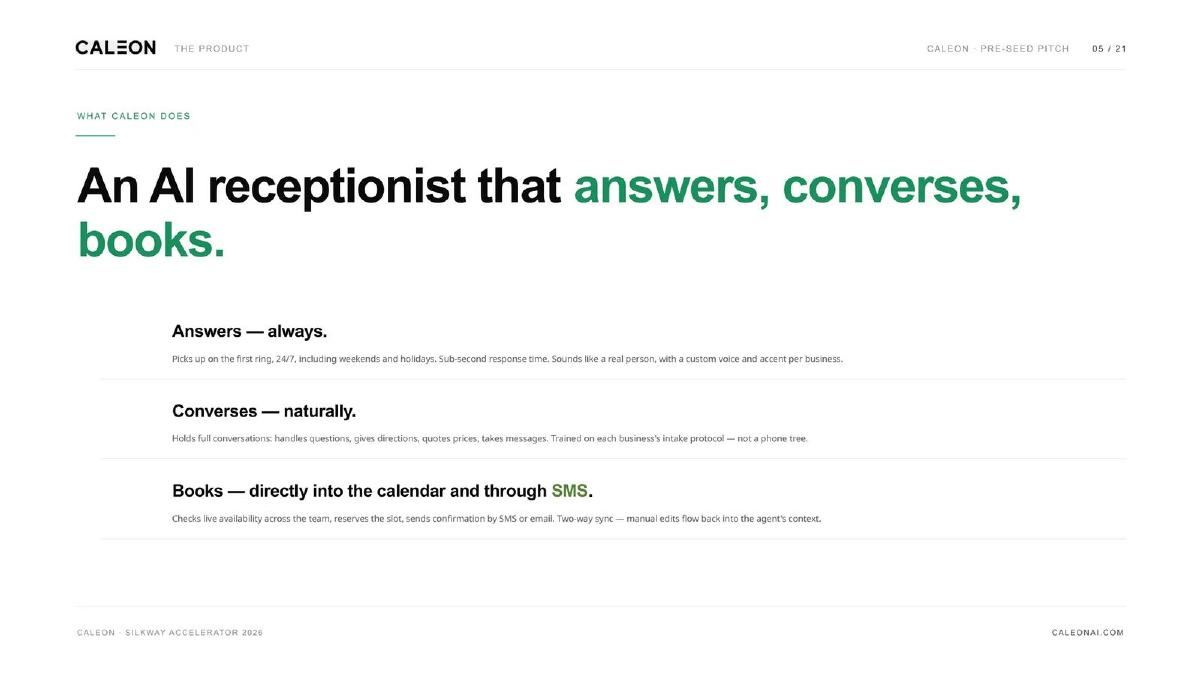
Slide 5 outlines the three core functions: Answers (24/7, sub-second response), Converses (natural dialogue, not a phone tree), and Books (direct calendar and SMS integration). Slide 6 is a 'Live Demo' slide featuring a transcript of a real call. It highlights a p50 turn-around latency of 0.8 seconds, claiming this is faster than human reception. The slide also includes a live demo phone number, encouraging investors to test the product immediately. Slide 7 explains the notification system, where the AI sends SMS alerts to workers for new bookings, hot leads, or high-urgency complaints, ensuring that human staff stay informed without needing to check a dashboard.
Integrations and User Experience
Slides 8-10
Caleon emphasizes that it works 'where the business already lives.' Slide 8 focuses on calendar integration, starting with Google Calendar and planning for Outlook and Apple. It mentions two-way sync, where manual edits to the calendar flow back to the AI's context. Slide 9 shows the 'Operator View,' an illustrative dashboard displaying metrics like calls today, booking rate (31 out of 47 in the example), and first-call resolution (98%). Slide 10 addresses 'Frustrated callers,' claiming the AI uses an empathetic tone to handle complaints and prioritizes them for human follow-up via SMS.
Vertical Strategy and Compliance
Slides 11-12
Slide 11 identifies the target industries: Dental, Legal, Salons, Home Services, Fitness, and Auto Repair. The common thread is that these are businesses where 'missing one call costs hundreds.' Slide 12 is a significant slide for the healthcare vertical, detailing HIPAA compliance. It lists technical safeguards like TLS 1.3 and AES-256 encryption, PHI isolation (data is not used to train models), and a commitment to SOC 2 Type I and Type II audits. This positioning is designed to lower the barrier to entry for medical and dental clinics.
Market Opportunity and Competitive Landscape
Slides 13-14
The market slide (Slide 13) calculates a $15B+ U.S. TAM based on appointment-economy receptionist spend. It narrows this down to a reachable SAM of $5B+ (SMBs already on digital calendars). The company's 'initial wedge' is priced at $150/month per location. Slide 14 provides a competitive matrix against Vapi, Retell AI, and Bland AI. Caleon’s primary differentiation is that it is a 'finished product' for SMB owners, whereas competitors sell developer tools. It highlights native calendar booking and HIPAA compliance as features that competitors leave as a 'customer's burden.'
Onboarding and Execution
Slide 15
To appeal to non-technical owners, Slide 15 details a five-step onboarding process: Create business, Add workers, Connect calendar, Configure AI, and an Onboarding call. The deck claims a business can go from sign-up to a live AI receptionist in approximately 3 days. This reinforces the 'finished product' narrative by showing a clear, low-friction path to implementation.
Traction and Roadmap
Slides 16-18
Slide 17 provides the current state of the business: 'Live product, paying pilots, and NO waitlist.' It cites 3 paid design partners and a waitlist of ~30 SMBs acquired after one week of Reddit and cold outbound efforts. Slide 18 lays out a 12-month plan. The first three months focus on hardening the product and reaching 15 locations. Months 4-6 focus on building a repeatable sales motion (hiring AE-SDR pairs) to reach 50 locations. The final six months aim for 100 locations, $250K+ ARR, and Series A readiness.
Team and The Ask
Slides 19-21
The team slide (Slide 19) features a single founder, Tuguldurnemekh Gantulga, described as a 'technical founder who ships weekly.' The deck notes he is based in the U.S. and building for both U.S. and Central Asia markets. Slide 20 presents the $750K pre-seed ask via a SAFE. The allocation is split between Team (50%), Distribution (30%), and Infra/Compliance (20%). The round is open, with a note that 'Silkway anchor welcome.' The final slide (Slide 21) reiterates the call to action: 'Don't read the deck. Call the agent.'
What Works in the Caleon AI Deck
Specific Problem Quantification: By citing the 62% voicemail rejection rate and the $30K cost of a human receptionist, the deck makes a compelling economic case for the product. It transforms a vague 'efficiency' play into a direct 'revenue recovery' play.
Vertical Focus: The emphasis on HIPAA compliance and native calendar integrations shows a deep understanding of the specific needs of the dental and medical verticals. This is a much stronger strategy than attempting to be a general-purpose AI assistant for everyone.
Low-Friction Demo: Including a live phone number and encouraging investors to 'fake book' an appointment is a high-conviction move. It proves the product works and demonstrates the sub-second latency mentioned in the slides.
Clear Competitive Positioning: The distinction between 'infrastructure' and 'finished product' is a vital one in the current AI landscape. It clearly identifies who the customer is (the business owner, not the developer) and why they would choose Caleon over a cheaper API-based alternative.
What is Missing or Weak
Team Depth: The deck shows a single founder. While he is described as a 'builder & engineer,' investors typically look for a balanced founding team (e.g., a technical lead and a sales/ops lead) at the pre-seed stage, especially when the roadmap calls for building a 'repeatable SMB sales motion.'
Unit Economics: While the pricing is stated ($150/month), there is no mention of the COGS (cost of goods sold) associated with voice AI. Telephony and LLM tokens can be expensive; showing the margin profile would strengthen the case for scalability.
Customer Acquisition Strategy: The roadmap mentions hiring AE-SDR pairs, but the deck lacks detail on how Caleon will compete for the attention of SMB owners, which is notoriously difficult and expensive. A 'Reddit + cold outbound' week is a good start, but a more robust GTM strategy for the $300 CAC target would be beneficial.
Founder Takeaways
Sell the Outcome, Not the Tech: Caleon succeeds by focusing on 'booked appointments' and 'recovered revenue' rather than just 'AI voice tech.' Founders should always lead with the business value. · Build for a Specific User: By explicitly stating that their customer 'has never written a line of code,' Caleon justifies its existence alongside much larger infrastructure companies. · Prove Latency: In voice AI, latency is the primary user experience hurdle. Caleon’s focus on 0.8s response times is a critical technical proof point that should be emulated by others in the space. · Compliance as a Feature: For founders in regulated spaces, treating compliance (like HIPAA) as a core product feature rather than a legal hurdle can be a significant competitive advantage.
Frequently asked questions
- What is Caleon AI's primary value proposition?
- Caleon AI provides a 24/7 AI voice receptionist that answers calls, holds natural conversations, and books appointments directly into a business's calendar. It targets SMBs that lose revenue when calls go unanswered, particularly after hours or during busy periods. The deck emphasizes sub-second latency and the ability to handle frustrated callers with empathy.
- How does Caleon AI differentiate itself from other AI voice companies?
- The deck explicitly compares Caleon to infrastructure players like Vapi, Retell AI, and Bland AI. While those companies sell APIs and SDKs to developers, Caleon sells a 'finished product' to SMB owners who do not write code. Key differentiators include native Google Calendar booking, built-in SMS worker alerts, and out-of-the-box HIPAA compliance for healthcare providers.
- What industries is Caleon AI targeting?
- The company focuses on 'appointment-based U.S. small businesses' where missing a call has a high financial cost. Specific verticals mentioned include Dental & Medical, Law Firms, Salons & Spas, Home Services (plumbers/HVAC), Fitness Studios, and Auto Repair shops. Healthcare is a primary focus due to the platform's HIPAA-compliant architecture.
- What are the company's current traction and future milestones?
- At the time of the deck, Caleon was pre-revenue with three paid design partners and a waitlist of about 30 businesses. The 12-month roadmap involves moving from 3 to 15 paying locations in the first three months, building a repeatable sales motion to reach 50 locations by month six, and achieving 100 paying locations and $250K+ ARR by month twelve.
- What are the details of the fundraising round?
- Caleon is raising a $750,000 pre-seed round via a SAFE. The funds are allocated as follows: 50% ($375K) for hiring a founding engineer and GTM lead, 30% ($225K) for distribution and sales, and 20% ($150K) for voice infrastructure and compliance. The round is intended to provide 18 months of runway with a Series A target in month 12.