FX HedgePool’s Series A deck is a masterclass in institutional positioning, focusing on the 'unbundling of liquidity from credit' within the massive foreign exchange market. By targeting the $66 trillion monthly FX swap volume—a segment they describe as the most neglected in finance—the company demonstrates clear product-market fit with $230 billion in captured volume (0.5% of the market) as stated on slide 4. The deck avoids the typical startup 'problem/solution' tropes in favor of a structural market critique, positioning their P2P matching platform as a necessary evolution for buy-side fir…
Key takeaways
- The company identifies FX Swaps as the largest and most neglected portion of the world's largest financial market (Slide 4).
- FX HedgePool has already captured $230 billion in volume, representing 0.5% of the $66 trillion monthly market (Slide 4).
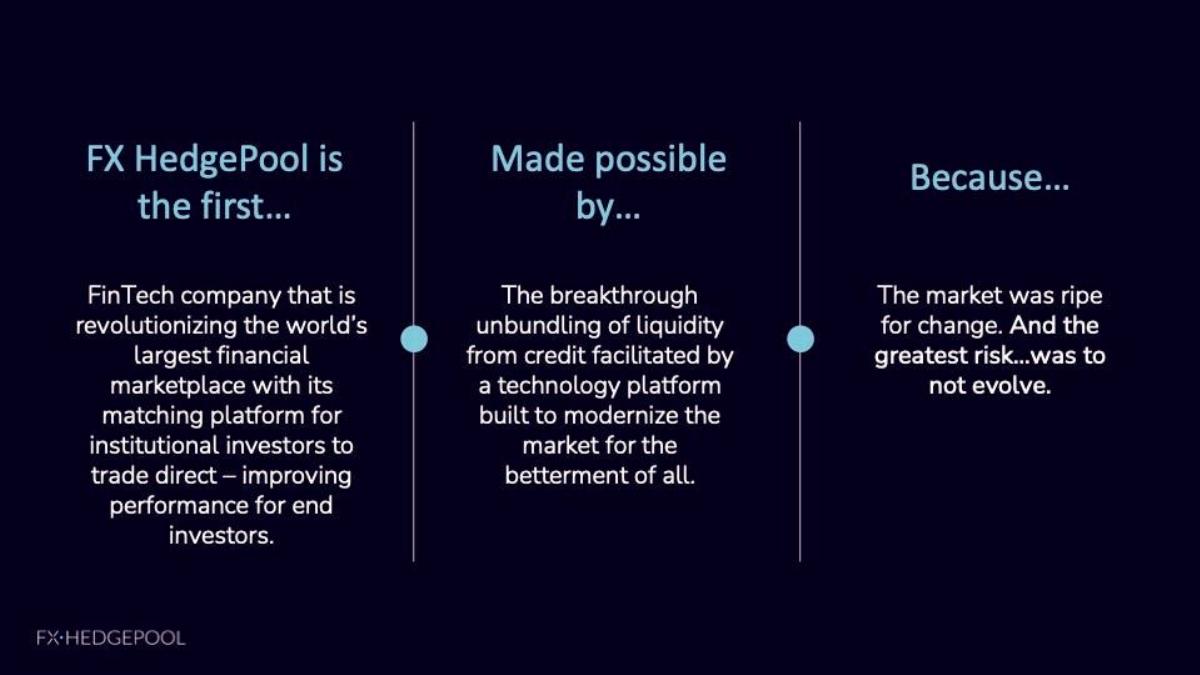
- The core value proposition is the 'unbundling of liquidity from credit' through a technology-driven matching platform (Slide 2).
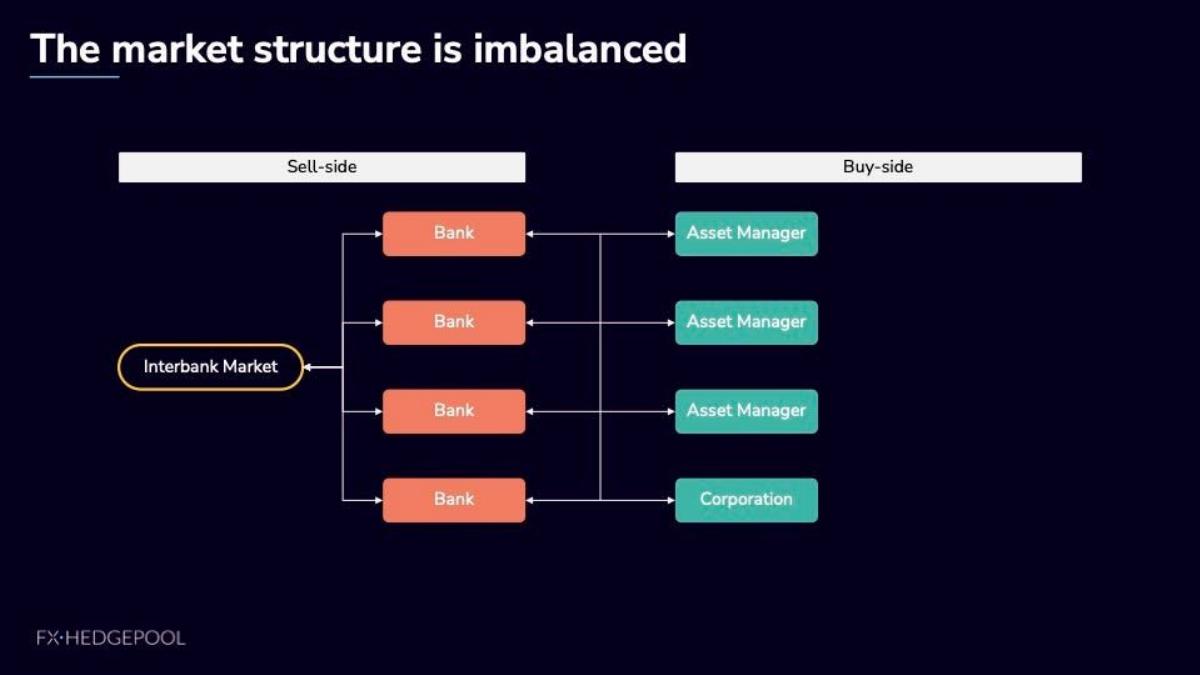
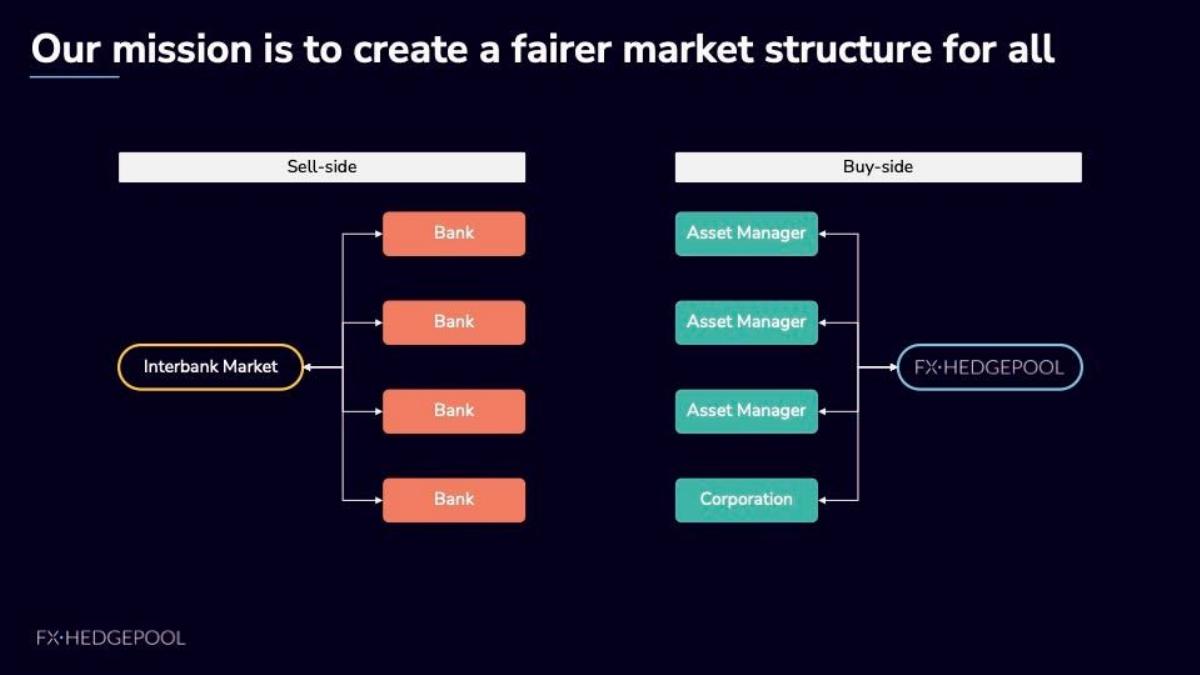
- The platform targets the 'Buy-side' (Asset Managers and Corporations) to facilitate direct trading, bypassing traditional 'Sell-side' bank intermediaries (Slide 3).
- Product offerings include FX Swaps (Monthly Mid-month, Month-end, and Quarterly IMM) and FX Spot (Daily Fixing) (Slide 5).
- The platform integrates with critical institutional infrastructure including OMS, EMS, and TMS (Slide 5).
- Key strategic partners include Amazon Web Services, Standard Chartered Bank, and World Market Research (Slide 5).
- The deck omits a dedicated team slide, detailed financial history, and a specific 'Ask' for the $8M round reported by Business Insider.
The Strategic Pivot to Peer-to-Peer FX
FX HedgePool’s deck is a sophisticated example of fintech positioning. Rather than focusing on minor incremental improvements, the company attacks the fundamental structure of the foreign exchange market. As reported by Business Insider, the company raised $8M in a Series A in 2024. The deck used for this round reflects a company that has already moved past the 'idea' phase and into the 'market penetration' phase, as evidenced by their stated volume figures.
Slide 1: Title and Positioning
The opening slide establishes FX HedgePool as 'The World’s Leading Peer-to-Peer Matching Platform.' The branding is minimalist and dark, signaling a professional, institutional-grade product. There are no distracting graphics, only a subtle light-sweep effect, which keeps the focus entirely on the company name and its category-defining claim.
Slide 2: The Thesis of Change
Slide 2 sets the stage by explaining the 'why' behind the company. It uses a three-pillar structure: 'FX HedgePool is the first...', 'Made possible by...', and 'Because...'. The key takeaway here is the 'breakthrough unbundling of liquidity from credit.' In traditional FX, these two are inextricably linked through banks. By separating them, FX HedgePool claims to modernize the market for the 'betterment of all.' This slide is critical because it justifies the existence of a new platform in a market that is already heavily intermediated.
Slide 3: Market Structure Visualization
This slide provides a clear 'Before and After' or 'Us vs. Them' visual. On the left, the 'Sell-side' consists of banks connected to the Interbank Market. On the right, the 'Buy-side' consists of Asset Managers and Corporations. FX HedgePool is positioned as the central node connecting the Buy-side entities directly to one another. The mission statement, 'Our mission is to create a fairer market structure for all,' is placed at the top, framing the disintermediation of banks as a moral and functional improvement for the industry.
Slide 4: The $66 Trillion Opportunity
Slide 4 is the 'Market Size' slide, but it doubles as a 'Traction' slide. It states that Foreign Exchange is the largest financial market in the world and identifies FX Swaps as the 'largest and most neglected portion.' The visual uses a large circle representing the $66 Trillion monthly volume of FX Swaps. A tiny dot within that circle represents the 0.5% ($230 Billion) already captured by FX HedgePool. This is a clever way to show both significant current traction and a massive remaining upside. It proves the model works at scale while highlighting that they have only scratched the surface.
Slide 5: Platform Highlights and Ecosystem
This slide moves into the technical and operational details. It categorizes the business into four quadrants: Products, Recent Upgrades, Key Partners, and Integration & Workflow Automation. Under 'Products,' it lists FX Swaps (Monthly Mid-month, Month-end, Quarterly IMM) and FX Spot (Daily Fixing). The 'Key Partners' section is particularly strong for a Series A, citing Amazon Web Services, Standard Chartered Bank, and 'Two leading OMSs.' This demonstrates that the platform is not an island; it is integrated into the existing workflows (OMS, EMS, TMS) of its institutional clients.
Slide 6: Conclusion
The final slide is a simple 'Thank You' on the same dark background as the title slide. It lacks a call to action or contact information, which suggests this deck may have been used as a leave-behind or a presentation support rather than a cold-outreach tool.
What Works in the FX HedgePool Deck
Clarity of Vision: The deck does not waste time explaining what a foreign exchange swap is. It assumes the investor understands the market and goes straight to the structural flaw: the bundling of liquidity and credit. This high-level approach is appropriate for a Series A fintech round where the investors are likely specialized in the sector.
Scale vs. Traction: By showing $230 billion in volume as only 0.5% of the market, the founders successfully communicate that they are a 'big' company that is still 'small' relative to the opportunity. This is the ideal narrative for a Series A: 'We have proven it works, now give us capital to take the other 99.5%.'
Ecosystem Integration: Slide 5 is vital. In institutional finance, no one buys a standalone tool. By listing integrations with OMS (Order Management Systems) and TMS (Treasury Management Systems), FX HedgePool proves that they have solved the 'plumbing' problem that kills most fintech startups.
What is Missing from the FX HedgePool Deck
The Team: There is no team slide in the provided 11-slide sequence. For an $8M Series A, the pedigree of the founders is usually a primary selling point, especially in a field as complex as FX swaps which requires deep regulatory and technical expertise. The omission of this slide in a teardown suggests the company is relying entirely on its market position and traction data.
Financials and Unit Economics: The deck mentions 'volume' ($230 Billion) but does not mention 'revenue.' In fintech, volume is a vanity metric if the take-rate is non-existent or if the cost of acquisition is too high. There is no mention of how the company actually makes money—whether through a SaaS fee, a per-trade commission, or a subscription model.
The Ask: While we know from publisher reports that the round was $8M, the deck itself does not state the amount being raised or the intended use of funds. A standard pitch deck should ideally outline whether the capital is for engineering, sales expansion, or regulatory licensing in new jurisdictions.
Founder Lessons
Use 'Market Architecture' to explain your value: If you are building in a crowded space, don't just list features. Show a diagram of how the market looks today and how your platform changes the flow of money or data. Slide 3 of this deck is a perfect example of this.
Contextualize your traction: $230 billion is a huge number, but without the context of the $66 trillion market, an investor might not know if that represents 50% of the market or 0.001%. By providing both numbers, FX HedgePool defines the ceiling of their growth.
Focus on 'Unbundling': Much of the last decade of fintech has been about unbundling bank services. FX HedgePool applies this specifically to 'liquidity and credit.' Founders should look for similar 'bundled' services in their own industries and center their pitch on the efficiency gained by separating them.
Frequently asked questions
- What is the primary problem FX HedgePool is solving?
- According to Slide 2 and 3, the problem is an inefficient market structure where liquidity is bundled with credit, forcing institutional investors to rely on sell-side banks. FX HedgePool solves this by providing a peer-to-peer matching platform that allows buy-side institutions like asset managers and corporations to trade directly with one another, improving performance for end investors.
- How much traction does FX HedgePool show in this deck?
- On Slide 4, the company reports that it has captured $230 billion in volume. While this is only 0.5% of the total $66 trillion monthly FX swap market, it serves as a proof of concept for the viability of peer-to-peer matching in a highly regulated and complex financial sector.
- Who are the target customers for this platform?
- Slide 3 explicitly identifies the 'Buy-side' as the target audience, specifically naming Asset Managers and Corporations. The platform aims to connect these entities directly to create a 'fairer market structure' compared to the traditional interbank-led model.
- What technical integrations does the platform support?
- Slide 5 lists 'Integration & Workflow Automation' as a platform highlight. It supports Order Management Systems (OMS), Execution Management Systems (EMS), and Treasury Management Systems (TMS). It also mentions existing integrations with 'Two leading OMSs' and infrastructure support from Amazon Web Services.
- What is missing from this pitch deck?
- The deck is notably missing a team slide, which is unusual for a Series A. It also lacks a detailed breakdown of unit economics, a competitive landscape analysis, and a specific slide detailing the use of funds for the $8M raised. It functions more as a high-level strategic overview than a granular operational plan.