Gaia Design’s 2015 deck is a textbook example of a Direct-to-Consumer (D2C) pitch tailored for an emerging market. By contrasting their lean, online-first model against the high overhead of traditional physical retailers, they presented a clear path to price disruption. The deck emphasizes a 'build-to-order' production model on slide 16 to mitigate inventory risk and highlights a team with specific experience in Latin American e-commerce and Google marketing on slide 8. While the deck is heavy on brand philosophy and operational flow, it notably lacks hard financial projections, market sizing…
Key takeaways
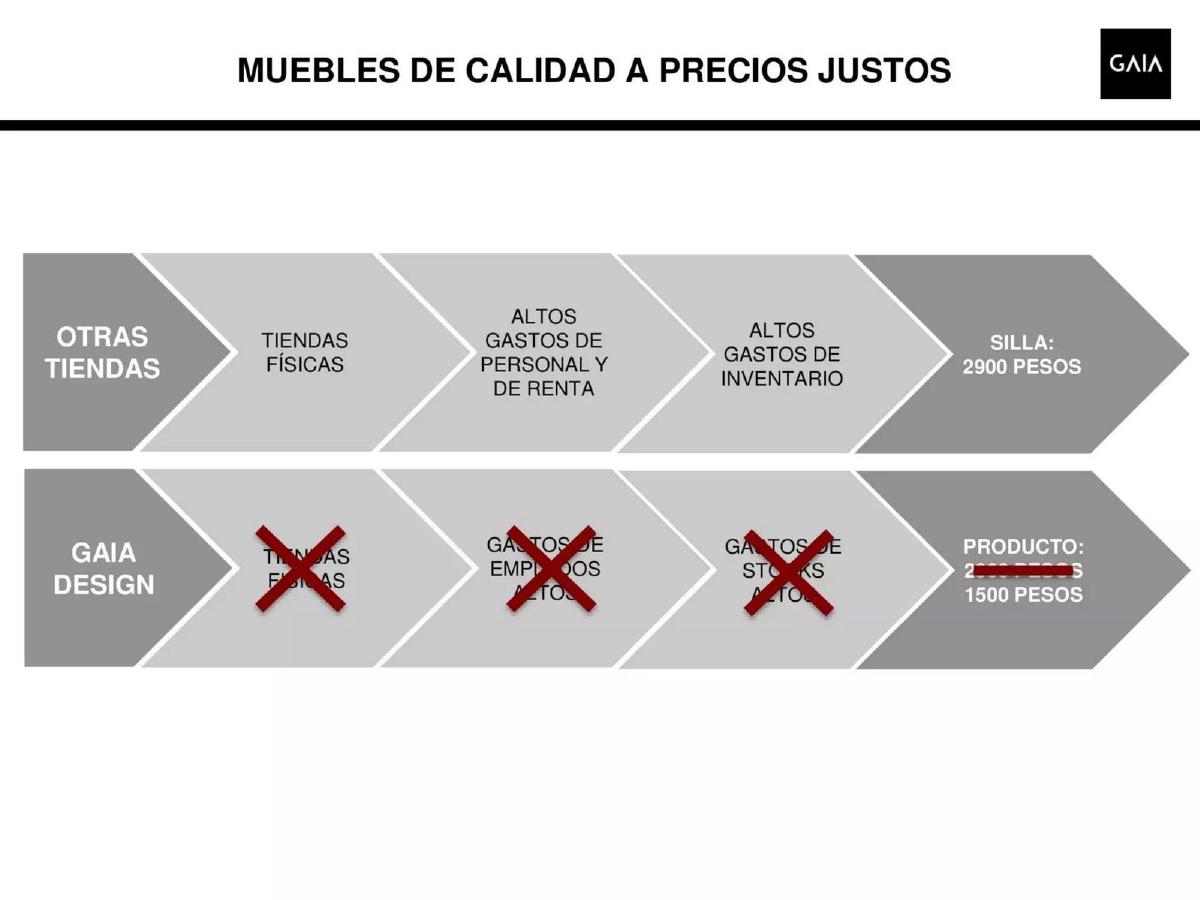
- The deck uses a comparative cost analysis on slide 6 to show how eliminating physical stores and inventory reduces a 2,900 peso chair to 1,500 pesos.
- Operational efficiency is centered on a 'build-to-order' model (slide 16) to avoid overproduction and accurately measure demand.
- The team slide (slide 8) highlights three founders with specific backgrounds in furniture sales in Latin America and online marketing at Google.
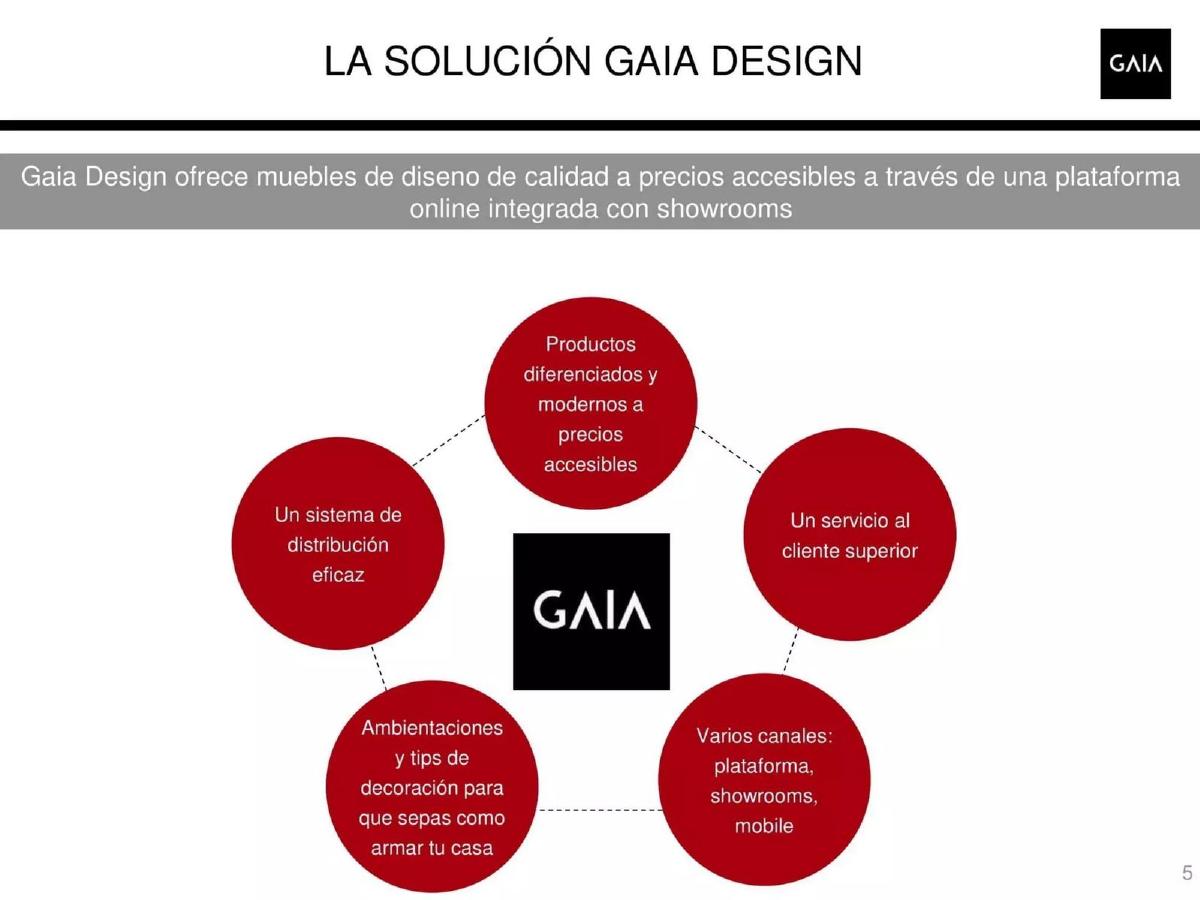
- Gaia positions itself as an omnichannel player, mentioning a platform, showrooms, and mobile presence on slide 5.
- Customer incentive is explicitly stated on slide 20: free shipping for orders exceeding 5,000 pesos, including coverage for damages.
- The deck emphasizes local sourcing, stating they work with the best Mexican artisans and designers to meet quality standards on slide 14.
- There is a complete absence of a competition slide, financial roadmap, or specific investment 'Ask' within these 22 slides.
- The visual identity is consistent, using a high-contrast red, black, and white palette that mirrors their e-commerce branding.
The D2C Furniture Playbook in Emerging Markets
Gaia Design’s pitch deck, dated May 2015, serves as a strategic overview of how to transplant the Direct-to-Consumer (D2C) furniture model—popularized by companies like Made.com or Casper—into the Mexican market. The deck focuses heavily on the 'Why' and the 'How' of their operations, rather than the 'How Much.' It is a narrative-driven presentation that prioritizes brand identity and supply chain innovation over spreadsheets and market data.
Slides 1-4: Brand Identity and Mission
The deck opens with a minimalist cover slide (Slide 1) establishing the location and date: Ciudad de México, Mayo 2015. This is immediately followed by a brand mantra on Slide 2: "Una historia en cada pieza" (A story in every piece). This emotional hook is reinforced on Slide 3 with a lifestyle image and a quote suggesting that the furniture surrounding us tells more stories than we realize.
Slide 4 provides the first concrete definition of the business. It defines GAIA as an online store for furniture and design accessories for the home, explicitly stating their goal to "revolutionize the furniture shopping experience in Mexico." By leading with a mission rather than a product list, Gaia attempts to frame themselves as a category disruptor rather than just another retailer.
Slides 5-7: The Solution and Price Disruption
Slide 5 introduces 'La Solución Gaia Design.' It uses a hub-and-spoke diagram to highlight five pillars: differentiated products at accessible prices, superior customer service, multiple channels (platform, showrooms, mobile), decoration tips/sets, and an efficient distribution system. This slide is crucial because it acknowledges that in the Mexican market, a pure online play might not be enough, hence the inclusion of showrooms.
Slide 6 is arguably the most important 'investor' slide in the deck. It presents a side-by-side comparison of 'Other Stores' versus 'Gaia Design.' It uses red 'X' marks to show that Gaia eliminates physical stores, high rent/personnel costs, and high inventory costs. The result is a price comparison for a chair: 2,900 pesos at traditional retail versus 1,500 pesos at Gaia. This 48% price reduction is the core economic engine of the pitch.
Slide 7 reinforces the 'Attractive Model' by mentioning modern design lines (like 'moderno mexicano') and a logistics system that allows for shorter delivery times.
Slides 8: The Team
Slide 8 introduces the team. While it lacks individual names or headshots of the founders (opting for a group photo on a staircase), it lists their credentials. It highlights three founders with experience in furniture e-commerce in Latin America and online marketing at Google. It also mentions a team of designers working directly with factories and a dedicated customer service team. For a Series-stage deck, this slide is somewhat light on specific pedigree but focuses on the relevant intersection of 'Local E-commerce' and 'Digital Marketing.'
Slides 9-20: Operational Walkthrough (The Six Steps)
A significant portion of the deck (Slides 9 through 20) is dedicated to explaining '¿Cuál es el funcionamiento de Gaia?' (How does Gaia work?). This is broken down into six distinct steps, with each step getting a dedicated 'build' slide that adds to a cumulative grid.
Step 1 (Slide 9-10): Searching for global design trends, innovations, and the best production methods. · Step 2 (Slide 11-12): Proposing innovative and exclusive projects by Gaia’s in-house design and interior team. · Step 3 (Slide 13-14): Working with the best Mexican providers (artisans and designers) to meet demanding quality standards. · Step 4 (Slide 15-16): Implementing a build-to-order model to avoid overproduction and measure demand. This is a key operational differentiator that protects margins. · Step 5 (Slide 17-18): Scheduling deliveries with each client and informing them of every step in the logistics process. · Step 6 (Slide 19-20): Offering free shipping for orders over 5,000 pesos , including coverage for damages.
This granular look at the operations is designed to de-risk the investment by showing that the founders understand the complexities of manufacturing and last-mile delivery in Mexico, which are often the primary failure points for e-commerce in the region.
Slides 21-22: Visual Proof and Closing
Slide 21 is a full-bleed lifestyle image titled "Mostrar la diversidad de los talentos mexicanos" (Showcasing the diversity of Mexican talents). It features a sofa, coffee table, and side tables in a styled room, proving the aesthetic quality of their catalog. Slide 22 closes the deck by repeating the logo and the brand tagline.
What Works in This Deck
The Price Comparison: Slide 6 is a masterclass in simplicity. By showing exactly which costs are being cut to achieve a specific price point (1,500 pesos vs 2,900 pesos), the founders make the business case intuitive. Investors don't need to be furniture experts to understand the power of a 50% discount driven by structural efficiency.
Operational Transparency: The six-step walkthrough (Slides 9-20) addresses the 'Operations' question head-on. In emerging markets, the biggest concern for investors is often execution—specifically supply chain and logistics. By detailing the build-to-order model and the communication flow with customers, Gaia demonstrates a sophisticated approach to these challenges.
Local Sourcing Narrative: By emphasizing Mexican artisans and designers (Slide 14 and 21), Gaia avoids looking like a simple importer of cheap goods. This adds a layer of 'defensibility' and brand soul that is harder for a global giant like IKEA or Amazon to replicate instantly in a local context.
What is Missing
The 'Ask': There is no slide indicating how much money Gaia is looking to raise or what the milestones for that capital will be. While this information is often handled in a separate document or verbal conversation, its absence in the deck makes the presentation feel more like a brand overview than a fundraising tool.
Traction and Metrics: For a company that eventually raised over $80 million, this 2015 deck is surprisingly devoid of data. There are no charts showing month-over-month growth, Customer Acquisition Cost (CAC), Lifetime Value (LTV), or even current revenue. In 2015, Gaia was likely early, but some indication of product-market fit would have strengthened the case.
Market Size (TAM): The deck assumes the investor already knows the Mexican furniture market is large. It fails to quantify the Total Addressable Market or the specific segment of the 'middle class' they are targeting. Without these numbers, it's hard to judge the scale of the opportunity.
Competitive Landscape: There is no mention of competitors. Whether it's traditional retailers like Liverpool or Palacio de Hierro, or other emerging e-commerce players, the deck operates in a vacuum. A 'Competitor Matrix' would have helped define Gaia’s unique positioning more clearly.
What a Founder Should Copy
The 'Build-to-Order' Justification: If you are in a hardware or physical goods space, copy the way Gaia explains their inventory management. Slide 16 uses the build-to-order model not just as a fact, but as a benefit: it avoids overproduction and allows for demand measurement. Framing a lean supply chain as a strategic advantage rather than a resource constraint is a powerful move.
Visual Consistency: The deck is beautiful. It uses high-quality photography and a consistent color palette that makes the brand feel premium despite the 'affordable' price point. Founders should emulate this: if you are selling 'design,' your deck must be well-designed.
The Cumulative Grid: The way slides 9-20 build upon each other to create a final 6-box grid is an effective way to walk an audience through a complex process without overwhelming them. It keeps the viewer oriented on where they are in the story.
Final Thoughts
Gaia Design’s deck is a 'Vision and Operations' deck. It succeeds in making the business model feel inevitable and the brand feel desirable. While it lacks the rigorous financial data typically expected in a Series-stage pitch, the clarity of their cost-cutting logic (Slide 6) and their commitment to a modern supply chain (Slide 16) clearly provided enough confidence for investors to back them to the tune of $82.9 million. It is a reminder that in the early stages, a clear 'Unit Economic' story can sometimes be more persuasive than a complex financial forecast.
Frequently asked questions
- What is the core value proposition of Gaia Design?
- Gaia Design positions itself as a revolutionary e-commerce platform for furniture in Mexico. As shown on slide 6, their primary value prop is price disruption. By removing the 'High Expenses' of physical stores, rent, and inventory, they claim to offer design-quality products at significantly lower prices—specifically illustrating a price drop from 2,900 pesos to 1,500 pesos for a single chair.
- How does Gaia Design manage its supply chain and inventory?
- According to slide 16, Gaia employs a 'build-to-order' model. This strategy is designed to prevent overproduction and allow the company to measure demand accurately before committing to manufacturing. This is paired with local sourcing from Mexican artisans (slide 14) and a logistics process where customers are informed at every step (slide 18).
- Who are the founders and what is their background?
- Slide 8 notes that there are three founders. Their collective experience includes online furniture sales specifically within Latin America and online marketing experience at Google. The deck suggests this combination of regional e-commerce knowledge and digital acquisition expertise is what allowed them to develop a solution tailored for the Mexican market.
- Is this a pure-play e-commerce deck?
- Not entirely. While the primary focus is the online store (www.gaiadesign.com.mx), slide 5 explicitly mentions 'Showrooms' as one of their channels. This indicates an omnichannel approach where physical spaces serve as touchpoints for a brand that otherwise operates with the lean overhead of a digital-first company.
- What critical information is missing from this pitch deck?
- The deck is missing several standard venture components: there is no market size analysis (TAM), no competitive landscape, no historical growth metrics (traction), and no financial projections. Most importantly, there is no 'Ask' slide detailing how much capital they are raising or how they intend to deploy it.