Gamestate is a blockchain-based gaming platform aiming to create a universal, immutable profile for player achievements across various titles and chains. The deck highlights four primary value streams: user-generated content monetization, unified achievement profiles (GXP), an NFT marketplace, and a distribution platform for non-NFT products. The business model relies heavily on its tokenomics, featuring a 10 billion total supply of STATE tokens, with 33% allocated for onboarding incentives like staking and DeFi farm rewards. While the deck provides a clear vision for its 'Cyber Nexus' social…
Key takeaways
- The core solution is an immutable, unified collation of rewardable player game achievements (Slide 2).
- Gamestate identifies four distinct user value streams, including NFT bragging rights and an e-commerce platform for hardware and mods (Slide 4).
- The tokenomics model features a 1B STATE initial launch supply and 9B STATE for subsequent multi-chain launches (Slide 5).
- A significant 33% of tokens are reserved for onboarding incentives, including GXP staking and LP providers (Slide 5).
- The market adoption strategy centers on the 'Cyber Nexus,' a social gateway between metaverse worlds using the InterWorlds API (Slide 6).
- The partnership strategy targets a wide range of stakeholders, from esports teams and hardware merchants to advertisers (Slide 6).
- The core team includes Cong Nguyen and Tung Duong Thanh, both associated with Blockchain Developer Asia and the DeFi For You platform (Slide 7).
- Advisors Brenn Hill and Khanh Nguyen bring experience in media technology and cross-chain engineering from Notional (Slide 8).
Slide-by-Slide Analysis
Slide 1: Title Slide
The deck opens with a high-contrast, neon-themed title slide featuring the Gamestate logo. The visual aesthetic is heavily influenced by 'cyberpunk' and 'metaverse' tropes, utilizing glowing blue and pink hues. A small 'Private and confidential' footer is present, but there is no specific date or versioning on the cover page.
Slide 2: The Solution
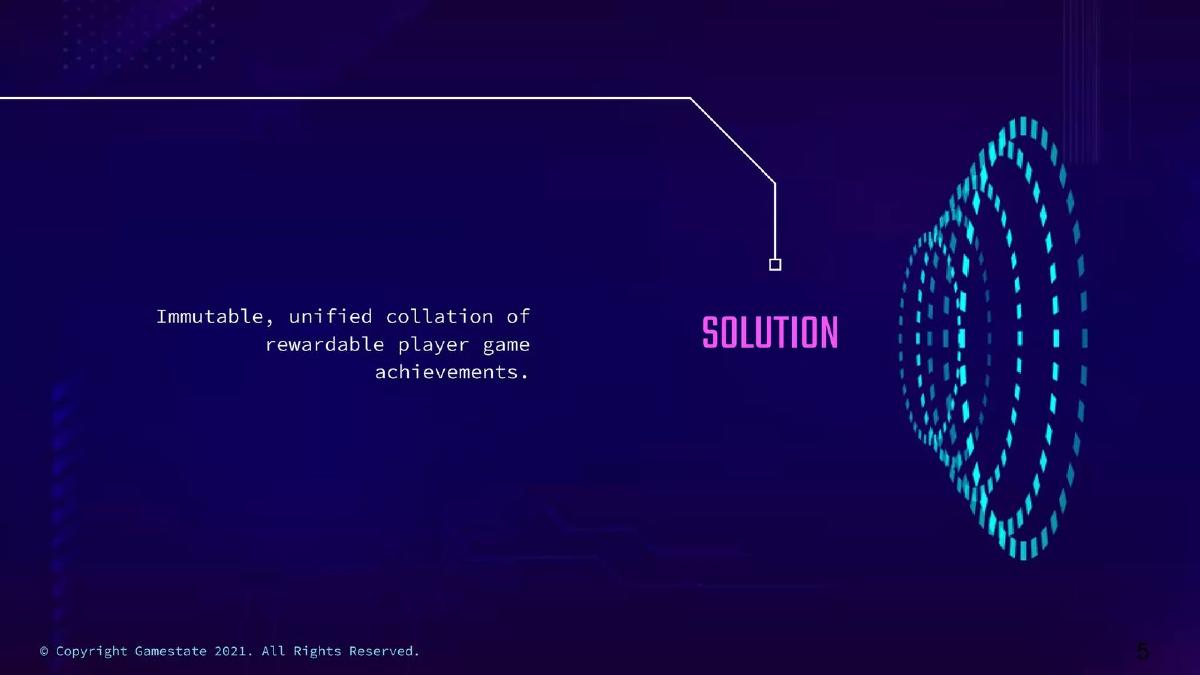
This slide defines the company's core value proposition in a single sentence: "Immutable, unified collation of rewardable player game achievements." The use of the word 'immutable' signals a blockchain-first approach. The graphic on the right, a series of concentric digital rings, reinforces the theme of data connectivity and synchronization across a central hub.
Slide 3: WAGMI Stadium + Ignition Launchpad
Slide 3 introduces the visual concept of the WAGMI Stadium and Ignition Launchpad . It features a 3D render of a rocket ship situated in a futuristic stadium environment. This suggests that Gamestate is not just a backend protocol but also a destination for events and new project launches (Initial Game Offerings or IGOs). The branding 'WAGMI' (We're All Gonna Make It) targets the specific cultural vernacular of the 2021-era crypto community.
Slide 4: User Value Streams
This slide breaks down how users interact with and profit from the platform. It lists four streams: 01 User-generated content monetisation (news, art, skins); 02 Unified game achievements profile (collating GXP and NFT badges); 03 NFT marketplace (creation and royalties); and 04 E-Commerce Discovery & Distribution Platform . Notably, item 04 mentions 'Non-NFT products' like hardware and game titles, suggesting an ambition to bridge the gap between Web3 and traditional gaming retail.
Slide 5: Tokenomics
The tokenomics slide provides the hard numbers for the STATE token. It declares a 1B STATE Initial Launch Supply and a massive 9B STATE reserve for 'subsequent progressive multi-chain launches.' A circular chart highlights that 33% of the supply is allocated to 'STATE Onboarding Incentives,' which includes GXP Staking and DeFi farm incentives. The slide also mentions an NFT Presale for avatars and 'Quantum Accelerator boosters,' indicating a multi-asset economy.
Slide 6: Market Adoption
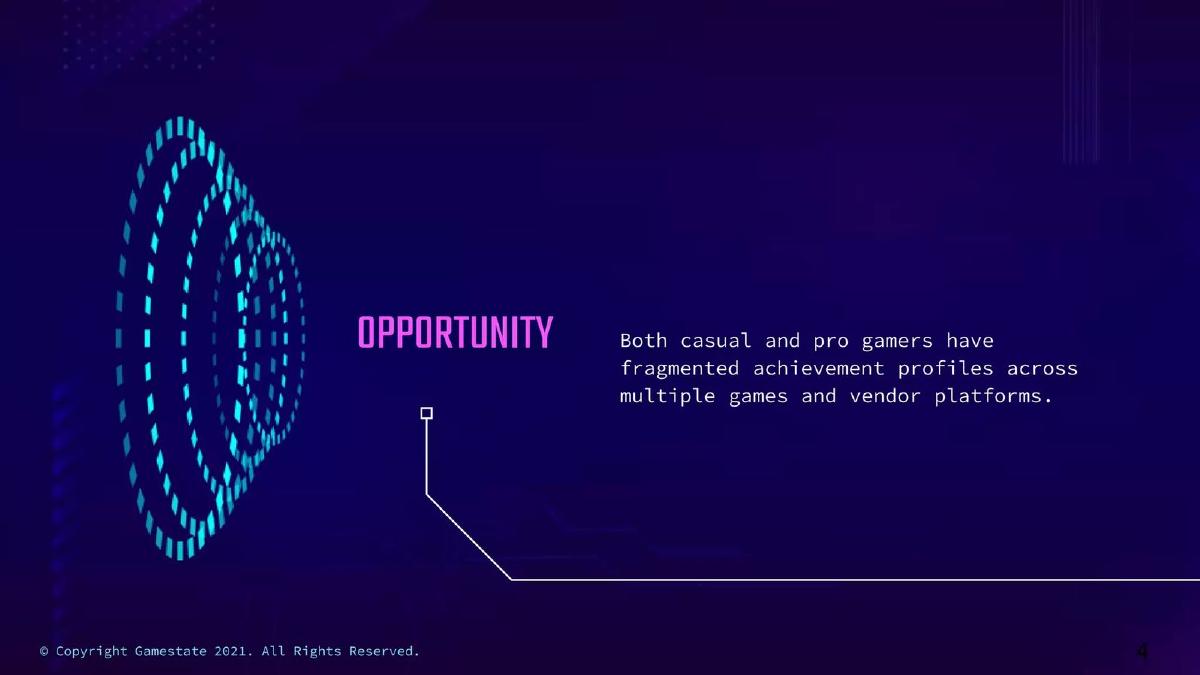
This slide outlines the go-to-market strategy divided into three pillars: User Acquisition , Cyber Nexus , and Partnerships . The 'Cyber Nexus' is described as a social gateway between metaverse worlds using the InterWorlds API . The partnership list is broad, encompassing artists, pro gamers, hardware merchants, and advertisers. This indicates a platform-play strategy where Gamestate acts as the connective tissue for the broader gaming industry.
Slide 7: Core Team
The core team is led by Cong Nguyen (CEO) and Tung Duong Thanh (Dev Lead) . Both are credited as being part of 'Blockchain Developer Asia.' The bios highlight their work on the DeFi For You platform and various projects for the Vietnamese government and banks. This establishes a foundation of technical execution capability in the Southeast Asian blockchain corridor.
Slide 8: Extended Team/Advisors
The final slide shown features advisors Brenn Hill and Khanh Nguyen , both associated with Notional . Hill is described as an engineering leader since 2009 with a focus on media and sports technology, while Khanh Nguyen is noted for expertise in cross-chain technology . Their inclusion reinforces the technical focus of the deck, particularly regarding the interoperability mentioned in the 'Cyber Nexus' section.
What Gamestate Does Well
The deck excels at establishing a cohesive visual identity . The neon-on-dark-purple aesthetic is consistent throughout, which helps in selling the 'metaverse' vision to investors who are looking for a specific brand feel. The User Value Streams (Slide 4) are clearly categorized, making it easy to understand how the platform intends to generate activity and value for its participants.
Furthermore, the Tokenomics (Slide 5) are presented with clear, high-level figures. By separating the initial launch supply from the multi-chain reserve, the founders show they have thought about long-term scalability and the inflationary pressures of a large token supply. The inclusion of GXP as a non-tradable ranking token is a smart move to prevent the 'pay-to-win' perception that plagues many blockchain games.
What Is Missing from the Deck
The most glaring omission in these slides is a specific funding ask . There is no mention of how much capital is being raised, the valuation, or the intended use of proceeds. While this information may be in the 23 slides not provided in this sample, its absence in the core strategy slides is notable.
Additionally, there are no financial projections or unit economics . We see how tokens are distributed, but not how the company (the entity behind the protocol) sustains itself beyond token sales. The deck also lacks a competitor analysis . In 2021, the 'metaverse achievement' space was crowded with projects like Enjin, Gala Games, and various guild platforms; failing to differentiate from these incumbents is a missed opportunity.
Finally, there is no roadmap . Investors need to see a timeline for the 'progressive multi-chain launches' and the development of the 'Cyber Nexus' API to judge the feasibility of the project.
Founder Takeaways: What to Copy
Clear Value Categorization: Use a slide like Slide 4 to group your product's benefits into logical 'streams.' This helps investors visualize the different facets of your business model simultaneously. · Technical Credibility: If your team has built government-grade or bank-grade software, highlight it as Gamestate does on Slide 7. In the volatile world of Web3, 'boring' institutional experience is a significant trust signal. · Dual-Token Logic: Separating 'reputation' (GXP) from 'currency' (STATE) is a best practice in gaming. Copy this structure if you are building a platform where skill needs to be recognized independently of financial stake. · Visual World-Building: The use of 3D renders (Slide 3) helps ground abstract concepts like 'launchpads' and 'metaverses' into something tangible that an investor can visualize.
Frequently asked questions
- What is the primary problem Gamestate is trying to solve?
- Gamestate addresses the fragmentation of gaming achievements. Currently, player progress and accolades are locked within individual games or platforms. Gamestate proposes an 'immutable, unified collation' (Slide 2) that allows players to carry their reputation and 'digital NFT bragging rights' (Slide 4) across different metaverse worlds and blockchains.
- How does the STATE token function within the ecosystem?
- The STATE token serves as the primary utility and incentive layer. According to Slide 5, 33% of the supply is dedicated to onboarding incentives such as staking and DeFi farm rewards. It is designed for multi-chain deployment, with 9 billion tokens reserved for progressive launches beyond the initial 1 billion token genesis.
- What is the difference between STATE and GXP in this deck?
- STATE is the tradable currency/token, while GXP appears to be a governance and ranking token. Slide 5 notes that GXP tokens are acquired by interacting with game partners and earning immutable achievements. This creates a two-tier system where GXP represents skill and reputation, while STATE facilitates the economy.
- What are the 'Cyber Nexus' and 'WAGMI Stadium'?
- These are the platform's physical-virtual infrastructure components. The Cyber Nexus (Slide 6) acts as a social gateway and event hub connecting different metaverses via the InterWorlds API. The WAGMI Stadium (Slide 3) is a visual representation of this hub, intended to host events and serve as a central marketplace.
- Who are the key people behind Gamestate?
- The project is led by CEO Cong Nguyen and Dev Lead Tung Duong Thanh, both from Blockchain Developer Asia. They have prior experience developing the DeFi For You platform and working on blockchain projects for the Vietnamese government. They are supported by advisors from Notional with expertise in media and cross-chain tech (Slides 7-8).