Geekatoo’s 16-slide deck is a masterclass in the 'less is more' philosophy of early-stage fundraising. The company positions itself as a direct competitor to Best Buy’s Geek Squad, highlighting a significant price delta where incumbents charge $299.99 for in-home service (Slide 2). The deck leans heavily on supply-side traction, showcasing a map of 3,000 providers nationwide (Slide 5) and a lean business model with a 35% commission (Slide 10). While the deck lacks traditional financial projections or a detailed competitive landscape, it compensates with strong unit economics, reporting a $20…
Key takeaways
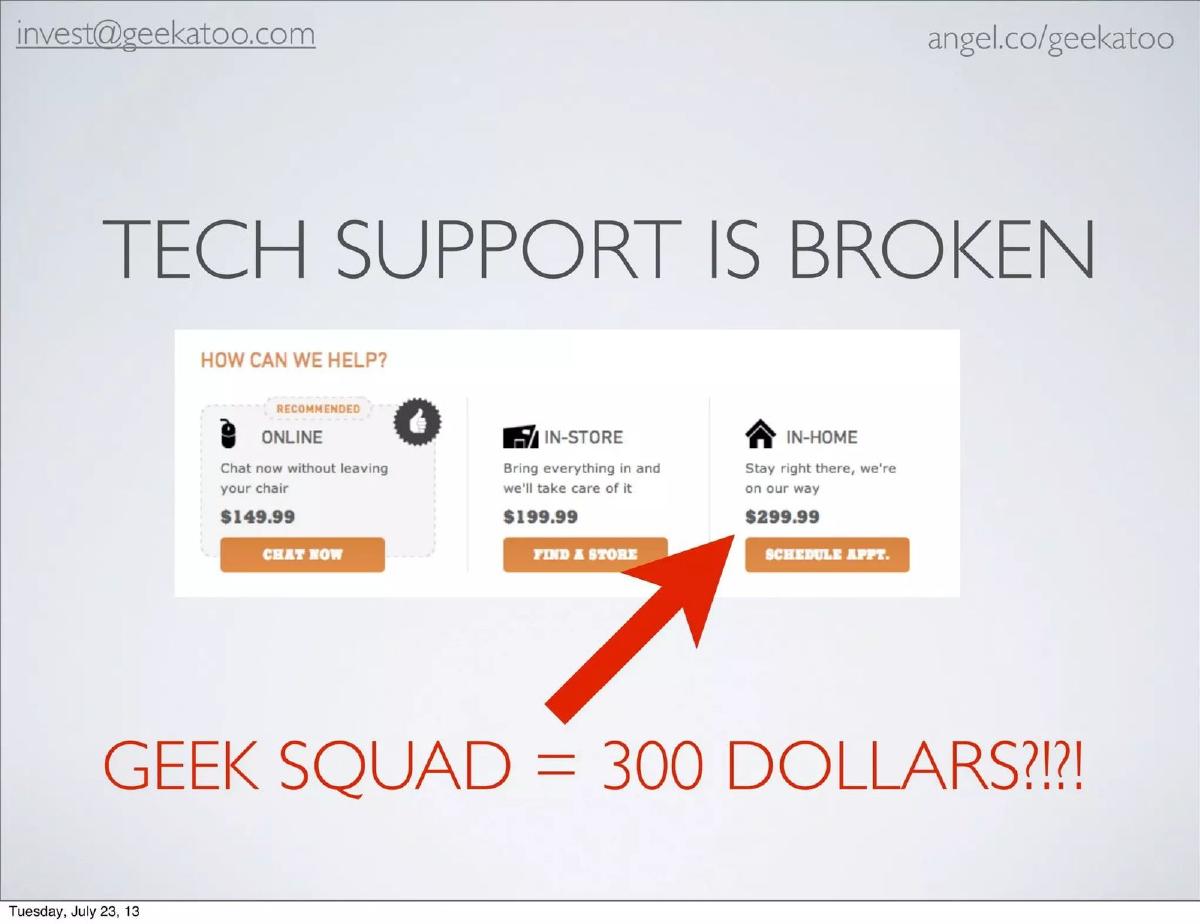
- The deck uses a direct comparison to Geek Squad's $299.99 pricing to establish an immediate value proposition on slide 2.
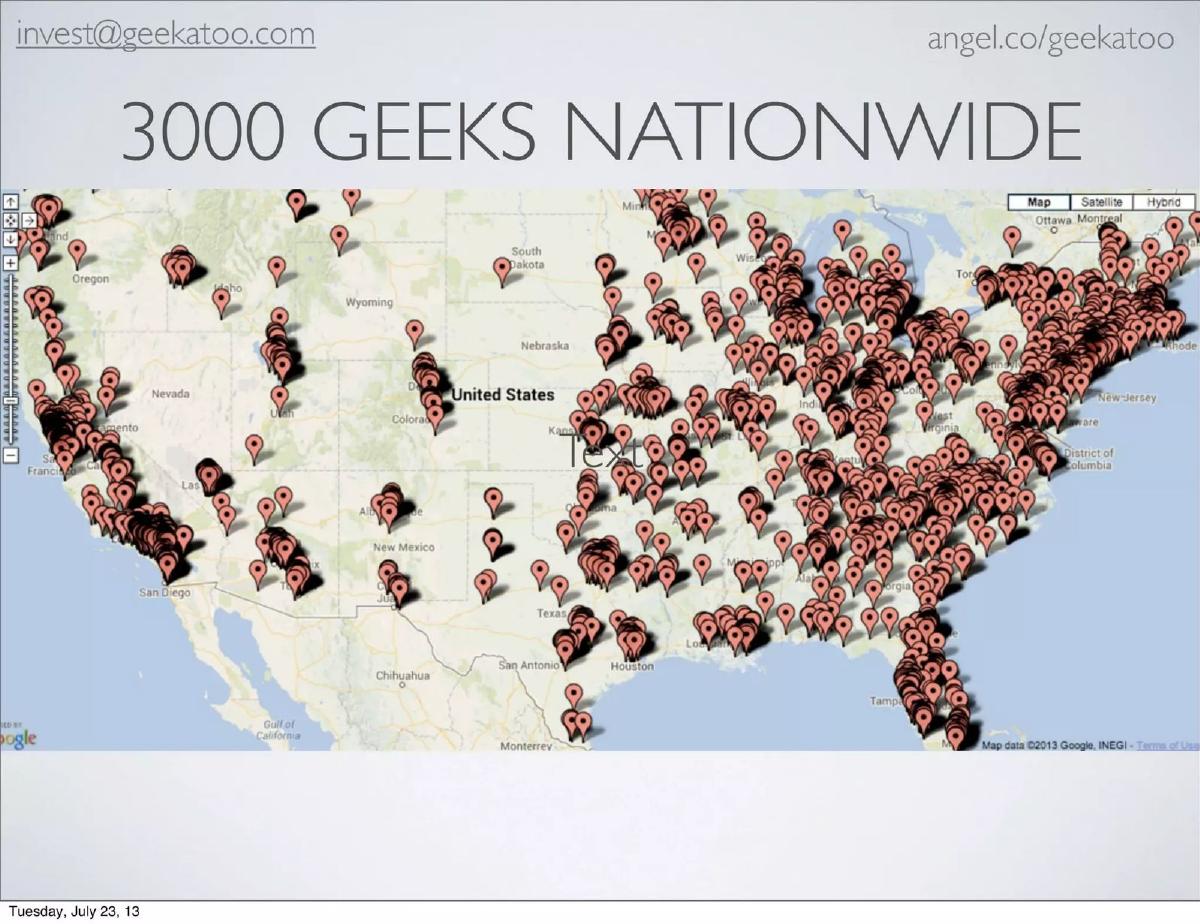
- Geekatoo reports a supply network of 3,000 providers across the United States as shown on slide 5.
- The marketplace take rate is explicitly stated as 35% on slide 10.
- Unit economics are highlighted on slide 12, showing a $20 Customer Acquisition Cost (CPA) and $34 average revenue per job.
- The company claims to be 'positive on first transaction,' suggesting immediate contribution margin profitability on slide 12.
- Traction is quantified at 300 total jobs ordered with a current run rate of 200 jobs per month on slide 11.
- The deck utilizes high-profile social proof with a testimonial from Stack Overflow co-founder Jeff Atwood on slide 13.
- The funding ask is clearly defined on slide 16 as a $750K round with $200K already raised at the time of the presentation.
The Minimalist Marketplace: A Geekatoo Teardown
Geekatoo’s pitch deck is a product of its era—2010—yet it carries a timeless quality in its brevity. With only 16 slides and very little text per slide, the deck relies on the 'Blink' test: can an investor understand the business in under 30 seconds? The company, which eventually raised $2.2 million, focused on the disruption of the high-margin, low-efficiency world of retail tech support. By leveraging a distributed workforce, they sought to undercut big-box retailers like Best Buy.
The Hook: Identifying the Broken Incumbent
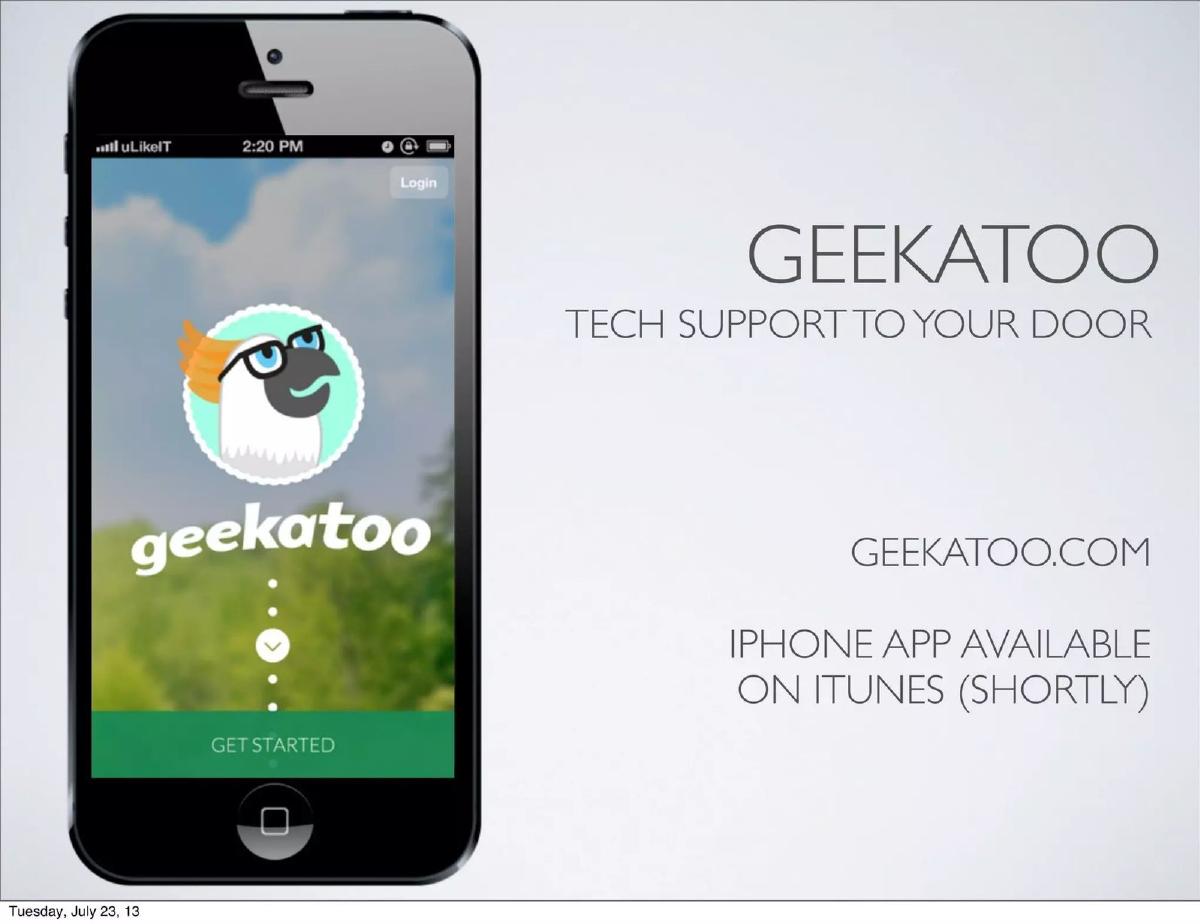
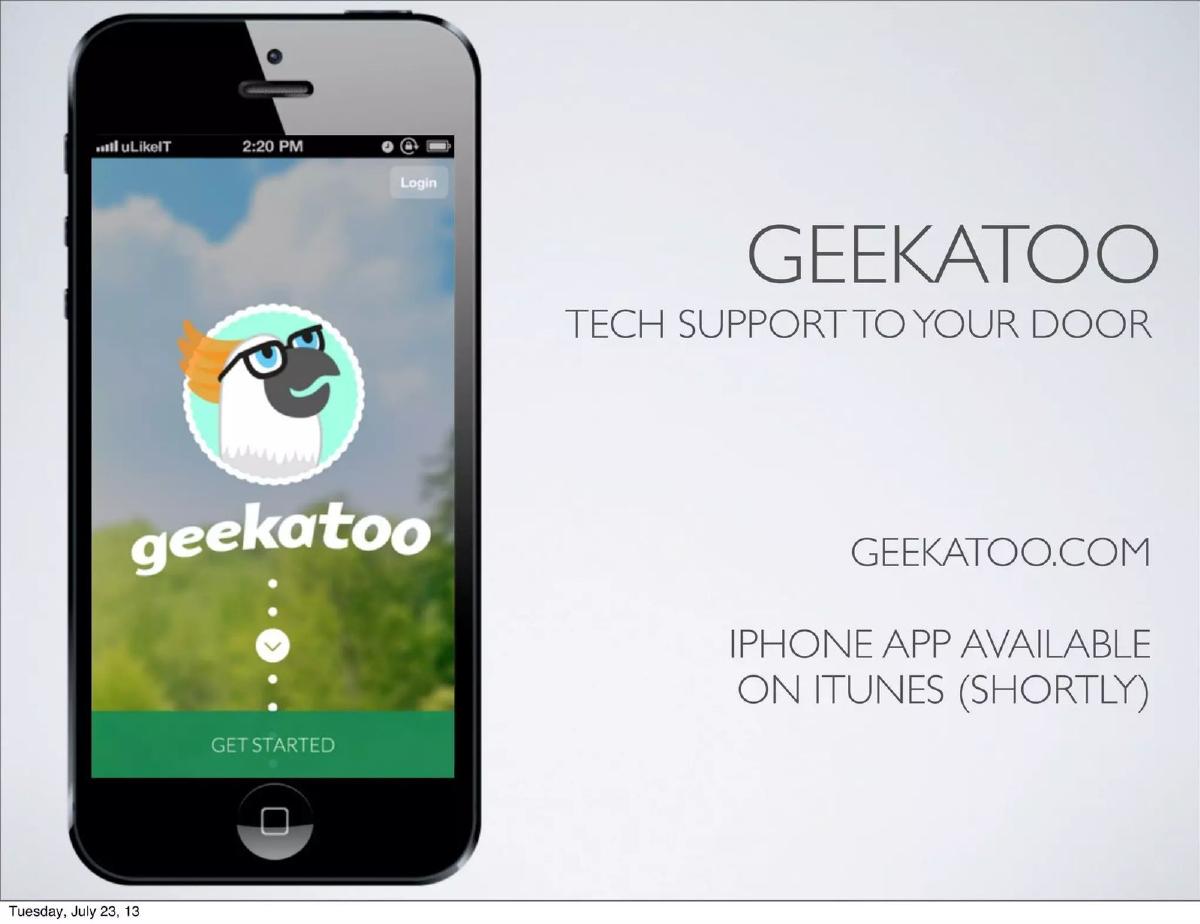
Slide 1: Title Slide The deck opens with a clean visual of an iPhone showing the Geekatoo app. The tagline 'Tech Support To Your Door' is functional. Interestingly, it notes the app is available 'shortly,' indicating this was likely a seed-stage or early Series A pitch where the mobile transition was still in progress.
Slide 2: The Problem This is the most effective slide in the deck. It uses a screenshot of a competitor's pricing (Geek Squad) and uses a large red arrow to point at a $299.99 price tag for in-home service. The text 'TECH SUPPORT IS BROKEN' and 'GEEK SQUAD = 300 DOLLARS?!?!' creates an immediate emotional response regarding overpricing.
Slide 3: The Solution A simple three-word slide: 'CUT OUT THE MIDDLEMAN.' In the context of 2010, this was the rallying cry of the burgeoning 'sharing economy.' By removing the retail overhead of a Best Buy, Geekatoo positions itself as the lean alternative.
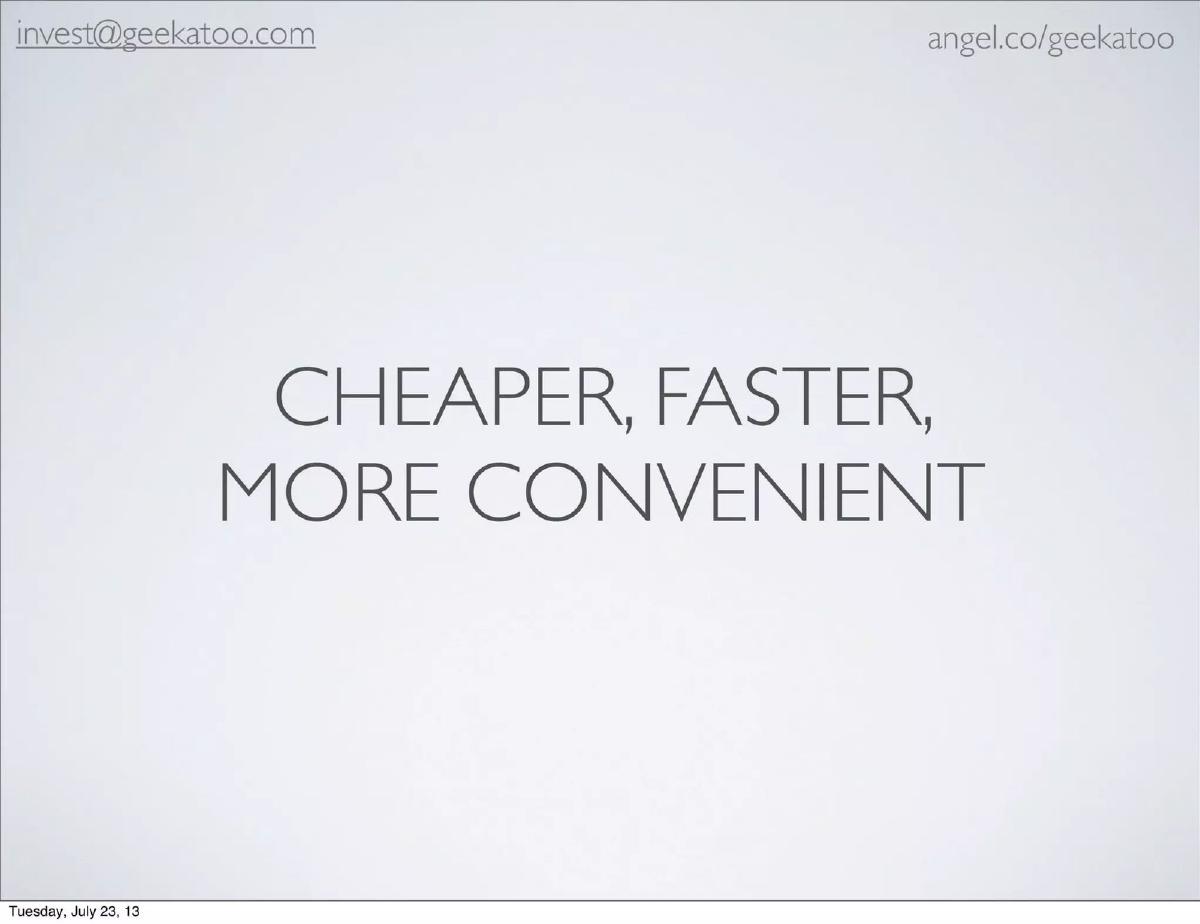
Slide 4: Value Proposition Continuing the minimalist trend, slide 4 lists 'CHEAPER, FASTER, MORE CONVENIENT.' While these are standard claims, the preceding slide on pricing gives the 'Cheaper' claim immediate credibility.
The Supply Side: 3,000 Geeks Nationwide
Slide 5: The Map For a marketplace, supply is everything. Slide 5 shows a Google Map of the US saturated with red pins. The headline '3000 GEEKS NATIONWIDE' proves that the company has already cleared the hurdle of recruiting a workforce. This is a crucial traction signal for investors who fear the 'cold start' problem.
Slide 6 & 7: User Experience These slides describe the friction-less signup process via web or iOS and the speed of service: 'HIRE GEEK WITHIN 5-30 MINUTES.' This addresses the 'Faster' and 'More Convenient' pillars of their value prop.
Service Catalog and Unit Economics
Slide 8: The Product This slide shows a grid of services with 'was/now' pricing. Examples include:
Eliminate Viruses: $129 (was $299) · Hook up a New Device: $59 (was $149) · Recover Lost Data: $199 (was $249)
This slide reinforces the '75% off' claim mentioned in the company's self-description by showing the actual price delta on common tasks.
Slide 9: The Business Model Slide 10 (labeled as the 9th content slide) is as transparent as it gets: 'GEEKATOO CUT: 35%.' For a service marketplace, a 35% take rate is healthy, providing ample room for customer acquisition costs while leaving enough for the provider to remain motivated.
Slide 10: Traction Slide 11 provides the hard numbers: '300 JOBS ORDERED TOTAL' and '200/MONTH.' This indicates the company is in the very early stages of its growth curve, but the fact that 66% of their total jobs happened in the last month suggests significant month-over-month acceleration.
Slide 11: Unit Economics Slide 12 is the 'investor slide.' It breaks down the math:
$20 CPA (Cost Per Acquisition) · $34 Avg. Revenue Per Job · Positive on First Transaction
This is a powerful statement. Many marketplaces lose money on the first few transactions to acquire a user; Geekatoo claims to be profitable immediately. This suggests a highly efficient acquisition engine or a very high-intent customer base.
Social Proof and Team
Slide 12: The Influencer Slide 13 features a quote from Jeff Atwood, co-founder of Stack Overflow. In the tech world, Atwood’s endorsement carries significant weight. His recommendation of Geekatoo as 'reliable local tech support that won't break the bank' serves as a high-level validation of the service quality.
Slide 13: The Emotional Hook Slide 14 is an unusual choice: a screenshot of an email from a mother ('Lenora') to her son ('Jeff'), thanking him for the service and calling him the 'best son ever.' This humanizes the tech support aspect, showing that the service solves a real pain point for non-technical demographics (and their children who usually have to provide the support for free).
Slide 14 & 15: The Team The team slides are individual. Kevin Davis is positioned as the technical/product lead with a background in Biopharma and journalism (ABC). Christian Shelton is the 'pedigree' hire, with degrees from Berkeley, Harvard, and LSE, plus experience at Sun Microsystems. The deck lacks a 'Team' slide that shows them together, which is a slight departure from modern standards but effective in highlighting individual strengths.
The Ask
Slide 16: The Closing The final slide repeats the branding and provides the investment details: '$200K RAISED' and '$750K ROUND.' It also points investors to their AngelList profile. This clear 'Ask' ensures there is no ambiguity about why the deck is being shown.
What Works in the Geekatoo Deck
Clarity of Contrast: The deck does an excellent job of positioning Geekatoo against a 'villain' (Geek Squad). By using actual competitor pricing screenshots, they move the conversation from theoretical savings to concrete math.
Supply-Side Proof: The map of 3,000 providers is the strongest visual in the deck. It suggests a level of operational maturity that belies the relatively low number of total jobs (300) completed at that time.
Unit Economic Transparency: Stating the take rate, CPA, and revenue per job on separate, bold slides shows a management team that is focused on the right metrics. Being 'positive on first transaction' is a metric that specifically appeals to venture capitalists looking for scalable models.
What is Missing from the Geekatoo Deck
Market Size (TAM): There is no mention of the Total Addressable Market. While it is implied that 'everyone with a computer' is a customer, investors usually want to see a bottom-up calculation of the billions of dollars spent on home services annually.
Retention Data: The deck mentions 200 jobs per month, but it doesn't specify if these are new or repeat customers. In a marketplace, the Lifetime Value (LTV) is driven by repeat usage, which is not addressed here.
Competitive Landscape: Beyond Geek Squad, there is no mention of other startups or local independent shops. A 'Magic Quadrant' or a feature comparison list would have helped define their moat beyond just 'cheaper.'
Future Roadmap: The deck is very focused on the 'now.' There is no vision for what Geekatoo becomes in 5 years. Does it expand into B2B? Does it move into home repair? The lack of a 'Vision' slide makes the business feel like a utility rather than a platform.
What a Founder Should Copy
The 'One Idea Per Slide' Rule: Geekatoo follows this perfectly. There are no dense paragraphs. Each slide delivers one punchy fact: the price is too high, we have the geeks, we make 35%, we are raising $750k. This prevents 'slide fatigue' during a pitch.
High-Signal Social Proof: If you have a testimonial from a titan in your industry (like Jeff Atwood), give it its own slide. Don't bury it in a corner. Geekatoo recognized that Atwood’s name was worth more than a dozen generic customer reviews.
Direct Price Comparison: If your startup is a 'low-cost' disruptor, show the incumbent's checkout screen. It is much more effective than a bullet point saying 'we are cheaper.'
The 'Mom' Test: Including the email from Lenora is a brilliant way to show the 'Job to be Done.' The service isn't just fixing a router; it's saving a son from having to spend his weekend doing tech support for his parents. Identifying the emotional buyer (the busy adult child) is a subtle but powerful marketing insight.
Conclusion
Geekatoo’s deck is a lean, mean fundraising machine. It doesn't hide behind complex charts or vague corporate jargon. It presents a simple arbitrage opportunity: retail tech support is expensive because of overhead; a distributed marketplace removes that overhead; here is the proof that we can acquire customers for less than we make from them. For an early-stage round, that is often all an investor needs to see to take the next meeting.
Frequently asked questions
- What is the primary problem Geekatoo aims to solve?
- Geekatoo targets the high cost and inconvenience of traditional tech support. Slide 2 explicitly points to Geek Squad's $299.99 in-home service fee as evidence that 'Tech Support is Broken.' By cutting out the middleman (Slide 3), Geekatoo aims to provide a cheaper, faster, and more convenient alternative through a distributed network of independent technicians.
- How does Geekatoo make money?
- The company operates on a standard marketplace commission model. Slide 10 states that the 'Geekatoo Cut' is 35%. This revenue is generated across various fixed-price services, such as virus elimination ($129) and home theater setup ($129), which are shown to be significantly discounted compared to market rates on slide 9.
- What does the deck reveal about their customer acquisition strategy?
- While the deck doesn't detail specific marketing channels, slide 12 provides the output of their strategy: a $20 CPA. Combined with an average revenue per job of $34, the company emphasizes that they are profitable on the very first transaction, a key metric for marketplace sustainability.
- Who are the founders and what is their background?
- The deck highlights two key team members. Kevin Davis (Slide 14) is described as a product/coder for Biopharma and a former ABC reporter. Christian Shelton (Slide 15) brings academic pedigree from UC Berkeley, Harvard, and LSE, along with professional experience from Sun Microsystems.
- What is the current scale of the provider network?
- At the time of this deck, Geekatoo had built a significant supply side. Slide 5 features a map of the United States densely covered in pins, representing 3,000 'geeks' nationwide. This suggests the platform had already solved the initial 'chicken and egg' problem common in marketplaces by securing service providers before scaling demand.