This 2010 deck from GameXplain represents an early attempt to disrupt the gaming guide market by replacing $20 printed books and long text FAQs with a video-based Q&A platform. Founders Andre Segers and Micah Seff, both veterans of IGN and GameSpot, sought $250,000 to build a dedicated platform to house their growing video content. At the time of the pitch, they claimed 1.5 million video guide views and 30,000 monthly visitors to their site within just six months of operation. The deck relies heavily on a user journey narrative featuring 'Sarah' to explain the social mechanics of their propos…
Key takeaways
- The company identified a market gap between expensive $20 printed guides and cumbersome text FAQs on slide 4.
- Traction was significant for a six-month-old startup, reporting 1.5 million video guide views on slide 11.
- The founders possessed deep domain expertise, with backgrounds as editors at IGN and GameSpot as noted on slide 15.
- The 'How it works' section (slides 6-10) uses a persona-based narrative to explain a social Q&A loop involving Facebook, Twitter, and AIM.
- The funding ask is specific: $250,000 to cover monthly costs including $10k for developers and $6k for salaries on slide 13.
- The deck lacks a dedicated competition slide, failing to address emerging video giants like YouTube or Twitch (then Justin.tv).
- Milestones on slide 14 focus on growth, aiming to scale weekly users from 250k to 1 million within 12 months.
- Revenue models are only hinted at through logos of brand sponsors like Nintendo, EA, and 2K Games on slide 12.
Executive Summary: The Transition to Video-First Gaming Media
The GameXplain pitch deck from August 2010 is a time capsule of the gaming industry's transition from text-based information to video content. At a time when YouTube was still maturing and Twitch was in its infancy as Justin.tv, GameXplain identified that the traditional methods of getting 'unstuck' in a video game—printed books and massive text files—were obsolete. The deck outlines a plan to build a social, video-driven Q&A platform led by industry veterans.
Slide 1: Title and Value Proposition
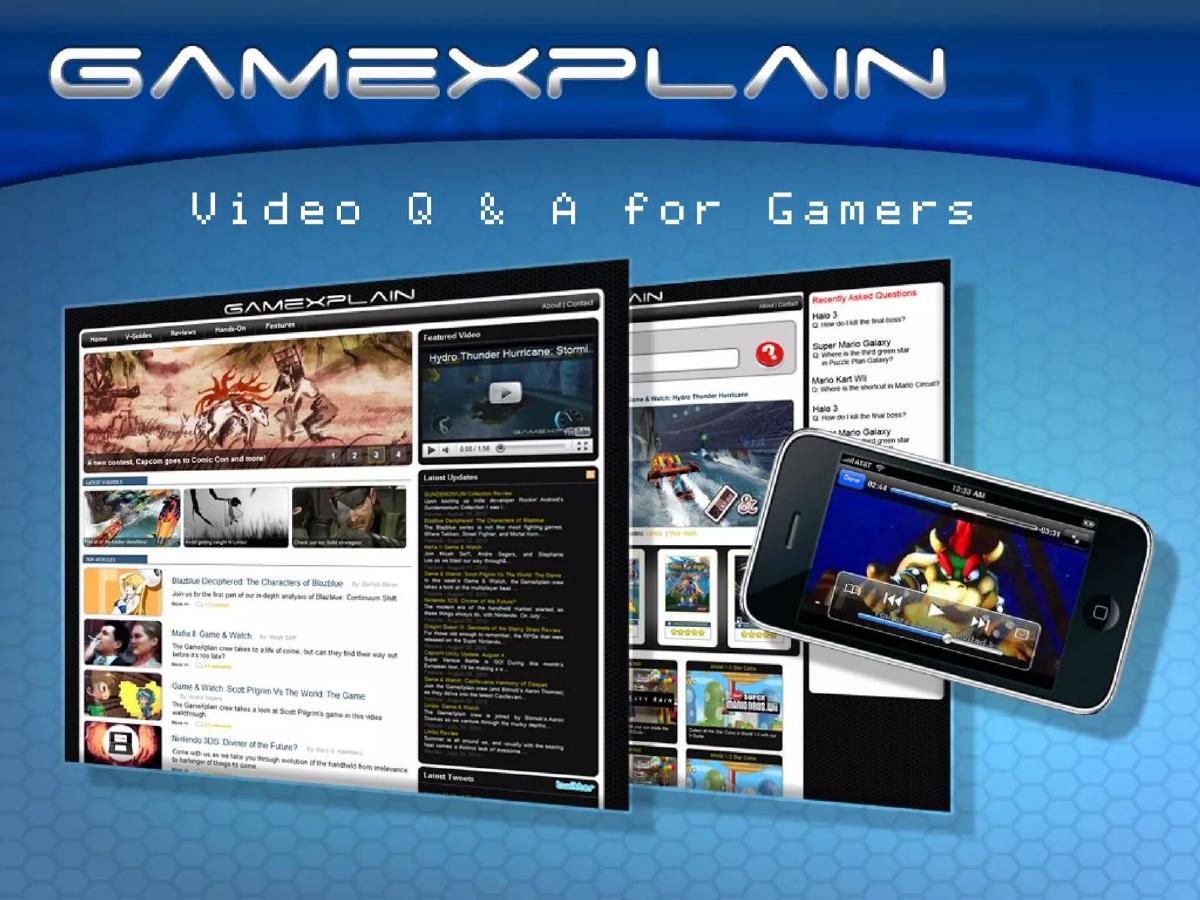
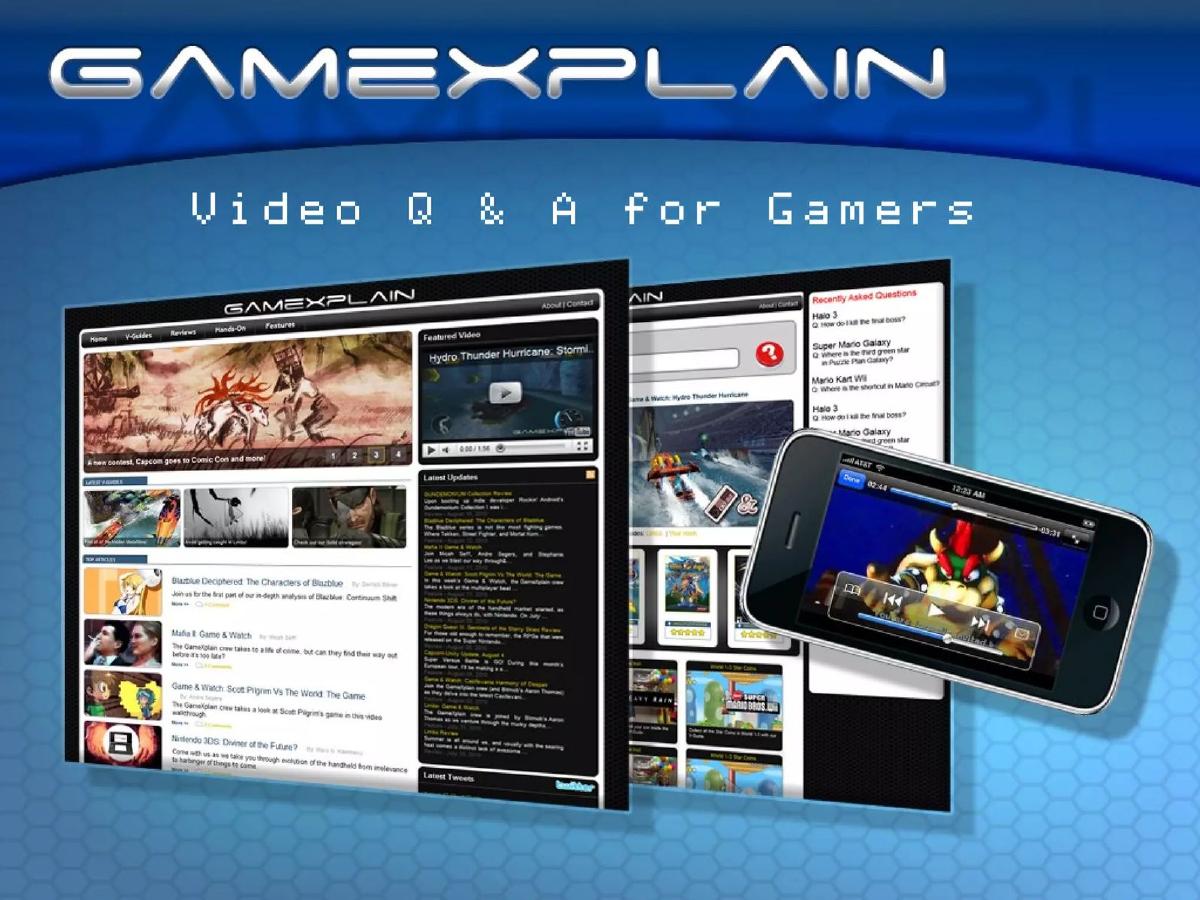
The cover slide introduces the brand with a high-gloss, early-2010s aesthetic. The tagline is clear: "Video Q & A for Gamers." The imagery shows a desktop website layout alongside an iPhone 3G/3GS, signaling a multi-platform approach. The presence of mobile is a critical inclusion for 2010, acknowledging the rise of the 'second screen' while gaming.
Slides 2-3: Market Size and User Behavior
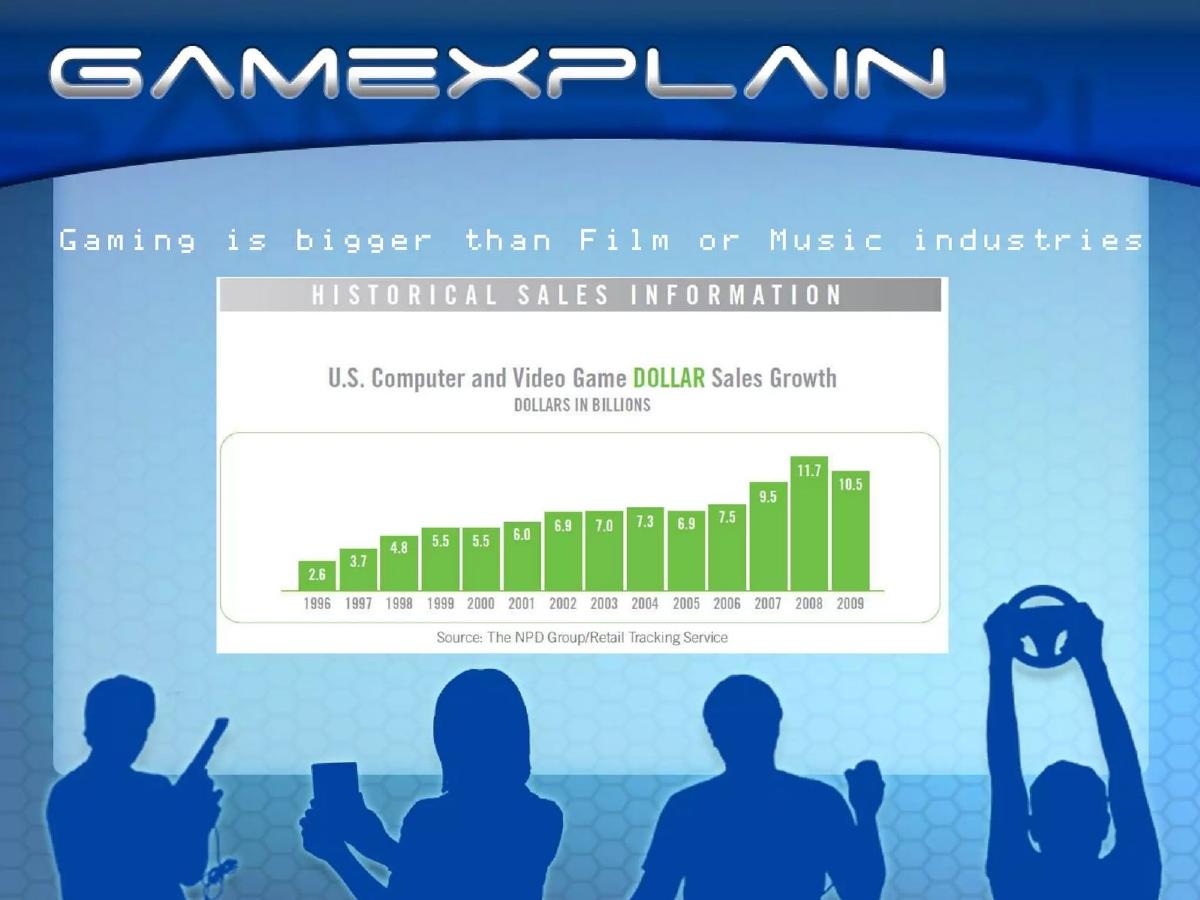
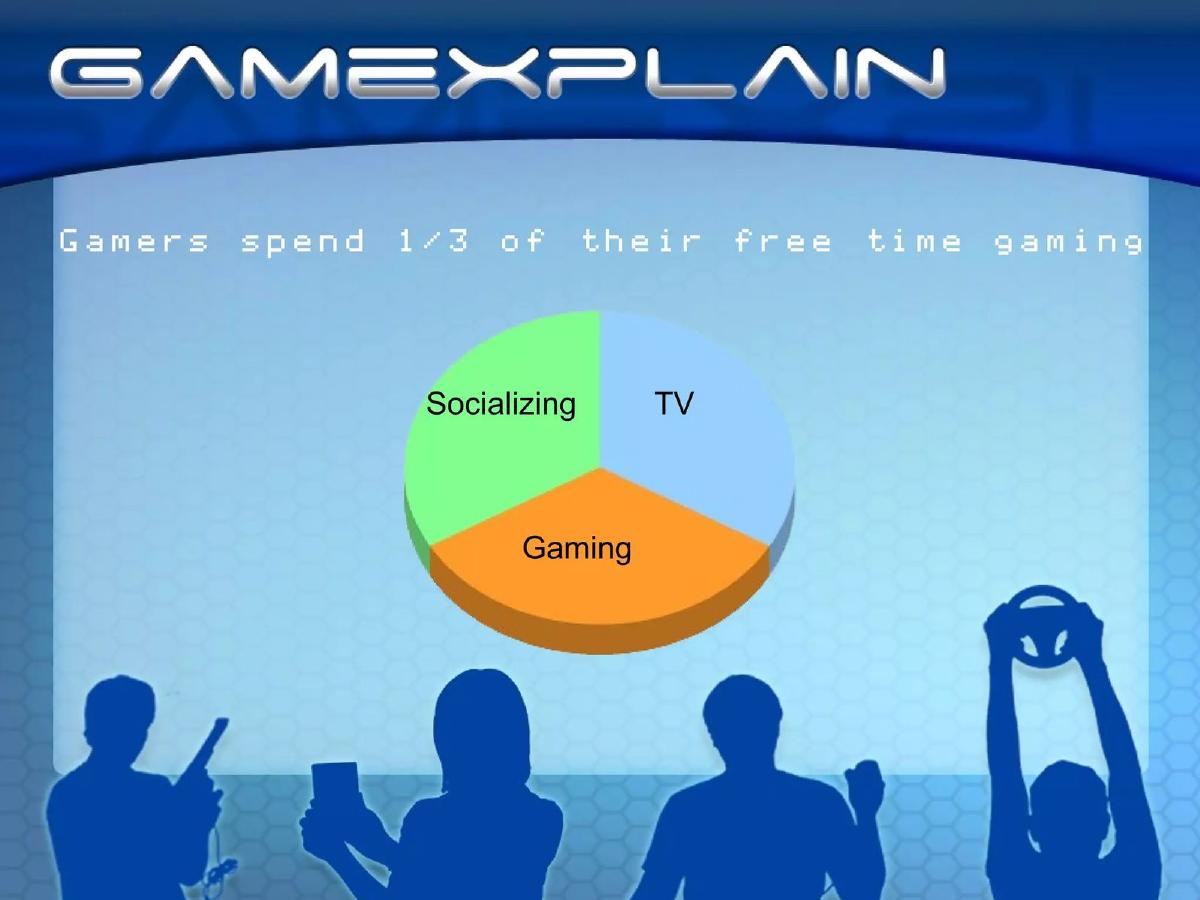
Slide 2 uses NPD Group data to show that U.S. Computer and Video Game sales reached $10.5 billion in 2009 , down slightly from a peak of $11.7 billion in 2008 but still showing massive growth since 1996 ($2.6 billion). The slide claims gaming is "bigger than Film or Music industries." Slide 3 uses a simple pie chart to assert that gamers spend 1/3 of their free time gaming , equal to time spent on TV and socializing. These slides establish the 'Why Now' by highlighting a massive, captive audience.
Slide 4: The Problem Statement
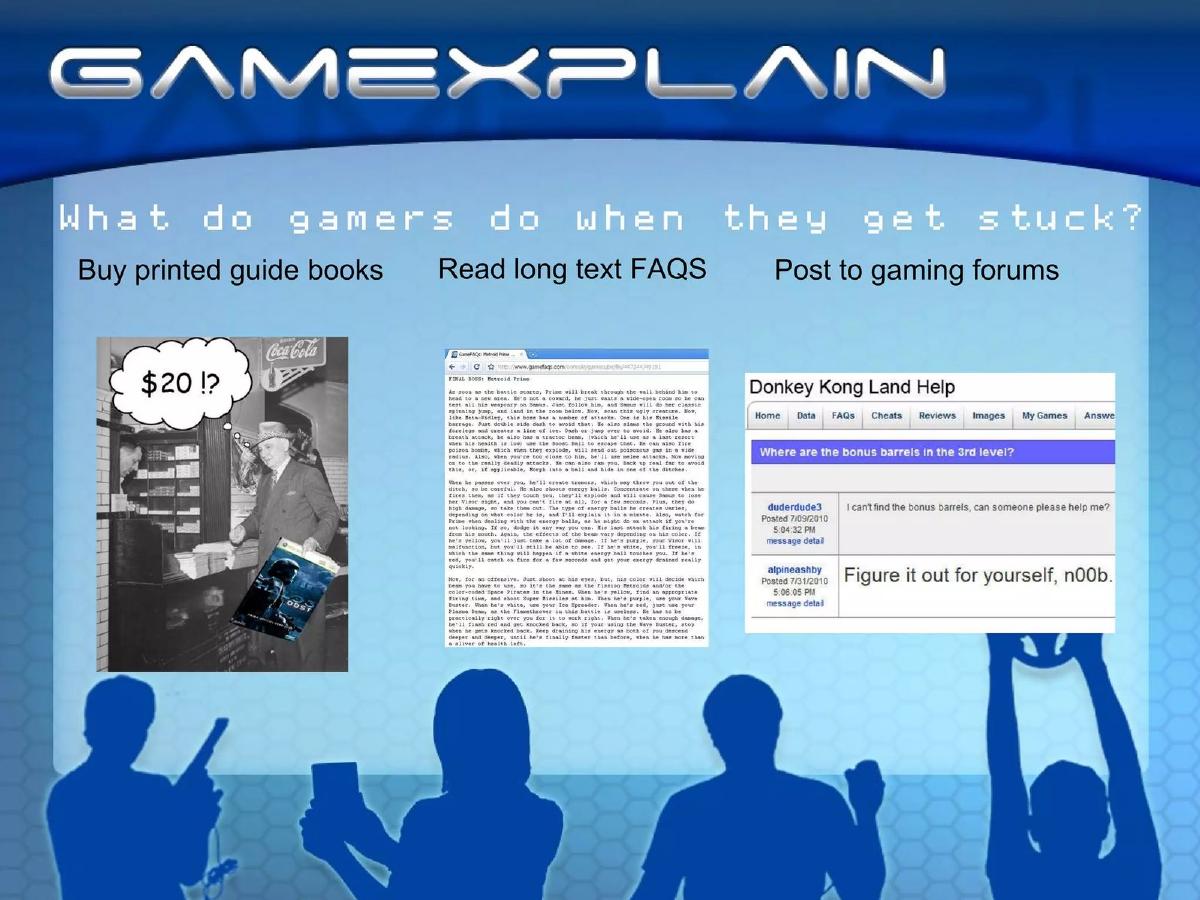
This slide identifies three pain points for gamers who get stuck: buying $20 printed guide books, reading long text FAQs (illustrated with a wall of text from a Metroid Prime guide), and posting to forums. The forum example includes a humorous but realistic interaction where a user asks for help and is told to "Figure it out for yourself, n00b." This establishes the need for a more curated, friendly, and visual solution.
Slide 5: The Solution
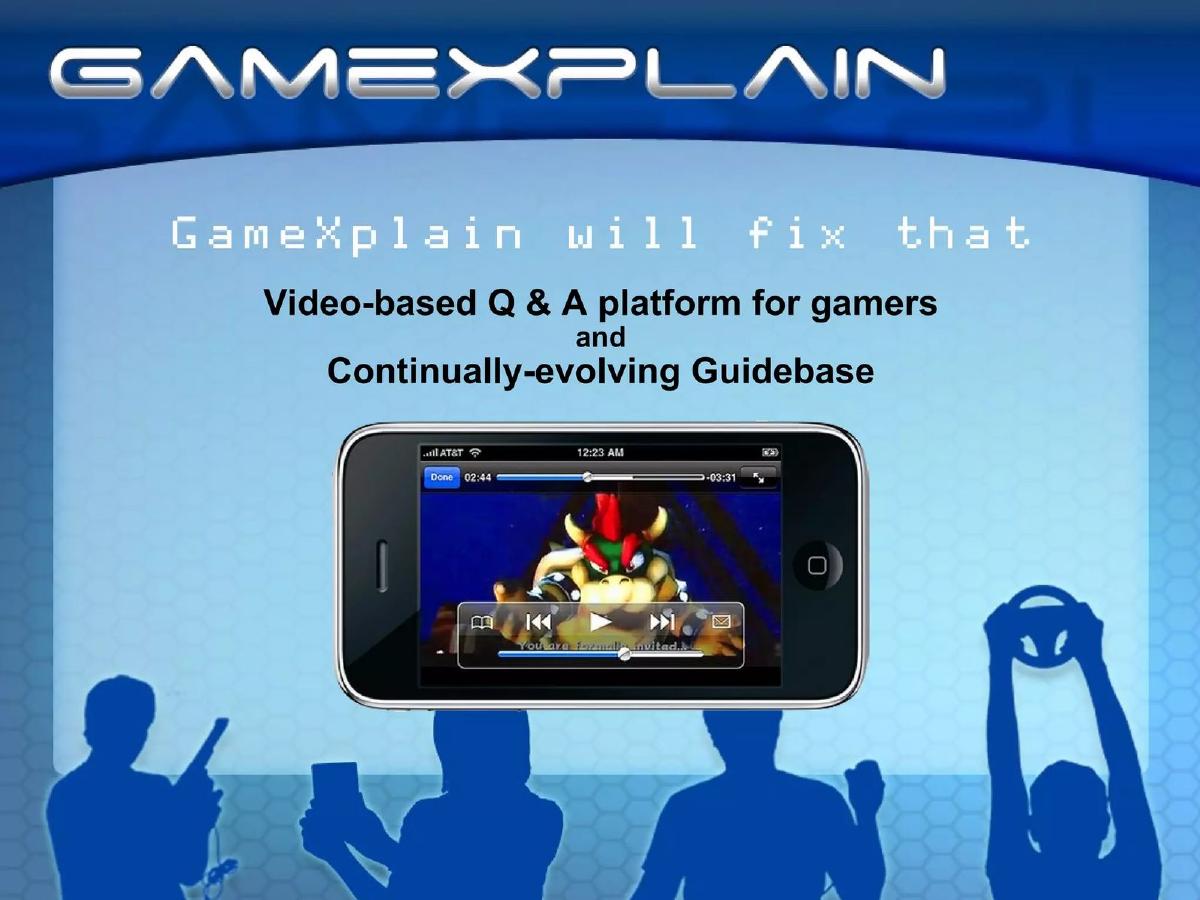
GameXplain positions itself as the fix: a "Video-based Q & A platform for gamers" and a "Continually-evolving Guidebase." The visual is an iPhone playing a video of a boss fight in Super Mario Galaxy 2, emphasizing that the solution is visual and portable.
Slides 6-10: The "Sarah" Narrative (How It Works)
The deck uses a five-step persona-based walkthrough to explain the platform's mechanics:
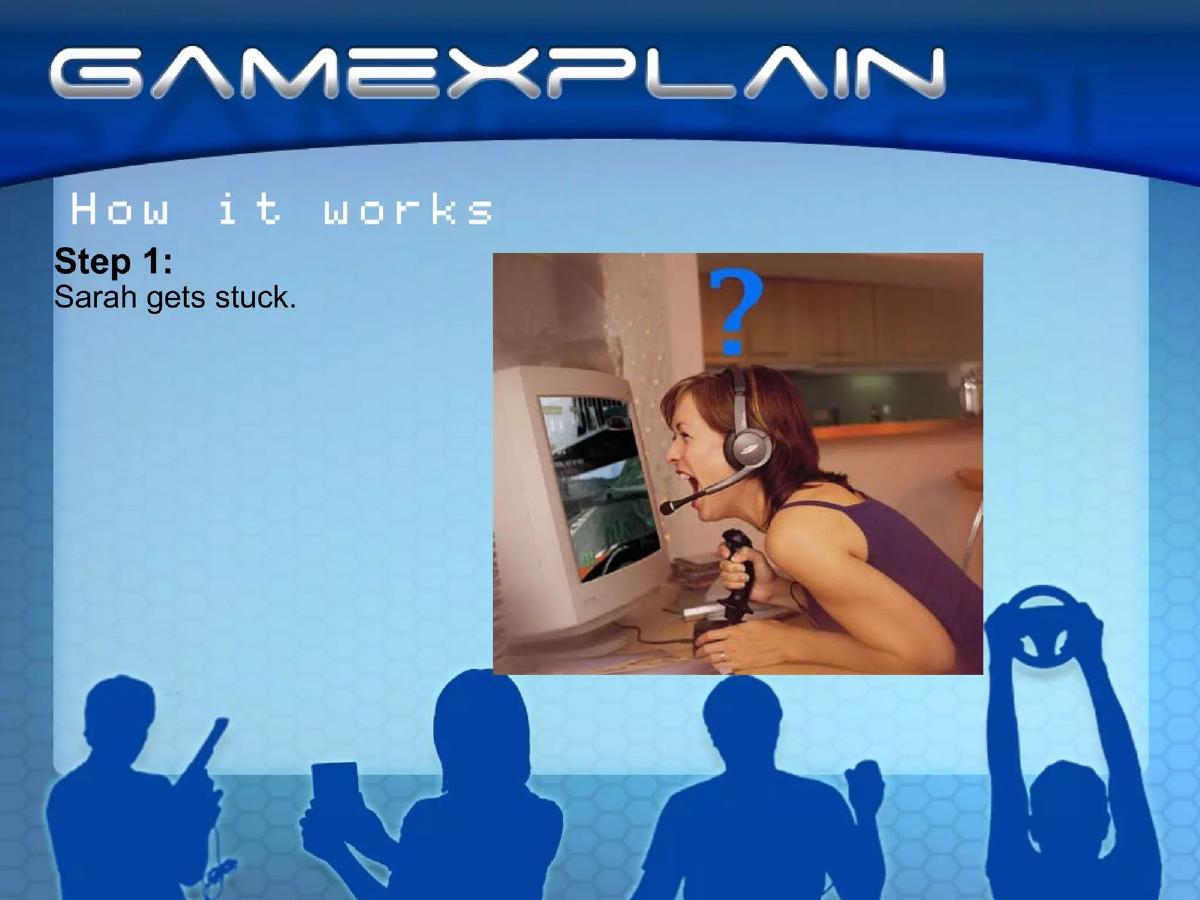
Step 1: Sarah gets stuck (Slide 6). · Step 2: Sarah goes to GameXplain and asks for help via a search/input bar (Slide 7). · Step 3: The request is broadcast to Facebook, Twitter, SMS, and AIM (Slide 8). · Step 4: "GameXperts" provide a video solution, which Sarah can rate with a "Yes/No" for helpfulness (Slide 9). · Step 5: Sarah endorses the video, and the helper earns rewards and levels up their profile (Slide 10).
This section effectively explains the gamification and social viral loops intended for the platform.
Slide 11: Traction and Proof of Concept
This is the strongest slide in the deck. It lists impressive figures achieved in just six months: 1.5 million+ video guide views , 150k+ weekly viewers of their highlights show, and 30k+ monthly visitors to the website. It includes a YouTube comment as social proof, showing that users already value their content for being helpful.
Slide 12: Partners and Sponsors
The deck lists Metacafe as a platform partner, including a quote from Doug Perry (Editorial Director at Metacafe) stating, "GameXplain rocked the house with traffic." It also displays logos for Nintendo, EA Games, 2K Games, and Cyberstep under "Brand Sponsors," suggesting early validation from major industry players.
Slide 13: The Ask
GameXplain was raising $250k to "build the platform." The monthly burn breakdown is provided: $10k for developers, $6k for salaries, $2k for on-screen talent, and $2k for expenses. This is a modest seed-stage ask, reflecting the lower overhead of a content-plus-tech play in 2010.
Slide 14: Milestones
Growing GuideBase weekly users from 250k to 1 million . · Launching a beta with 1k weekly active users. · Hiring two developers. · Establishing partnerships with Revision3 and Google TV.
The focus is heavily on user acquisition and platform expansion.
Slide 15: The Team
The final slide highlights the founders' pedigree. Andre Segers (Editor-in-chief at Gamespot Guides, Editor at IGN Guides) and Micah Seff (Editor/Host at IGN) bring significant industry authority. In a content-heavy business, having leaders who previously ran the largest guide sections in the world is a major competitive advantage.
What GameXplain Did Well
The deck excels at demonstrating Domain Expertise . By highlighting their backgrounds at IGN and GameSpot, the founders immediately answer the question of why they are the right people to build a guide platform. They also did an excellent job of showing Early Traction . Reaching 1.5 million views in six months is a strong indicator of product-market fit for their content, even if the platform itself wasn't fully built yet.
The use of a User Narrative (Sarah) makes a potentially complex social integration easy to understand. Instead of explaining API integrations, they show the emotional journey of a frustrated gamer getting help and the helper getting rewarded.
What Was Missing
The most glaring omission is a Competitor Analysis . By 2010, YouTube was already the primary destination for video walkthroughs. The deck doesn't explain how GameXplain's proprietary platform would compete with or complement YouTube's massive reach. Furthermore, there is no mention of Twitch/Justin.tv , which was beginning to capture the live-help market.
The Monetization Strategy is also vague. While brand sponsors are mentioned, there are no unit economics, projected ad rates, or details on how the "rewards" for GameXperts would be funded. Finally, the Exit Strategy is missing, leaving investors to guess whether this is a lifestyle media business or a scalable tech platform.
Founder's Guide: What to Copy
Specific Use of Funds: Slide 13 is a great example of how to present a small raise. Instead of just saying "Product Development," they broke it down into salaries, developers, and talent. This gives investors a clear picture of the company's immediate priorities.
Social Proof: Including a quote from a partner (Metacafe) and a screenshot of a positive user comment (YouTube) provides multi-layered validation. It shows that both industry peers and end-users support the product.
The 'Why Now' Logic: Slides 2-4 do a great job of setting the stage. They don't just say "gaming is big"; they show that the way people get help is currently broken (expensive books, mean forum users), creating a specific opening for a new solution.
Frequently asked questions
- What was the primary problem GameXplain aimed to solve?
- According to slide 4, the problem was the inefficiency of existing gaming help. Gamers were forced to buy $20 printed guide books, read 'long text FAQS,' or post to forums where they might be met with unhelpful comments like 'Figure it out for yourself, n00b.' GameXplain proposed a video-based alternative that was faster and more intuitive.
- How much money was GameXplain raising and for what?
- Slide 13 states the company was raising $250,000. The breakdown of monthly spend included $10,000 for developers, $6,000 for salaries, $2,000 for on-screen talent, and $2,000 for general expenses. The stated goal for these funds was to 'build the platform' beyond their existing site.
- What kind of traction did the company have at the time of the pitch?
- Slide 11 reports that within six months, the company achieved 1.5 million+ video guide views, 150k+ weekly viewers of their highlights show, and 30k+ monthly visitors to GameXplain.com. Slide 14 also mentions a 'current level' of 250k weekly users for their GuideBase.
- Who were the founders and what was their background?
- The founders listed on slide 15 are Andre Segers and Micah Seff. Segers was previously the Editor-in-chief at Gamespot Guides and an Editor at IGN Guides. Seff was an Editor and on-air host at IGN and had consulted on social media campaigns for brands like Sony Pictures and Visa.
- What social platforms did GameXplain intend to integrate with?
- Slide 8 illustrates the social loop, showing integrations with Facebook, Twitter, the App Store, SMS, and AIM (AOL Instant Messenger). The goal was to allow users to broadcast their 'cry for help' to friends and 'GameXperts' across these existing networks.