The Yuga Labs pitch deck is a sprawling 90-slide manifesto that successfully transitioned the company from a profile-picture NFT project into a multi-billion dollar gaming and media ecosystem. By the time this deck was circulated in February 2022, Yuga Labs was already a revenue powerhouse, reporting $127.11M in net revenue for 2021 with a staggering 92.4% net margin. The deck’s primary function was to prove that Bored Ape Yacht Club (BAYC) wasn't just a collection of 'JPEGs' but the foundation for 'Otherside,' a massive multiplayer metaverse. It leans heavily on social proof, showcasing a ga…
Key takeaways
- The company reported an actual net revenue of $127.11M for 2021 on a total expense of only $4.24M (Slide 87).
- Yuga Labs projected a 2022 budget with total revenue of $539.30M and a gross profit margin of 98.8% (Slide 87).
- The deck highlights a massive celebrity 'marketing team,' featuring holders like Justin Bieber, Serena Williams, and Snoop Dogg (Slides 16, 17).
- Early gaming traction was demonstrated through the 'Apes vs. Mutants' mobile game, which attracted 30,000 players over 6 days (Slide 24).
- The 'Otherside' metaverse is positioned as a 'MetaRPG' that launches with a land sale, where digital plots correspond to in-game territory (Slide 76).
- The business model shifts from simple NFT sales to an 'in-game app store' powered by an SDK for third-party creators (Slide 61).
- The deck explicitly critiques existing metaverse attempts as 'buggy software' and 'empty servers,' positioning Yuga as the solution to the attention problem (Slide 43).
- Financial metrics show a 306% increase in revenue, reaching a $402M milestone as a key performance indicator (Slide 88).
The 90-Slide Manifesto: How Yuga Labs Defined the NFT Era
In February 2022, Yuga Labs was no longer a scrappy startup; it was a cultural phenomenon. This deck, updated during that peak, served as the bridge between the 'Bored Ape' craze and the ambitious 'Otherside' metaverse. With 90 slides in total, the deck is exhaustive, moving from high-level cultural philosophy to granular income statements. It is a masterclass in using traction to silence skepticism about valuation .
Slides 1-9: The Vision and the Gap
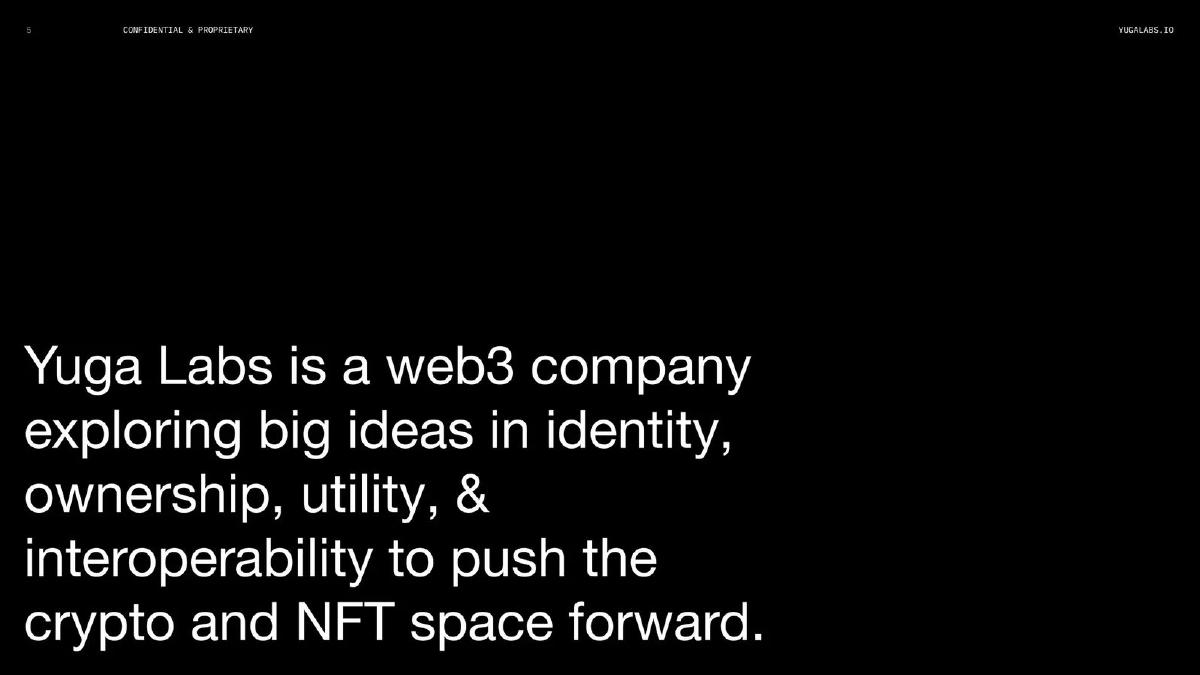
The deck opens with a minimalist aesthetic. Slide 1 establishes the Yuga Labs brand, followed by Slide 5 which defines the company as a 'web3 company exploring big ideas in identity, ownership, utility, & interoperability.' This is a strategic move to distance the company from the 'NFT' label, which was already becoming polarizing. Slide 9 narrows the focus: 'We’re bridging the gap between culture and web3.' By positioning themselves as the 'bridge,' Yuga Labs claims a unique territory that tech-heavy competitors couldn't occupy.
Slides 16-18: Social Proof as a Moat
One of the most powerful sections of the deck is the 'Blue Chip' validation. Slide 16 explicitly states that Bored Ape Yacht Club is the 'premier Blue Chip NFT.' It backs this up with hard floor prices (117 ETH for BAYC) and a list of 'well-known ape holders' that reads like a Hollywood A-list. Slide 17 and 18 use a visual 'wall of fame' featuring Justin Bieber, Serena Williams, and Snoop Dogg. For an investor, this isn't just vanity; it represents a marketing spend of zero for a reach of hundreds of millions. The deck claims that by granting commercial ownership rights to members, they created a 'marketing team of thousands.'
Slide 24: Proving the 'Game' Thesis
Before asking for hundreds of millions to build a metaverse, Yuga had to prove they could build a game. Slide 24 showcases 'Apes vs. Mutants.' The metrics are modest but vital: 30,000 players and 6 days played. While these aren't 'AAA' gaming numbers, they served as a proof of concept that the community was willing to engage with the brand in an interactive environment, not just a Discord server.
Slides 29-45: The Metaverse Critique
Slides 29 through 45 represent the 'Problem' phase of the deck. Slide 38 acknowledges the 'race to the metaverse' involving Microsoft, Walmart, and Gucci. However, Slide 43 takes a sharp turn, calling the current 'Metaverse Land Rush' an illusion . By criticizing the 'buggy software' and 'empty servers' of competitors, Yuga Labs sets the stage for their 'Solution.' Slide 45 asks the rhetorical question: 'If everyone is building their own [metaverse] how does that work?' This suggests that Yuga intends to be the unifying layer.
Slides 56-65: The Otherside Economy
The 'Solution' is introduced as more than a game. Slide 56 uses the 'If we build it they will come' trope, but Slide 61 adds the technical meat: an SDK for creators and an 'in-game app store.' This is the pivot from a content studio to a platform . Slide 64 and 65 emphasize that this is a 'whole new economy' involving trading, bartering, and a 'soft currency.' This is where the business model shifts from one-off NFT drops to recurring ecosystem fees.
Slides 74-77: The MetaRPG and Land Sales
Yuga Labs uses narrative storytelling in Slide 74 (The Big Bang) to introduce the lore of their world. This leads directly to the monetization strategy in Slide 76: 'The MetaRPG will launch with a land sale.' Slide 77 shows 'work in progress concept art' for 'Shadow Land,' complete with resource tiers and 'Koda' creatures. This slide is crucial because it connects the abstract 'metaverse' to a concrete, purchasable asset that investors can value.
Slides 81-88: The Financial Powerhouse
The deck concludes with a series of 'checkmarks' on Slide 81, asserting their readiness for a massive, live multiplayer experience. But the real 'closer' is Slide 87: the Income Statement . The numbers are staggering. In 2021, Yuga Labs generated $137.58M in revenue with only $6.23M in COGS. Their net revenue was $127.11M. Slide 88 shows a 306% revenue growth trend, hitting $402M. These slides transform the pitch from a speculative 'web3' play into a high-performance business case that few VCs could ignore.
What Works in the Yuga Labs Deck
Unassailable Traction: Most decks project future revenue; Yuga showed $127M in actual net profit. This changes the conversation from 'will this work?' to 'how big can this get?' · Cultural Dominance: The use of celebrity imagery (Slides 17-18) serves as a proxy for brand equity. It proves the 'product-market fit' has already been achieved at a global scale. · Strategic Positioning: By calling the current metaverse a 'buggy illusion' (Slide 43), they positioned themselves as the 'adults in the room' who understood that engagement, not just land-squatting, is the key to a virtual world. · Visual Narrative: The deck moves from stark, high-contrast text slides to rich, immersive concept art (Slide 77), mirroring the transition from a simple idea to a complex world.
What is Missing from the Yuga Labs Deck
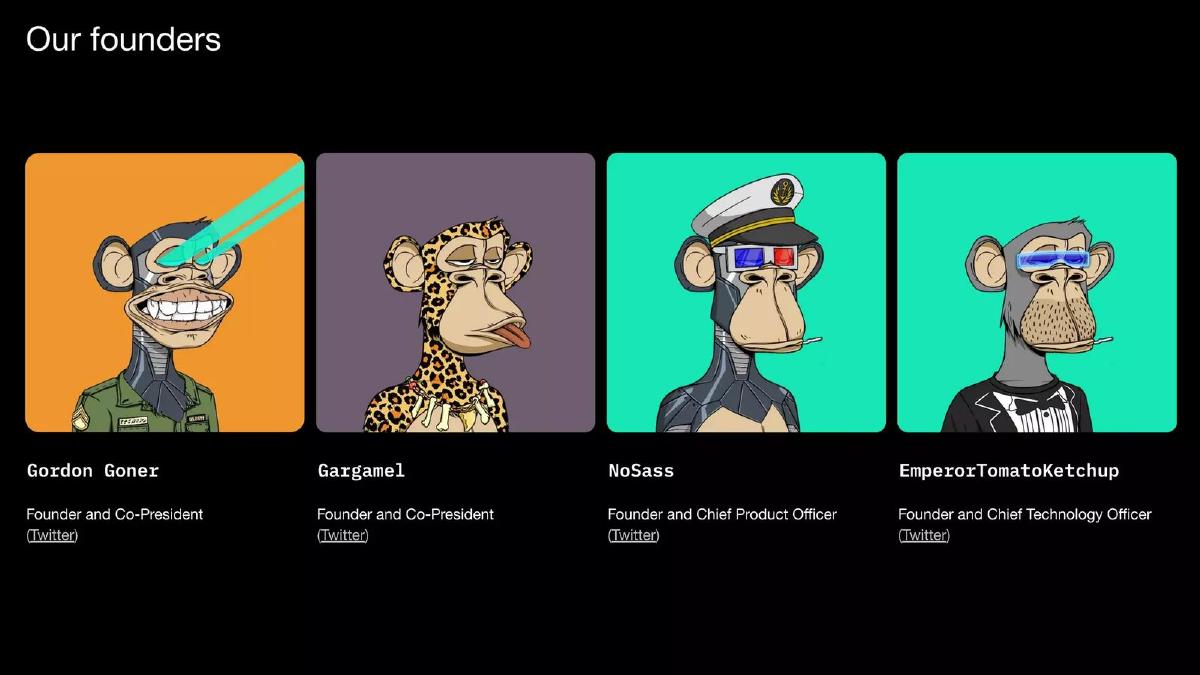
The Team Slide: In the 23 slides provided, there is no mention of the founders' backgrounds. While the founders (Gargamel and Gordon Goner) were famously pseudonymous at the time, most $450M rounds require deep technical vetting of the C-suite. · Competitive Analysis: The deck critiques the 'metaverse' generally but avoids naming specific competitors like The Sandbox or Decentraland. This 'category of one' approach is bold but leaves out how they will win the technical talent war against Big Tech. · Unit Economics: While the income statement is impressive, there is little detail on the Customer Acquisition Cost (CAC) or the long-term LTV of a 'land owner' versus a 'casual player.' · The Ask: There is no slide explicitly stating 'We are raising $450M for X, Y, and Z.' The deck functions more as a 'State of the Union' than a traditional request for capital.
What Founders Should Copy
The 'Social Proof' Slide: If you have high-profile users or partners, don't just list their logos. Show them using the product. Yuga's 'Ape Gallery' is much more visceral than a list of names. · The Critique of the Status Quo: Don't just say your product is good; explain why the current market leaders are failing. Yuga’s 'Metaverse Land Rush is an Illusion' slide is a perfect example of identifying a market pain point (empty servers) and promising a cure. · Transparency in Margins: If your margins are high, flaunt them. Slide 87’s '92.4% Net Revenue %' is the strongest argument in the entire 90-slide deck. It proves the business is a 'money printer' that just needs a larger stage. · Lore and World-Building: For consumer-facing products, especially in gaming or social, the 'story' matters. Yuga’s 'Big Bang' slide (Slide 74) shows that they aren't just building software; they are building a mythology that users will want to inhabit.
Frequently asked questions
- How did Yuga Labs justify a $450M raise with this deck?
- Yuga Labs justified the massive capital injection by showing unprecedented financial efficiency. Slide 87 reveals they generated $127.11M in net revenue in 2021 while spending only $4.24M. This 92.4% net margin proved the brand's power. They then framed the $450M as the necessary fuel to transition from a high-margin NFT shop into a high-scale technology platform (the Otherside metaverse) that could capture a much larger share of the global gaming market.
- What was the core problem Yuga Labs claimed to solve?
- According to the editorial context and Slide 43, Yuga Labs identified the 'Metaverse Land Rush' as an illusion plagued by 'buggy software' and 'empty servers.' They argued that social hubs aren't enough to hold attention. Their solution was to build a 'MetaRPG'—a game-first ecosystem where ownership, utility, and a 'whole new economy' (Slide 64) provide the stickiness that previous metaverse attempts lacked.
- How important was celebrity endorsement in this pitch?
- It was central. Slides 16 and 17 are dedicated entirely to 'Social Proof.' By listing names like Mark Cuban, Steph Curry, and Jimmy Fallon, Yuga Labs signaled to VCs that they had already achieved cultural escape velocity. They framed these celebrities not just as customers, but as a 'marketing team of thousands' (Slide 16) that provided the project with an uncopyable moat in the attention economy.
- What are the primary revenue streams mentioned?
- The deck outlines a multi-faceted revenue model. Initially, it relied on primary sales of NFT collections (BAYC, MAYC, BAKC) and secondary market royalties. However, the future-looking slides (61, 65, 76) introduce new streams: land sales for the MetaRPG, transaction fees from an 'in-game app store' for creators, and the introduction of a 'soft currency' to facilitate in-game spending and bartering.
- What is missing from the Yuga Labs pitch deck?
- Notably absent from the 23 slides provided are a traditional 'Team' slide (biographies of the founders), a 'Competition' slide (direct comparison to projects like Decentraland or Sandbox), and a specific 'Use of Funds' slide. While the full 90-slide deck may contain these, the core narrative relies more on brand momentum and financial results than on the technical resumes of the leadership team.