Cryptomover’s 9-slide pitch deck is a study in brevity, produced during the early surge of the 2017 crypto bull market. The company positions itself as a regulated crypto investment manager for the Asian market, leveraging the traditional finance backgrounds of its founders (ex-Deutsche Bank). The core value proposition is the 'C10' index fund, offering a basket of 10 coins with daily rebalancing. While the deck successfully highlights a massive $4 trillion ETF market opportunity and early traction of $1M in assets, it suffers from significant omissions. There is no mention of a specific fund…
Key takeaways
- The company identifies a $150 billion coin market and a $4 trillion ETF market as the primary opportunity (Slide 3).
- Cryptomover's core vision is to become a regulated crypto investment manager specifically targeting the Asian market (Slide 4).
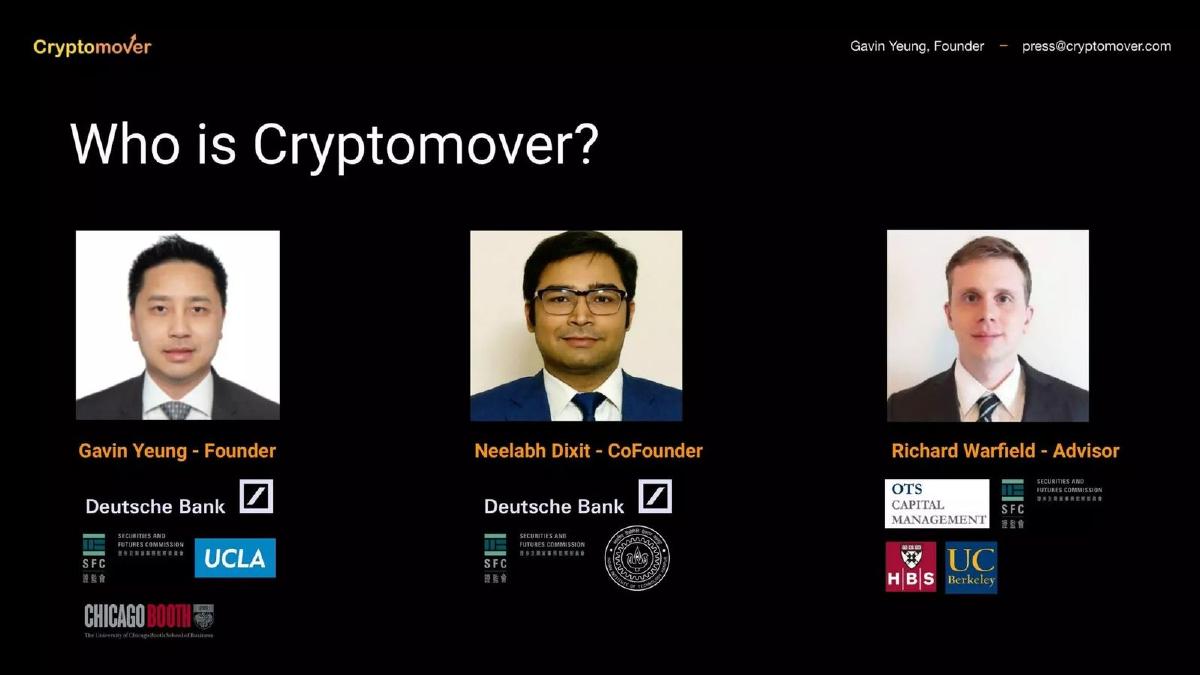
- The founding team emphasizes institutional credibility, featuring two former Deutsche Bank employees and an advisor with SFC and HBS credentials (Slide 5).
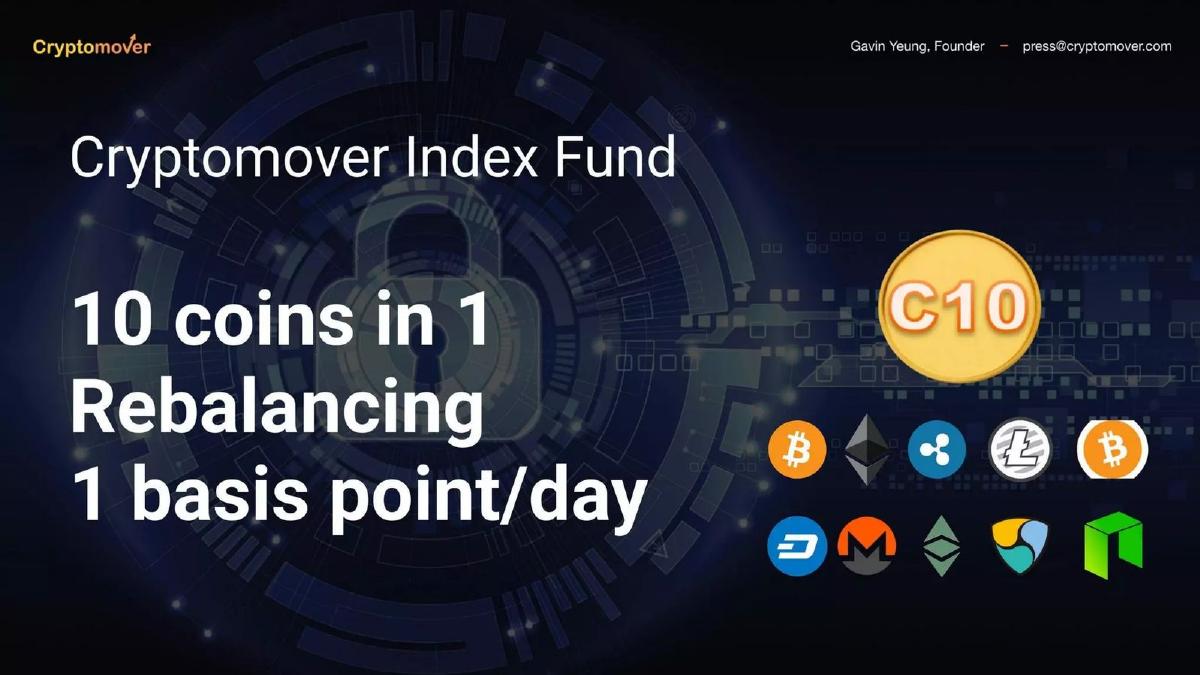
- The flagship product is the 'C10' Index Fund, which includes 10 coins and features daily rebalancing at 1 basis point per day (Slide 6).
- The deck claims early investors achieved a 6x return on their money between January and September 2017 (Slide 7).
- Traction is defined by over $1M in assets under management and the development of a risk and compliance system (Slide 8).
- The deck completely omits a financial 'ask' or a breakdown of how investment capital would be utilized.
- There is no slide dedicated to the competitive landscape or the technical architecture of the trading platform.
The Cryptomover Teardown
Cryptomover emerged in 2016, a period when the bridge between traditional finance (TradFi) and the burgeoning cryptocurrency market was still being built. This 9-slide deck is a minimalist artifact of that era, focusing heavily on team pedigree and market size rather than granular product mechanics. It is a 'vision' deck designed to appeal to institutional-minded investors who were wary of the 'Wild West' nature of early crypto exchanges.
Slide 1: Title Slide
The deck opens with a simple black background featuring the Cryptomover logo. The logo incorporates an upward-pointing arrow in the 'r', signaling growth. Contact information for Founder Gavin Yeung is provided at the bottom. A QR code in the top right corner suggests this deck was likely used in a live presentation setting where viewers could quickly scan for more information.
Slide 2: The Value Proposition
This slide serves as the hook. It identifies the core problem—complexity and lack of accessibility in crypto—and offers a simple solution. The use of high-contrast orange text on a black background is a recurring design theme intended to emphasize key terms.
Slide 3: Market Opportunity
Cryptomover quantifies the opportunity by comparing two figures: a "$150 billion" coin market and a "$4 trillion" ETF market. By placing these numbers side-by-side, the deck suggests that as crypto matures, it will inevitably adopt the index-based structures (ETFs) that dominate traditional finance. This is a classic 'large market' slide that seeks to justify the venture's scale.
Slide 4: Vision Statement
The vision is stated clearly: "a regulated crypto investment manager in Asia." The choice of words here is deliberate. 'Regulated' addresses the primary fear of institutional investors in 2016-2017, and 'Asia' defines the geographic moat. The background image of the Hong Kong skyline reinforces the company's intended headquarters and operational focus.
Slide 5: The Team
This is arguably the strongest slide in the deck. It features Gavin Yeung (Founder), Neelabh Dixit (Co-Founder), and Richard Warfield (Advisor). The slide is heavy on institutional logos, including Deutsche Bank , SFC (Securities and Futures Commission) , UCLA , Chicago Booth , HBS , and UC Berkeley . For a crypto startup in 2016, this level of traditional financial and academic pedigree was a significant differentiator intended to build trust.
Slide 6: The Product (C10 Index Fund)
The deck introduces the 'Cryptomover Index Fund' or 'C10'. The slide lists three key features: "10 coins in 1" , "Rebalancing" , and "1 basis point/day" . Icons for various cryptocurrencies (Bitcoin, Ethereum, Ripple, Litecoin, Bitcoin Cash, Dash, Monero, Ethereum Classic, Zcash, and Neo) are displayed. This slide explains the 'how'—investors get diversified exposure through a single managed product.
Slide 7: Performance and Traction
A line graph shows a sharp upward trajectory from January 2017 to September 2017. The headline claims "Early investors have made 6X their money." While impressive, this performance is largely reflective of the 2017 crypto bull market rather than proprietary trading alpha, though it serves to demonstrate the 'easy' gains promised on Slide 2.
Slide 8: Real Traction
The deck moves from market performance to internal milestones. It lists "Family Offices + High Net Worth" as the client base and claims "Over $1M in assets" under management. It also mentions a "Risk & compliance system," which ties back to the 'regulated' vision mentioned on Slide 4. The background image of a handwritten notebook with '84% conversation rate' and '$42,000' is somewhat distracting and doesn't clearly align with the text.
Slide 9: Closing Slide
The deck concludes by repeating the value proposition: "Make cryptocurrency investing easy and accessible." It provides the founder's contact information again, maintaining the minimalist aesthetic of the rest of the presentation.
What Works
Institutional Credibility: By highlighting the Deutsche Bank and SFC connections, the founders position themselves as the 'adults in the room' of the early crypto era. · Simplicity: The 'C10' product is easy to understand. It doesn't get bogged down in blockchain technicalities, focusing instead on the investment outcome. · Market Comparison: Comparing the crypto market to the $4T ETF market is a powerful way to show the 'room for growth' without needing complex spreadsheets.
What is Missing
The Ask: There is no slide indicating how much money the company is looking to raise or what the valuation expectations are. · Business Model: Beyond a mention of '1 basis point/day', there is no explanation of how Cryptomover generates revenue. Are there management fees? Performance fees? Withdrawal fees? · Competitive Landscape: In 2016/2017, other index-like products (such as Bitwise or Grayscale) were emerging. The deck fails to explain why Cryptomover is the superior choice. · Regulatory Roadmap: While the deck mentions being 'regulated', it doesn't specify which licenses they hold or are applying for, which is a critical detail for an investment manager. · Technology: There is no mention of how the assets are secured (custody solutions) or how the rebalancing algorithm actually functions.
What a Founder Should Copy
Logo/Brand Consistency: The deck uses a consistent color palette and clean typography that feels professional and modern. The 'Vision' Slide: Slide 4 is a perfect example of a concise vision statement. It defines the 'what' (investment manager), the 'how' (regulated), and the 'where' (Asia) in seven words. Logo Soup for Credibility: If your team has worked at prestigious institutions, use those logos. In the early stages of a startup, you are selling the team's potential as much as the product. High-Level Market Sizing: Using a well-known adjacent market (like ETFs) to benchmark a new market (like Crypto) is an effective way to communicate scale quickly.
Frequently asked questions
- What is the primary product offered by Cryptomover?
- According to slide 6, the primary product is the Cryptomover Index Fund, specifically the 'C10'. This fund holds 10 different cryptocurrencies in a single vehicle, featuring daily rebalancing and a cost of 1 basis point per day.
- Who is the target audience for this platform?
- Slide 8 explicitly identifies Family Offices and High Net Worth individuals as the target demographic, noting that the company has already secured over $1M in assets from these groups.
- What is the background of the Cryptomover founders?
- The team has a strong background in traditional finance. Founder Gavin Yeung and Co-Founder Neelabh Dixit are both alumni of Deutsche Bank. The team also highlights connections to the SFC (Securities and Futures Commission), UCLA, and Chicago Booth (Slide 5).
- Does the deck explain how the company makes money?
- No. While slide 6 mentions '1 basis point/day' in the context of the index fund, the deck does not provide a formal business model, revenue projections, or a breakdown of management fees.
- What geographic market is Cryptomover focusing on?
- Slide 4 states the vision is to be a regulated crypto investment manager in Asia, with the background image featuring the Hong Kong skyline.