CrowdSmart's 2016 deck presents a data-driven approach to early-stage investing, centered on their proprietary 'Startup Investment Readiness Score' (SIR Score). The platform functions as a bridge between startups, expert investors, and matching funds, utilizing collective intelligence to quantify risk. By positioning the SIR Score as a 'FICO-like' metric for startups, the company attempts to standardize the opaque due diligence process. The business model is two-pronged: a $2,400 annual subscription for startups and a matching fund that generates set-up fees and 10% carried interest. While th…
Key takeaways
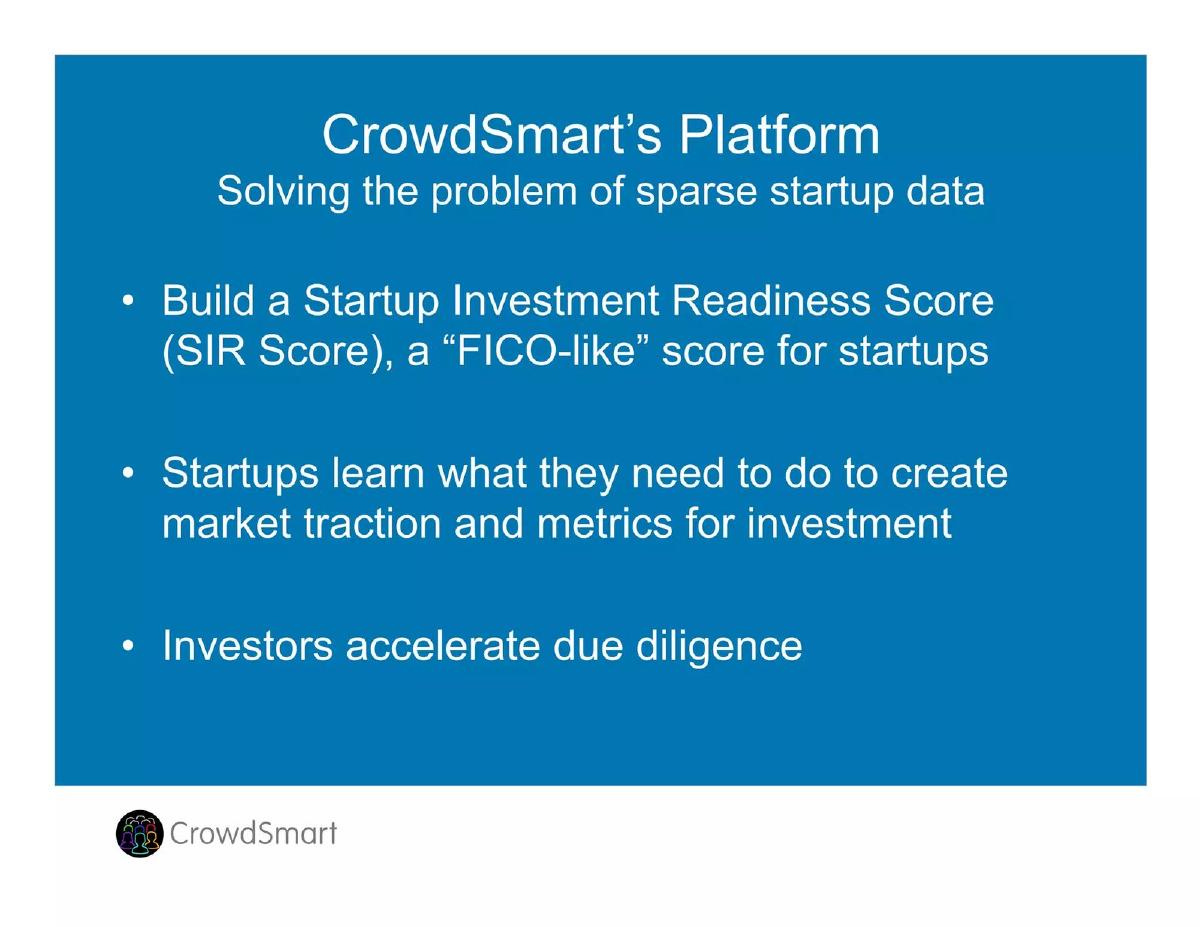
- The core product is the Startup Investment Readiness Score (SIR Score), described as a FICO-like metric for startups (Slide 3).
- The business model relies on two revenue streams: a $2,400 annual startup subscription and a matching fund with 10% carried interest (Slide 9).
- CrowdSmart leverages 'Smart Crowd Investors & Experts' to provide the qualitative data needed for their scoring system (Slide 2).
- The management team claims a track record of founding or leading 10 technology startups with exits exceeding $1 billion (Slide 10).
- The platform targets three specific startup stages: Pre-Funded, Seed Funded, and Series A (Slide 5).
- Investment capital is unlocked through a formula: SIR Score + multiple expert investors + matching fund (Slide 6).
- The deck includes a screenshot of a 'Radar' tool where investors rate opportunities on a scale from 'Not At All' to 'Totally' (Slide 7).
- The advisory board is heavily academic, featuring professors from UCLA, University of Michigan, UC Irvine, and UC Berkeley (Slide 10).
CrowdSmart: Standardizing the Seed Stage
The 2016 pitch deck for CrowdSmart attempts to tackle one of the most difficult problems in venture capital: the lack of standardized data for early-stage companies. By introducing the 'SIR Score,' CrowdSmart positions itself not just as a platform, but as a new layer of financial infrastructure. This teardown examines how they presented this vision to investors.
Slide 1: Title Slide
The deck opens with the tagline 'Data Driven Startup Investing' and a sub-header promising an 'Accelerated path to capital for top scoring startups.' The imagery is a blurred photo of a presentation, emphasizing the 'crowd' aspect of their name. It establishes the company's focus immediately: using data to streamline the funding process.
Slide 2: Business Plan Overview
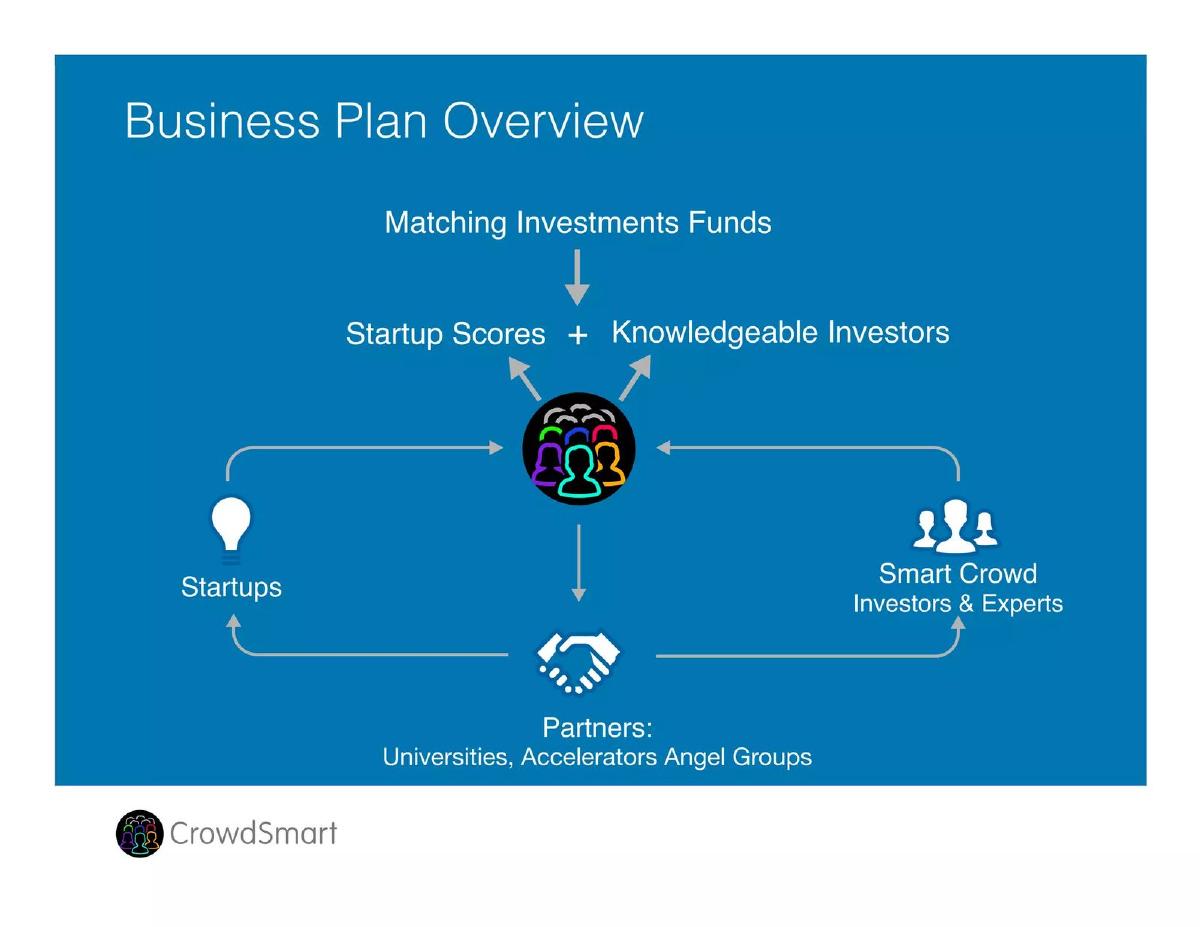
This slide uses a flow diagram to explain the ecosystem. At the center is the CrowdSmart logo, which acts as a clearinghouse. Startups and Smart Crowd Investors & Experts feed data into the center. This results in Startup Scores and Knowledgeable Investors , which are then paired with Matching Investment Funds . The slide also mentions partners like universities, accelerators, and angel groups, suggesting a B2B2C distribution model where they plug into existing startup hubs.
Slide 3: CrowdSmart’s Platform
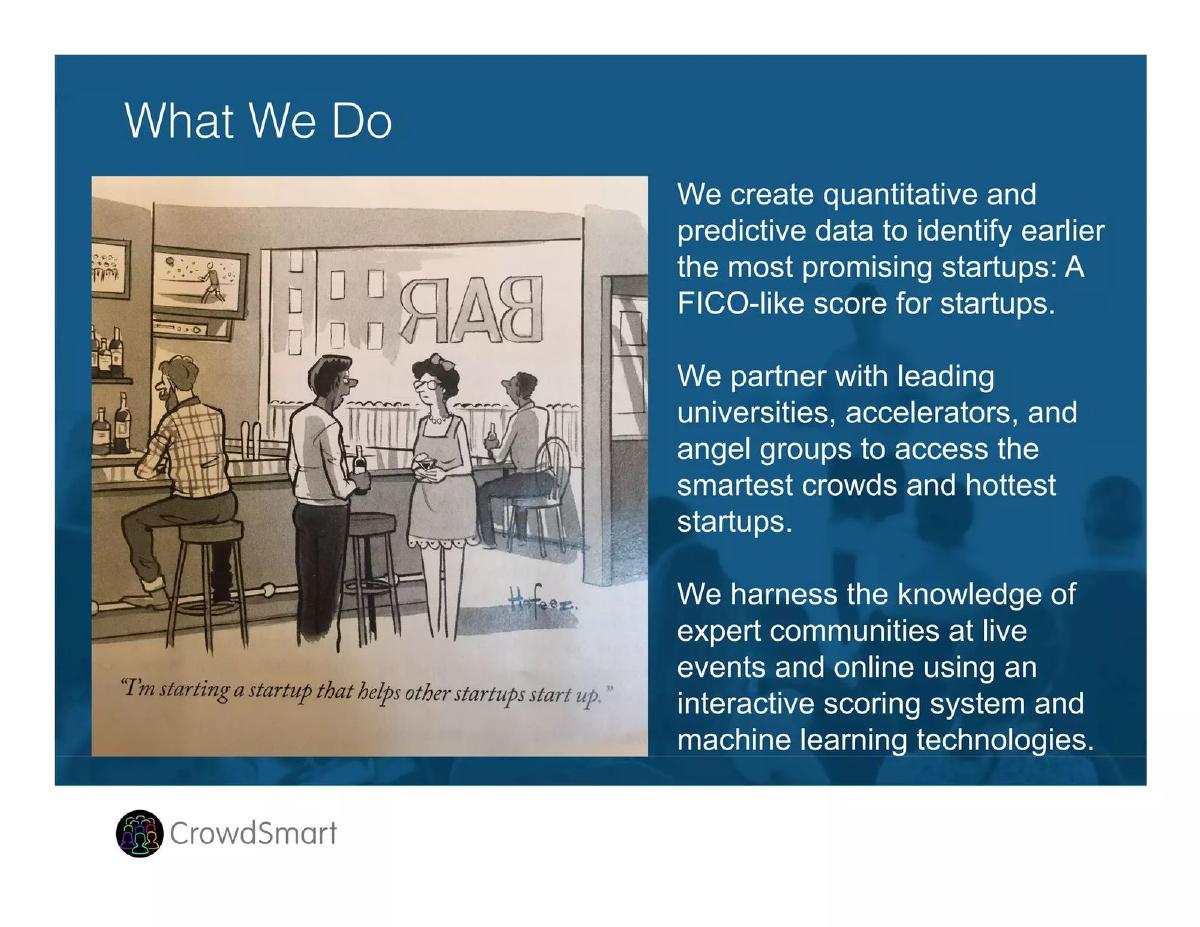
Slide 3 defines the core value proposition: 'Solving the problem of sparse startup data.' The key takeaway here is the Startup Investment Readiness Score (SIR Score) , which they explicitly call a 'FICO-like' score for startups. This is a powerful analogy, as it suggests a future where startup risk is as easily quantifiable as consumer credit risk. The slide claims this helps startups learn how to create traction and helps investors accelerate due diligence.
Slide 4: Past Experience with Predictions
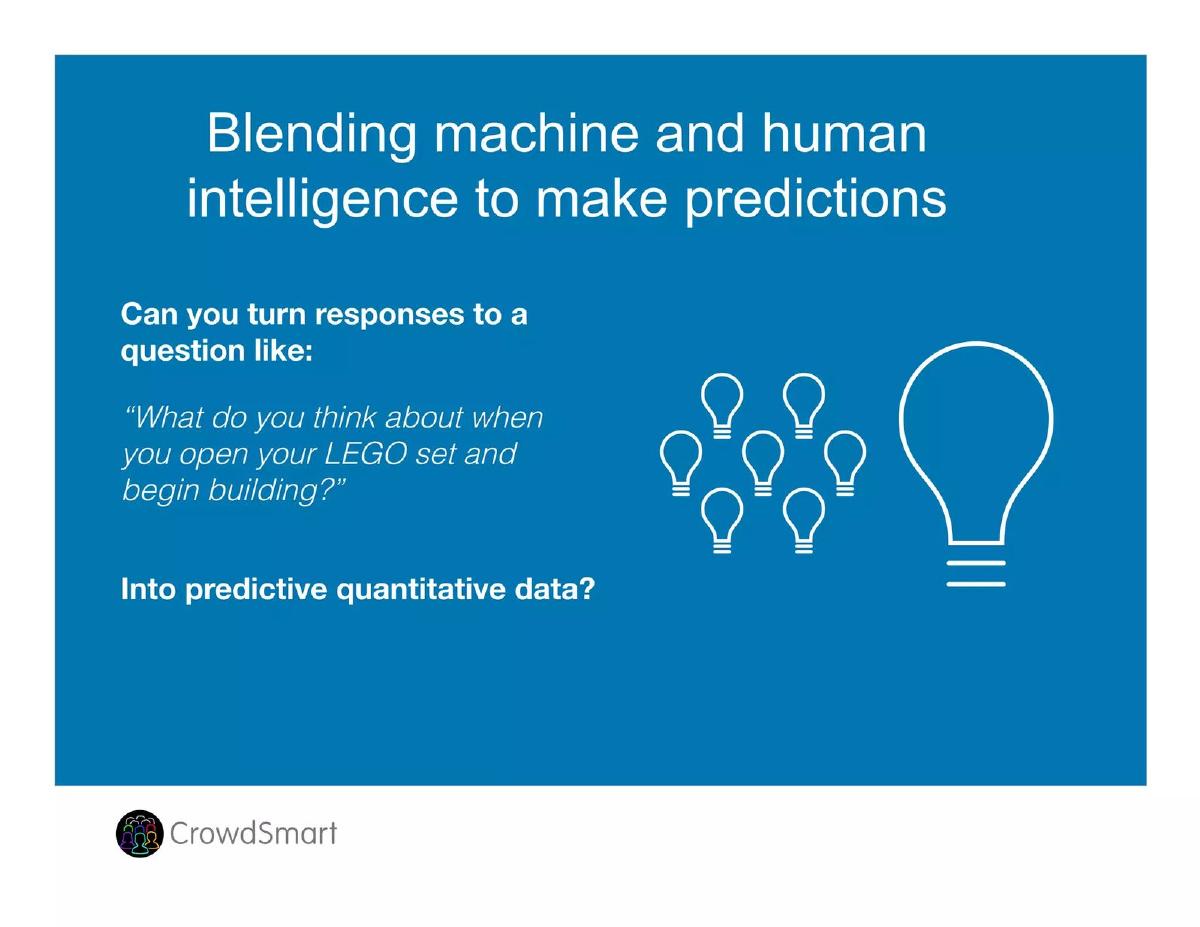
To build credibility for their scoring algorithm, Slide 4 shows screenshots of past projects involving brands like NBC, P&G, and LEGO. The slide claims 'Better Predicts: Product success; New market opportunities; and more...' This is intended to prove that the founders aren't just guessing; they have a history of building predictive models for major corporations, though the slide doesn't detail the specific outcomes of these past ventures.
Slide 5: Touch Points for Building Startup Metrics
This slide provides a roadmap of how the platform collects data over time. It divides the startup lifecycle into three stages: Pre-Funded , Seed Funded , and Series A . As a company moves along the timeline, the 'Touch Points' evolve from qualitative (advisers, mentors, prospects) to quantitative (customers, financial metrics, competitive ranking). This illustrates that the SIR Score is intended to be a dynamic metric that grows with the company.
Slide 6: Investment Model Catalyst for Syndication
Slide 6 explains the mechanics of the funding. It presents a formula: SIR Score + Investor 1 + Investor 2 + ... Investor N + Matching Fund = $ Startup Capital . The matching fund is only available to companies that achieve a high SIR Score and attract a minimum set of 'expert' investors. This is a clever way to mitigate risk; the platform doesn't just rely on its algorithm, nor does it just rely on human investors. It requires both to align before deploying capital.
Slide 7: Example of 'Radar'
This slide provides a look at the user interface. It shows a tool called 'Radar' where an investor is asked: 'Does the company presentation convince you that this is a hot opportunity?' The user moves an orange circle on a slider between 'Not At All' and 'Totally.' This slide is crucial because it shows how CrowdSmart converts subjective human opinion into a numerical data point (in this case, a '9').
Slide 8: Example: Hot Opportunity?
Following the input slide, Slide 8 shows the output. It displays a 'Response breakdown' histogram with a mean score of 78.8% . Below the chart is a list of qualitative comments from experts, including their individual scores and 'Ratings' (likely a reputation score for the expert). This demonstrates how the platform aggregates 'collective intelligence' to provide a nuanced view of a startup's potential.
Slide 9: Revenues
The business model is presented with two bullet points. First, a Startup Platform Subscription Fee of $2,400 per year . Second, Matching Fund Fees , which include a set-up fee plus 10% carried interest . This dual-revenue model is interesting because it provides immediate SaaS-like cash flow from the startups while maintaining the long-term upside of a venture fund. However, the deck does not specify how many startups were currently paying this fee at the time of the presentation.
Slide 10: CrowdSmart Team
The final slide in this selection focuses on the team. The headline claim is that the management team has 'previously founded / led 10 technology startups that sold or IPO’d for over $1 billion .' The slide lists Fred Campbell (CEO), Tom Kehler (Chief Scientist), and others. The 'Business, Academic, Investment, Science Board and Advisors' section is particularly heavy on PhDs and academic credentials, reinforcing the 'data-driven' and 'scientific' nature of their approach. Notable names include Kim Polese as Chairman and academic representatives from UCLA and UC Berkeley.
What Works in This Deck
The FICO Analogy: Comparing the SIR Score to a FICO score is a brilliant piece of positioning. It takes a complex, algorithmic concept and makes it instantly understandable to any investor. · Dual Revenue Streams: Combining a subscription model with a carry-based fund model shows a sophisticated understanding of how to monetize both the software and the asset class. · Academic Credibility: For a company claiming to use 'collective intelligence' and 'science,' having a board filled with PhDs from top-tier research universities is a strong signal of legitimacy. · Visualizing the 'How': Slides 7 and 8 do a great job of showing exactly how the data is collected and presented. It moves the conversation from abstract 'AI' to a tangible product.
What Is Missing from This Deck
The Ask: There is no slide in this 10-slide selection that states how much money CrowdSmart is looking to raise or what the valuation expectations are. · Market Size: While the deck explains the product well, it doesn't quantify the Total Addressable Market (TAM). How many startups are in their target stages? How large is the matching fund opportunity? · Competitive Landscape: The deck doesn't mention other equity crowdfunding platforms (like AngelList or SeedInvest) or other data-driven investment firms. Investors would want to know how CrowdSmart's algorithm differs from competitors. · Traction Metrics: While they show an 'example' of a hot opportunity, they don't provide aggregate data on how many startups have gone through the platform, the average SIR score, or the performance of the matching fund to date.
Lessons for Founders
Use Familiar Anchors: If you are building something highly technical or novel, use a 'The [X] for [Y]' comparison (like the FICO analogy) to help investors categorize your business quickly. · Show the 'Work': Don't just say you have an algorithm. Show the input screens and the output reports. Seeing the actual UI makes the technology feel real and 'shippable.' · Leverage Your Board: If your team lacks a specific type of pedigree, use your advisory board to fill the gap. CrowdSmart used their academic board to bolster the 'science' part of their pitch. · Be Clear on Revenue: Listing specific dollar amounts (like the $2,400 fee) and percentage points (10% carry) shows that you have a concrete plan for monetization, rather than just a vague hope of 'figuring it out later.'
Frequently asked questions
- What is the SIR Score mentioned in the deck?
- The Startup Investment Readiness Score (SIR Score) is CrowdSmart's proprietary metric designed to act as a 'FICO-like' score for early-stage companies. According to Slide 3, it aims to solve the problem of sparse startup data by quantifying investment readiness, helping startups understand their market traction and allowing investors to accelerate the due diligence process through standardized data points.
- How does CrowdSmart make money?
- Based on Slide 9, the company has two primary revenue streams. First, they charge startups a 'Startup Platform Subscription Fee' of $2,400 per year. Second, they operate a matching fund that generates revenue through a set-up fee and a 10% carried interest on the profits of the investments made through the platform.
- What role do external investors play in the CrowdSmart ecosystem?
- External investors, referred to as 'Smart Crowd Investors & Experts,' are essential to the scoring mechanism. Slide 6 shows that the 'Investment Model Catalyst' requires a high SIR Score plus a minimum set of these expert investors to trigger the 'Matching Fund.' They provide the qualitative feedback and ratings that the platform then aggregates into data-driven insights.
- Who is behind CrowdSmart according to the 2016 deck?
- The management team is led by CEO Fred Campbell and Chief Scientist Tom Kehler. The deck notes on Slide 10 that the team has collectively led 10 startups to exits or IPOs worth over $1 billion. The team also includes CTO Markus Guehrs, VP Product Emily WaskLewicz, and a robust advisory board of PhDs from major research universities.
- What stages of startups does the platform serve?
- Slide 5 illustrates a timeline of 'Touch Points' that spans from Pre-Funded to Seed Funded and finally Series A. The platform aims to build metrics across this entire lifecycle, moving from advisor and mentor feedback in the early stages to financial metrics and competitive ranking as the company approaches Series A.