This 2016 corporate overview for Cornerstone OnDemand (CSOD) serves as a strategic roadmap for a public company aiming to reach $1 billion in revenue. The deck emphasizes the company's evolution from a learning-centric tool to a full-suite talent management leader, validated by its position in the Gartner Magic Quadrant. With a reported revenue CAGR of 53.6% and bookings CAGR of 50.7% from 2007 to 2015, the narrative focuses on market dominance and expansion into small business and developer ecosystems. By highlighting the 'Cornerstone Edge' platform and a purpose-built SMB edition, the compa…
Key takeaways
- Cornerstone reports a significant 53.6% Revenue CAGR from 2007 to 2015, reaching $339.7 million (Slide 13).
- The company positions itself as the top leader in the Gartner Magic Quadrant for Talent Management Suites as of August 2015 (Slide 9).
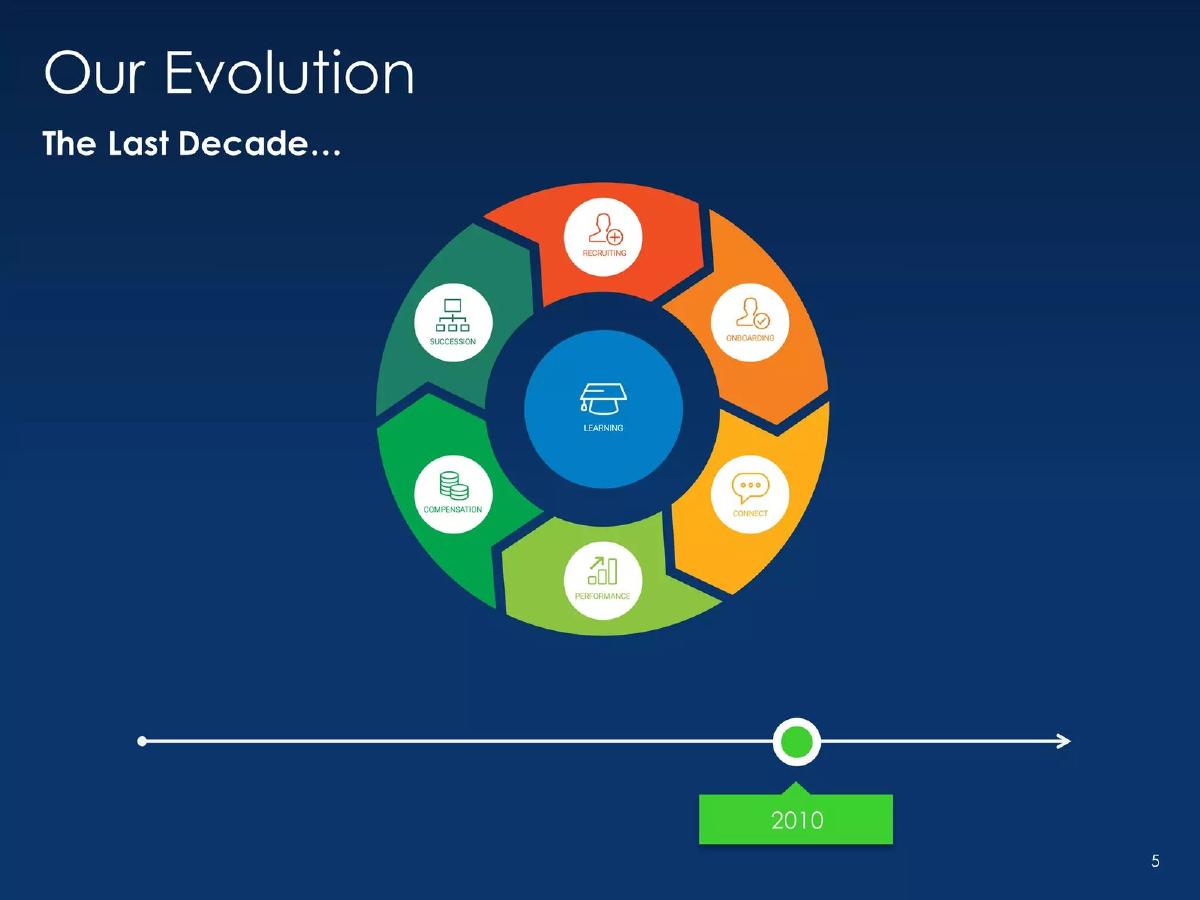
- A strategic shift is shown from a 2010 focus to a multi-pillar suite including Recruiting, Onboarding, Connect, Performance, Compensation, and Succession (Slide 5).
- The 'Marching to $1 Billion' goal is the central theme for the company's future opportunity (Slide 17).
- Growth strategy relies on six pillars: core market sales, global expansion, market segmentation, vertical opportunity, installed base, and extended enterprise (Slide 21).
- The company introduced a 'Growth Edition' specifically for small businesses, featuring a 3-hour deployment time (Slide 25).
- Future growth is tied to 'Cornerstone Edge,' a developer-focused ecosystem for building and marketing third-party apps (Slide 33).
- Bookings growth closely mirrors revenue, showing a 50.7% CAGR and reaching $400.5 million in 2015 (Slide 13).
Executive Summary: The Path to a Billion
The Cornerstone OnDemand (CSOD) First Quarter 2016 Corporate Overview is a high-level strategic document designed for the investor community. Unlike a seed-stage pitch deck that must prove a problem exists, this deck focuses on the mechanics of scaling a proven winner. The narrative is built around three core pillars: historical dominance, market leadership validation, and the technical infrastructure required to reach $1 billion in annual revenue. By utilizing long-term CAGR data and third-party analyst rankings, Cornerstone presents itself as the inevitable winner in the talent management space.
Slide 1: Title Slide
The deck opens with a clean, corporate title slide: "Corporate Overview First Quarter 2016." The branding is consistent with the Cornerstone logo and the tagline "realize your potential." This sets a professional, stable tone suitable for a publicly traded company communicating with institutional investors.
Slide 5: Our Evolution
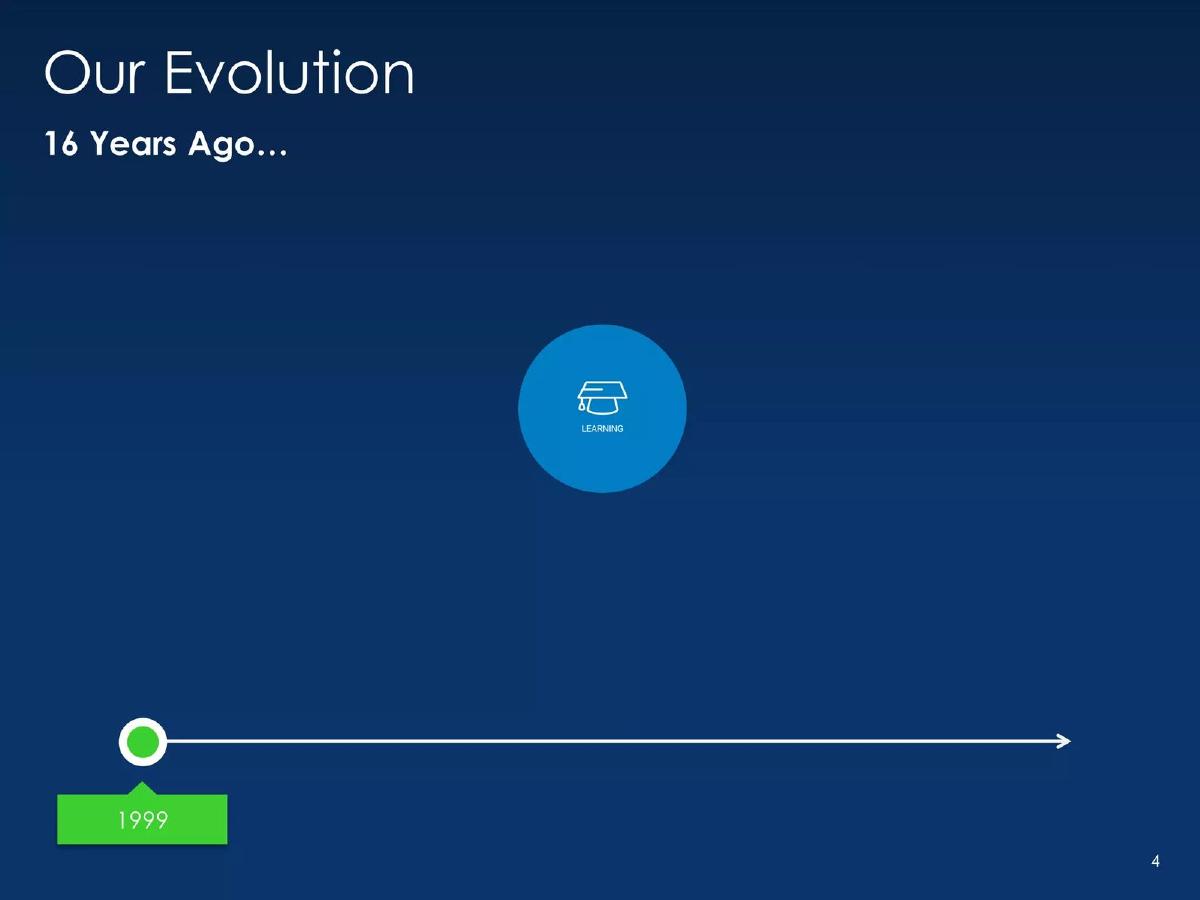
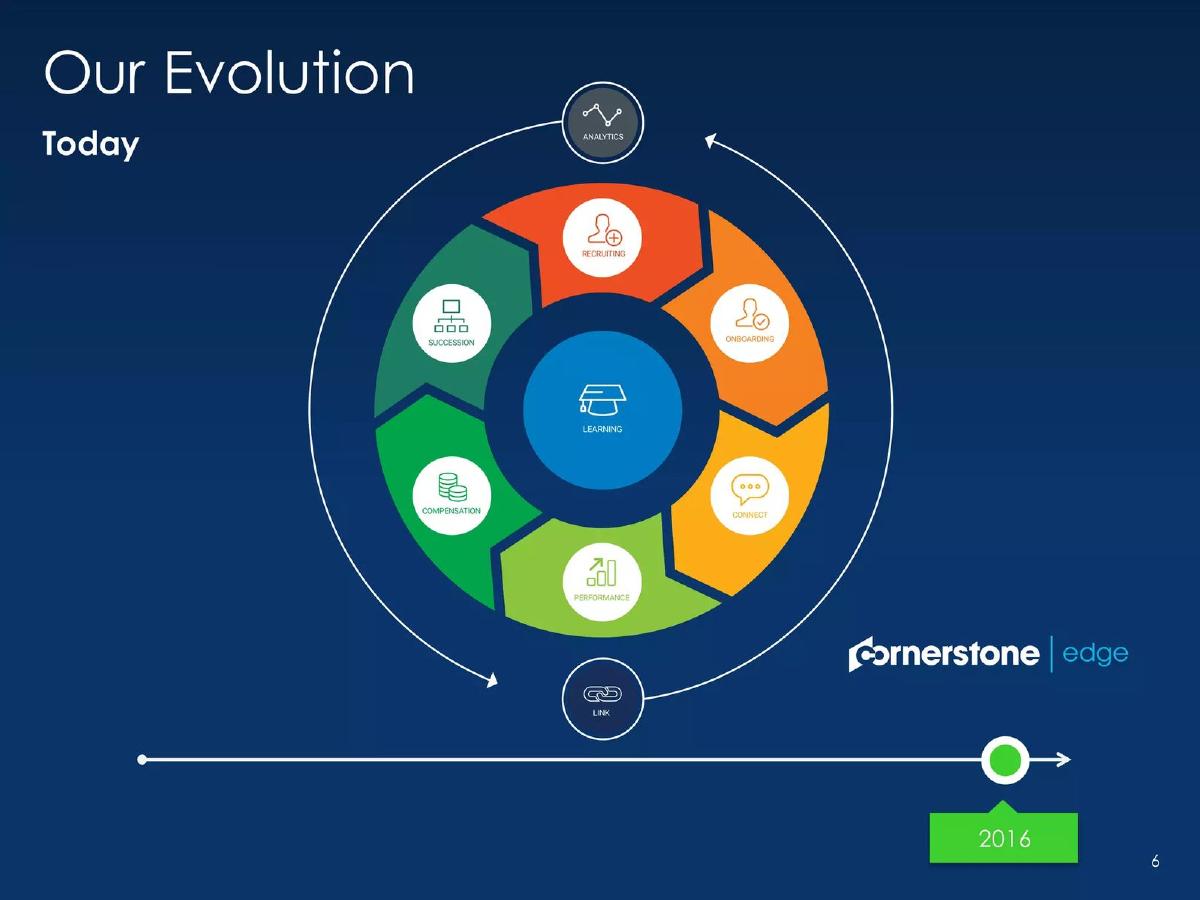
Slide 5, titled "Our Evolution: The Last Decade...", uses a circular diagram to illustrate the company's product expansion. At the center is "Learning," which was the company's original core competency. Surrounding it are the modules added to create a full suite: Recruiting, Onboarding, Connect, Performance, Compensation, and Succession. A timeline at the bottom highlights 2010 as a pivotal year. This slide is crucial because it justifies the company's transition from a niche tool to a comprehensive Talent Management Suite, which significantly increases their Total Addressable Market (TAM) and potential for account expansion.
Slide 9: Market Leadership Validation
Cornerstone uses Slide 9 to establish its competitive standing using the Gartner Magic Quadrant for Talent Management Suites (August 2015). The slide places Cornerstone firmly in the "Leaders" quadrant. Notably, the graphic shows Cornerstone positioned higher on the "Ability to Execute" axis than legacy giants SAP (SuccessFactors) and Oracle (Talent Management Cloud). This slide serves as a powerful piece of social proof, suggesting that despite being smaller than Oracle or SAP, Cornerstone's specialized focus results in a superior product and better execution.
Slide 13: Financial Performance Metrics
This is the most data-dense slide in the provided set, titled "Strong Results." It features two bar charts covering the period from 2007 to 2015. The first chart shows Revenue growing from $11.0 million to $339.7 million, representing a CAGR of 53.6%. The second chart shows Bookings growing from $15.0 million to $400.5 million, a CAGR of 50.7%. The use of a nine-year data set is intentional; it demonstrates that the company's growth is not a short-term fluke but a sustained, predictable trend. The fact that bookings ($400.5M) exceed revenue ($339.7M) is a positive indicator for future revenue recognition in a SaaS model.
Slide 17: The North Star Goal
Slide 17 acts as a transition slide with the bold text: "Our Opportunity: Marching to $1 Billion." This provides a clear, quantifiable goal for the company. It shifts the investor's mindset from looking at what the company has done to what it intends to achieve next. Setting a "billion-dollar" target is a common trope in mid-to-late stage decks to signal that the company still has significant room for 3x growth from its current levels.
Slide 21: Growth Strategy Levers
Titled "Opportunities Abound," Slide 21 lists six specific areas for future growth. These include Continued Core Market Sales, Global Expansion, Market Segmentation, Vertical Opportunity, Installed Base Opportunity, and Extended Enterprise. While the slide is visually simple—using a background image of a person drawing a growth line on a ladder—it provides a checklist for analysts to evaluate the company's future quarterly reports. It signals that growth will come from both horizontal (new markets/geographies) and vertical (more products to existing customers) expansion.
Slide 25: Segmenting the Market
Slide 25 introduces the "Growth Edition for Small Business." This represents a strategic move to capture the down-market segment. The slide lists four key features: Mobile ready, Self-configurable, 3-hour deployment, and Bundled training. The mention of a "3 hour deployment" is particularly important as it addresses the primary pain point of HR software: long, expensive implementation periods. By offering a "purpose-built" solution for growing businesses, Cornerstone is attempting to block smaller competitors from gaining a foothold in the SMB space.
Slide 29: Future Outlook
Slide 29 is another transition slide titled "The Future: Beyond 2016." It prepares the audience for the long-term vision of the company, moving beyond immediate quarterly results to the structural changes in how the company will operate as a platform.
Slide 33: The Platform Play
The final slide in the set, Slide 33, details "Cornerstone Edge." This is the company's evolution into a platform-as-a-service (PaaS). The slide breaks the ecosystem into four components: Learn (Developer community), Integrate (API & Integrations), Build (Edge Builder), and Market (Marketplace). This is a sophisticated strategic move. By allowing third-party developers to build and market apps on top of Cornerstone, the company creates a network effect and increases switching costs for its customers. It moves the company from being a vendor to being the operating system for HR.
What Makes This Deck Effective?
The effectiveness of this deck lies in its clarity and its use of third-party validation. For a company at this stage, investors are looking for two things: proof of past performance and a credible plan for future growth. Slide 13 provides the proof (53.6% CAGR), and Slide 9 provides the validation (Gartner Leadership). The deck does not waste time explaining what Talent Management is; it assumes the audience knows the market and focuses entirely on why Cornerstone is winning that market.
The transition from a software product to a platform (Slide 33) is also a key strength. In the SaaS world, platforms command higher multiples than simple applications because they are more "sticky" and can generate revenue from a developer ecosystem. By highlighting the Marketplace and API library, Cornerstone is signaling that it is building a moat that will be difficult for competitors to cross.
What Is Missing?
As this is a corporate overview for a public company, it lacks several elements common in startup decks, but there are still notable omissions. There is no mention of unit economics, such as Customer Acquisition Cost (CAC) or Lifetime Value (LTV). While the CAGR is impressive, investors also want to know the cost of that growth. Additionally, there is no slide dedicated to the management team in this selection, though as a public company, this information is widely available elsewhere. Finally, the deck lacks a specific competitive analysis slide that goes beyond the Gartner quadrant; it doesn't address how they plan to beat specific threats from emerging AI-driven HR startups that were beginning to gain traction in 2016.
Lessons for Founders
Use CAGR to Tell a Story: If you have more than three years of data, use CAGR to show the consistency of your growth. It smooths out seasonal fluctuations and shows the underlying health of the business (Slide 13). · Leverage Third-Party Validation: Don't just say you are the leader; show a map from a recognized analyst like Gartner or Forrester that proves it. If you are too early for Gartner, use G2 Crowd grids or major customer testimonials (Slide 9). · Define Your "North Star": Give your investors a clear, ambitious goal to rally behind. "Marching to $1 Billion" is a simple, effective way to communicate the scale of your ambition (Slide 17). · Show Product Evolution: Clearly illustrate how your product has grown from a single feature to a suite. This helps justify a larger valuation and shows a path to increasing Average Contract Value (ACV) through upselling (Slide 5). · The Platform Pivot: If your goal is to become a platform, show the infrastructure (APIs, Developer Tools, Marketplace) that will make it possible. Investors love the scalability of a platform model (Slide 33).
Frequently asked questions
- What is the primary financial metric used to show growth?
- Cornerstone uses Compound Annual Growth Rate (CAGR) to demonstrate long-term performance. On slide 13, they highlight a 53.6% Revenue CAGR and a 50.7% Bookings CAGR between 2007 and 2015. This specific metric is effective for showing consistent, high-velocity growth over nearly a decade, which is critical for maintaining investor confidence in a high-valuation SaaS company.
- How does Cornerstone define its competitive position?
- The company relies on third-party validation rather than self-assessment. Slide 9 features the Gartner Magic Quadrant for Talent Management Suites from August 2015. It places Cornerstone in the 'Leaders' quadrant, notably higher on the 'Ability to Execute' axis than major competitors like SAP (SuccessFactors) and Oracle (Talent Management Cloud).
- What is the 'Cornerstone Edge' mentioned in the deck?
- As shown on slide 33, Cornerstone Edge is the company's platform-as-a-service (PaaS) play. It consists of four stages: Learn (Developer community), Integrate (API library), Build (Edge Builder tools), and Market (Cornerstone Marketplace). This indicates a shift from being just a software provider to becoming a platform where third parties can build and sell their own applications.
- How is the company expanding its market reach beyond enterprise?
- Slide 25 introduces the 'Growth Edition for Small Business.' This is a purpose-built version of their talent management solution designed for rapid adoption. Key selling points include it being mobile-ready, self-configurable, and capable of a '3 hour deployment,' which contrasts with the typically long implementation cycles of enterprise software.
- What are the specific pillars of their future growth strategy?
- Slide 21 outlines six growth levers: Continued Core Market Sales, Global Expansion, Market Segmentation, Vertical Opportunity, Installed Base Opportunity (upselling existing clients), and Extended Enterprise. These categories suggest the company is looking for growth both by finding new customers and by increasing the lifetime value of existing ones.