Cultinet is a niche professional networking platform targeting the intersection of the visual arts and management sectors. The deck outlines a clear three-step user journey—request, view, connect—aimed at facilitating collaborations between artists, curators, and cultural institutions. With a revenue model based on low-cost subscriptions ($6/month for artists and $100/year for institutions), the company positions itself between broad corporate networks like LinkedIn and specialized arts recruitment firms. While the deck provides a functional overview of the product and its go-to-market strate…
Key takeaways
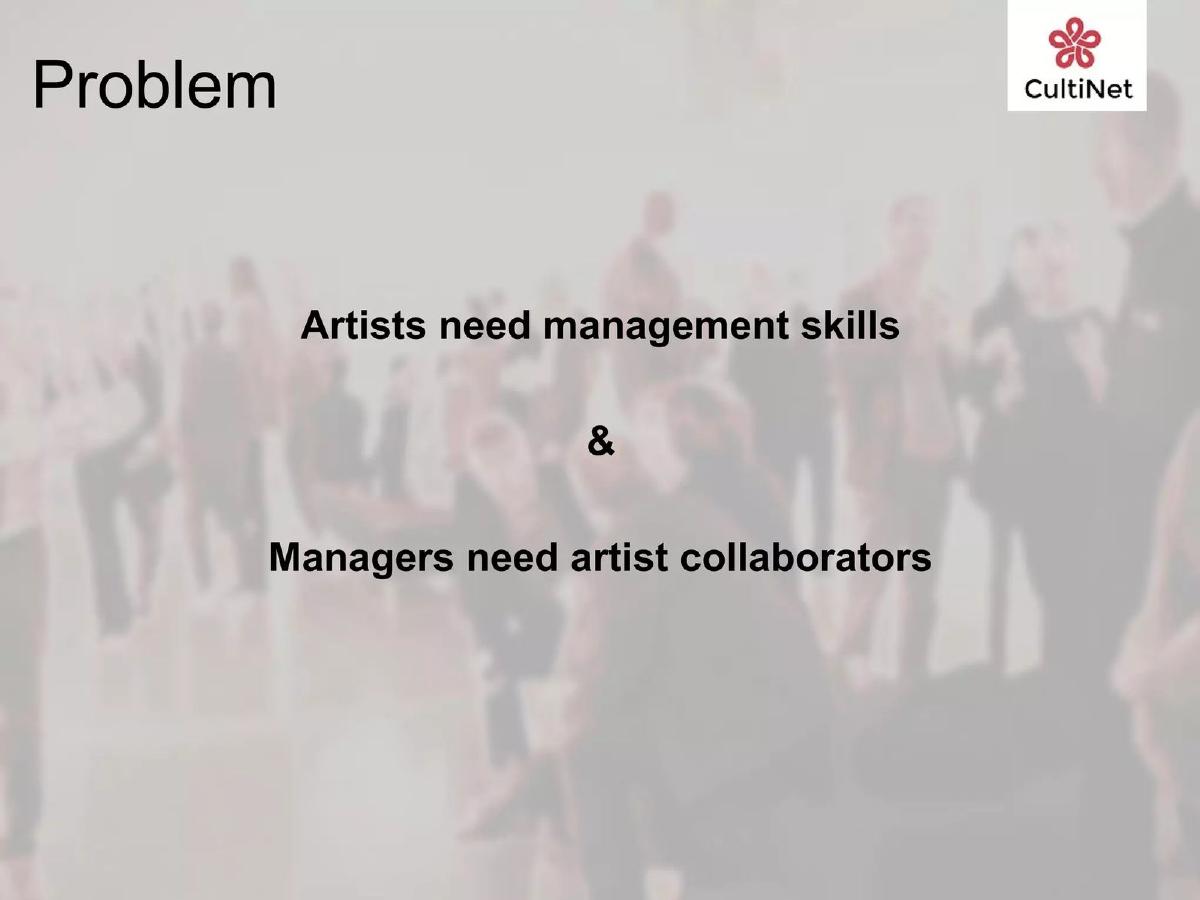
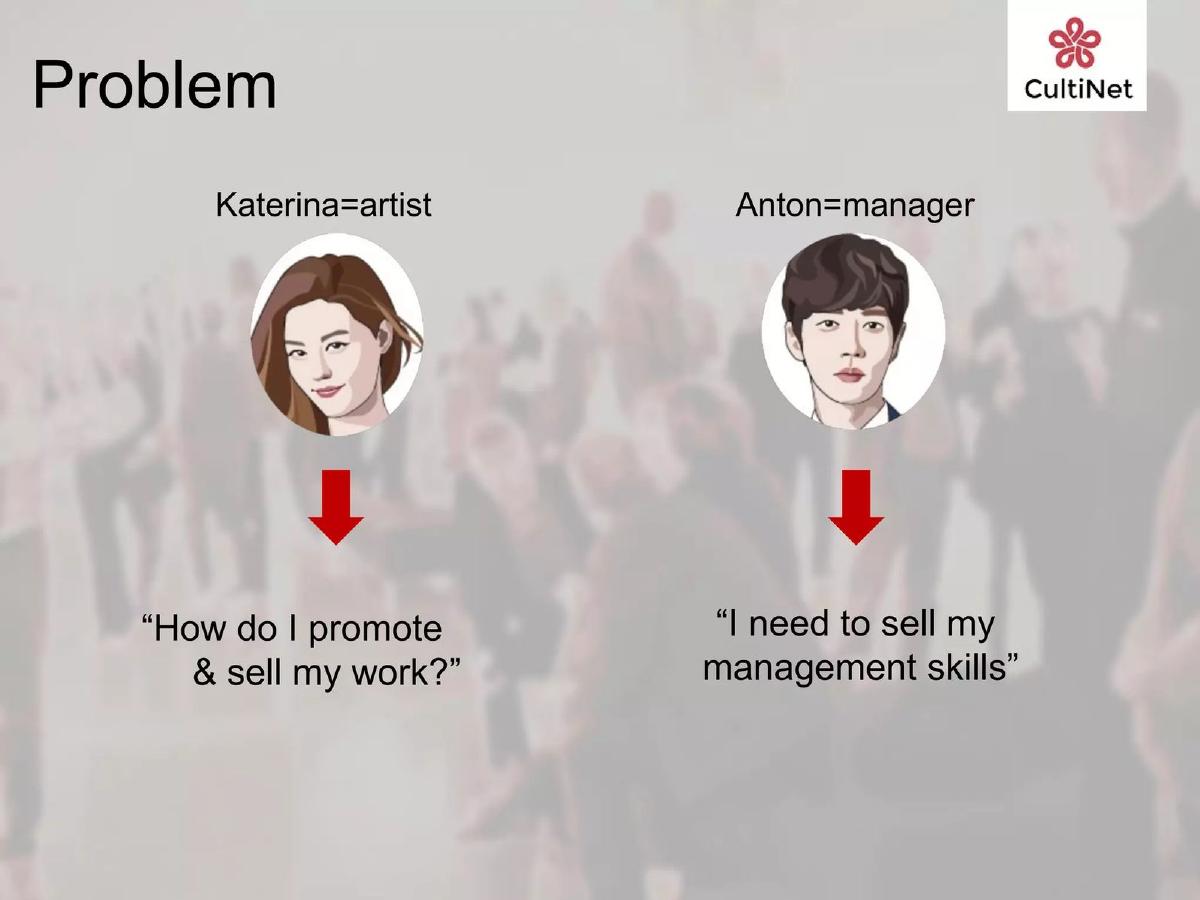
- The platform targets two distinct user groups: visual artists needing business skills and managers seeking creative talent (Slide 2).
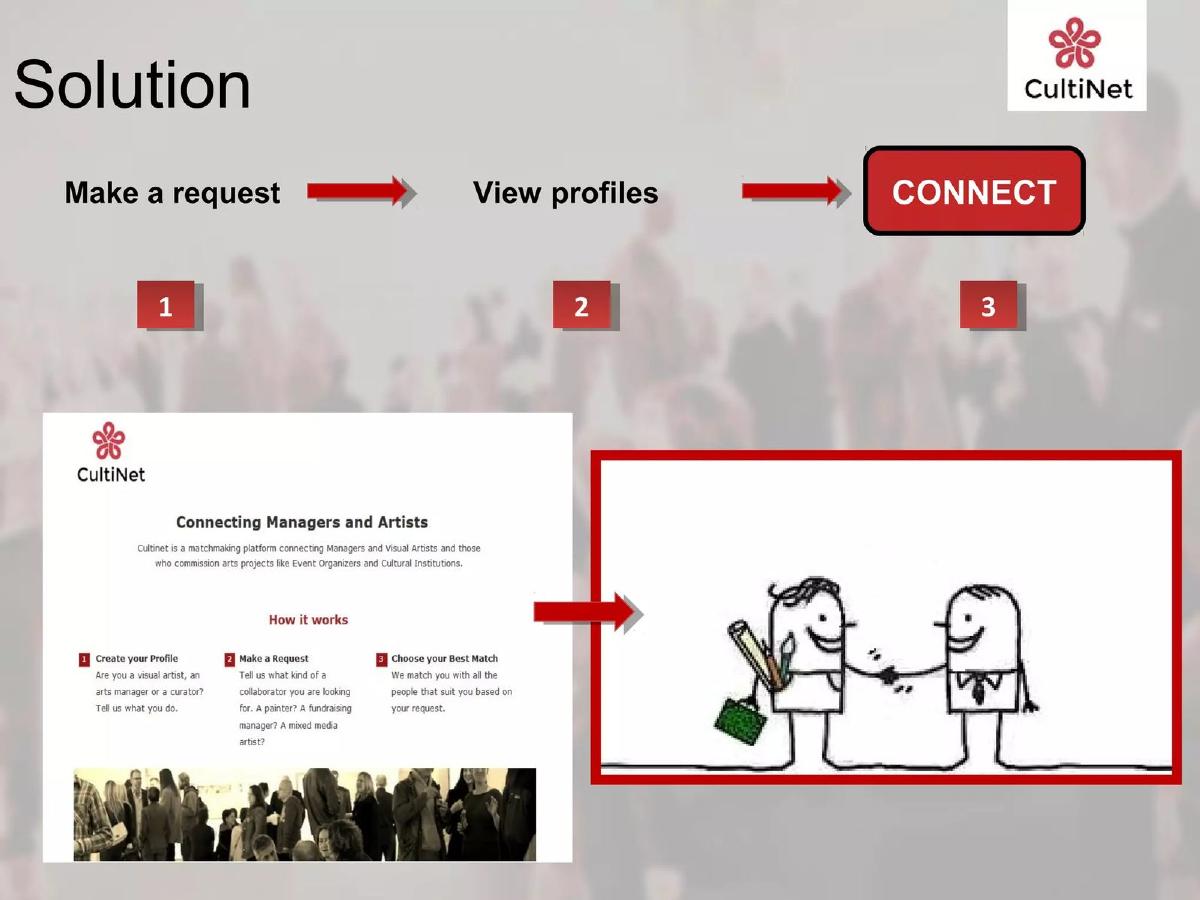
- The user experience is simplified into a three-step process: Make a request, View profiles, and Connect (Slide 3).
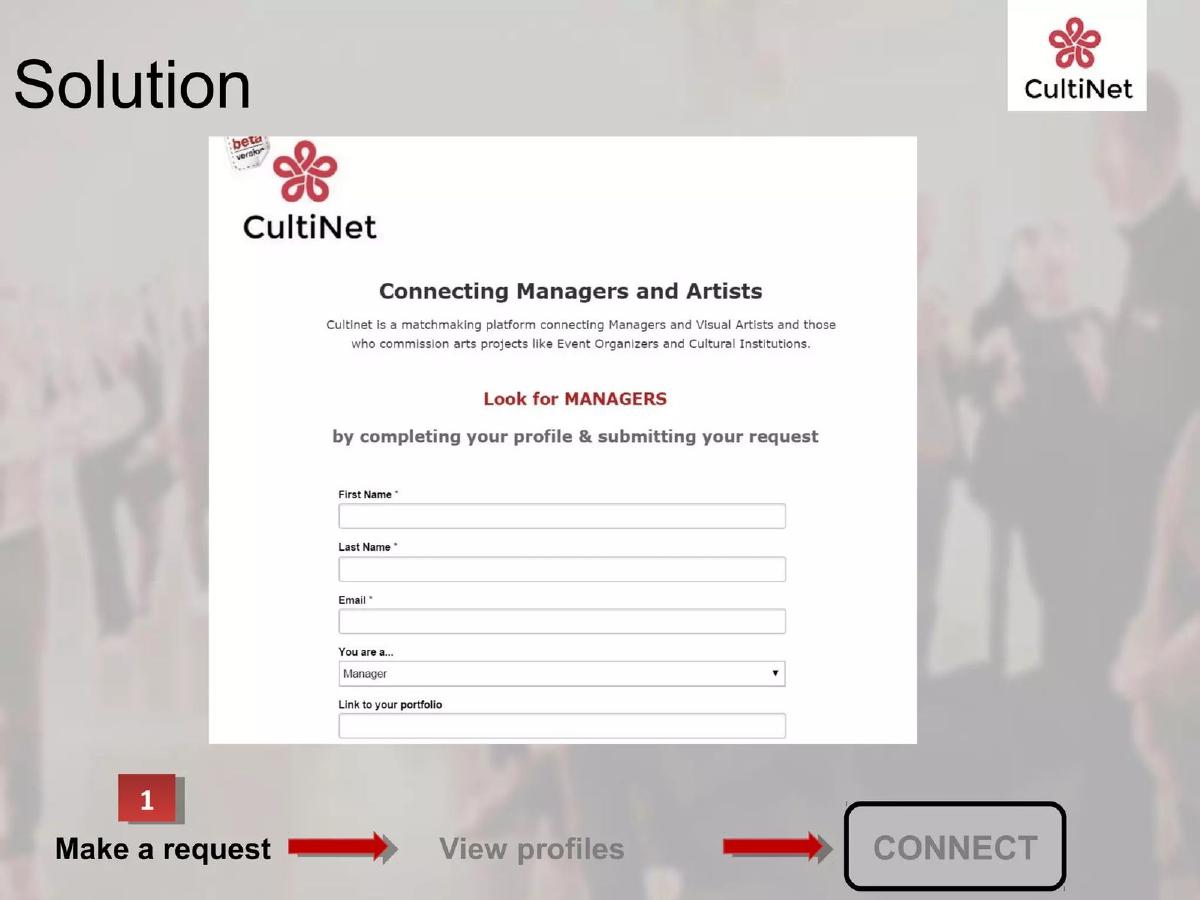
- Product screenshots show a 'beta version' tag and a matching algorithm that provides percentage-based compatibility scores (Slide 4).
- Cultinet positions itself in the overlap between 'Corporate' networks like LinkedIn and 'Arts Recruitment' firms like ArtStaffing.com (Slide 5).
- Go-to-market strategy relies on customer development through blogs, events, and strategic partnerships (Slide 6).
- Revenue is generated via a $6/month subscription for artists and a $100/year subscription for institutions (Slide 7).
- The deck mentions an 'Affiliations %' revenue stream but does not define the percentage or the nature of these affiliations (Slide 7).
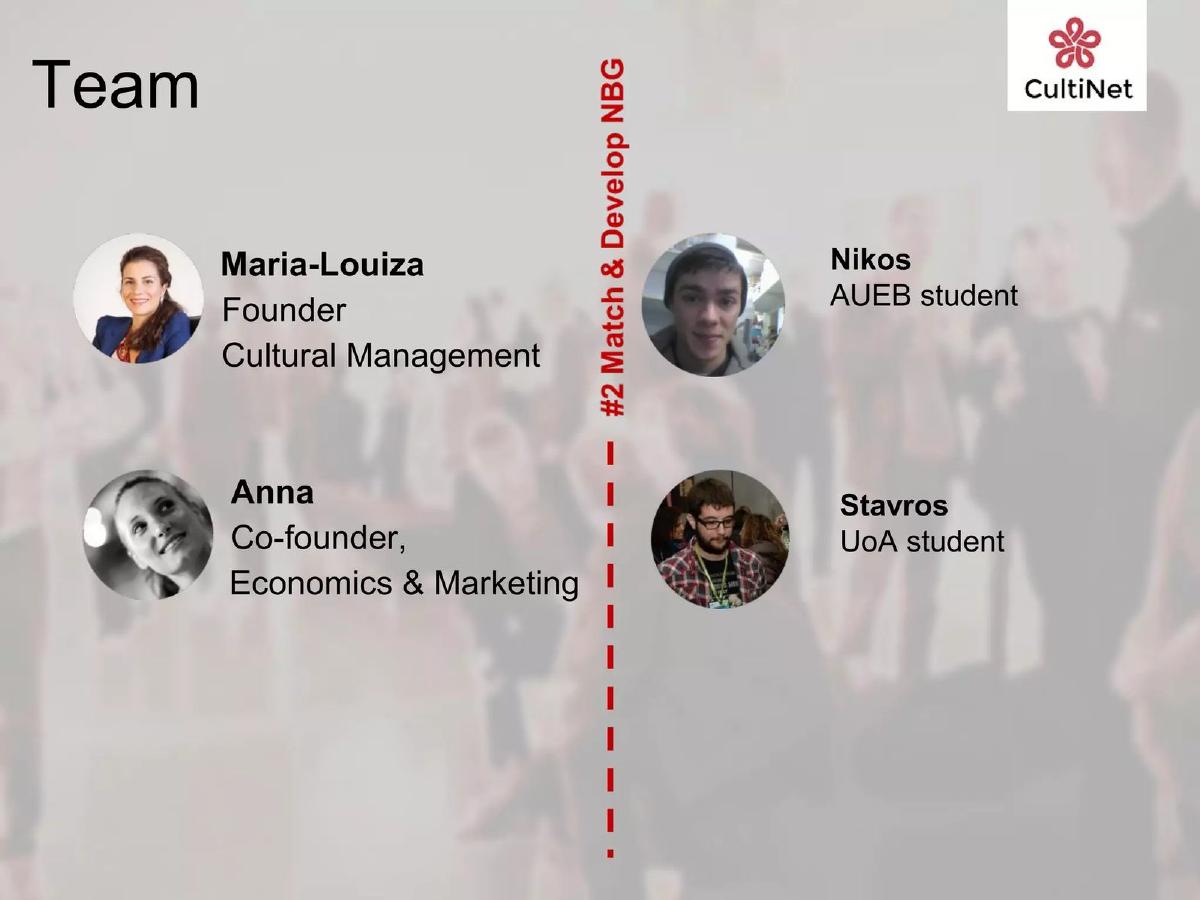
- There is no team slide, no financial projections, and no mention of the amount of capital being raised (Slides 1-8).
Executive Summary: The Niche Networking Play
Cultinet is a specialized matchmaking platform designed to connect the creative and administrative sides of the art world. The deck, titled for a 'Match & Develop' competition, focuses heavily on the product's utility and its positioning within the broader recruitment landscape. While the visual presentation is consistent, the deck functions more as a product walkthrough than a high-growth investment proposal, lacking the financial depth and team validation typically required by institutional investors.
Slide 1: Title and Value Proposition
The cover slide introduces Cultinet with the tagline "Connecting Managers and Visual Artists." The branding is minimalist, featuring a red floral-style logo. The background image is a blurred gallery or event space, which immediately signals the target industry. The value proposition is clear and narrow, focusing specifically on the visual arts rather than the broader creative economy.
Slide 2: The Dual-Sided Problem
Slide 2 defines the market gap. It identifies that "Artists need management skills" and "Managers need artist collaborators." This suggests a marketplace where the 'currency' isn't just jobs, but skill-sharing and project-based partnership. It highlights a common pain point in the arts: the divide between creative production and the business of art (fundraising, logistics, and curation).
Slide 3: The Three-Step Solution
The solution is presented as a simple workflow: 1. Make a request, 2. View profiles, 3. Connect. The slide includes a screenshot of a landing page that further defines the target audience to include "Event Organizers and Cultural Institutions." A cartoon illustration of two figures shaking hands emphasizes the goal of the platform: facilitating professional handshakes between different disciplines.
Slide 4: Product Interface and Matching
This slide provides a closer look at the user interface, specifically the "Your Matches" screen. It features three sample profiles (Takis Spyropoulos, Eva Fidjeland, and Tony Evreniadis) with "Skills Match" percentages. For example, Takis is listed as an "80% match" for a Project Manager role. The inclusion of a "beta version" stamp indicates the product is in early development or testing phases. The interface is clean, focusing on headshots and specific artistic tags like Photography and Digital Arts.
Slide 5: Competitive Landscape
Cultinet uses a Venn diagram to map its competition. On the left are "Corporate" giants like LinkedIn and Viadeo . On the right are "Arts Recruitment" specialists including Sophie Macpherson Ltd, ArtStaffing.com, ART, Lacey West Art International, and Drummond Read . Cultinet places itself in the center, suggesting it offers the professional networking scale of LinkedIn with the industry-specific focus of a boutique recruitment firm.
Slide 6: Go-to-Market Strategy
The strategy for growth is centered on "Customer Development." The slide lists four pillars: Direct Marketing, Digital Marketing, Strategic Partnerships, and Training customers through blogs and events. This approach suggests a community-led growth model, where the company establishes authority through content and physical presence at arts events to build trust within a notoriously tight-knit industry.
Slide 7: The Revenue Model
Subscription Visual Artists: $6/mo · Subscription Institution/Organization: $100/y · Affiliations %: (Percentage not specified)
The pricing for artists is notably low, likely intended to minimize friction for a demographic often characterized by inconsistent income. The institutional price point is also modest, suggesting a volume-based strategy rather than a high-touch enterprise sales model.
Slide 8: Conclusion
The final slide is a standard "Thank you!" with the company's URL. It lacks a call to action or contact information for specific team members, which is a missed opportunity for engagement in a competition or investor setting.
What Works in This Deck
Clarity of Purpose: The deck does not try to be everything to everyone. It stays strictly within the visual arts and management niche. The problem and solution are articulated in very few words, making the core concept easy to grasp within seconds.
Visual Consistency: The use of the red and white color palette across all slides, combined with the consistent background image, gives the deck a professional, cohesive feel. The product screenshots are integrated well, showing that a functional interface actually exists.
Market Positioning: The competitive slide is effective. By placing themselves between LinkedIn and high-end recruiters, they carve out a space for a mid-market, accessible networking tool that doesn't currently exist in a digitized, automated format for the arts.
What Is Missing
The Team: This is the most significant omission. In early-stage startups, the founders' background is often more important than the product. There is no information on who is building this or why they have the industry connections to make it successful.
Market Size (TAM): There is no mention of how many visual artists or arts managers exist globally or in their target region. Without a Total Addressable Market (TAM) calculation, investors cannot judge if the $6/month subscription model can ever scale into a significant business.
Traction and Metrics: While the 'beta' tag is mentioned, there are no numbers regarding current users, waitlist size, or successful matches made during the pilot phase. Evidence of 'proof of concept' is entirely absent.
The Ask: A pitch deck is a fundraising tool. This deck fails to state how much capital is required, what the milestones for the next 18 months are, or how the funds will be allocated between development and marketing.
Founder Takeaways
Price for the User: Cultinet’s decision to price artist subscriptions at $6/month is a smart nod to their target audience's financial reality. Founders building for the 'starving artist' demographic must ensure their pricing reflects the user's cash flow, even if it requires a much higher volume of users to reach profitability.
Simplify the UX: The three-step process (Request -> View -> Connect) is a great way to explain a marketplace. Founders often over-complicate their 'How it Works' slides with technical jargon; Cultinet’s approach of using simple verbs is much more effective for a general audience.
Niche Down to Scale Up: By focusing only on 'Visual Artists' rather than 'All Creatives,' Cultinet can build features specifically for that workflow (like portfolio integration). Founders should follow this lead: win a specific niche before attempting to horizontalize the platform.
Frequently asked questions
- What is the primary problem Cultinet aims to solve?
- According to slide 2, the problem is twofold: visual artists often lack the management and fundraising skills necessary to advance their careers, while arts managers and curators frequently struggle to find the right artist collaborators for specific projects or commissions.
- How does the matching algorithm work?
- Slide 4 displays a 'Your Matches' screen where users are presented with profiles based on their specific requests. The platform provides a 'Skills Match' percentage (e.g., 80%, 73%, 60%) based on categories like Photography, Digital Arts, and Project Management to help users filter potential collaborators.
- What is the pricing structure for Cultinet?
- Slide 7 outlines a tiered subscription model. Individual visual artists are charged $6 per month. Institutions or organizations, such as event organizers or cultural centers, are charged a flat fee of $100 per year. There is also a placeholder for affiliate revenue.
- Who are Cultinet's main competitors?
- Slide 5 identifies two categories of competition. General professional networks like LinkedIn and Viadeo represent the 'Corporate' side. Specialized firms like Sophie Macpherson Ltd, ArtStaffing.com, and Lacey West Art International represent the 'Arts Recruitment' side. Cultinet aims to sit in the middle of these two segments.
- What information is missing from this pitch deck?
- The deck is missing several standard venture components. There is no team slide identifying the founders' expertise, no market size analysis (TAM), no traction metrics (user growth or revenue to date), and no 'Ask' slide detailing how much money they are raising and how it will be spent.